
A Facebook ad restriction limits or disables part of an ad account after Meta flags a policy issue, a verification gap, or unusual activity. You remove a Facebook ad restriction by reading the exact reason in Account Quality, fixing that one issue, and requesting a review. Meta says most reviews finish within 48 hours.
Key Takeaways
- Reviews move fast once you request one. Meta’s own help pages say an Account Quality review usually finishes within 48 hours, though some cases take longer (Meta Business Help Center).
- Enforcement is heavy and mostly automatic. Meta reports removing 65 million scam ads from Facebook and Instagram, with 94% caught before anyone reported them (Meta Transparency Center).
- The reach at stake is large. Facebook ads reach roughly 2.41 billion people a month in Meta’s own planning tools, so even a short restriction affects a huge, instant audience (DataReportal).
- Edits restart the clock. Most ads are reviewed within 24 hours, Meta says, but a fresh review starts every time you change targeting, creative or billing on a live ad (Meta Business Help Center).
- Verification has a fixed checklist. Meta accepts one of five document types for business verification, each under 10 MB, before some restrictions lift (Meta Business Help Center).
In this guide
- What Most Facebook Ad Restriction Advice Gets Wrong
- How Meta Decides to Restrict an Ad Account
- The Three Levels of a Facebook Ad Restriction
- How to Fix Each Level of Restriction
- Why Most Appeals Get Rejected
- The Policy Categories Behind Most Facebook Ad Restriction Cases
- How to Monitor Your Account’s Health Before It Is Restricted
- The One Decision Rule: Fix the Level, Then the Document, Then the Wording
- A Real Case: An Agency Account Flagged Over an Olive Oil Ad
- Frequently Asked Questions About Facebook Ad Restriction
- Turn This Into a Repeatable Skill, Not a One-Time Fix
What Most Facebook Ad Restriction Advice Gets Wrong
Most articles on a Facebook ad restriction repeat four steps. Check your notification. Click appeal. Wait. Hope. That advice is not wrong. But it treats every restriction as one problem with one fix.
Meta actually applies a Facebook ad restriction at three different levels, for different reasons, with different appeal paths. If you use the wrong fix for your level, you waste the one review window you get before support options narrow.
A few ground rules first. Meta’s own figures on enforcement and review times come from its Business Help Center and Transparency Center. So treat them as the platform’s own reporting on itself, not an independent audit. The named case later in this guide is self-reported by one agency owner, not confirmed by Meta. Read every number here as a current snapshot, not a permanent rule.
How Meta Decides to Restrict an Ad Account
Meta checks ad content twice: once before an ad goes live, and again on an ongoing basis. Meta’s own help pages say most ads clear review within 24 hours, mostly through automated systems. Human reviewers handle edge cases and help train those systems. Each review looks at the ad’s images, text, targeting and landing page together, not the creative alone.
Meta also watches account-level behaviour beyond single ads. Its Business Help Center lists severe or repeated policy violations, attempts to evade enforcement, and inauthentic accounts among the documented triggers for a Facebook ad restriction. A sudden jump in daily budget, several declined payments, or logins from unfamiliar locations can each trigger a closer look, even when every single ad was approved.
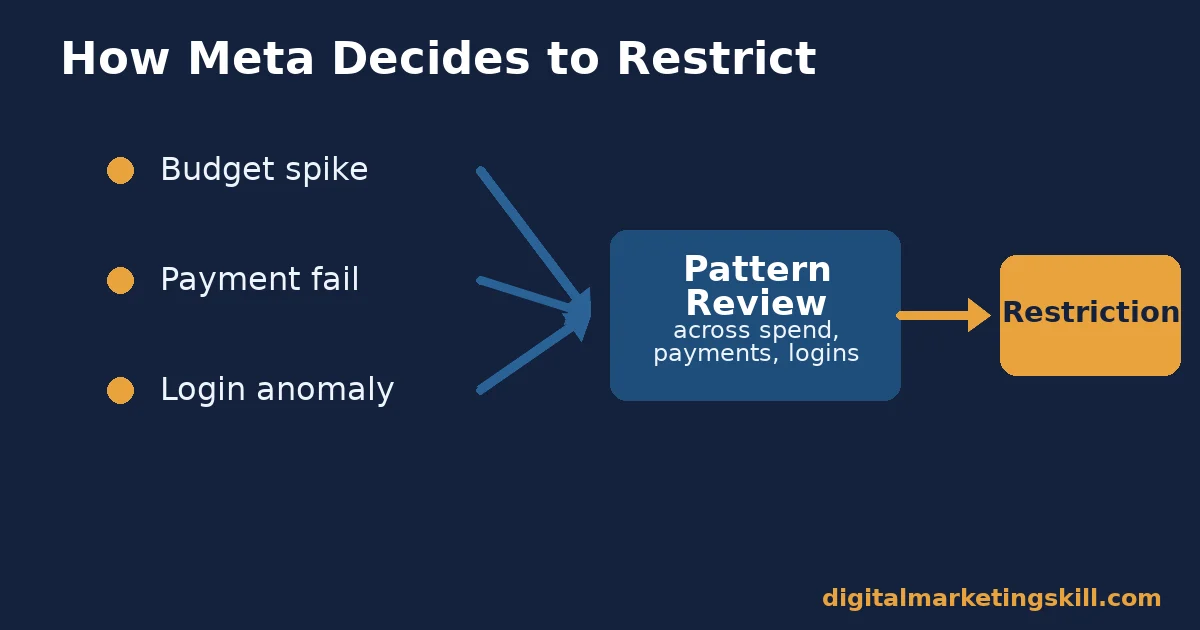
This is why a restriction can land with no single bad ad to point to. The decision often comes from a pattern across many signals, not one piece of content. That is also why fixing the one disapproved ad does not always clear a restriction that was really triggered by the account’s wider behaviour.
Enforcement Runs at a Massive Scale
Meta’s Transparency Center reports removing 65 million scam ads from Facebook and Instagram, and it caught 94% of them before a single user reported them. At that scale, an automated system makes the first call on almost every account.
False positives are a known side effect, not a rare edge case. Facebook’s reach raises the stakes further: DataReportal’s global digital report puts Facebook’s monthly ad reach at around 2.41 billion people. A Facebook ad restriction on even one account can cut off access to a sizeable share of that audience overnight.
Meta’s own spokespeople have acknowledged that advertisers feel frustrated by limited explanations for suspensions. That matters for how you respond. A vague notice is common, not a sign you are being singled out.
The fastest path forward is still the formal review request, not back-and-forth messages. If the restriction actually sits on your Page rather than your ad account, the fix often starts one step earlier; our guide to the Facebook page creation limit covers that related restriction.
The Three Levels of a Facebook Ad Restriction
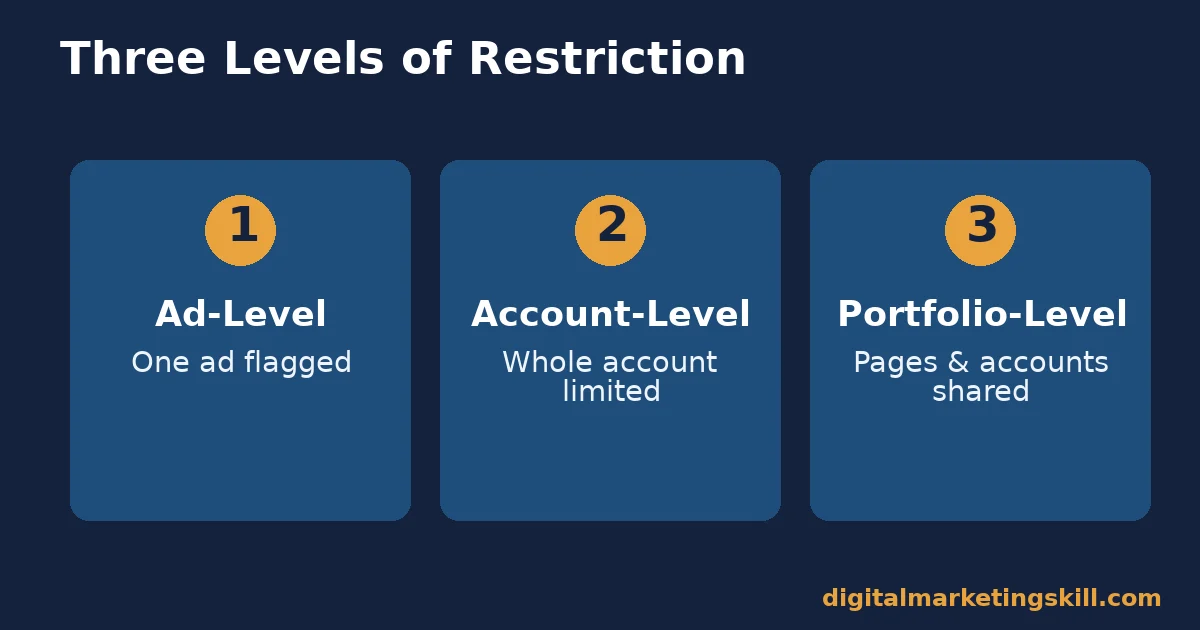
Every Facebook ad restriction sits at one of three levels. Knowing your level decides where you go to fix it and what proof you need to bring.
Ad-Level Restriction: Built From a Single Policy Flag
This is the narrowest Facebook ad restriction. Meta disapproves one ad, or one small group of ads, for a specific reason shown in Ads Manager. Common flags include a personal-attributes claim, an unsupported health claim, or a landing page that does not match the ad.
The rest of the account usually keeps running. You can edit or remove the flagged ad, or appeal that single decision, without touching anything else.
Account-Level Restriction: Built From a Pattern of Signals
This restriction limits or disables the whole ad account. Meta’s stated triggers include severe or repeated policy violations, attempts to evade review or enforcement, and inauthentic accounts used to run ads.
Here, one edit rarely fixes the problem. You need to review the account’s recent history as a whole: what changed in spending, which ads were disapproved, and whether login activity looks unusual. Do this before you write an appeal. The same full-account thinking shows up in our breakdown of social media marketing risks, which covers account security alongside policy risk.
Business Portfolio Restriction: Built From Shared Assets
The widest restriction hits a whole Business Portfolio: several ad accounts, Pages and team members at once. It usually ties back to a verification problem, an ownership dispute over a shared asset, or a serious violation traced to the business itself rather than one ad account.
Several ad accounts and Pages can sit inside one portfolio. So this level carries the highest cost when it stays unresolved, and usually the longest document list before it lifts.
How to Fix Each Level of Restriction
The sections below mirror the three levels above. Match your fix to the level you actually have. The wrong fix wastes your one review request.
Ad-Level: Lead With a Narrow, Specific Fix
Open the disapproved ad and read the full policy reason first. Do not change anything yet. Then edit only the part that caused the flag: the claim, the image, the targeting, or the landing page. Resubmit or request a review for that one ad alone.
Avoid editing unrelated settings at the same time. Every change to targeting, creative or billing on a live ad restarts its review. So unrelated edits can delay the exact fix you are trying to get approved. Our walkthrough of how to use Facebook Ads Manager shows where that per-ad review status and appeal link actually sit.
Account-Level: Lead With a Full Account Review, Not a Single Edit
Before you appeal, read every notice in Account Quality, not just the latest one. List every disapproved ad from the past month, any payment failures, and any recent budget change. Fix what you control first: correct payment details, pause ads that still break policy, and remove content that repeats a past violation.
Then submit one clear review request. Name the specific policy area involved and state exactly what you changed. A request that just says “please review” gives a human reviewer nothing new to act on.
Business Portfolio: Lead With Verification First
If verification caused the restriction, gather one accepted document first: a certificate or articles of incorporation, a business registration or licence document, a government-issued tax document, a business bank statement, or a utility bill. Keep it under 10 MB and fully legible. Confirm your legal business name, address and phone number match that document exactly.
If the restriction instead involves a dispute over a shared asset, such as a Page another team member controls, resolve the ownership question inside the portfolio’s asset settings first. A review of the restriction cannot fix an unresolved ownership conflict sitting underneath it.
Why Most Appeals Get Rejected
A rejected appeal rarely comes down to bad luck. It usually traces to one of four avoidable mistakes.
- The appeal restates the problem instead of the fix. Explaining why you disagree is not the same as showing what changed.
- It targets the wrong level. Appealing one ad will not lift a Facebook ad restriction that Meta applied to the whole account or portfolio.
- Documents do not match the account details exactly. A mismatched business name, address or phone number causes one of the most common verification failures.
- A second violation lands during the review. Running non-compliant ads on a different account while under review signals exactly the pattern Meta is watching for.
Which Mistake to Check First
Start with the level mismatch. It quietly wastes the most review attempts. Next, check your documents against the account’s exact legal details. Only then should you focus on the wording of the appeal itself. Fixing the structure of your response matters more than fixing its tone.
The Policy Categories Behind Most Facebook Ad Restriction Cases
Knowing the level is one filter. Knowing the policy category is the other. Most Facebook ad restriction notices trace back to one of four broad categories, and each needs a different kind of fix.
Content and Claims
This covers misleading claims, prohibited products or services, and personal-attribute targeting. The fix is almost always rewriting the ad copy or image, not disputing the policy itself. Keep claims specific and provable, and avoid language that implies something about a viewer’s health, finances or identity.
Identity and Payment
This covers unverified business identity, declined payments, and outstanding balances. These restrictions usually lift once you complete the missing step: verify the business, update the payment method, or clear the balance. There is rarely a policy argument to make here, only an administrative one.
Behaviour and Account Pattern
This covers sudden budget jumps, repeated violations, and activity that looks like an attempt to evade past enforcement. Fixing this category means changing the pattern itself: slow down budget increases, resolve every outstanding violation, and avoid opening a second account to replace a restricted one.
Security and Access
This covers compromised logins, unauthorised admins, and suspicious device activity. The fix starts with securing the account: change the password, remove any admin you did not add, and turn on two-factor authentication before you request a review.
Security-related restrictions can look confusing at first, because the notice may mention policy language even though the real cause is a break-in rather than a bad ad. Check your login history before you write any appeal, since an unfamiliar device or location there explains far more than the ad itself usually does.
How to Monitor Your Account’s Health Before It Is Restricted
Most Facebook ad restriction cases show warning signs in Account Quality days before the account gets limited. Each metric below has a one-sentence definition and a note on how to read it.
Five Signals Worth Checking Weekly
- Ad disapproval rate. The share of your submitted ads that Meta disapproves. A rising rate across unrelated campaigns points to an account-level pattern, not one bad ad.
- Policy violation count in Account Quality. Meta lists recent violations on this page. One is normal; several in a short window is the clearest early warning you will get.
- Payment failure count. Declined charges or an outstanding balance are a documented trigger for a Facebook ad restriction, so track them like you track ad spend.
- Verification status. Business Suite’s Security Center shows this. Fix an unverified or expiring status before it becomes the reason for a restriction, not after.
- Login and access anomalies. Unusual sign-in locations or new admins added without your approval often come right before an account-level restriction tied to suspicious activity.
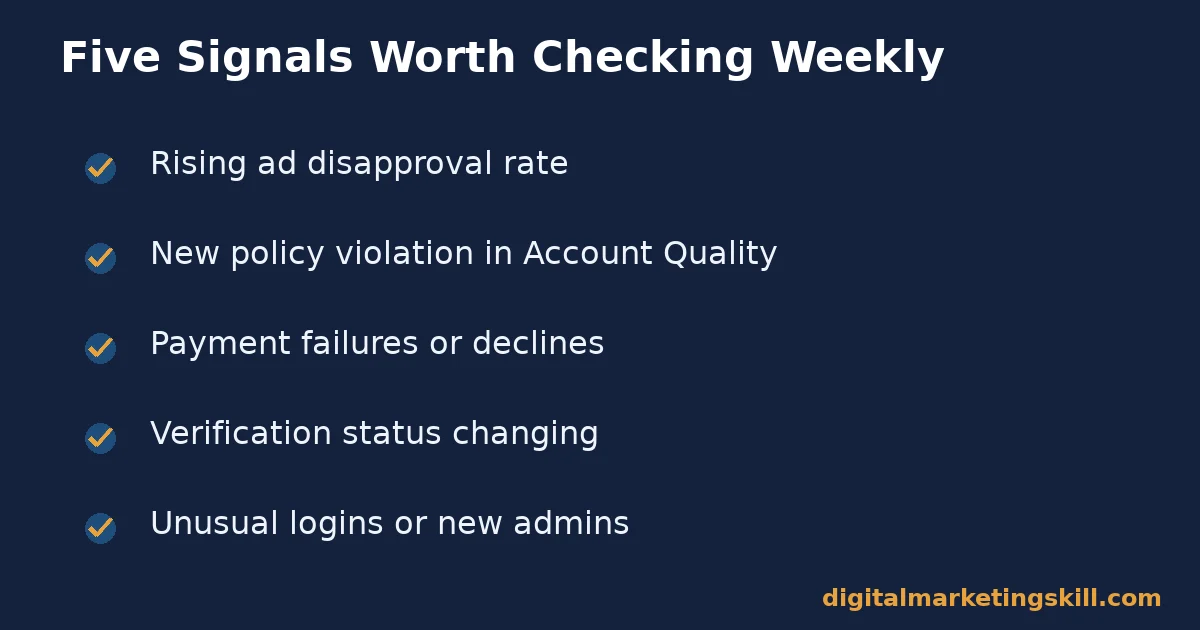
Check these five signals on a fixed schedule, not only after something breaks. A quick weekly scan takes a few minutes and catches most problems while they are still one ad away from an account-level restriction.
The One Decision Rule: Fix the Level, Then the Document, Then the Wording
When a Facebook ad restriction lands, follow this order. First, identify the exact level named in the notice. Second, gather the one document or change that level requires. Third, write the review request.
Illustrative, invented numbers. Picture an account running 40 active ads. One ad gets disapproved for an unsupported health claim. If the owner edits all 40 ads out of caution, every one re-enters review.
The account now looks like it is making unrelated changes during an active flag. Fixing only the one flagged ad works better. Leave the other 39 untouched. This keeps the review narrow and gives the account no new signals to evaluate.
A Quick Checklist Before You Submit Any Appeal
- Screenshot or save the exact wording of the restriction notice.
- Confirm the level: one ad, the whole account, or the full Business Portfolio.
- Fix the one root cause that notice names, not every setting you can find.
- Gather one matching document if verification is part of the notice.
- Write a short, specific review request that states what changed.
- Avoid creating a new account or page while the review is open.
A Real Case: An Agency Account Flagged Over an Olive Oil Ad
A documented report on advertiser suspensions describes Kassie Mullins, an agency owner, whose account was shut down after Meta flagged an olive oil ad under its weapons policy, apparently over the word “guns” used in an unrelated sense.
The same report cites Meta’s own figure of more than 10 million small business advertisers on its platforms. It quotes a company spokesperson who acknowledged advertiser frustration while giving limited detail on individual cases. Meta’s scale in this market shows up separately in its SEC filings, which report tens of billions of dollars in quarterly advertising revenue.
Treat this as one reported case from one advertiser group, not a measured failure rate. Still, it shows two things worth planning around. Automated matching can misread an ordinary word. And getting a clear explanation from Meta directly can move slowly, even when the real fix, removing one flagged word, is simple once you find it.
Frequently Asked Questions About Facebook Ad Restriction
How long does a Facebook ad restriction review take?
Meta’s Business Help Center states that an Account Quality review usually finishes within about 48 hours, though some cases take longer. You will usually hear the outcome by email or inside Account Quality.
Can I open a new ad account instead of appealing a restriction?
No. Meta’s policies treat attempts to evade enforcement, including opening a new account to continue restricted activity, as grounds for further restriction. Appeal the existing account instead of working around it.
Why was my ad account restricted with no specific ad mentioned?
Account-level and Business Portfolio restrictions often rest on a pattern across spending, payments and login activity, not one ad. Check Account Quality for the stated reason before you assume one piece of content caused it.
Does paying off an outstanding balance remove a Facebook ad restriction?
It can, if a payment issue caused the restriction. It will not clear a restriction tied to a policy violation or an unverified business. Match your fix to the reason Account Quality actually states.
Will editing my disapproved ad trigger a new review automatically?
Yes. A change to targeting, creative, optimisation or billing on a previously reviewed ad starts a new review. Edit only the specific element that caused the disapproval.
How many documents does business verification need?
Usually one. Meta accepts a certificate or articles of incorporation, a business registration or licence document, a government-issued tax document, a business bank statement, or a utility bill. Keep it under 10 MB, fully legible, with business details that match exactly.
Does a Facebook ad restriction ever affect Instagram ads too?
Yes, when the restriction sits on a shared ad account or Business Portfolio. Since Meta runs ad review for Facebook and Instagram through the same systems, an account-level or portfolio-level restriction usually blocks both at once.
What should I do if my appeal is rejected the first time?
Re-read the stated reason closely, since a rejected appeal often means the level or the fix was wrong, not that the case is hopeless. Correct the specific issue named, gather fresh supporting documents if verification is involved, and submit one new, clearly worded review request rather than repeating the same explanation.
Turn This Into a Repeatable Skill, Not a One-Time Fix
A Facebook ad restriction is a policy and verification problem first, and a technical one second. Read the exact notice. Match your fix to the right level. Keep your documents consistent. Most cases resolve inside Meta’s own stated review windows once you do.
If you want to build this kind of platform-policy fluency alongside paid media, analytics and AI-assisted marketing skills, the Digital Marketing Skill Institute’s Master Diploma in Digital & AI Marketing covers it inside the AI-Powered Social Media Management and Advertising track. That track is one of four AI-powered tracks built from ten courses in total, with a Full Stack option for completing all four.
Every track includes unlimited one-on-one coaching and mentoring, a U.S. Project Internship with a verified U.S. Work Reference Letter, and dual US and UK accreditation recognised in more than 100 countries, wherever you live in your country. The program runs 100% online, so you can apply the same account-health habits from this guide to real client accounts as you learn.
See the full program on the Master Diploma page, read real outcomes on student reviews, browse more guides on the digital marketing blog, or go straight to the application page to start anywhere in your country. Learn more about the Institute at digitalmarketingskill.com, or visit digitalmarketingskill.com directly for details on every track.
Every figure in this guide was checked against its original source before publication. Figures marked as illustrative are invented examples, not real results.
