
A Facebook page for business separates your brand from your personal profile. It gives customers one place to find your hours, reviews and a way to contact you. Meta says the platform reaches 3.07 billion monthly users. A complete page still matters. But setup alone is not a strategy. What you post and how fast you reply decide whether it earns trust.
Key Takeaways
- Scale is still real. Facebook has 3.07 billion monthly active users, more than any other social platform (Statista, reported by Sprout Social).
- Average engagement is low. The average Facebook business page saw a 0.15% engagement rate across all account sizes (Social Insider, reported by Sprout Social).
- Video is where attention goes. 48% of Facebook users say short-form video is the content type they interact with most (Sprout Social’s Content Strategy Report).
- Marketers still rely on it. 86% of marketers use Facebook for marketing. 47% call it their top platform (Business.com, reported by Shopify).
- An incomplete page costs sales. In a US survey of 1,146 adults, 87.7% had skipped a business because they could not find enough about it online (TrustedFirms.io survey, self-reported, US-only).
In this guide
- Why a Facebook Page for Business Still Matters
- How a Facebook Page for Business Actually Works
- What Differs By Business Type
- How to Set Up a Facebook Page for Each Business Type
- Common Mistakes That Undo a Good Setup
- Making Your Facebook Page Findable Beyond Facebook
- How to Measure a Facebook Page for Business
- The One Rule: Match Your First Post to Your Call-to-Action Button
- A Real Case: What Changes When a Page Looks Complete
- Frequently Asked Questions About a Facebook Page for Business
- Turn Your Page Into a Lead Source, Not Just a Listing
Why a Facebook Page for Business Still Matters
Most advice on a Facebook page for business stops at the setup checklist. Add a photo. Pick a category. Publish. That part is easy. It takes fifteen minutes. The part most advice skips is what happens next. An empty or inconsistent page can cost you customers instead of helping you.
This guide covers both halves. First, it walks through creating a Facebook page for business step by step. Then it shows what changes by business type: local shop, online store or service provider. Last, it shows how to measure whether the page is actually working.
A few ground rules first. The usage figures below come from named research firms. Treat them as a snapshot, not a permanent ranking. The trust survey is self-reported by US adults. Read it as a signal about buyer psychology, not a universal law. Any example marked “illustrative” is invented to show the logic. It is not a real case.
How a Facebook Page for Business Actually Works
A Facebook page is a public profile. Anyone can follow it without you approving the connection. A personal profile needs mutual friending first. That single difference is why Meta requires businesses to use a page, not a personal account. Pages are built to be found by strangers, not just contacts.
Pages and Profiles Play Different Roles
A personal profile is for individuals. Meta’s own terms require businesses to use a page instead. Pages carry tools a profile lacks. These include a call-to-action button, Page Insights analytics, paid ad access and multiple admin roles: admin, editor, moderator, advertiser and analyst. They also keep a public message log separate from your personal inbox.
That separation protects your privacy too. Running a business from a personal profile exposes your friends list and personal photos to anyone who messages you. A dedicated page avoids that entirely.
Pages are also more transparent than profiles by design. Visitors can view a page’s “Page Transparency” panel, which shows when the page was created, any name changes and the country its admins are managing from. That visibility is part of why a complete, consistent page builds more trust than a personal account standing in for one: visitors can verify the basics themselves instead of taking your word for it.
What Decides Whether People See Your Page
Three signals decide whether your posts reach anyone’s feed. First, how often your current followers engage with your posts. Second, how complete your page is: category, hours, location, photo. Third, how recently you posted. A page that goes quiet for weeks loses reach, even with its existing followers. The ranking system reads inactivity as a weak signal of relevance.
Category choice affects discovery directly too. Both search and the “nearby” tab filter by category. Pick the wrong one, such as “Shopping & Retail” for a service business, and you disappear from the searches your real customers run.
Facebook also lets you choose more than one category. Use the second slot for a closely related service rather than a loosely connected one, since an overly broad set of categories dilutes the match instead of widening it. A bakery that also caters events, for example, can add “Caterer” alongside “Bakery,” but adding unrelated tags just to appear in more searches usually backfires by confusing the ranking signal described above.
What Differs By Business Type
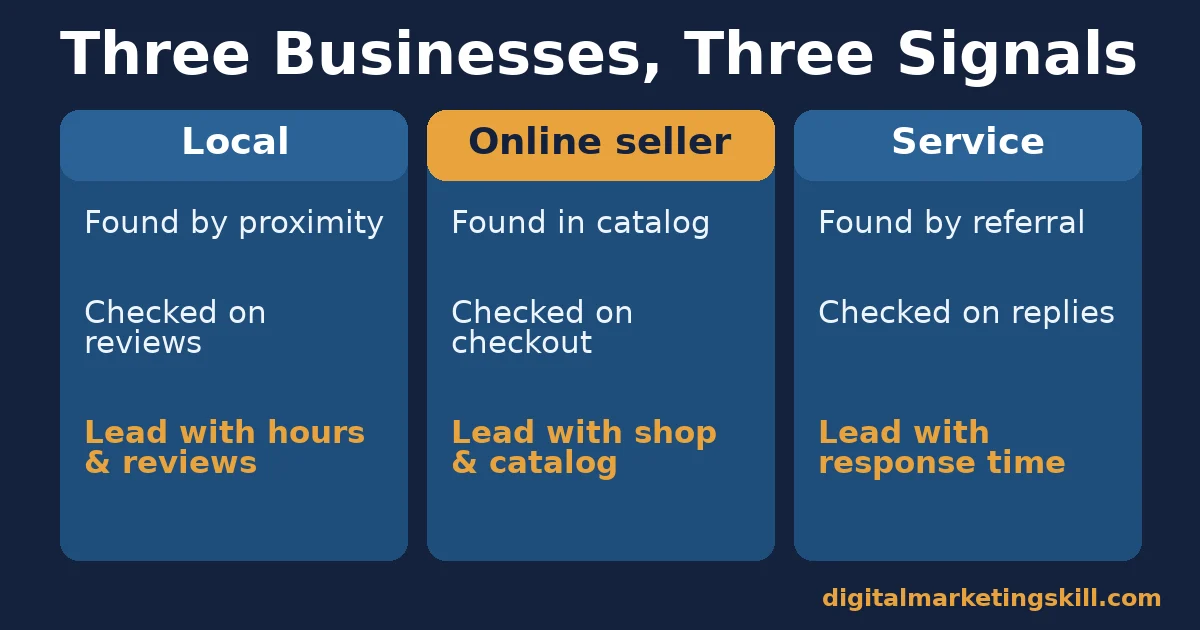
A generic “create a page” checklist treats a boutique, an online store and a freelance consultant the same way. They are not the same. Each one earns trust through a different signal. Page setup should lead with that signal first.
Local Businesses: Built For Foot Traffic and Proximity
A local business, like a café or a repair shop, is found through proximity search and reviews. In the TrustedFirms.io survey above, 83.6% of respondents said they check reviews before buying from a business they don’t know. For a local page, address, hours and reviews carry more weight than any single post.
Online Sellers: Built For Catalog and Marketplace
An online seller’s customers never visit a physical store. So the page’s job is to make products browsable without leaving Facebook. The platform built Marketplace and Shop for exactly this. eMarketer found that 20.1% of global consumers have bought something through Facebook Marketplace, as reported in the Shopify statistics round-up linked above. Here, a working product catalog matters more than post frequency.
Service Providers: Built For Trust and Response Time
A service provider, like a consultant or a coach, sells a relationship before they sell a deliverable. The page’s job is to prove responsiveness before the first message is sent. A response-time badge, client testimonials and a clear service description do more work here than visuals.
How to Set Up a Facebook Page for Each Business Type
The sections below mirror the three business types above. Start with the step that matches the signal your customers actually check. Then fill in the rest of the checklist.
Local Businesses: Lead With Hours, Location and Reviews
Log in to your personal account, then go to facebook.com/pages/create. You can only start a page from a personal account, but the page itself stays separate from your profile. Name the page after your business. Choose the category that matches your real service. Add your address and hours before you publish anything else. Then turn on reviews and ask your first five customers directly. An empty review section reads as unproven, even if you’ve served customers for years.
Online Sellers: Lead With Catalog and Checkout Links
After creating the page, set the category to “Shopping & Retail” or a specific product type. Connect a product catalog through Meta Commerce Manager so items show as a browsable shop tab. Set the call-to-action button to “Shop Now” instead of a generic “Learn More.” Make sure that button links to a working, mobile-friendly checkout page. A broken or slow link at this step loses the sale you already won with the post or ad.
Service Providers: Lead With Response Time and Proof
Set your call-to-action button to “Send Message” or “Book Now,” depending on whether you want a conversation first or a direct booking. Reply within 15 minutes during business hours for the first few weeks. Facebook displays a “very responsive” badge automatically once you qualify. It is one of the few trust signals visible before a prospect ever messages you. Pin a short welcome post naming exactly what you offer, plus one client result with their permission. Service pages with no visible proof tend to get browsed, not booked.
Common Mistakes That Undo a Good Setup
Even a page built correctly can lose ground to a few repeat mistakes. Watch for these five, since each one quietly cancels out the setup work above.
Mistake 1: Category and Content Don’t Match
A page listed under “Education” that mostly posts product discounts confuses both the ranking system and the visitor. Keep posts aligned with the category you chose, or update the category to match what you actually publish.
Mistake 2: Long Silent Gaps Between Posts
A burst of ten posts followed by six quiet weeks resets more than momentum. It resets the relevance signal described earlier. A smaller, steady schedule outperforms an inconsistent one over a full quarter.
Mistake 3: The Call-to-Action Button Doesn’t Match the Goal
A “Learn More” button on a page meant to sell directly adds a step most buyers won’t take. Match the button to the one action you most want, as covered in the decision rule below.
Mistake 4: Reviews Go Unanswered
A negative review with no business reply looks worse than the review itself. Reply briefly, state what changed or will change, and move the detailed conversation to a private message.
Mistake 5: Running the Business From a Personal Profile
Some owners skip the page entirely and post business updates from their personal profile. That blocks access to Insights, ads and admin roles, and it mixes personal and business audiences in a way that’s hard to undo later.
Making Your Facebook Page Findable Beyond Facebook
A Facebook page for business doesn’t only show up inside Facebook’s own search. Google indexes public pages too, so the same page can appear in a search for your business name even before your website does. A few small details decide how well that works.
Page Name and About Section
Use your actual business name as the page name, without extra keywords stuffed in. Facebook’s own search and Google both read the “About” section as a short description, so write one or two plain sentences stating what you do and who you serve. Vague descriptions, such as “we do everything,” tell search systems nothing to match against a real query.
Username and Link Consistency
Choose a username close to your actual business name, since this becomes your page’s custom URL (facebook.com/yourbusiness). Then use that same name consistently across your website, Google Business Profile and other platforms. Inconsistent names across platforms make it harder for search engines, and for customers doing a quick double-check, to confirm the page belongs to the business they searched for.
Linking Your Page and Website Together
Add your Facebook page link to your website’s footer or contact page, and add your website link to the Facebook page’s info panel. That two-way link helps search engines connect both profiles to the same business, which supports the kind of trust-building this guide covers above: a visitor who checks your website, then finds a matching, active Facebook page, gets the consistency signal that the TrustedFirms.io survey above found many buyers are already looking for.
How to Measure a Facebook Page for Business
Once the page is live, the question shifts from setup to performance. Find these five numbers in Meta Business Suite’s Insights tab. Together they show whether the page is doing its job.
Five Metrics That Show Real Performance
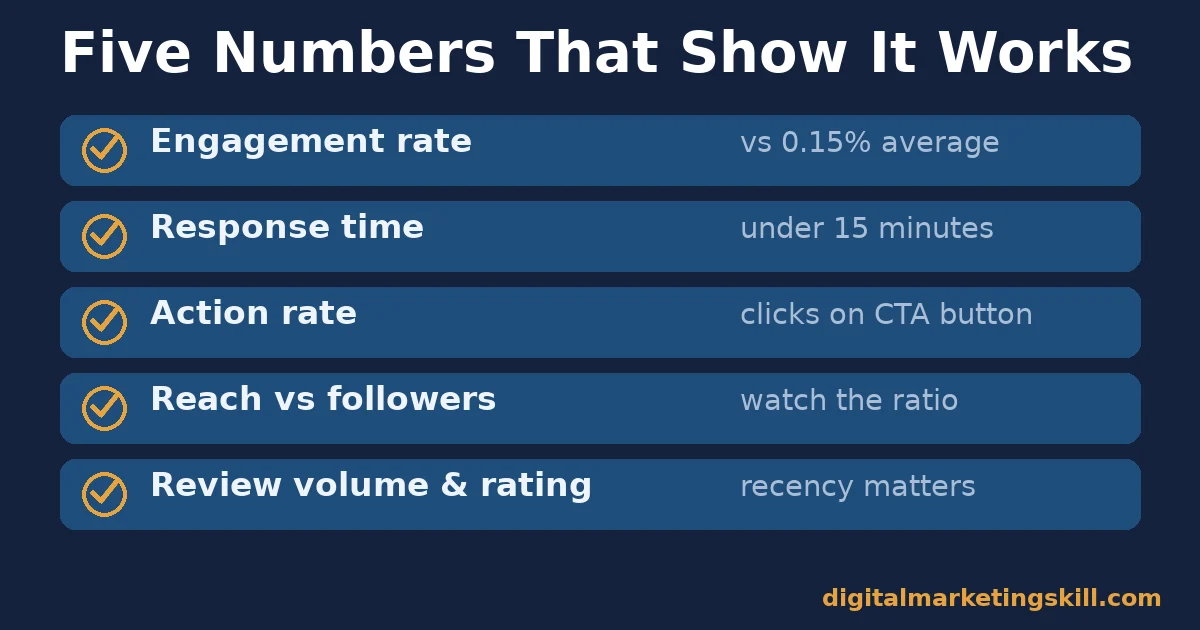
Engagement rate is reactions, comments, shares and clicks divided by reach. So compare your number against the 0.15% cross-industry average above, not against a competitor’s follower count. Response rate and time shows what share of messages you answered, and how fast. For this one, keep the time under 15 minutes during business hours.
Action rate is the share of profile visitors who tap your call-to-action button. Therefore, a low number usually means the button or its destination doesn’t match what visitors expect. Reach versus followers compares how many people saw a post to your total follower count. A shrinking ratio over several weeks is an early sign that posting frequency or relevance has slipped. Finally, review volume and rating tracks both the star average and how recently reviews were left, because a high rating from two years ago reads differently than five reviews from last month.
The One Rule: Match Your First Post to Your Call-to-Action Button
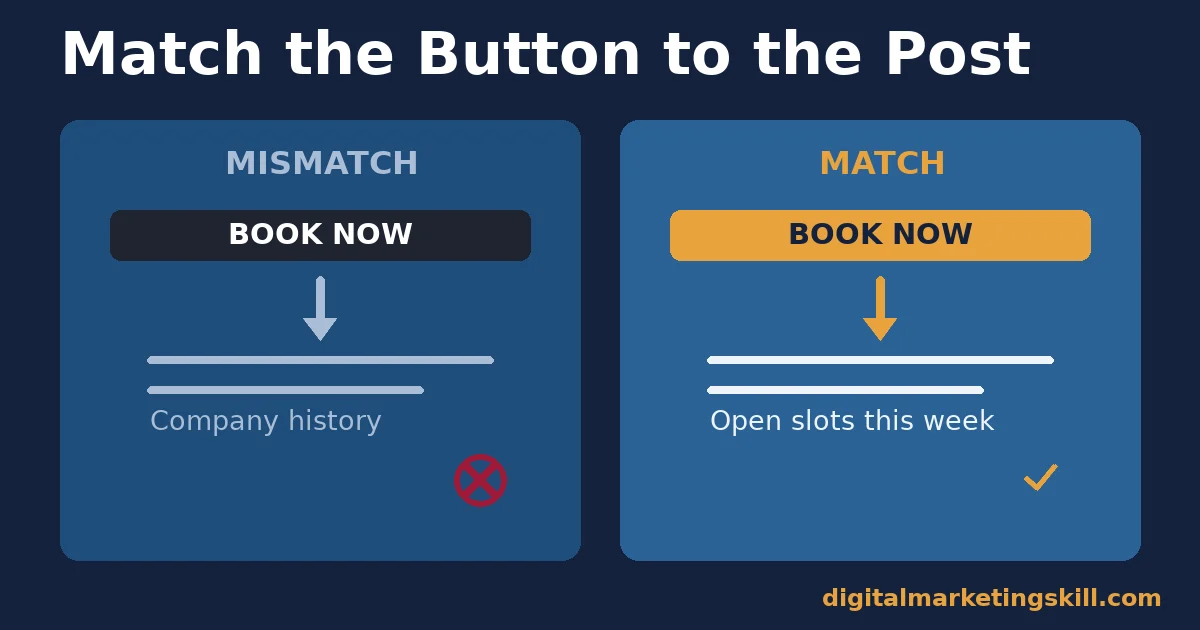
The single highest-leverage fix on most new pages is simple. Make your first pinned post answer the exact question your call-to-action button raises. If the button says “Shop Now,” pin a post showing products and a price range. If it says “Book Now,” pin availability or a booking link. If it says “Send Message,” set an expectation for reply time.
Illustrative, invented example: a page sets its button to “Book Now” but pins a post about company history. A visitor clicks the button and lands on a scheduling page with no context. They abandon the booking, because nothing explained what they were booking or how long it takes. Swapping the pinned post for available slots and a one-line service description closes that gap, without touching the button at all.
A Real Case: What Changes When a Page Looks Complete
Cold Stone Creamery’s Facebook page is a useful example of a complete setup. The page is named after the brand. The category matches the business: food and drink. The profile photo is instantly recognisable. Posting follows a consistent pattern. None of this guarantees sales by itself, and Meta does not publish page-level sales figures for individual franchises, so no revenue number can be attributed to the page here.
What is checkable is the setup itself. It follows the same category-match and consistency pattern recommended above for any brand with multiple locations. The limit on this example: one brand’s layout shows what a complete setup looks like. It is not proof that setup alone drives sales. Pair the same approach with your own response-time and engagement tracking, rather than copying the format and assuming the same result.
A smaller business can take the same pattern without a franchise budget. The cost of matching your category, filling in hours and location, and replying to every message within 15 minutes is mostly time, not money. What the Cold Stone example really shows is that the basics scale: a one-location shop and a national chain follow the identical checklist, just with a different team size behind it.
Frequently Asked Questions About a Facebook Page for Business
Is a Facebook page for business free to create?
Yes. Creating and running a Facebook page costs nothing. You only pay if you choose to run paid ads or boost posts from it.
Can I run a Facebook page for business without a personal profile?
No. Meta requires a personal account to create and administer a page. The page itself stays public and separate from your profile’s friends list and personal posts.
How many admins can a Facebook page for business have?
You can assign several people different roles: admin, editor, moderator, advertiser or analyst. Set these through Page access settings in Meta Business Suite, so no one has to share a single login.
What is the Facebook page creation limit?
Meta caps how many pages one account can create in a short period, to prevent spam. If you manage several brands, our guide to the Facebook page creation limit explains the thresholds and how to avoid tripping them.
Should I boost every post on my Facebook page for business?
No. Boost posts that are already earning organic engagement. Paid spend on a post nobody is responding to usually wastes budget instead of fixing the content.
How often should a business post on its Facebook page?
There’s no universal number. Consistency matters more than volume. A predictable schedule, even two or three posts a week, beats sporadic bursts followed by silence.
Why did my Facebook page lose reach suddenly?
Check three things first: posting gaps, a recent category or name change, and your response-time average. All three feed the ranking signals described above. A sudden platform-wide change is far less common than one of these three resetting.
Does a verified badge help a Facebook page for business?
It can help with trust, since a badge signals the page is confirmed as authentic. But a badge alone does not fix a slow response time or an empty review section, which matter more to most visitors day to day.
Can one Facebook page serve more than one business type?
Yes, a hybrid business, such as a shop that also books repair appointments, can combine the local and service signals covered above. Lead with whichever signal your specific customers check first, then add the second set of features.
Should I connect WhatsApp or Instagram to my Facebook page for business?
If your customers already use one of those apps to reach you, connecting it through Meta Business Suite lets you answer every channel from one inbox. That keeps your response-time average consistent across platforms, instead of tracking it separately in each app.
Turn Your Page Into a Lead Source, Not Just a Listing
A Facebook page for business is the easy, fifteen-minute part. Turning it into a channel that brings in customers takes more. Digital Marketing Skill Institute’s Master Diploma in Digital & AI Marketing covers that skill set. It offers four AI-powered tracks built from ten execution-first courses. These cover AI-Powered Social Media Management and Advertising, AI-Powered Lead Generation and Email Automation, AI-Powered Google Specialist and AI-Powered WordPress and SEO Specialist. A Full Stack option lets learners complete all four.
The program also includes unlimited one-on-one coaching, a U.S. Project Internship with a verified U.S. Work Reference Letter, and dual US and UK accreditation recognised in more than 100 countries. In short, it runs 100% online, wherever you live.
See the full program on the Master Diploma in Digital & AI Marketing page. Or browse more guides on the digital marketing blog, read outcomes on the reviews page, or go straight to apply to start. You can build these skills, wherever you live, starting at digitalmarketingskill.com. The Institute’s own page follows the same setup logic covered here, so you can see the approach in practice directly on digitalmarketingskill.com.
Every figure in this guide was checked against its original source before publication. Figures marked as illustrative are invented examples, not real results.
