
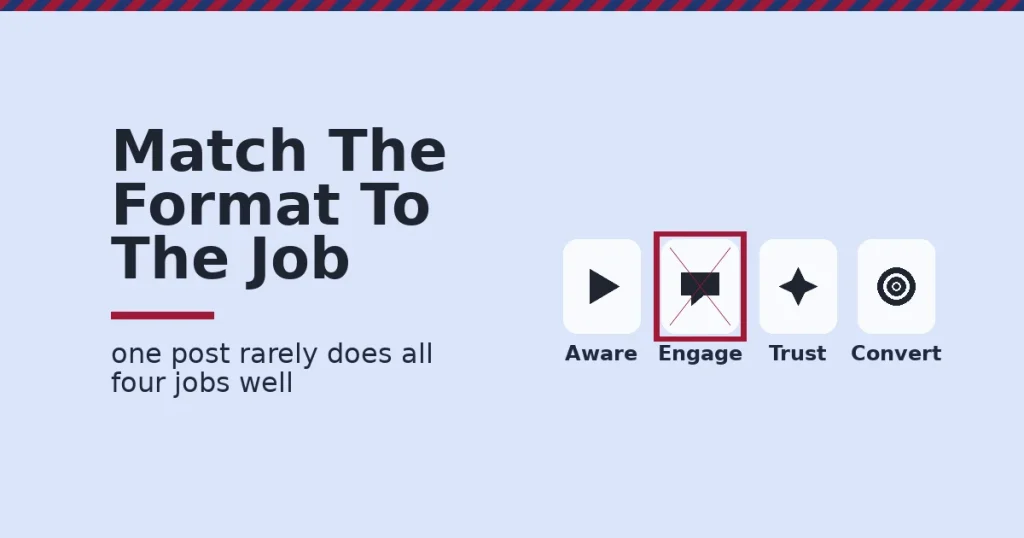
Social media content only works when the format matches the job it needs to do. A list of twenty content ideas will not fix a page that gets views but no engagement. This guide groups social media content by what it actually accomplishes, so you can pick the right one on purpose.
Key Takeaways
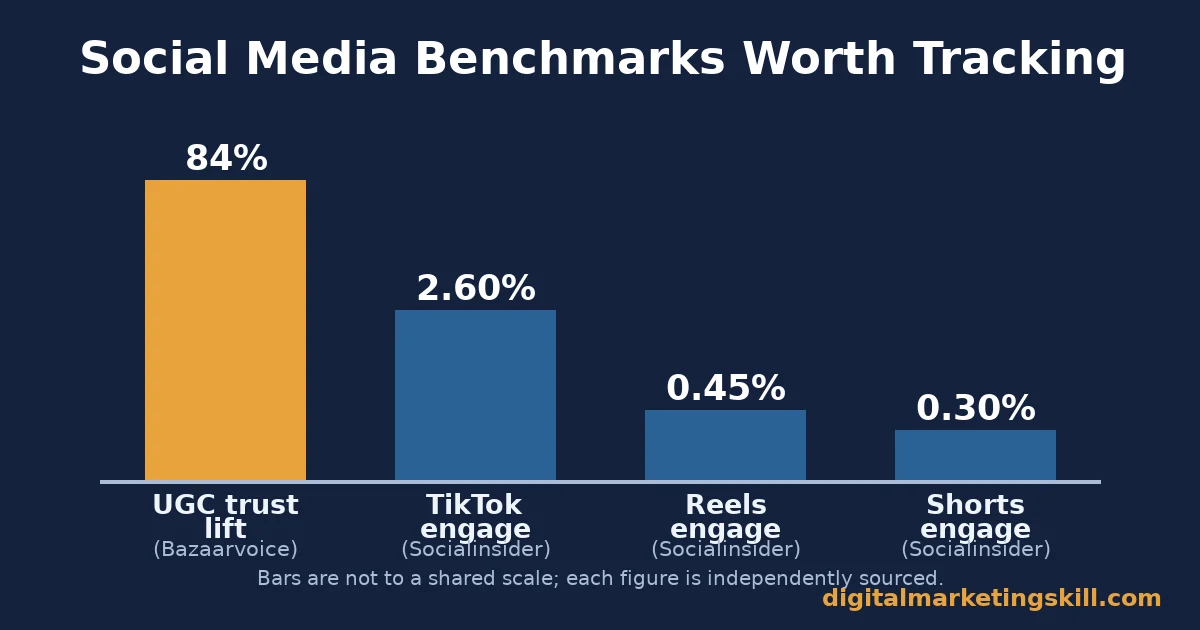
- TikTok videos average a 2.60% engagement rate, versus 0.45% for Instagram Reels and 0.30% for YouTube Shorts, based on an analysis of over 80 million videos (Socialinsider).
- 84% of consumers say they are more likely to trust a brand’s marketing when it features user-generated content (Bazaarvoice).
- More than 5.6 billion people use social media worldwide, so even a small format shift can reach a meaningful audience (DataReportal).
- 58% of B2B marketers say content marketing increased their sales or revenue, in a self-reported industry survey (Content Marketing Institute).
- Short-form video consistently out-engages long-form posts on every major platform tracked, though the exact gap varies by platform and audience.
In this guide
- Why A List Of Content Types Isn’t A Strategy
- How Social Media Content Actually Drives Results
- Social Media Content By Platform
- How To Act On Each Platform’s Strengths
- Common Mistakes That Waste Good Social Media Content
- Turning One Idea Into Several Formats
- Tools That Make Social Media Content Easier To Plan
- How To Measure Whether Your Social Media Content Is Working
- The One Rule For Fixing Underperforming Social Media Content
- A Real Content Shift, And What It Doesn’t Prove
- Frequently Asked Questions About Social Media Content
- Your Next Step With Social Media Content
Why A List Of Content Types Isn’t A Strategy
Search for social media content ideas and you will find lists of fifteen, twenty, even fifty formats. Text posts, reels, polls, memes. The list is rarely the problem. Knowing which one to use, and why, is. Most small teams already know how to make a reel or write a poll. What they lack is a clear reason to pick one over the other on any given day.
A format that works for brand awareness can fail completely at driving a sale. A format that builds trust takes time most businesses rush past. The job of this guide is to sort social media content by what each format is actually good at, not by how many types exist. That distinction matters more than it sounds, because two accounts can post the exact same number of pieces per week and get completely different results.
A few ground rules first. Platform engagement rates shift often and vary by industry, so treat every figure here as a reference point, not a target. Nothing in this guide guarantees any specific result for any individual business. Every example and worked number in this guide is labeled as such, so you always know whether a figure came from a real, checked source or an illustrative example built to explain the logic.
How Social Media Content Actually Drives Results
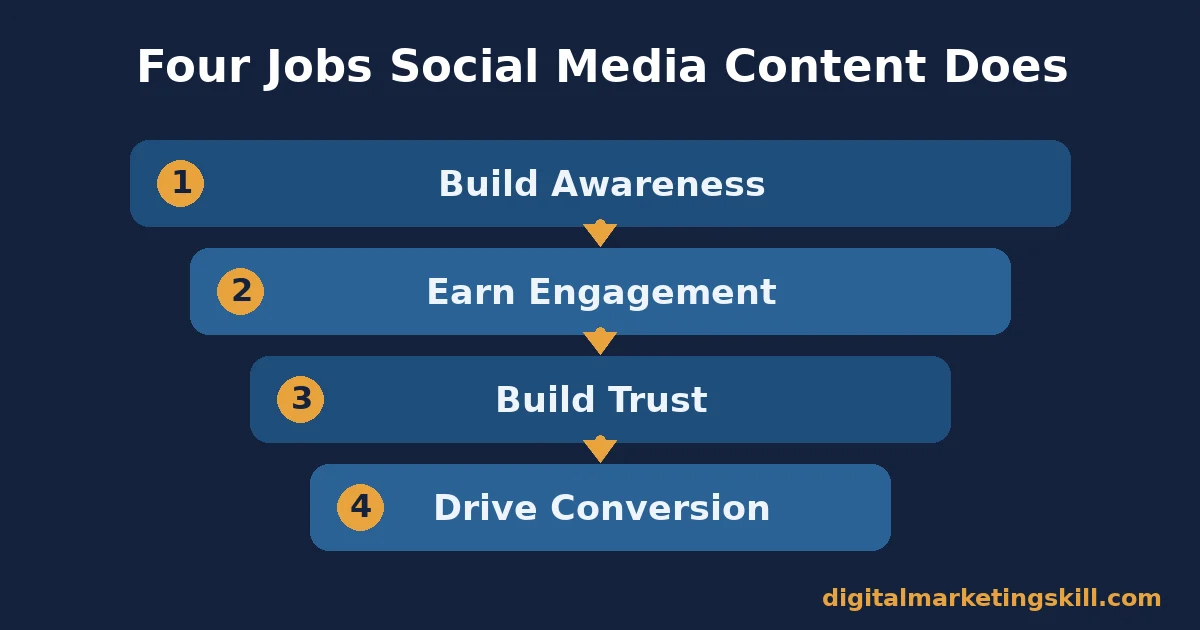
Every piece of social media content does one of four jobs: building awareness, earning engagement, building trust, or driving a conversion. Most accounts post the same format for every job. That habit wastes the format’s real strength. A format built to grab attention rarely also builds trust, and a format built to build trust rarely also closes a sale.
Awareness Formats
Short-form video, trending audio, and simple text posts introduce a brand to people who have never seen it before. These formats work because they ask nothing of the viewer except a few seconds of attention. TikTok videos average a 2.60% engagement rate, well above Instagram Reels at 0.45% and YouTube Shorts at 0.30%, based on an analysis of over 80 million videos (Socialinsider). A short video marketing habit, even without special equipment, usually outperforms a static image for this job.
Engagement Formats
Polls, questions, and behind-the-scenes posts ask the viewer to respond. A poll is low effort for the viewer and high signal for the brand, since every response tells you something about what the audience actually wants. Understanding your target audience segmentation first makes every engagement format perform better, because the question actually matters to the people seeing it.
Trust Formats
Customer testimonials, reviews, and user-generated content do the convincing work that brand messaging alone cannot. 84% of consumers say they are more likely to trust a brand’s marketing when it features user-generated content (Bazaarvoice). A single real customer photo often outperforms a polished product shot here. The reason is simple: a viewer assumes a brand will say good things about itself, but assumes a stranger has less reason to lie.
Conversion Formats
Product spotlights, limited-time offers, and clear calls-to-action close the loop. These formats work best after a viewer has already seen the brand a few times through awareness and trust content. They rarely work as a first impression. A cold viewer who has never seen the brand before usually needs context first, not a direct offer.
Social Media Content By Platform
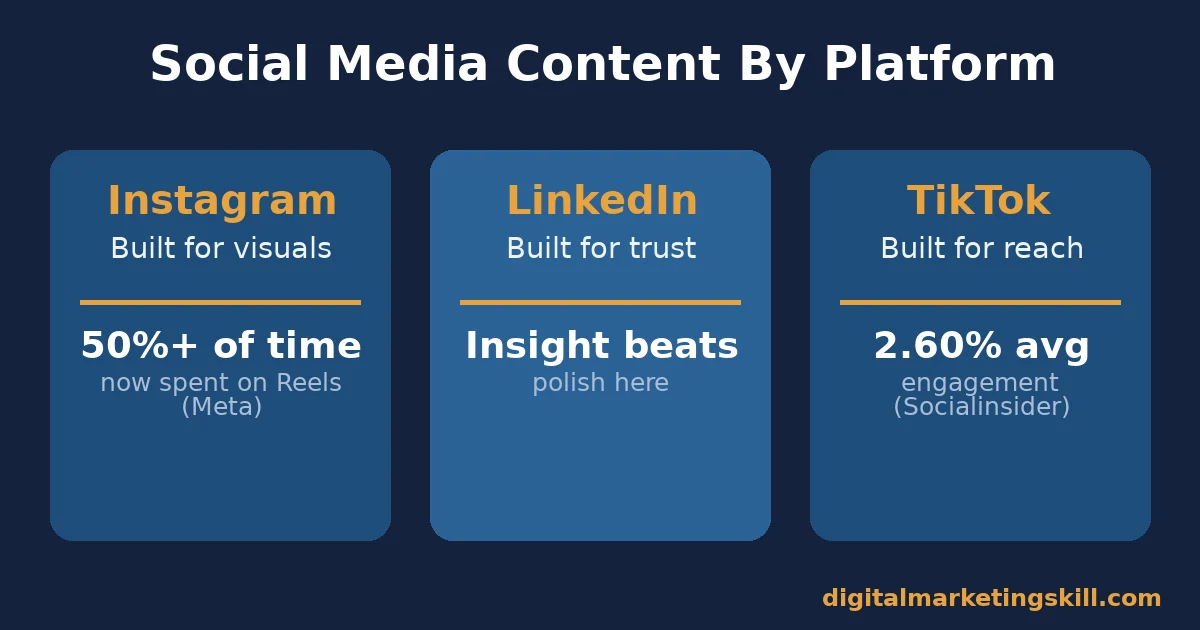
The four jobs above stay the same everywhere, but each major platform rewards a different format for each job.
Instagram: Built For Visual Discovery
Instagram favors polished visuals and short video. Reels now account for more than 50% of all time people spend on the platform, according to Meta’s own figures (as confirmed by Meta). A feed built only on static images misses most of the available attention.
LinkedIn: Built For Professional Trust
LinkedIn rewards insight over polish. A specific, well-argued post from a real person usually outperforms a branded graphic, because the platform’s audience is there to learn something from other professionals.
TikTok: Built For Short-Form Reach
TikTok’s algorithm favors native, unpolished video over anything that looks like a traditional ad. New accounts can reach large audiences fast here, but only with content made for the platform. Content repurposed from somewhere else, with a logo stamped in the corner, tends to underperform even when the message is good.
How To Act On Each Platform’s Strengths
Knowing a platform’s strength only helps once you actually lead with it.
Instagram: Lead With Reels And Carousels
Post short video for reach, and use carousel posts for anything that needs more explanation than a single image allows. Save static single images for product shots and quotes, where they still perform well. Mixing all three formats across a week, rather than relying on just one, tends to reach more of the audience than any single format alone.
LinkedIn: Lead With Insight And Real Numbers
Write from direct experience and name specific figures when you can. A generic motivational post gets scrolled past; a specific lesson from a real project gets read. The audience here skims quickly but reads closely once something earns their attention, so the first sentence carries more weight than on almost any other platform. The same blog SEO habits that make an article rank, like a clear point stated early, also make a LinkedIn post worth finishing.
TikTok: Lead With Native, Unpolished Video
Film vertically, keep the hook in the first two seconds, and resist the urge to make it look like a commercial. A shaky, honest clip filmed on a phone regularly outperforms an expensive, polished video on this platform specifically. The platform’s own research consistently favors content that looks like it was made by a person, not a studio.
Common Mistakes That Waste Good Social Media Content
Three mistakes show up again and again, across almost every account size. Each one is easy to fix once you can see it.
Posting One Format For Every Job
Many accounts post the same style of image every day, no matter the goal. Awareness, trust, and conversion each need a different format. One format stretched across all three jobs does none of them well. A product photo can grab attention once. It rarely builds trust on its own, and it rarely closes a sale without more context around it.
Burying The Point Past The First Line
Most viewers decide whether to keep watching or reading within the first two seconds or the first line of text. A slow build-up loses the viewer before the actual message ever arrives. Put the most interesting part first, every time, even if that feels like giving away the ending too early.
Ignoring Which Formats Actually Perform
Posting on instinct feels productive, but it rarely beats checking which formats already work. A quick look at past engagement by format usually points straight at what to make more of. Five minutes spent reviewing last month’s top three posts, by format, often reveals more than an hour of new brainstorming.
Chasing Every Trend Regardless Of Fit
Not every trending sound or format fits every brand. Jumping on a trend that has nothing to do with the business confuses the audience more than it helps. A trend is only worth joining if it still makes sense once the brand’s actual message is attached to it. If the connection feels forced, the audience notices, and the post reads as an attempt to chase attention rather than say something real.
Turning One Idea Into Several Formats
You do not need twenty new ideas every week. You need one good idea, reshaped for each job it needs to do.
A Simple Example
Say a business publishes one useful blog post. That single idea can become a short video for awareness, a poll question for engagement, a customer quote for trust, and a direct offer post for conversion. One idea, four jobs, four different formats. The underlying message never changes. Only the shape it takes changes, to fit the job each piece of social media content needs to do.
Why This Saves Real Time
Generating fresh ideas is the slow part of content creation. Reshaping one strong idea into several formats is fast by comparison. Most small teams run out of time before they run out of good ideas, so this approach protects the time that matters most. A single hour spent reshaping one idea across formats usually produces more usable content than a full day spent hunting for four separate new ones.
Tools That Make Social Media Content Easier To Plan
None of these formats require expensive software, but the right tool removes a lot of manual effort at each stage.
Planning And Scheduling Tools
A content calendar tool keeps every format on a consistent schedule. This matters more than any single post, since consistency is what builds an audience over time. A simple shared spreadsheet works fine at first; a dedicated tool only becomes worth paying for once multiple people are posting across several platforms.
Design And Editing Tools
Simple design tools let a small team produce polished graphics without hiring a designer. For short-form video, a basic phone editing app is usually enough to start. Expensive equipment rarely moves the needle before the format and message are already working.
Analytics Tools
Built-in platform analytics already show engagement, reach, and saves by post. A separate analytics tool becomes useful once you are comparing performance across several platforms at once. Before that point, the built-in dashboards usually give you everything you need to make a good decision.
How To Measure Whether Your Social Media Content Is Working
Track these numbers by format, not just by account. Averaging everything together hides which formats are actually earning their place.
- Engagement rate: likes, comments, and shares divided by reach or followers. Rates vary widely by platform and format, so compare a format to its own history more than to an outside benchmark.
- Reach: how many unique people saw the content. Strong reach with weak engagement usually means the format is right but the message is not. Weak reach with strong engagement usually means the opposite.
- Saves and shares: a stronger signal than likes, since both require the viewer to act rather than just tap once.
- UGC submission rate: how often customers create content about your brand unprompted. A rising rate is one of the clearest trust signals available.
- Click-through or conversion rate: the share who take the next step off the platform entirely. This is the number that ties content back to revenue.
The One Rule For Fixing Underperforming Social Media Content
Here is the decision rule: diagnose by reach versus engagement before changing anything else.
Here is an illustrative, invented example to show the logic, not a real result. Say a post reaches 10,000 people but earns only 20 likes and no comments. Reach is healthy, so distribution and timing are not the problem. Engagement collapsed, so the content itself is the likely cause, not the posting schedule. Now say a different post earns strong engagement from the few hundred people who saw it, but reach stayed flat. Here the content works; the problem is distribution, hashtags, or posting time, not the format itself.
This rule stops the common mistake of changing the content when the real problem was never seen by enough people to judge fairly. It also stops the opposite mistake: buying more reach for a post that nobody wanted to engage with in the first place.
A Real Content Shift, And What It Doesn’t Prove
Bazaarvoice’s research across its retail clients found a clear pattern. Shoppers who viewed user-generated content before buying converted at meaningfully higher rates than those who saw only brand-produced photography, a pattern consistent enough that the company now publishes it as a standing benchmark. The lesson was not “post more photos.” It was that content made by real customers does convincing work that a studio shoot cannot replicate.
On a smaller scale, DMSI student Damola Akanbi now earns approximately $1,500 per client running digital marketing campaigns. That work began with the same kind of format-by-format testing covered in this guide, as published on the Institute’s reviews page. One result like this does not predict what anyone else will earn; see the Institute’s earnings disclaimer for the full context. Both examples point the same way: a specific format change, tested and measured, beats posting more of everything. Neither result came from a large budget. Both came from picking one thing to test, watching the number that mattered, and adjusting from there.
Frequently Asked Questions About Social Media Content
What type of social media content gets the most engagement?
Short-form video consistently out-engages other formats on most major platforms right now. The exact margin shifts over time, so check current platform data before committing a full strategy to any one format.
How many types of social media content should a small business use?
Fewer formats done well beats many formats done poorly. Three or four formats, each tied to a clear job such as awareness or trust, usually outperform a scattershot mix of everything available.
Is user-generated content better than professionally produced content?
They serve different jobs. UGC tends to build trust faster because it reads as unbiased. Professional content still matters for product clarity and brand consistency, so most accounts need both.
Do social media content formats differ for B2B versus B2C businesses?
Yes. B2B audiences respond well to specific insight and data, closer to LinkedIn’s native style. B2C audiences respond more to visual and entertainment-first formats, closer to Instagram and TikTok’s native style.
What social media content format builds the most trust?
Customer testimonials and user-generated content tend to build trust fastest, since they come from a source the viewer does not expect to be biased in the brand’s favor.
Should every piece of content include a call-to-action?
No. Awareness and trust content often performs better without a hard sell. Save the direct call-to-action for conversion-focused content, once the audience already recognizes the brand.
How long does it take to see results from a new content format?
Give a new format several weeks and a reasonable number of posts before judging it. One post rarely tells you much; a pattern across ten or more posts tells you a lot more.
What is the biggest difference between good and bad social media content?
Good content knows which of the four jobs it is doing. Bad content tries to do all four at once, or does not know, and usually ends up doing none of them well.
Your Next Step With Social Media Content
Fit this plan into a wider small business marketing plan rather than treating social content as a standalone task. Picking the right format for the right job takes more than a checklist. It takes practiced skill in content strategy, platform-specific tactics, and measurement, built through real testing rather than guesswork.
The Digital Marketing Skill Institute’s Master Diploma in Digital & AI Marketing is built around four AI-powered tracks covering ten courses in total. One of them, the AI-Powered Social Media Management and Advertising track, covers exactly the skills in this guide. Students who complete all four tracks qualify for the Full Stack option. Every path includes unlimited 1-on-1 coaching and mentoring, a U.S. Project Internship with a verified U.S. Work Reference Letter, and a dual US and UK accredited diploma recognised in more than 100 countries. The program runs 100% online, so you can study from anywhere in your country.
See the full course structure on the Master Diploma program page, browse more guides on the digital marketing blog, or apply directly at digitalmarketingskill.com/apply/. Wherever you live, these ideas work the same way: match the format to the job, then measure what changed. Learn more at digitalmarketingskill.com, and start building social media content that earns its place at digitalmarketingskill.com.
Every figure in this guide was checked against its original source before publication. Figures marked as illustrative are invented examples, not real results.
