
A lookalike audience is a group of new people that an ad platform picks because they resemble a list of people you already know, such as your customers or leads. You give the platform a source list, and it finds others with similar traits and behaviour. As a result, you can reach strangers who are more likely to act like your best customers.
Key Takeaways
- A lookalike audience starts from a source list, also called a seed. On Meta, that seed needs at least 100 people from one country.
- The platform, not you, decides who looks similar. It uses its own data on behaviour and interests.
- Smaller lookalikes are closer matches. Larger ones reach more people but match less closely.
- The quality of the seed matters more than its size. A list of buyers usually beats a list of everyone who clicked.
- Meta and TikTok still offer lookalikes. Google and LinkedIn have replaced them with automated targeting.
What Is a Lookalike Audience?
Think of a lookalike audience as a way to clone your best customers. You can’t see who is in it, and you can’t pick the people yourself. Instead, you tell the platform who your ideal people are, and it does the matching for you.
For example, a skincare brand might upload a list of 2,000 customers who bought twice. Meta then looks for other users in the same country who behave like those buyers. The brand can then show ads to that new group, even though none of them have heard of it yet.
That’s why marketers use lookalikes for prospecting. In other words, they help you find new customers, while retargeting ads help you win back people who already know you.
How a Lookalike Audience Works
The platform builds every lookalike in three steps. First, you choose a source. Next, the platform studies what those people have in common. Finally, it finds other users who share those patterns and groups them into a new audience.
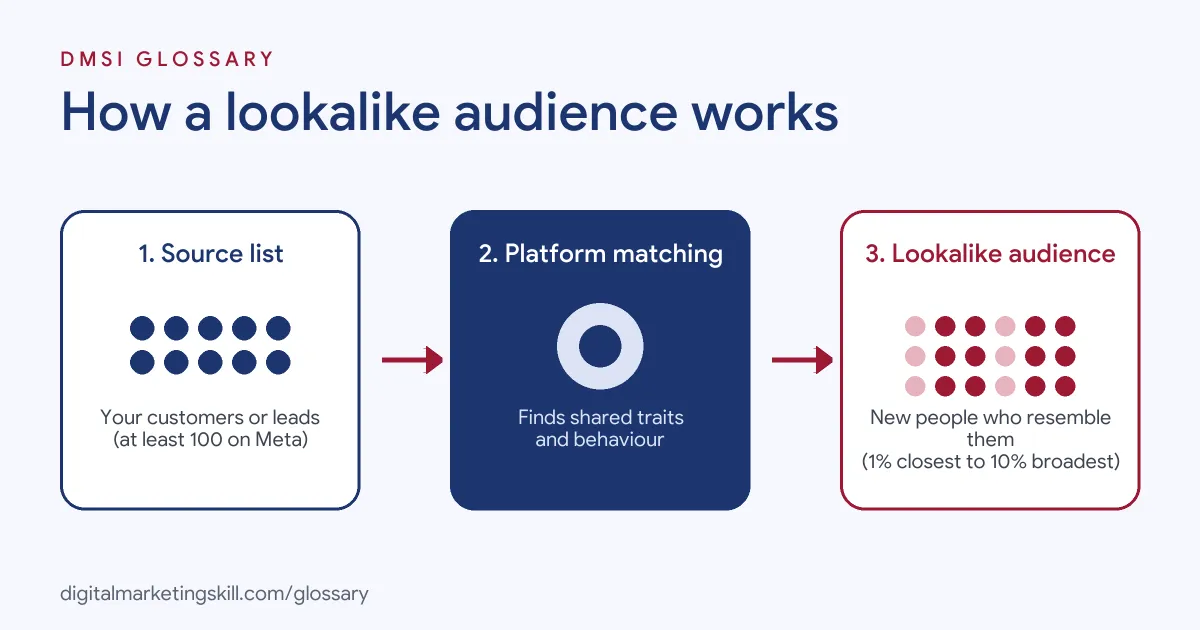
The Source Audience
The source is the most important choice you make. It can be a customer list, people who visited your website, people who engaged with your page, or people who took an action in your app.
Each platform sets a minimum size. Meta’s developer documentation says a source “must have at least 100 members” from the country you target. TikTok, by contrast, asks for a source of at least 1,000 people. In practice, a bigger source gives the system more to learn from, so it usually performs better.
Audience Size and Similarity
Next, you choose how big the new audience should be. On Meta, you pick a percentage of the country’s population. In Ads Manager, a 1% lookalike is the closest match, while 10% is much broader. TikTok uses three simple options instead: Narrow, Balanced and Broad.
There is always a trade-off here. A small lookalike audience matches your source closely but may run out of people quickly. A large one gives you more reach, but the match is weaker. So most teams start small, then widen the audience once they see results.
How Often It Updates
Lookalikes are not fixed lists. According to Meta’s documentation, it refreshes the members of a lookalike every three days while an active ad set uses it. As a result, the audience keeps pace as your source list grows.
Lookalike Audience Examples
Here are three common ways businesses use lookalikes:
- Online store: A fashion brand builds a 1% lookalike from customers who spent the most. It then runs new-collection ads to that group.
- Lead generation: A training school builds a lookalike from people who downloaded a free guide and later enrolled. As a result, its ads reach people more likely to sign up, not just click.
- Mobile app: A fitness app uploads users who stayed active for 30 days. Then it builds a lookalike to find more users who will keep the app.
In each case, the seed is a group of high-value people. That choice is what makes the lookalike useful.
Lookalike Audiences on Meta, TikTok, Google and LinkedIn
Not every platform still offers this feature. Here is where things stand:
| Platform | Feature today | Key detail |
|---|---|---|
| Meta (Facebook and Instagram) | Lookalike Audiences | Source of at least 100 people from one country; size set as a percentage |
| TikTok | Lookalike Audiences | Source of at least 1,000 people; Narrow, Balanced or Broad |
| Google Ads | Replaced | Google retired similar audiences and replaced them with optimised targeting and audience expansion |
| Replaced | LinkedIn ended lookalike targeting and now points advertisers to predictive audiences |
Meanwhile, Meta’s automated Advantage+ audience can treat your lookalike as a suggestion rather than a hard limit. In that case, Meta may show ads to people outside it if it predicts better results.
How to Create a Lookalike Audience in Meta Ads Manager
The steps below follow the standard flow in Meta Ads Manager. The menu names can change slightly over time, but the logic stays the same.
- Open Ads Manager and go to Audiences.
- Select Create audience, then Lookalike audience.
- Choose your source. This can be a custom audience, such as past buyers, or a page or pixel.
- Pick the country or region where you want to find new people.
- Set the audience size. Start with 1% for the closest match.
- Select Create audience. After that, add it to an ad set when it is ready.
Before you launch, check your pixel and your customer data. Otherwise, the lookalike will learn from the wrong people.
Best Practices for a Lookalike Audience
A few habits separate good results from wasted budget:
- Use your best people as the seed. One US job listing for a Senior Paid Social Specialist asks for “lookalikes built off funded customers rather than leads.” In other words, seed from people who paid, not just people who showed interest.
- Keep the seed fresh. Update customer lists regularly, so the platform learns from recent buyers.
- Test more than one size. For instance, run a 1% and a 3% lookalike side by side and compare the cost per result.
- Exclude existing customers. Otherwise, you may pay to reach people who have already bought.
- Judge results on sales or leads. Clicks alone can hide a poor match.
Common Mistakes to Avoid
Many beginners make the same few errors. First, they use a seed that is too broad, such as everyone who visited the site. Second, they pick the largest size straight away. Third, they forget to exclude buyers. Finally, they give up after a few days, before the campaign has enough data. Each of these is easy to fix once you know to look for it.
Lookalike Audience vs Custom Audience vs Interest Targeting
These three options are often confused, so here is a quick comparison:
| Option | Who it reaches | Best for |
|---|---|---|
| Custom audience | People who already know you, such as visitors or customers | Retargeting and follow-ups |
| Lookalike audience | New people who resemble a list you provide | Finding new customers at scale |
| Interest targeting | People the platform links to chosen interests | Testing new markets with no data yet |
In short, a custom audience looks back, interest targeting guesses, and a lookalike learns from your own data.
Where You’ll Use Lookalike Audiences at Work
Lookalikes are a core skill in paid social roles. For example, recent remote job listings ask candidates to:
- “Use custom audiences, lookalikes, and interest-based targeting to improve reach and relevance” (Facebook Ads Specialist).
- Show a “good understanding of cold audiences, retargeting, and Lookalike audiences” (PPC and Meta Ads Specialist).
- Build “lookalikes built off funded customers rather than leads” (Senior Paid Social Specialist).
So if you want to work as a Paid Social Specialist, Media Buyer or Social Media Manager, employers will expect you to build, test and report on lookalikes. They will also want proof, such as a campaign where you can show the results.
Learn It in the Social Media Track
You can learn to build and test a lookalike audience in the AI-Powered Social Media Management and Advertising track. There, you plan, create and run a paid social campaign for a real brand, so you finish with results you can show an employer. You also work on a U.S. Project Internship from day one, with unlimited 1-on-1 mentoring.
Want more ideas for building a strong seed list? See our guide to lead magnet ideas, which shows how to grow the list your lookalikes learn from.
Frequently Asked Questions
What is a lookalike audience in simple terms?
It is a group of new people that an ad platform finds because they resemble people you already know, such as your customers. You supply the list, and the platform does the matching.
How many people do you need for a lookalike audience?
On Meta, the source needs at least 100 people from the target country. TikTok needs at least 1,000. However, larger sources of high-value customers usually give better results.
What is a good lookalike audience size?
Most advertisers start with 1% on Meta, which is the closest match. If results are good, they test 2–5% to reach more people.
Does Google Ads have lookalike audiences?
Not any more. Google retired similar audiences. Instead, it now uses optimised targeting and audience expansion to find new people.
Is a lookalike audience the same as retargeting?
No. Retargeting shows ads to people who already know you. A lookalike reaches new people who simply resemble them.
Sources: Meta for Developers: Lookalike Audiences; TikTok Ads Help: About lookalike audiences; PPC Land: LinkedIn to discontinue Lookalike Audiences; iO: Google discontinues Similar Audiences; remote job listings on Himalayas.