
Lead magnet ideas only work when they trade something small for something the visitor actually wants. Most guides list formats, checklist, ebook, quiz, without explaining why one format converts at 20% and another barely clears 1%. This guide shows what differs by format, how to measure each one, and one rule for picking the right lead magnet idea for your offer.
Key Takeaways
- Generating leads is the third-biggest challenge marketers report, named by 29.6% of over 1,500 marketers surveyed by HubSpot.
- The same survey found 93.8% of marketers say lead quality improved over the past year. And 55.7% say generating leads is easier than a decade ago.
- In a GetResponse survey of 790 marketers, video and written lead magnets tied as the formats marketers said performed best, each named by roughly a quarter of respondents.
- Short-form content outperformed long-form in the same survey: 73% of marketers using short video reported higher conversion, and 58.6% said the same for short written content.
- The median landing page converts at 6.6%, per Unbounce’s analysis of 41,000 pages, but email-driven traffic converts nearly twice as well as paid traffic, at 19.3% versus 10.9-12.0%.
In this guide
- The Lead Magnet Gap
- How a Lead Magnet Actually Works
- Lead Magnet Performance by Traffic Source
- What Differs by Lead Magnet Format
- How to Lead With Each Format
- Measuring Whether Your Lead Magnet Ideas Are Working
- The One Rule for Picking a Lead Magnet Format
- A Real Case: What 790 Marketers Said Worked
- Common Lead Magnet Mistakes to Avoid
- Where to Place Lead Magnet Ideas for Maximum Reach
- Frequently Asked Questions About Lead Magnet Ideas
- Build the Skills Behind Every Lead Magnet Idea
The Lead Magnet Gap
Most lists of lead magnet ideas are just that: lists. They name ten formats and leave you to guess which one fits your audience, your offer, and the stage of the funnel you are trying to fill.
That gap matters more than it first appears. A business that picks the wrong format for its stage and audience does not just underperform. It often concludes, wrongly, that lead magnets themselves do not work for its market.
Testing a second format before giving up on the category entirely usually reveals the real issue was fit, not the idea of a lead magnet at all.
This guide is a framework built from published survey data, not a guarantee that any single format will convert at a specific rate. Conversion rates in every study here varied by industry, traffic source, and execution. Treat every number as a benchmark to test against, not a promise.
The ground rule is simple: a lead magnet only works if the exchange feels fair. Ask for too much, and visitors leave. Offer too little, and the few who do opt in become poor-quality leads who never open the next email.
This same ground rule applies no matter how the platform or format trends change over time. Fashions in lead magnet ideas shift, from ebooks to quizzes to interactive calculators, but the underlying exchange a visitor is weighing does not.
How a Lead Magnet Actually Works
A lead magnet is a resource offered in exchange for contact information, almost always an email address. The visitor decides whether the resource is worth the exchange in the first few seconds of seeing the offer.
That decision runs on three factors. Specificity: how precisely the resource solves one real problem. Effort: how much work the visitor believes it will take to get value from it. Trust: whether the visitor believes the resource will actually deliver what it promises.
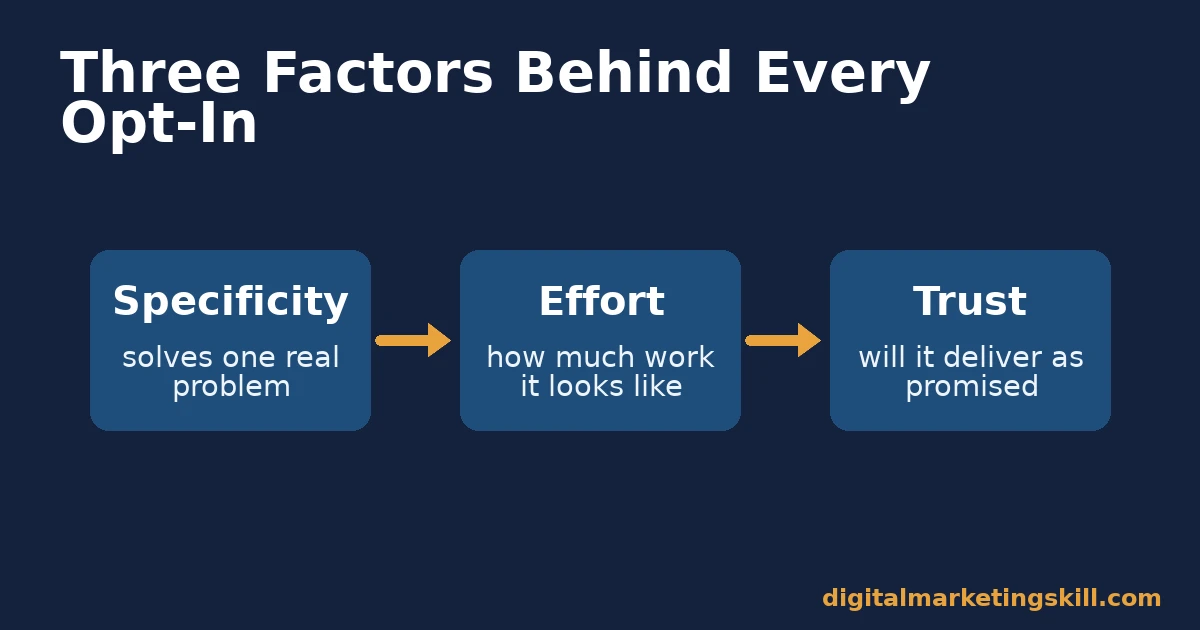
A generic resource fails on specificity. Excellent content still fails on effort if it runs too long. An unfamiliar, unproven source fails on trust, no matter how good the idea behind it is.
This is why format matters less than most lists suggest. The three factors above explain why a short checklist often beats a longer, better-written ebook, even when the ebook contains more useful information.
None of this means format is irrelevant, only that it is not the first thing to diagnose. Fix specificity, effort, and trust first. The best format for your specific offer usually becomes obvious from the testing itself.
Teams that skip this diagnosis step tend to cycle through lead magnet ideas quickly, abandoning each one after a single underwhelming test, without ever learning which of the three underlying factors was actually holding results back.
Lead Magnet Performance by Traffic Source
The same lead magnet idea converts differently depending on where the traffic comes from, which is easy to miss when testing on a single channel.
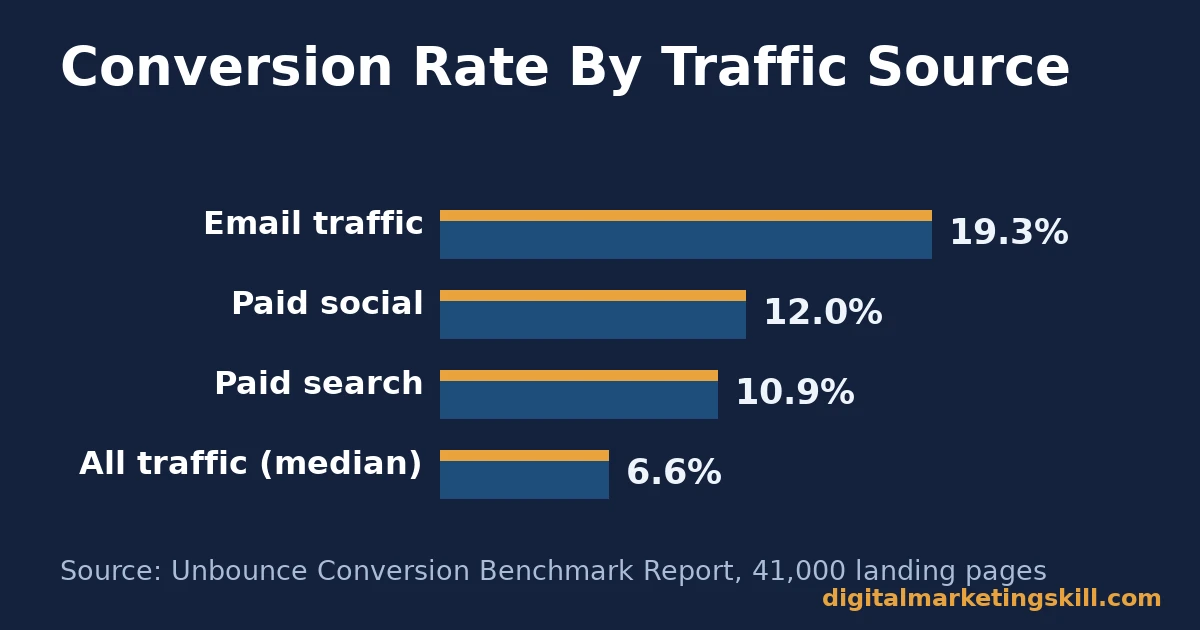
Unbounce’s analysis found email-sourced landing page traffic converts at 19.3%, almost double paid social at 12.0% and paid search at 10.9%. A lead magnet idea that performs brilliantly in an email newsletter can underperform badly as a paid ad. This happens even with identical copy and design.
This gap exists because email traffic already trusts the sender. A cold visitor arriving from a paid ad has no such trust yet, so the specificity and effort factors described above carry more weight for that audience than for a warm email list.
In practice, this means a single test on a single channel rarely settles the question of which lead magnet idea is “best” for your business. The honest answer is almost always best for which audience, on which channel.
Before concluding a lead magnet idea “does not work,” check which channel it was tested on. A format that fails on cold paid traffic may simply need a warmer audience, not a redesign.
Segmenting results by channel, even roughly, before judging a test is a small habit that saves a lot of wasted redesign work. Many of the strongest lead magnet ideas get discarded too early simply because they were tested on the wrong audience first.
What Differs by Lead Magnet Format
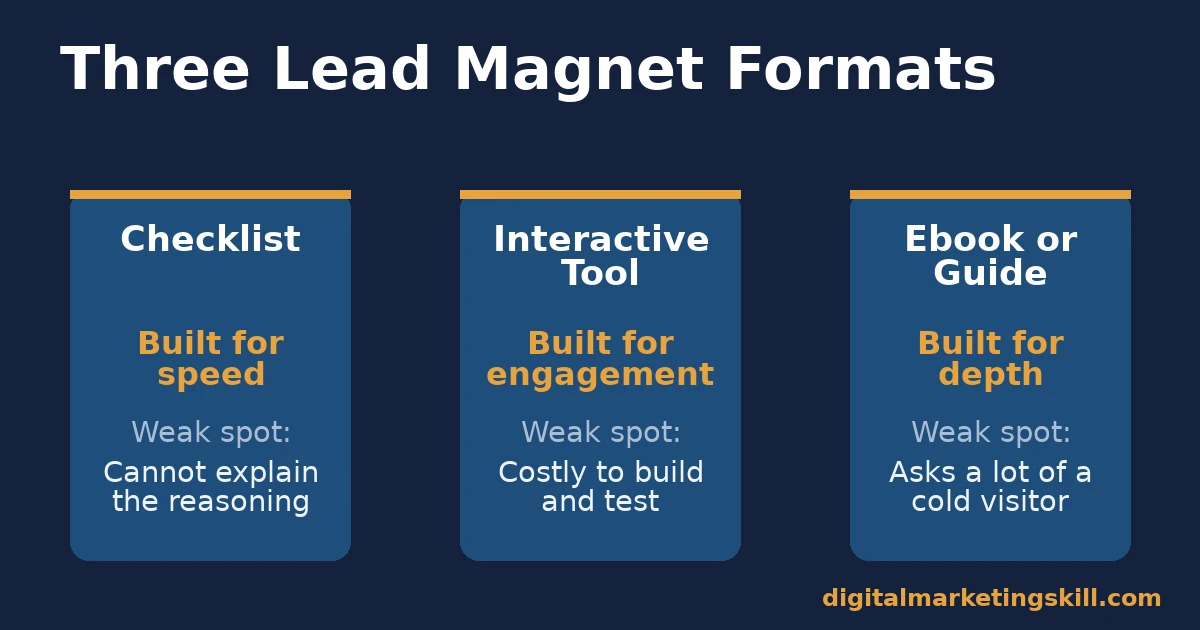
Three broad formats cover most effective lead magnet ideas. Each wins on a different one of the three factors above.
Checklists: Built For Speed
A condensed, actionable list that a visitor can scan and use within minutes. Checklists score high on effort, since there is little perceived work involved in reading one.
Their weak spot is depth. A checklist cannot explain the reasoning behind each step. It works best for an audience that already understands the context and just wants the steps.
A good checklist-based lead magnet idea usually comes from content you already have. Summarizing a popular blog post into a condensed, actionable list costs far less production time than building something new from scratch.
Interactive Tools: Built For Engagement
A quiz, calculator, or assessment that produces a personalized result. These lead magnet ideas score high on specificity, since the output is tailored to the individual visitor, not generic.
Their weak spot is production cost. A good interactive tool takes real development time, so it rarely makes sense as the first lead magnet idea a small team tests.
Start interactive tools only after a simpler format has already proven the topic converts. Building a calculator for an unproven topic risks spending real development time on a lead magnet idea nobody wanted in the first place.
Ebooks and Guides: Built For Depth
A longer resource that covers a topic thoroughly, often compiled from existing blog content. These score high on trust, since depth signals real expertise behind the brand.
Their weak spot is effort. A long resource asks a lot of a visitor who has not yet decided whether your brand is worth that time. That is why ebooks often convert lower than shorter formats on cold traffic.
Ebooks and guides tend to work best further down the funnel. Offer them to a visitor who has already read several blog posts from you, rather than as the first lead magnet idea a cold visitor encounters.
How to Lead With Each Format
Picking a format is half the decision. Presenting it so the exchange feels fair to a cold visitor is the other half.
Checklists: Lead With the Outcome
Name the specific result the checklist delivers, in the headline, not the process behind it. “7-Point Launch Checklist” tells a visitor exactly what they get; “Our Launch Process” does not.
Keep the checklist itself short enough to finish in one sitting. A checklist that takes an hour to complete has quietly become a different, heavier lead magnet idea.
Interactive Tools: Lead With the Promise of a Personal Answer
Open with the question the tool answers, not a description of how it works. “What’s Your Marketing Budget Benchmark?” earns more clicks than “Try Our Calculator.”
Deliver the personalized result immediately after the email capture, not after a delay. A tool that makes visitors wait for their result loses much of the specificity advantage that made it worth building.
Ebooks and Guides: Lead With Proof of Depth
Show the table of contents or a short excerpt before asking for an email address. Visitors need evidence the depth is real, not just promised, before they trust a longer commitment.
Keep the opt-in form short. Baymard Institute’s research on form complexity found completion rates decline as field count rises. The same logic applies to a lead magnet form sitting on top of an already long resource.
Measuring Whether Your Lead Magnet Ideas Are Working
Four numbers, available in most email and landing page tools, cover what matters.
Opt-in conversion rate is the share of visitors who submit the form, out of everyone who saw the offer. Compare it to the 6.6% landing page median, but remember email-sourced traffic converts far higher than paid traffic.
Cost per lead is total spend on promoting the lead magnet, divided by leads captured. Track it by traffic source separately, since paid and organic leads rarely cost the same.
Lead-to-customer rate is the share of captured leads who eventually buy. A lead magnet with a high opt-in rate but a low lead-to-customer rate is attracting the wrong audience, not the right one.
Once a lead opts in, where they read your follow-up matters too. Litmus Email Analytics found mobile and webmail together account for over 80% of email opens. That is one reason a lead magnet’s follow-up sequence needs to render cleanly on a small screen, not just a desktop preview.
Resource completion rate is the share of leads who actually open or use the resource after downloading it. A low completion rate signals the resource over-promised relative to what it delivers.
Track opt-in rate and lead-to-customer rate together. A format that wins on one but loses badly on the other usually needs a different audience, not just a different headline.
The One Rule for Picking a Lead Magnet Format
Match the format to the factor your current lead magnet idea is actually failing on. If opt-in rate is low, the problem is usually specificity or effort, so try a shorter, more precise format. If opt-in rate is fine but lead-to-customer rate is poor, the problem is trust or targeting, not format at all.
Here is an illustrative, invented example. Say a landing page converts at a healthy 8%, above the 6.6% median, but only 1% of those leads ever buy. Swapping the ebook for a checklist would not fix this.
The real problem is that the lead magnet idea attracts people curious about the topic, not people close to a buying decision. A bottom-of-funnel offer, like a free trial or demo, fits that stage better than a different top-of-funnel format would.
Diagnosing which factor is broken, before changing format, saves the time it takes to test a new resource that fixes a problem you did not actually have.
This rule applies to every one of the lead magnet ideas in this guide, not just the three formats profiled above. The diagnosis step comes first, always, regardless of which format you eventually choose to test.
A Real Case: What 790 Marketers Said Worked
The clearest evidence of which lead magnet ideas marketers believe perform best comes from a GetResponse survey of 790 marketers. Most were solopreneurs or small teams.
Video and written content tied as the top performers, each cited by roughly a quarter of respondents as their best-converting format. Short-form content beat long-form by a wide margin: 73% of marketers using short video, and 58.6% using short written content, reported higher conversion than their longer alternatives.
The limits matter here. This is a self-reported survey of what marketers believe performed best, not an independently measured conversion rate. The respondent base also skewed toward solopreneurs and small internet-marketing businesses. Use it as a directional signal, not a guarantee that short-form will outperform for every audience.
Common Lead Magnet Mistakes to Avoid
Three mistakes show up repeatedly, across every format.
These mistakes cut across every one of the lead magnet ideas covered above, from checklists to interactive tools to longer guides. Spotting which one applies to your current offer is usually faster than redesigning the resource from scratch.
A visitor weighs the topic, the format, and the source all at once, in the few seconds before deciding whether your offer is worth their email address. Each mistake above breaks one of those three factors, which is why fixing the right one matters more than fixing all three at once.
Making the lead magnet idea too broad. A resource that tries to help everyone with everything fails the specificity test for nearly all of them. A narrower promise, to a narrower audience, almost always converts better.
Over-promising in the headline. A headline that oversells what the resource delivers raises opt-in rate while lowering trust and completion rate. The gap between the promise and the delivery is exactly what kills a lead’s willingness to open your next email.
Never testing a second format. A team that settles on one lead magnet idea and never tests another learns nothing. There is no way to know whether a different format would convert meaningfully better for the same offer.
Where to Place Lead Magnet Ideas for Maximum Reach
A well-built resource still fails if nobody sees the offer. Placement decides how many visitors even get the chance to evaluate your lead magnet ideas in the first place.
Blog posts are the most common placement, and the most overlooked detail is timing. A lead magnet offered partway through a post, right after the section that creates the need for it, tends to outperform one bundled only at the very end, after most readers have already left.
Testing placement costs almost nothing compared to building a new resource. Moving an existing lead magnet idea higher up the page is often a faster win than designing an entirely new one.
Exit-intent popups capture visitors who are about to leave without converting. They work best paired with a specific, narrow offer rather than a generic newsletter signup, since a visitor already leaving needs a stronger reason to stay than a vague promise of updates.
OptinMonster’s own guide to lead magnets covers dozens of narrow, specific offer ideas worth testing in this slot.
Email signatures, social bios, and dedicated landing pages extend reach beyond the blog itself. None of these replace a strong offer; they only matter once the underlying lead magnet idea has already proven it converts somewhere else first.
Frequently Asked Questions About Lead Magnet Ideas
What is the best lead magnet idea for a new business?
A checklist or short template tied to one specific, common problem your audience already recognizes. New brands have not yet earned the trust a longer resource like an ebook depends on, so a low-effort, high-specificity format fits best.
How long should a lead magnet be?
Short enough to finish in one sitting, for most formats. The GetResponse data above shows short-form content outperforming long-form by a wide margin across both video and written formats.
Do quizzes and interactive lead magnets actually convert better?
They can, because a personalized result scores well on specificity. However, they cost more to build than a checklist, so they make more sense once you already know your audience responds to the topic.
Why do my lead magnet ideas get downloads but no sales?
Usually because the opt-in rate and the lead-to-customer rate are measuring two different problems. A high opt-in rate with few resulting sales points to the wrong audience stage, not a format problem.
Should a lead magnet be gated behind a long form?
No. A longer resource already asks for the visitor’s time; stacking a long form on top compounds the effort cost. Keep the form to name and email unless you have a specific reason to ask for more.
How many lead magnet ideas should a business test?
More than one. Testing a second format against your current best performer is the only reliable way to learn whether your audience actually prefers it, rather than assuming based on what worked for someone else’s audience.
Does a lead magnet need to be free?
Almost always, yes, for the top of the funnel. A paid or heavily discounted resource can work as a bottom-of-funnel lead magnet idea, once a visitor already trusts the brand. A cold visitor rarely exchanges both money and an email address for something unproven.
Can the same lead magnet idea work for both B2B and B2C audiences?
Sometimes, but the format that fits best usually differs. B2B audiences tend to respond to checklists, templates, and industry-specific guides, while B2C audiences often respond better to quizzes, discounts, and entertaining interactive formats.
Build the Skills Behind Every Lead Magnet Idea
Turning lead magnet ideas into a reliable pipeline of qualified leads is one piece of a much broader skill set. It is taught across the Digital Marketing Skill Institute’s Master Diploma in Digital & AI Marketing.
The program is built from four AI-powered tracks: AI-Powered Social Media Management and Advertising, AI-Powered Lead Generation and Email Automation, AI-Powered Google Specialist, and AI-Powered WordPress and SEO Specialist. Together, these total ten courses, with a Full Stack option for students who complete all four.
Every track includes unlimited 1-on-1 coaching and mentoring, a U.S. Project Internship with a verified U.S. Work Reference Letter, and dual US and UK accreditation recognised in more than 100 countries. The program runs 100% online, so you can build these skills from anywhere in your country.
See how a strong lead generation tactic complements your lead magnet, and check your email signup conversion rate against realistic benchmarks. Learn how to turn leads into customers, or set a realistic marketing budget for testing new formats.
Read real outcomes on the reviews page, or go straight to the application page. Learn more about the Institute at digitalmarketingskill.com, or start your own program search from the homepage at any time.
Every figure in this guide was checked against its original source before publication. Figures marked as illustrative are invented examples, not real results.
![9 Amazing Digital Marketing Skills to Make Money Online [With Proof]](https://digitalmarketingskill.com/wp-content/uploads/2019/07/9-Amazing-Digital-Marketing-Skills-to-Make-Money-Online-With-Proof-17.png)






