
Agentic AI is a type of artificial intelligence that can work towards a goal with limited supervision, by planning steps, taking actions with tools and adjusting as it goes. Rather than waiting for a new prompt each time, it keeps going until the job is done or a person steps in. It matters for marketers because it can take on multi-step work, such as research, reporting and campaign checks, while people stay in control of the results.
Key Takeaways
- The word “agentic” refers to agency: the ability to act on its own towards a goal.
- These systems are built from one or more AI agents, often coordinated by an orchestration layer.
- Generative AI creates content when you ask. By contrast, an agentic system plans and acts across several steps.
- The main benefit is autonomy, but autonomy also magnifies the usual AI risks.
- Good teams set clear goals, guardrails and human checkpoints before they let it act.
What Is Agentic AI?
IBM defines it as “an artificial intelligence system that can accomplish a specific goal with limited supervision.” It consists of AI agents, which IBM describes as models that mimic human decision-making to solve problems in real time.
IBM also explains the name. “Agentic” refers to these models’ agency, “or, their capacity to act independently and purposefully.” So the focus shifts from answering questions to getting things done.
Here is a simple marketing example. You ask a chatbot to write a report, and it gives you a draft. With an agentic system, you set the goal instead. It then pulls last week’s ad data, compares it with targets, flags problems and drafts the report for you to review.
How Agentic AI Works
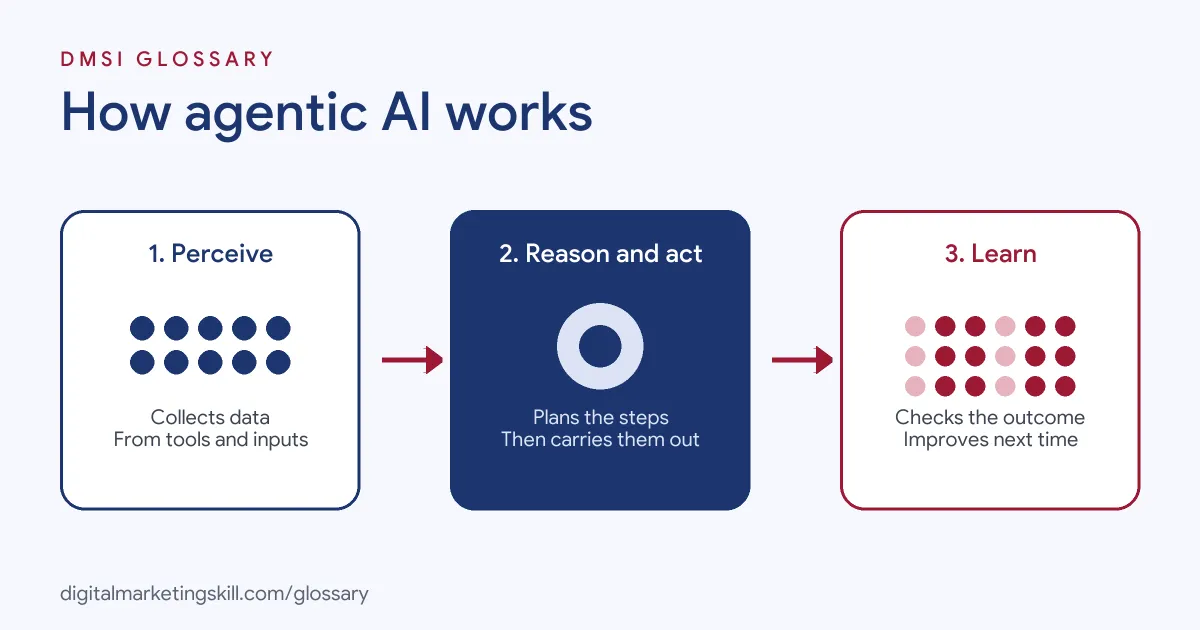
Most explanations describe a loop of three broad stages. First, the system perceives: it collects data from tools and inputs. Next, it reasons and acts: it plans the steps and carries them out. Then it learns: it checks the outcome and improves next time.
The Steps in Detail
IBM breaks the process into clearer parts:
- Perception: it gathers up-to-date data to work with.
- Reasoning: it interprets the data and the request, and spots patterns.
- Goal setting: it sets objectives from your goals and plans how to reach them.
- Decision-making: it weighs possible actions and picks the best one.
- Execution: it acts, for example through APIs or other systems.
- Learning and adaptation: it reviews the outcome and refines its approach.
Orchestration and Multiple Agents
Complex jobs often need more than one agent. In a multiagent system, IBM says each agent handles one subtask, and orchestration coordinates their work. For example, one agent might gather data while another writes the summary. Some designs use a “conductor” model that supervises simpler agents. IBM notes this suits step-by-step workflows but can create bottlenecks.
Guardrails and Human Control
NVIDIA describes a shift from simple automation to systems that manage whole workflows “within defined security and governance boundaries.” In business settings, it says the agent’s core works within guardrails and policy rules. In other words, a well-built system is never a free-for-all. People decide what it can touch and when it must stop.
Agentic AI Examples
Here are three realistic ways marketing teams apply the idea:
- Campaign monitoring: A system checks ad accounts each morning. It flags spend spikes and broken links, then suggests fixes for a specialist to approve.
- Content operations: One agent researches a topic, another drafts an outline and a third checks it against the brand style guide. After that, an editor reviews everything.
- Lead follow-up: When a lead fills in a form, the system looks up the company, scores the lead and drafts a personal email. A salesperson then decides whether to send it.
NVIDIA gives a similar example from business reporting. An agent uses APIs to retrieve raw sales data, machine learning to find trends and a code tool to generate a graph. Throughout, it evaluates each action and learns from user feedback.
In each case, the AI handles the busywork. Meanwhile, a person keeps the final say.
Agentic AI vs Generative AI vs Automation
These terms overlap, so here is a quick comparison:
| Approach | What it does | Who decides the steps |
|---|---|---|
| Rule-based automation | Runs the same fixed steps every time | A person, in advance |
| Generative AI | Creates text, images or code when prompted | You, one prompt at a time |
| Agentic AI | Plans and carries out multi-step tasks towards a goal | The system, within limits you set |
IBM notes that generative systems are limited by the data they were trained on. Agentic systems, in contrast, can use tools to fetch up-to-date information. However, Anthropic advises starting simple. For many tasks, a single well-built prompt is “usually enough.”
How to Use Agentic AI Safely at Work
Follow these steps before you hand any task to an autonomous system:
- Pick a narrow, repeatable task. Weekly reporting is a better start than “run our marketing.”
- Write down the goal and the limits. Include budgets, accounts and actions that are off limits.
- Give read-only access first. Let it recommend before it acts.
- Add human checkpoints. Require approval before any change to live campaigns or customer data.
- Test in a safe space. Anthropic recommends “extensive testing in sandboxed environments.”
- Review the results. Compare its output with your own work, then widen its role only if quality holds.
After a run of good results, you can let it take small actions on its own, such as pausing an ad that breaks a rule you set. Even then, keep the log and review it regularly.
Best Practices for Agentic AI
- Keep a log. IBM recommends giving users access to a log of agent actions, so errors are easy to spot.
- Allow interruption. Make sure a person can stop the process at any point.
- Design rewards with care. IBM warns that a poorly designed reward can lead the AI to exploit loopholes.
- Protect data and privacy. Above all, follow your company’s rules on customer information.
- Measure the business result. Time saved only counts if quality stays the same or improves.
Common Mistakes to Avoid
The biggest mistake is giving too much freedom too soon. IBM points out that autonomy is the main benefit, but it “can bring serious consequences” if a system goes “off the rails.” Another mistake is using an agentic setup for a task a simple prompt could handle. Some teams also skip testing, then trust the output blindly. Finally, many forget about cost. More steps mean more model calls, so track what each task really costs to run.
Where You’ll Use Agentic AI at Work
Most job listings that name the term are in tech and product roles. For example, recent remote listings ask for:
- “Hands-on experience with foundation models, LLM alignment, agentic AI, or autonomous AI agents” (Autonomous Learning Engineer).
- Someone who will “shape new interaction patterns for agentic AI features” (Staff Product Designer).
- “Experience supporting autonomous or agentic AI systems and implementing AI behavioral testing and evaluation” (Software Engineer).
In marketing roles, the same idea shows up as working with AI agents. One Google Ads Specialist listing, for instance, wants someone who can “direct AI agents effectively, critically assess their outputs and apply sound judgement before taking action.” So the marketing skill is not building these systems. Instead, it is briefing them, checking their work and knowing when to say no.
Learn It in the Full Stack Programme
AI fundamentals, including strategy and planning, are part of every DMSI track. To use AI across every channel, choose the Full Stack programme, which includes all four tracks and all ten courses. You build one portfolio project from each track. You also join a U.S. Project Internship from day one, with unlimited 1-on-1 mentoring.
To go further, read our guide to AI in digital marketing and our look at whether AI will replace digital marketers. You can also read our glossary entry on the AI agent.
Frequently Asked Questions
What is agentic AI in simple terms?
It is AI that can plan and carry out several steps towards a goal on its own, using tools and checking its progress, with limited supervision.
What is the difference between agentic AI and generative AI?
Generative AI creates content when you prompt it. An agentic system goes further: it plans, takes actions with tools and adjusts its approach across many steps.
Is agentic AI the same as an AI agent?
They are closely linked. An AI agent is a single system that acts towards a goal. The agentic approach is wider, and it can involve one agent or many working together.
Is agentic AI risky?
It can be. Because it acts on its own, mistakes can spread. Use clear limits, activity logs and human approval for important actions.
Will agentic AI replace marketing jobs?
It changes them rather than removing the need for people. Marketers still set goals, judge quality and make the final decisions.
Sources: IBM: What is agentic AI?; IBM: What are AI agents?; NVIDIA: What are autonomous AI agents?; Anthropic: Building effective agents; remote job listings on Himalayas.