
Ecommerce is buying or selling goods, services or digital products online rather than in a physical store. What is ecommerce in practice? A website or marketplace listing takes the place of a till, and a payment processor replaces cash. A courier or a download link replaces the bag you’d carry out the door.
Key Takeaways
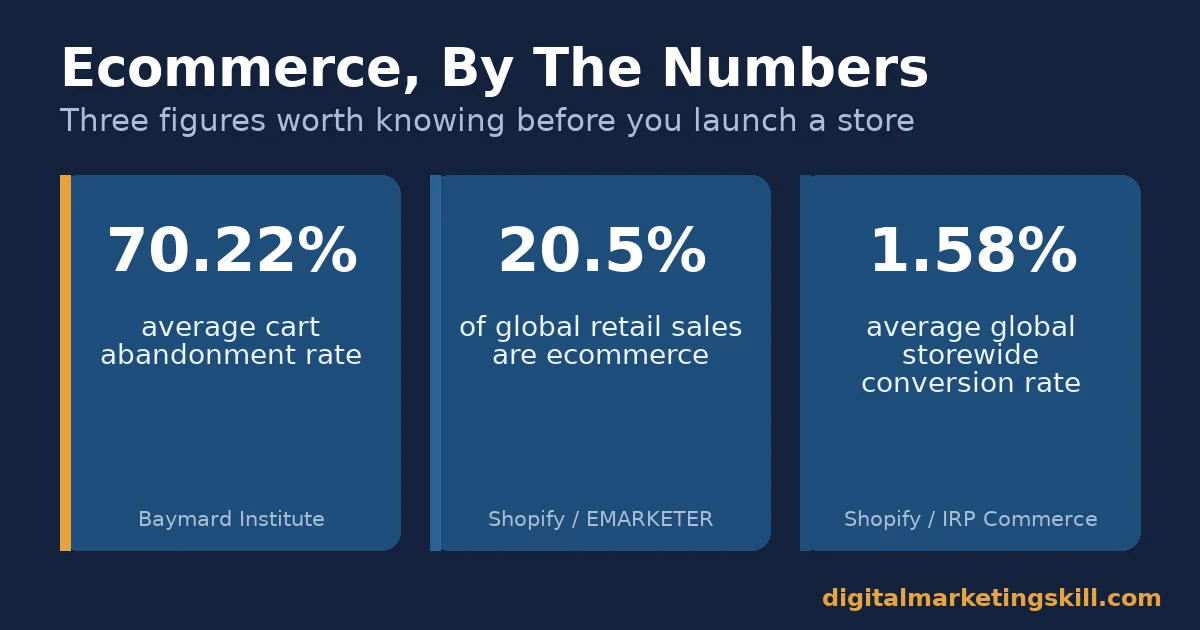
- Most carts never convert. Baymard Institute averaged 50 separate studies and found a 70.22% cart abandonment rate. Most stores lose the majority of their ready buyers before checkout finishes.
- Cost surprises drive the loss. In that same Baymard research, 40% of shoppers who abandoned a cart, excluding browsers, blamed extra costs like shipping, tax or fees shown too late.
- Ecommerce is still a minority of retail. Shopify, citing EMARKETER, reports ecommerce accounts for roughly 20.5% of global retail sales. Most purchases worldwide still happen offline.
- Conversion rates are low everywhere. The same report, citing IRP Commerce, puts the average global storewide conversion rate at around 1.58%. Roughly 98 of every 100 visitors leave without buying.
- The audience is genuinely global. DataReportal counts 6.04 billion internet users worldwide, equal to 73.2% of the global population. That is the pool any online store can reach.
In this guide
- What Most “What Is Ecommerce” Explainers Skip
- What Is Ecommerce? The Process, Step By Step
- What Changes By Ecommerce Model
- How To Choose And Launch Each Model
- What Is Ecommerce, Grouped By Who Actually Buys
- Where Ecommerce Businesses Actually Lose Sales
- What Is Ecommerce Success? Five Metrics That Show It
- The One Decision Rule: Fix Checkout Before You Spend More On Traffic
- A Real Case: What a Small, Focused Ad Budget Can Return
- Frequently Asked Questions About What Is Ecommerce
- Build The Skills Behind a Working Ecommerce Store
What Most “What Is Ecommerce” Explainers Skip
Most explainers answer what is ecommerce with a dictionary definition. Then they jump straight to “how to start a store.” They skip the part that actually determines whether a store survives: where the money leaks out between a visitor arriving and a sale completing.
This guide covers both halves. Read the figures above as a useful snapshot, not a fixed rule. The Shopify-reported global share is pulled upward by China’s unusually high online retail penetration. A figure closer to 12.8% is a more realistic benchmark once China is excluded. Baymard’s abandonment research blends many studies across regions and store types. Treat it as a strong average, not your store’s guaranteed number.
What Is Ecommerce? The Process, Step By Step
Underneath the marketing, every ecommerce transaction follows the same basic chain. A storefront displays a product or service. A shopper adds it to a cart, then enters payment and delivery details. Next, a payment processor authorizes and captures the funds. The order then routes to fulfilment: a warehouse, a supplier, or an instant digital download.
Each link in that chain is also a place a sale can fail. A slow storefront loses visitors before they see the product. A confusing cart loses shoppers before checkout even starts. Then a payment decline or a hidden shipping fee loses them at the final step. That final step is exactly where Baymard’s 70.22% abandonment figure comes from.
Speed matters earlier in the chain than most owners expect. Google’s own Core Web Vitals guidance treats loading speed, interactivity and visual stability as direct, measurable signals of whether a page experience is good enough to keep a visitor around. A storefront that fails these basics loses shoppers before they ever see a product, long before checkout is even a factor.
Understanding ecommerce as a chain, rather than a single event, changes what you optimise. Fixing the step with the biggest leak almost always beats adding more traffic to a chain that already loses most of its visitors.
What Is Ecommerce Without Trust And Reach?
Part of answering what is ecommerce honestly is admitting how much of the chain depends on trust, not just technology. Any business that stores, processes or transmits card data has to meet the PCI Data Security Standard. The PCI Security Standards Council describes it as a baseline of technical and operational requirements designed to protect payment account data.
Skipping this is not optional once real card numbers are involved. Most hosted payment processors handle the heaviest requirements for you.
The reach of ecommerce also depends on who can actually pay online. The World Bank’s Global Findex survey finds that 79% of adults worldwide now have an account at a bank, another financial institution, or a mobile money provider. That is the baseline population that can realistically complete an online purchase at all.
What Changes By Ecommerce Model
Not every ecommerce business sources and ships products the same way. The two most common models work so differently that each needs its own expectations around margin, speed and risk.
Inventory-Based Selling: Built For Margin Control
An inventory-based store buys or manufactures stock up front, then holds it until it sells. That happens either in its own warehouse or through a fulfilment partner. This gives the owner full control over product quality, packaging and how fast an order ships.
That control comes at a cost. Cash is tied up in stock before a single sale happens, and unsold inventory is a real financial risk. In exchange, margins are usually higher. There is no third party taking a cut of each sale for holding and shipping the product.
Dropshipping: Built For Low Startup Cost
A dropshipping store lists products it never physically holds. When an order comes in, the store owner forwards it to a supplier. The supplier ships directly to the customer, and the owner never touches inventory or packaging.
This model’s appeal is obvious: a store can launch with almost no upfront stock cost. The trade-off is weaker margins, since the supplier keeps a share of the price. Control over shipping speed and packaging quality is weaker too, and both show up directly in customer complaints and refund requests.
How To Choose And Launch Each Model
The right starting move depends on which model fits the budget and risk tolerance you actually have today, not the one that sounds most impressive.
Inventory-Based Selling: Lead With Supplier Vetting
Before committing cash to stock, test demand with a small batch or a pre-order campaign. Vet any manufacturer or wholesaler on sample quality, minimum order size and realistic lead times. A late shipment damages trust faster than almost anything else in ecommerce.
Once demand is proven, negotiate pricing based on volume. Keep a cash buffer for the gap between paying a supplier and getting paid by customers. That gap is where undercapitalised inventory businesses usually fail first. Many first-time owners discover what is ecommerce cash flow really means only after their first large reorder is due before the previous batch has fully sold.
Dropshipping: Lead With Niche And Fulfilment Speed
Pick a specific niche rather than a broad general store. A focused store can write better product copy and target advertising more precisely than a store trying to sell everything. Then vet suppliers on shipping time before price, because slow delivery is the single biggest driver of dropshipping refund requests and complaints. Our guide to how dropshipping works and what it costs covers supplier and fee comparisons in more depth.
Order samples yourself before listing a product. A supplier’s photos rarely show the packaging quality or real shipping speed a customer will actually experience.
What Is Ecommerce, Grouped By Who Actually Buys
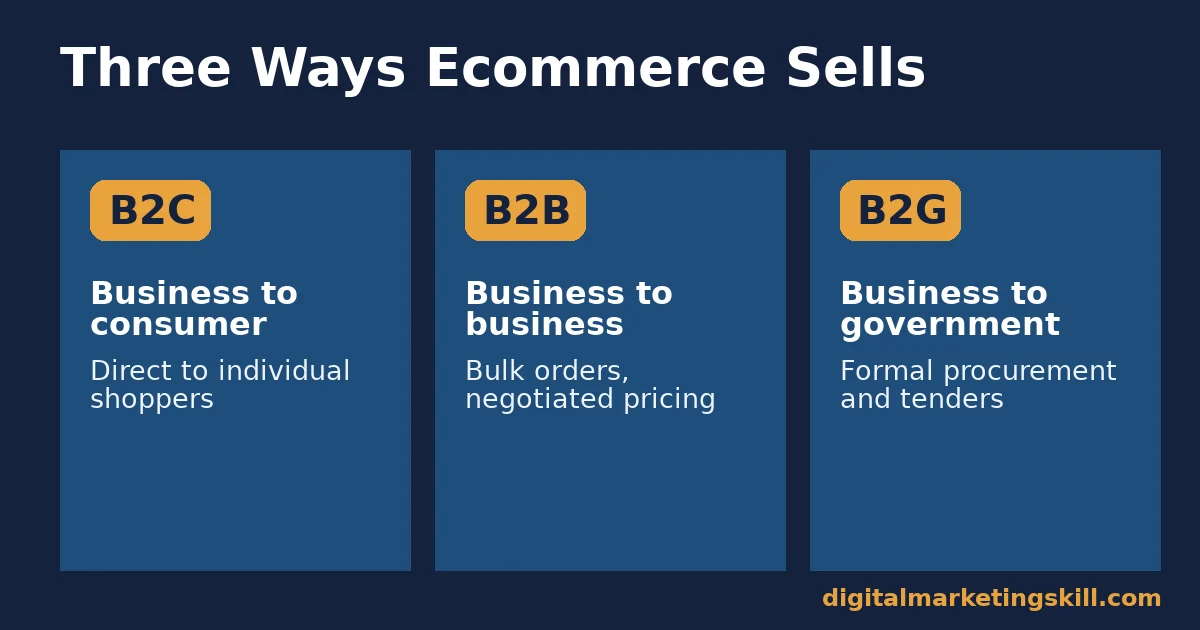
Beyond how a store sources its products, what is ecommerce also depends on who sits on the other side of the transaction. Three buyer categories cover almost every online sale.
- Business-to-consumer (B2C). A business sells directly to individual shoppers. This is the model most people picture when they ask what is ecommerce: a retailer’s website, a fashion brand’s store, or a marketplace listing aimed at everyday buyers.
- Business-to-business (B2B). A business sells to other businesses, often in bulk and with negotiated pricing. A supplier selling packaging materials to a manufacturer through an online portal is a B2B ecommerce transaction.
- Business-to-government (B2G). A business sells to a government body or public agency, usually through a formal procurement or tender process managed online. Office supplies, specialised software and uniforms are common examples. These deals usually move more slowly than a consumer purchase, since formal procurement rules and approval chains govern who can buy what and from whom.
The same store can sell across more than one of these categories at once. A software company might sell subscriptions to individual consumers. It might also sell negotiated enterprise licences to other businesses, plus compliance-specific packages to government agencies, all through the same checkout system.
Where Ecommerce Businesses Actually Lose Sales
Most new store owners assume their biggest problem is not enough traffic. Baymard’s research suggests the bigger problem, for most stores, is what happens to the traffic they already have.
Beyond the 40% who cite surprise costs, Baymard’s aggregated data also finds that 20% of abandoners blame slow delivery estimates. Another 19% distrust entering card details on the site, and 18% abandon because the store forces an account to be created before checkout. Every one of these is fixable without spending another dollar on ads.
None of them require a bigger marketing budget or a redesign of the whole site. Most are small, specific changes: show the full price earlier, offer a realistic delivery estimate, and let a shopper check out without forcing a new account.
A short, transparent checkout addresses most of these reasons directly. Show total cost early, offer a guest checkout option, and state a realistic delivery window. Our guide to ecommerce checkout mistakes walks through the fixes in detail. Fixing checkout is usually cheaper and faster than fixing a traffic problem, and it improves the return on every traffic channel at once.
What Is Ecommerce Success? Five Metrics That Show It
A handful of metrics, read together, show whether an ecommerce store is actually working. Each one is defined plainly below.
Five Metrics That Show Real Store Health
- Conversion rate. The share of visitors who complete a purchase. Shopify’s benchmark, citing IRP Commerce, puts the global average around 1.58%. Judge your own rate against your own history, not against that single figure.
- Cart abandonment rate. The share of shoppers who add a product to cart but never complete checkout. Compare yours with Baymard’s 70.22% average. Treat anything far above that as a signal to audit your checkout flow specifically.
- Average order value (AOV). Total revenue divided by number of orders. A rising AOV with a flat conversion rate usually means upsells or bundling are working.
- Customer acquisition cost (CAC). What it costs, in ad spend and tools, to win one paying customer. CAC only means something next to AOV and repeat purchase rate. A high CAC can still be profitable for a store with strong repeat sales.
- Repeat purchase rate. The share of customers who buy more than once. A healthy repeat rate reduces reliance on constantly paying for new traffic, which matters most once ad costs rise.
What Is Ecommerce On Mobile, And Why Track It Separately
A large and growing share of ecommerce traffic now arrives on a phone rather than a desktop computer. Treat mobile conversion rate as its own metric, not a rounding error folded into your overall average. A store that checks out poorly on mobile can look healthy overall while quietly losing a huge share of its actual visitors.
A slow mobile checkout, a form that is hard to tap accurately, or a payment field that does not trigger the right on-screen keyboard are all common, fixable mobile-specific leaks.
How To Read These Numbers Together
Start with cart abandonment rate. It is usually the fastest to fix and the highest-leverage number on this list. If abandonment is high while traffic is healthy, the fix lives in checkout, not in marketing.
Once abandonment is under control, read conversion rate and AOV together. A low conversion rate with a healthy AOV suggests the right people are not reaching the store yet. A decent conversion rate with a low AOV suggests the product or pricing mix needs work. If sales are dropping off somewhere specific in the journey, our guide to the ecommerce sales funnel helps pinpoint which stage is losing the most sales.
The One Decision Rule: Fix Checkout Before You Spend More On Traffic
If you remember one rule from this guide, make it this one: never increase ad spend to fix a sales problem until you have checked checkout friction first. More traffic through a leaky checkout just means more money lost at the same leak.
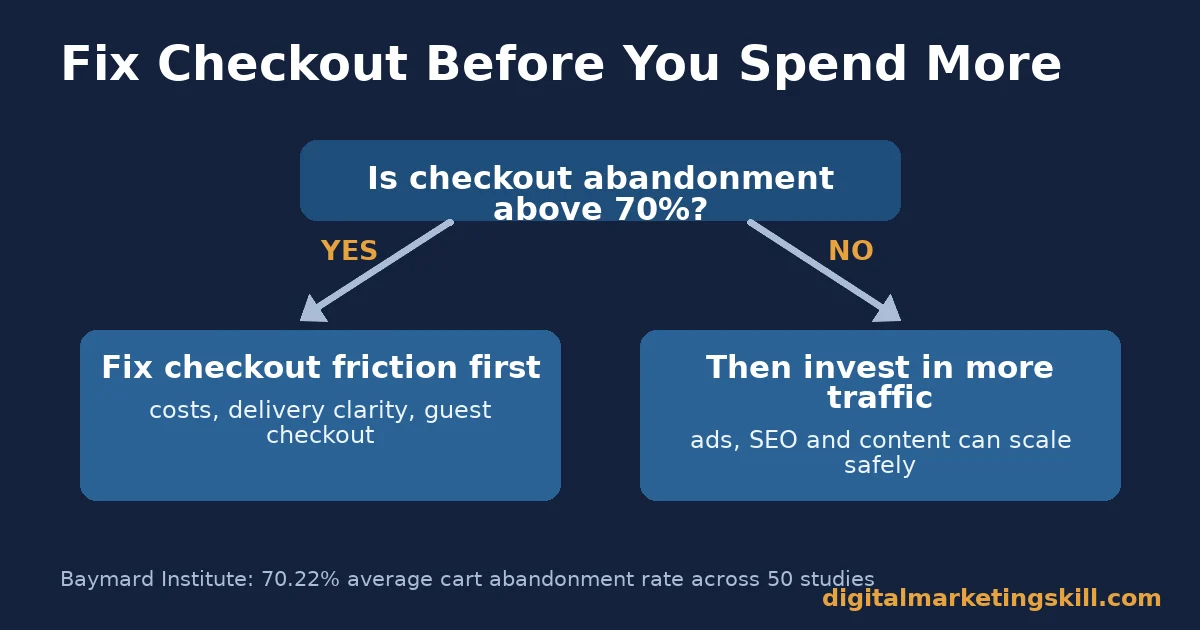
Here is an illustrative example, with invented numbers. A small store gets 1,000 visitors a month at a 1.5% conversion rate, producing 15 sales. The owner doubles ad spend, and traffic rises to 2,000 visitors. But checkout friction holds conversion rate flat, so sales only rise to 30, at double the cost per sale.
Suppose the owner had instead fixed a hidden shipping fee shown late in checkout, lifting conversion to 2.5%. The original 1,000 visitors alone would have produced 25 sales, for no extra ad spend at all. The lesson generalises well beyond this one example: a fix that lifts conversion rate improves every future visitor, paid or organic, while a fix that only adds traffic has to be paid for again every single month. Checkout fixes compound over time; extra ad spend does not.
A Real Case: What a Small, Focused Ad Budget Can Return
Ayooluwa Osemi, a Digital Marketing Skill Institute graduate, described a small test on the Institute’s reviews page. Spending $14 on an ad test, the result was $878 in returns, over 300% on that spend.
Treat this as one person’s documented result, not a typical outcome. Ad performance like this depends heavily on the product, audience and offer, and most campaigns will not replicate it. The Institute’s own earnings disclaimer explains the limits of any single result like this one. The case does show one thing plainly: a small, well-targeted budget can outperform a larger, untested one.
That matters more to a new ecommerce store than the size of the budget itself. For a store still testing its first products, that is often a more useful lesson than any amount of theory about what is ecommerce or how big a budget should be.
Frequently Asked Questions About What Is Ecommerce
What is ecommerce in simple terms?
Ecommerce is buying or selling goods, services or digital products online instead of in a physical location. A website or app takes orders, a payment processor handles the money, and delivery or a download completes the sale.
What are the main types of ecommerce business models?
Businesses are commonly grouped by who they sell to: business-to-consumer, business-to-business and business-to-government. They are also grouped by how they source products: holding inventory themselves, manufacturing to order, buying wholesale, or dropshipping through a supplier.
Is dropshipping still a viable way to start an ecommerce business?
It can be, mainly because it needs very little upfront stock cost. The trade-off is thinner margins and less control over shipping speed, so it suits testing a niche more than it suits building a premium, high-margin brand.
Why do so many ecommerce stores lose sales at checkout?
Baymard Institute’s research across 50 studies found an average cart abandonment rate of 70.22%. Surprise costs, slow delivery estimates and forced account creation are among the most common reasons. Most of these are fixable through checkout design alone.
What is a good ecommerce conversion rate?
Shopify’s benchmark, citing IRP Commerce, puts the global average around 1.58%. Conversion rate varies widely by product, price point and traffic source, though. Your own store’s trend over time is a more useful target than any single published average.
How much money do I need to start an ecommerce business?
It depends entirely on the model. A dropshipping store can start with little more than a website and advertising budget. An inventory-based store needs cash tied up in stock before the first sale.
Does ecommerce work for service-based or digital products, not just physical goods?
Yes. Ecommerce covers any online transaction, including digital downloads, software subscriptions and online-booked services, not only physical products shipped to a customer.
What is ecommerce payment security, and do I need to worry about it?
Yes, if your store ever touches card data directly. The PCI Data Security Standard sets mandatory technical and operational requirements for any business that stores, processes or transmits payment card data. Most hosted checkout providers absorb the heaviest parts of this requirement for you, which is one reason few small stores need to think about raw card data at all.
How does ecommerce fit inside a wider digital marketing strategy?
A store is only one part of the system. Traffic, conversion and retention all depend on the broader digital marketing work around it. Our guide to ecommerce digital marketing covers how the two fit together.
Build The Skills Behind a Working Ecommerce Store
Understanding what is ecommerce is the starting point. Turning that understanding into a store that actually converts takes real, practiced skill. Digital Marketing Skill Institute teaches those skills inside its Master Diploma in Digital & AI Marketing.
The AI-Powered WordPress and SEO Specialist track covers building and optimising the store itself. The AI-Powered Google Specialist track covers driving and converting the traffic that reaches it. Both sit inside four AI-powered tracks totalling ten courses, with a Full Stack option for completing all four, so a store owner can learn the build side and the growth side together instead of piecing the skills together from scattered sources.
The programme includes unlimited 1-on-1 coaching and mentoring and a U.S. Project Internship with a verified U.S. Work Reference Letter. It is dual US and UK accredited and recognised in more than 100 countries. Students also get real project work rather than theory alone, which matters most for a topic like ecommerce where the difference between a store that converts and one that doesn’t usually comes down to small, testable details. The programme runs 100% online, so you can build these skills from anywhere in your country.
Browse more guides on the Digital Marketing Skill Institute blog, read real outcomes on the reviews page, or when you are ready, apply for the Master Diploma directly from Digital Marketing Skill Institute.
Every figure in this guide was checked against its original source before publication. Figures marked as illustrative are invented examples, not real results.
