Online business ideas range from freelance services you can start today to online stores that take months to validate. The four models that work are freelancing, affiliate marketing, e-commerce and content publishing. Each one needs a different mix of time, cash and skill before it pays. This guide shows how each model makes money. It also shows how to pick the right one for you.
Key Takeaways
- Four models cover almost every online business idea. Freelancing, affiliate marketing, e-commerce and content publishing each monetize differently. Mixing them up early is the most common mistake.
- The audience is large and still growing. DataReportal’s Digital overview put global internet users at 6.12 billion people, about 73.8% of the world’s population. Social media user identities reached 5.79 billion.
- Freelancing is fast to start but caps on your hours. Upwork’s Freelance Forward research found 64 million people freelanced in the United States in one year. That is about 38% of the US workforce, a US-only figure.
- E-commerce keeps taking share from physical retail. The US Census Bureau’s Quarterly Retail E-Commerce Sales report put e-commerce at 17.1% of total US retail sales, a US-only figure that has been climbing most quarters.
- Email stays the highest-return channel for every model. Litmus’s State of Email research reported $36 to $42 returned for every $1 spent on email.
In this guide
- What Most Lists Of Online Business Ideas Get Wrong
- How Each Of These Online Business Ideas Actually Makes Money
- What Differs Among These Online Business Ideas
- Pairing Two Online Business Ideas
- Cost And Time To First Dollar, By Model
- How To Launch Each Of These Online Business Ideas The Right Way
- How To Measure Whether Your Online Business Idea Is Working
- The One Rule: Match These Online Business Ideas To Your Time, Capital And Skill
- A Real Case: What One Small Ad Test Produced
- Frequently Asked Questions About Online Business Ideas
- Your Next Step With Digital Marketing Skill Institute
What Most Lists Of Online Business Ideas Get Wrong
Search “online business ideas” and you get fifty bullet points. Dropshipping, print on demand, virtual assistant, course creator, stock photography, and more. The list keeps growing. Almost any skill or product can be sold online. That breadth is the problem. Fifty options tell you nothing about which one fits your time, your savings or your skill right now.
This guide narrows the field to four underlying models. Every item on those long lists is really a version of one of them. One is freelancing, where you sell your own time. Another is affiliate marketing, where you sell someone else’s product for a commission. A third is e-commerce, where you sell a product you control, physical or digital. The fourth is content and blogging, where you sell attention and monetize it later.
A ground rule before we go further. The figures below are checked against the source that published them. Each one is labeled where it is US-only or a single company’s own number. Nothing here is a guaranteed income. Any example marked “illustrative” is an invented number used only to show the math.
How Each Of These Online Business Ideas Actually Makes Money
Freelancing converts hours into invoices. You agree a price for a defined piece of work, a logo, a landing page, a month of social posts. You get paid when it is delivered. There is no inventory and no audience to build first. That is why it is the fastest of the four to start. But your income is capped by the hours you can personally sell.
Affiliate marketing converts recommendations into commissions. A merchant gives you a tracked link. When someone buys through it, you earn a percentage or a flat fee. You never touch the product, handle payment or do support. The model is close to pure marketing.
But you also have no control over price, stock or the buyer’s experience after the click. Our guide on how to start affiliate marketing walks through the full setup.
Among online business ideas, affiliate marketing is the closest to pure marketing with no operations at all.
E-commerce converts product margin into profit. You buy or make a product for less than you sell it for. The difference, minus shipping, platform fees and returns, is your margin. Shopify’s own figures describe millions of merchants running stores in more than 175 countries on its platform. Listing a product has a low barrier. Selling one profitably does not.
A lower-capital version of this model is covered in our guide on how dropshipping works and what it costs.
Content and blogging converts attention into several income streams at once. Display ads, sponsorships, your own digital product, an email list, or affiliate links placed inside useful content. It is the slowest of the four to pay anything, because you need an audience before any stream works. But it is the only model where one piece of work keeps earning long after you publish it.
What Differs Among These Online Business Ideas
The four models differ in three places. How fast they produce a first dollar. How much upfront capital they need. And what skill actually moves the needle. These online business ideas are not equally risky, fast or cheap, so comparing them side by side matters before you commit. Here is each one on its own terms.
Freelancing: Sell A Skill You Already Have
Freelancing turns a skill you already have, writing, design, development, bookkeeping, video editing, into paid work. No product to build first. You need close to zero starting capital, a portfolio of 2-3 samples, and a profile on one platform. The Bureau of Labor Statistics’ Contingent Worker Supplement counted 11.9 million independent contractors in the United States, 7.4% of total employment, a US-only figure.
The ceiling is real, though. You are trading hours for money. Growth comes from raising your rate or hiring help, not from more traffic.
Affiliate Marketing: Promote Products You Trust
Affiliate marketing pays you for sending buyers to someone else’s product. It needs almost no capital. But it needs an audience or a search-ranked page before it earns anything, and that can take months. The skill that moves the needle is picking offers your specific audience actually wants. Not the highest commission on the page.
E-Commerce: Stock, Make Or Dropship A Product
E-commerce sells a specific product, physical or digital. You hold it as inventory, manufacture it, or ship it through a dropshipping supplier who fulfils the order for you. It needs more capital than the first two models: inventory, a storefront, ads to get the first sales. The skill that matters most is unit economics, knowing your true cost per sale before you scale ad spend.
Content And Blogging: Publish And Build An Audience
Content and blogging sells attention first and converts it into income later, through several channels at once. It needs almost no cash, but a lot of time before it earns anything. Often six to twelve months of consistent publishing before traffic or an email list reaches a size that pays.
WordPress now runs 40.0% of all websites, according to W3Techs. That makes it the most common foundation writers choose. If you want to freelance on the side while an audience builds, our comparison of the best freelance websites covers where to start.
Pairing Two Online Business Ideas
These four models are not mutually exclusive. Most people who earn a full income online eventually run two at once. A common pairing is content and affiliate marketing. The audience you build through publishing becomes the same audience you recommend products to. The work of building the platform pays twice.
Freelancing and e-commerce pair less naturally, since both compete for the same scarce hours. Combining two online business ideas this way spreads risk without doubling your workload, as long as you choose a pair that shares little competition for your time. That is one reason the decision rule below starts with time and capital, not personal preference.
Cost And Time To First Dollar, By Model
Online business ideas are often sold as equally accessible, but the cash and time each one needs differs sharply. Before picking a model, see the four side by side on the two resources that matter most. How much cash you need before you can sell anything. And how long it realistically takes to get paid once you start.
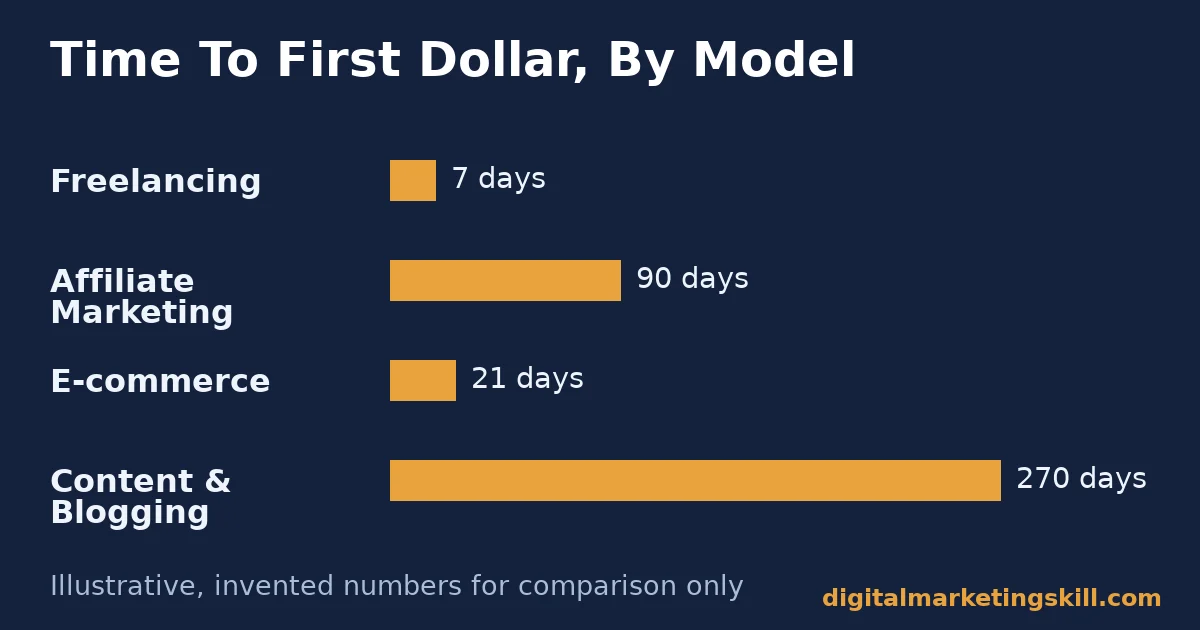
Freelancing needs close to $0 in starting capital, since the product is your own time. It can produce a first paid invoice within one to two weeks of sending proposals. The main cost is the hours spent pitching before the first client says yes.
Affiliate marketing needs little capital either, maybe a domain and hosting. It typically takes two to six months before a new page ranks well enough in search, or an audience grows large enough, to produce a reliable first commission.
E-commerce needs the most upfront cash of the four. A storefront, initial inventory or a dropshipping supplier relationship, and an ad budget to find the first buyers. Time to first sale can be days, if you validate demand first. The real cost shows up later, if unit economics are not checked before scaling spend.
Content and blogging needs almost no cash but the most time. Expect six to twelve months of consistent publishing before traffic or an email list is large enough for ads, sponsorships or your own product to earn real money. This is also the model most likely to keep paying years later, which the other three rarely do without continuous effort.
How To Launch Each Of These Online Business Ideas The Right Way
Picking the model is step one. Launching it so it actually produces income is a separate set of moves, specific to each one.
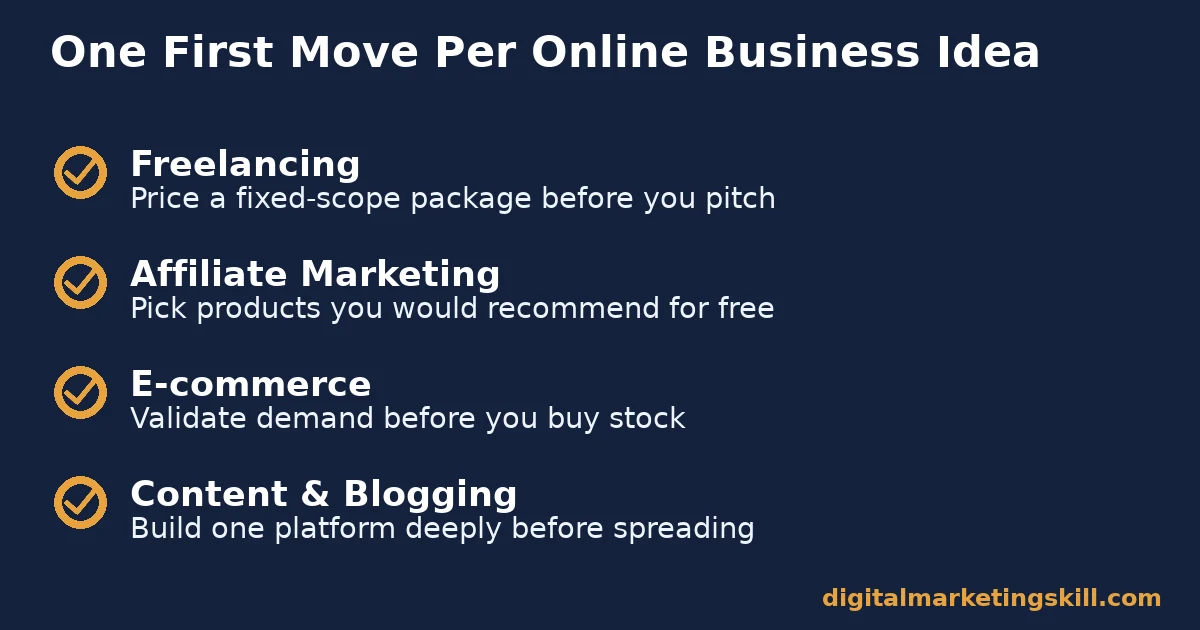
Freelancing: Price And Package Before You Pitch
Set a fixed-scope package, for example “5-page WordPress site” or “10 blog posts”, with a clear price. Do this before you talk to a client, instead of quoting an hourly rate case by case. Fixed packages close faster, because the buyer knows the full cost up front. They also protect you from scope creep once work begins.
Apply to jobs that match your 2-3 strongest samples, rather than every open listing. A focused portfolio wins more often than a broad one. Our freelancing for beginners guide walks through building that first portfolio. If a marketplace like Fiverr is your starting point, see how Fiverr’s levels and fees actually work.
Affiliate Marketing: Pick Products You’d Actually Recommend
Choose offers you would recommend even without a commission. An audience that stops trusting your recommendations stops clicking them. Favor merchants with a cookie window long enough to credit a buyer who comes back later.
Read the program’s own terms, not a reseller’s summary. Put the link inside content that answers a real question first. A link with no context converts far worse than one placed inside an honest comparison or how-to.
E-Commerce: Validate Demand Before You Buy Stock
Test demand with a small ad budget and a waitlist or pre-order page, before committing to inventory. If nobody will pre-order, nobody will buy once it ships either. Once you have a validated product, calculate your true cost per sale: product, shipping, platform fee, ad spend, returns. Do this before increasing ad budget, so growth does not quietly erase your margin.
Content And Blogging: Build One Platform Deeply Before Spreading
Publish consistently on one platform, a blog or one video channel, until it produces a measurable result. Do not split early effort across five channels at once. Build an email list from the first post. It is the one audience you own outright. A social following or a search ranking can disappear overnight with an algorithm change. A list you can still message directly.
How To Measure Whether Your Online Business Idea Is Working
Each model has one number that tells you, honestly, whether it is working. This matters before revenue is large enough to judge on its own.
Freelancing: proposal-to-client rate. The share of proposals you send that turn into a paid contract. Track it over your last 20 proposals. A rate under 10% usually means your portfolio, price or niche needs to change.
Affiliate marketing: earnings per click (EPC). Commission earned divided by clicks sent to the offer. Compare EPC across offers in the same niche before deciding which to keep promoting. The highest commission rate does not always produce the highest EPC.
E-commerce: customer acquisition cost against lifetime value (CAC vs LTV). What it costs in ads and fees to win one customer, measured against what that customer is worth across every purchase. A healthy ratio keeps LTV at three times CAC or higher. Anything close to 1:1 means growth is not profitable yet.
Content and blogging: email list growth rate. New subscribers gained each month, as a percentage of your existing list. A list that is not growing month over month usually means the content is not reaching new readers.
The One Rule: Match These Online Business Ideas To Your Time, Capital And Skill
If you need income inside 30 days, and you have more spare hours than spare cash, start with freelancing. If you have an existing audience, or can commit to building one, start with affiliate marketing or content. Pick whichever matches how fast you need the first dollar.
If you have capital to risk and a specific product you can source or make, consider e-commerce. But validate demand before you spend it on inventory.
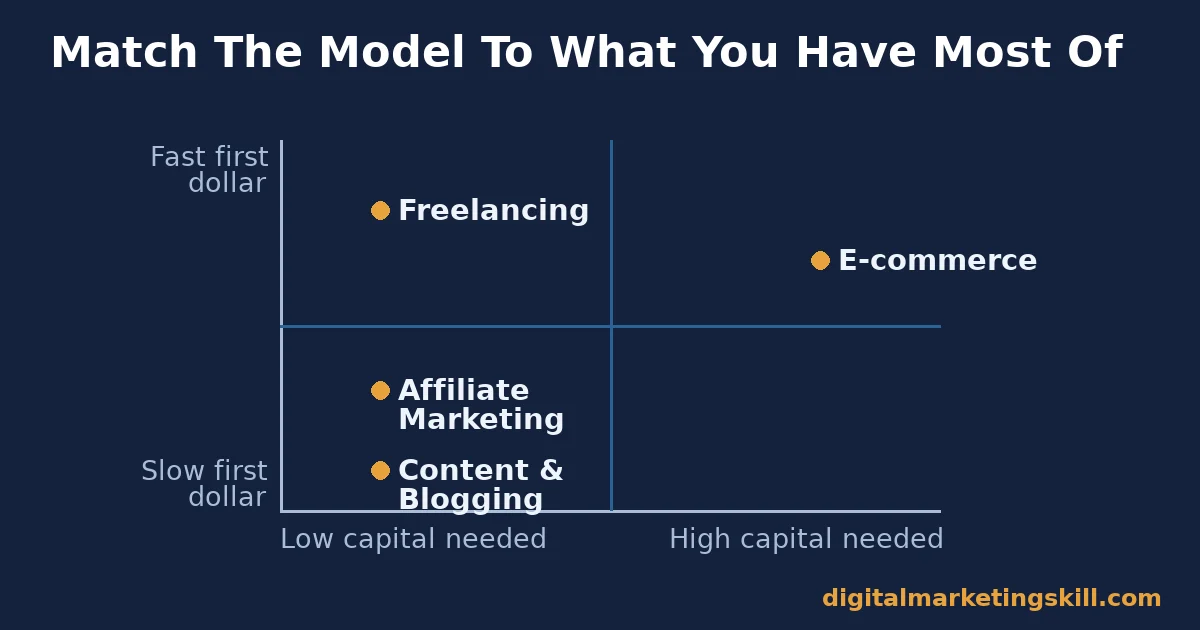
Illustrative, invented numbers: someone with $200 in savings and 15 spare hours a week could land two freelance clients in a month, at $150 each. That produces $300 before any ad spend.
The same $200 put into e-commerce ad testing might not clear a single profitable sale before the budget runs out. The rule is not “freelancing is better”. It is that the model has to match the resource you actually have the most of.
A Real Case: What One Small Ad Test Produced
Ayooluwa Osemi, a Digital Marketing Skill Institute graduate, reported spending $14 on Facebook and Instagram ads and making $878 in return. This was published on the Institute’s own reviews page. The result shows that a small, well-targeted ad budget can return many multiples of its cost.
It does not show that every ad test performs this way. The figure comes from one campaign, reported by the person who ran it. It is not an audited or averaged result across many sellers. Treat it as a best-case illustration of the mechanism, not a typical outcome. Read the Institute’s earnings disclaimer before using any student result to set expectations for your own online business idea.
Frequently Asked Questions About Online Business Ideas
Which online business idea is fastest to start with no money?
Freelancing. It sells a skill you already have, rather than a product you need to buy, build or stock. A portfolio of 2-3 samples and a profile on one freelance platform is usually enough for your first proposal.
Can you combine more than one online business idea?
Yes, and many people do once the first one is stable. A common path is freelancing for immediate income, while building a blog or email list on the side. Affiliate links get added once that audience exists. Trying to start all four at once usually slows every one of them down.
How long does it take an online business idea to become profitable?
It depends on the model. Freelancing can produce its first paid invoice within days. Affiliate marketing and content publishing typically need months to build enough audience or search ranking to earn consistently. E-commerce depends on how fast you validate demand before spending on inventory and ads.
Do you need a website for every online business idea?
No. Freelancing can run entirely through a marketplace profile. Affiliate marketing can start on an existing social account. A website becomes valuable once you want to own your traffic and your email list, instead of renting an audience from a platform.
What is the biggest risk in e-commerce specifically?
Buying inventory before demand is validated. Unsold stock ties up cash and, for physical goods, storage space. Testing with a waitlist or a small pre-order run, before a larger order, removes most of that risk.
Is affiliate marketing worth it without a large following?
Yes, if the content ranks in search rather than depending on reach. A single well-researched comparison or how-to page can earn commissions for years once it ranks. That is true even from a small or brand-new audience, because search traffic does not require you to already have followers.
What skill matters most across all four online business ideas?
Basic digital marketing. Knowing how to reach the right audience, write copy that converts, and read the one metric that tells you whether an offer is working. The product changes by model. That underlying skill does not.
What tools do you actually need to start an online business idea?
Fewer than most lists suggest. Freelancing needs a portfolio and a profile on one marketplace. Affiliate marketing and content publishing need a website or one social account, plus an email tool once you have subscribers. E-commerce needs a storefront platform and a way to accept payment. Add tools only once a free version stops being enough.
Your Next Step With Digital Marketing Skill Institute
Whichever online business idea fits your time and capital right now, the skill that makes it work is the same. Reaching the right audience and converting that attention into revenue. Digital Marketing Skill Institute’s Master Diploma in Digital & AI Marketing teaches this through four AI-powered tracks. AI-Powered Social Media Management and Advertising, AI-Powered Lead Generation and Email Automation, AI-Powered Google Specialist, and AI-Powered WordPress and SEO Specialist.
A Full Stack option covers all four and earns the combined certificate.
Whichever path you take, the training is built around real online business ideas you can apply immediately, not theory alone. Every track includes unlimited 1-on-1 coaching and mentoring, plus a U.S. Project Internship with a verified U.S. Work Reference Letter.
The program carries dual US and UK accreditation, recognized in more than 100 countries. It runs 100% online, so you can build your online business idea from anywhere in your country.
Start with the Digital Marketing Skill Institute blog. See the full program on the Master Diploma page. Browse real outcomes on the reviews page. When you are ready, apply here. Digital Marketing Skill Institute built this program for people starting from anywhere, wherever you live. digitalmarketingskill.com is the best place to start exploring which track fits your online business idea.
Every figure in this guide was checked against its original source before publication. Figures marked as illustrative are invented examples, not real results.