A keyword strategy is a plan for which search terms you target and why. Pick terms by intent first. Match each one to the right page second. Measure conversions third, not just rankings. Skip that order and traffic grows while revenue does not.
Key Takeaways
- More than two in three US Google searches now end without a click, up sharply over the last two years (SparkToro).
- Roughly 93% of keywords in Ahrefs’ US database get fewer than 10 searches a month. About 15% of daily Google searches have never been searched before (Ahrefs).
- Google’s own guidance says its “language matching systems are sophisticated” enough to understand a page’s relevance without exact keyword matches (Google Search Central).
- A keyword strategy built only around search volume misses most of the opportunity. The large majority of real queries are long-tail and low-volume individually.
- Matching intent to page type matters more than keyword volume. A page built to inform will not convert the way a page built to sell does, no matter how it ranks.
In this guide
- Why Most Keyword Strategy Advice Stops At Search Volume
- How A Keyword Strategy Actually Connects To Results
- What Differs By Search Intent In A Keyword Strategy
- How To Lead With The Right Page For Each Intent
- Measuring A Keyword Strategy: KPIs And How To Read Them
- The One Decision Rule Behind Every Keyword Strategy
- A Real Case: Matching Content To What People Actually Search
- Frequently Asked Questions About Keyword Strategy
- Turn This Into A Skill You Can Apply To Any Site
Why Most Keyword Strategy Advice Stops At Search Volume
Search for keyword strategy advice and most of it ends at the same place. Find keywords. Check search volume. Pick the highest ones. That approach treats every keyword the same, as if ranking were the only goal.
It is not. A keyword strategy exists to connect a specific searcher, at a specific point in their decision, to the page that answers their need. Volume tells you how many people search a term. It tells you nothing about what they want when they do.
This is a snapshot of how search behaviour works right now, not a fixed formula. Search engines change constantly, and zero-click results keep growing. Treat every benchmark here as a comparison point, not a permanent target.
Most keyword strategy failures trace back to this same gap. A list of ranked terms is not a strategy. A plan that connects intent, page type and measurement is.
This matters more now than it did a few years ago, because the cost of getting it wrong has risen. Traffic is harder to win as zero-click results grow, so a keyword strategy that wastes effort on the wrong intent wastes a scarcer resource than before.
How A Keyword Strategy Actually Connects To Results
Three things determine whether a keyword strategy produces revenue, not just rankings. How many searchers click through at all. What they want when they search. Whether the landing page matches that want.
The Click Reality Most Plans Ignore
Not every search results in a click to any website. In the US, more than two in three Google searches now end without a click. That share has risen sharply over the last two years, according to SparkToro’s analysis.
AI-generated answers and featured snippets now satisfy many searches before anyone reaches a website. This changes what “ranking well” means. A keyword strategy built purely around ranking position, with no attention to which queries still send clicks, will overstate its own success.
Some keywords are still worth targeting even with a low click-through rate. Being cited as the source inside an AI answer builds authority that a lower-traffic competitor cannot match, even without the click.
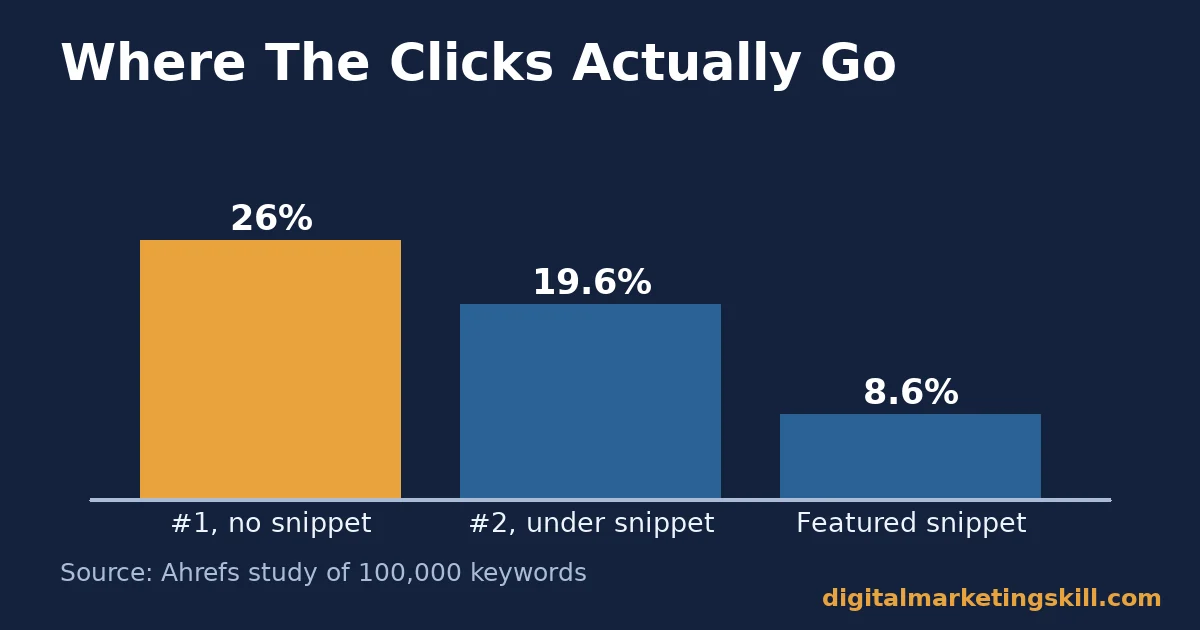
Featured snippets make this worse for the ranking just below them. An Ahrefs study of 100,000 keywords found the featured snippet position captures only about 8.6% of clicks. A plain number-one ranking, with no snippet above it, captures around 26%.
The number-two position, sitting right under a snippet, is left with roughly 19.6%. A keyword strategy that only tracks rank, and not which result type occupies the top of the page, will misread why traffic moved.
The Long-Tail Reality Most Plans Ignore
Search volume tools make it tempting to chase a handful of big, round-number keywords. But Ahrefs’ own keyword database shows roughly 93% of US keywords get fewer than 10 searches a month. About 15% of daily Google searches have never been searched before at all.
A keyword strategy that only targets high-volume terms is ignoring most of real search behaviour. Long-tail terms, added together, often outweigh the handful of head terms in total traffic.
They usually convert better too, because a long, specific phrase tells you far more about what the searcher wants than a short, generic one does. Someone searching a three-word category term could want almost anything in that space.
Someone searching an eight-word phrase with a specific brand, feature and city has already narrowed the field considerably. A page built for exactly that phrase has a much easier job satisfying them.
This is also why a keyword strategy built entirely around a handful of head terms plateaus so quickly. Once you rank for the obvious terms, the next gains almost always come from covering more of the long tail, not from pushing harder on the same few keywords.
What Differs By Search Intent In A Keyword Strategy
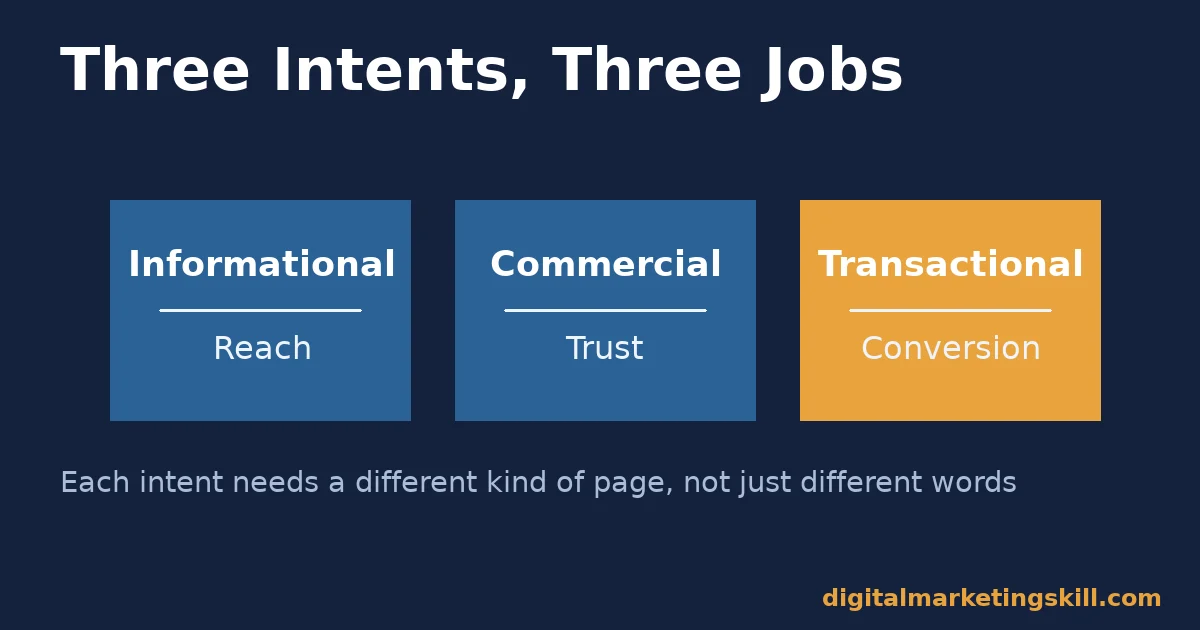
Keywords split into three broad intents. Each one needs a different kind of page, not just different words.
Informational Keywords: Built For Top-Of-Funnel Reach
These are “what is,” “how to” and “why” searches. The searcher wants an answer, not a sale. Ranking here builds reach and trust, even though the immediate conversion rate is usually low.
Treat the low conversion rate as expected, not as a failure. The return on an informational page often shows up later, in branded search or a direct return visit, rather than in the first session. Track that delayed return where you can, rather than writing off an informational page because its own conversion number looks weak in isolation.
Commercial Keywords: Built For Comparison And Trust
These include “best,” “vs” and “review” searches. The searcher already knows the category and is comparing options. They are close to a decision but not ready to buy yet.
A page targeting this intent should assume the visitor has already seen at least one competitor. Ignoring that context, and writing as if this were the searcher’s first introduction to the category, wastes the specific advantage a commercial keyword offers.
Naming competitors directly, where it is accurate and fair, usually builds more trust than avoiding the comparison the searcher came to make. Visitors can tell when a review is really just a sales page wearing a different label, and that recognition costs more trust than an honest, specific comparison ever would.
Transactional Keywords: Built For Immediate Conversion
These include “buy,” “price,” “near me” and brand-plus-product searches. The searcher has decided what they want. They are choosing where to get it. Conversion rate matters far more than raw traffic here.
A Fourth Category Worth Naming: Navigational
Some searches are neither informational, commercial nor transactional in the classic sense. A searcher typing a brand name directly, or a specific page title, already knows exactly where they want to go. These navigational searches usually need no keyword strategy at all beyond making sure the right page is indexed and easy to find; they are not where a keyword strategy’s effort should go.
Most Sites Need All Three, In Proportion
A keyword strategy that only targets transactional terms misses the searchers who are not ready yet, and loses the compounding reach that informational content builds over time. One that only targets informational terms builds an audience that never converts.
A reasonable starting split for many small and mid-sized sites is roughly half informational content, a third commercial, and the rest transactional. Adjust that split to match the actual shape of your market’s search behaviour rather than copying it as a fixed rule.
How To Lead With The Right Page For Each Intent
Matching a page to intent is the single highest-leverage move in a keyword strategy. It beats chasing extra search volume almost every time.
Informational Keywords: Lead With Depth And Clarity
Answer the question fully and plainly, high in the page. A searcher who gets a clear answer fast is more likely to trust the site later, even if they do not buy today.
Resist the urge to delay the answer for the sake of word count. A page that makes a searcher scroll past three paragraphs of preamble to find the actual answer loses trust before it has a chance to build any. Our guide to content marketing strategy covers how to plan this kind of top-of-funnel content at scale.
Commercial Keywords: Lead With Comparison And Proof
Give the searcher what they came for: a direct comparison, named criteria, and evidence. Not a sales pitch dressed up as a review. A page that avoids the comparison the searcher is actively doing loses them to a competitor who did not avoid it.
Transactional Keywords: Lead With A Friction-Free Path To Action
Remove every unnecessary step between arrival and the action. A transactional searcher has already decided. A page that buries the next step in extra content is working against its own keyword strategy, not with it.
This does not mean strip the page of all information. It means put the action within easy reach from the first screen. Supporting detail can live below it, for the smaller group of visitors who still want to double-check before acting. Our landing page optimization checklist covers this in more depth.
Measuring A Keyword Strategy: KPIs And How To Read Them
Rankings alone do not tell you if a keyword strategy is working. Track these instead.
The Four KPIs To Track
Pull these straight from your own search console data. Google’s own documentation defines impressions as how often a link was seen on Google. Clicks are how often someone followed that link to your site. CTR is clicks divided by impressions.
- Organic click-through rate by query — clicks divided by impressions for a specific keyword. A low CTR on a well-ranked page often signals an intent mismatch, or growing zero-click competition from AI answers.
- Conversion rate by landing page — completions divided by organic visitors, grouped by the intent type the page targets. Transactional pages should convert far higher than informational ones; comparing them directly misreads the data.
- Query-to-page match rate — the share of your top queries whose top-ranking page actually matches that query’s intent. A high-traffic informational query ranking on a product page usually signals a mapping problem, not a content problem.
- Long-tail share of traffic — the percentage of organic visits coming from queries outside your top 20 tracked keywords. A healthy keyword strategy usually shows this growing over time as content depth increases.
Read Rank And Conversion Together, Not Separately
A page can rank first and still fail a keyword strategy if the intent is wrong. Read ranking position next to conversion rate for that same page. Never judge one of those numbers in isolation.
Review all four KPIs on the same schedule, not piecemeal. A keyword strategy that looks healthy on clicks alone can still be quietly losing revenue if the query-to-page match rate is slipping underneath it.
Build a simple quarterly habit around this. Pull the four numbers for your top 20 pages by traffic. Flag anything where conversion rate does not match the page’s intended intent type, and fix the mapping before writing any new content. Fixing an existing mismatch is usually faster than producing a new page from scratch.
The One Decision Rule Behind Every Keyword Strategy
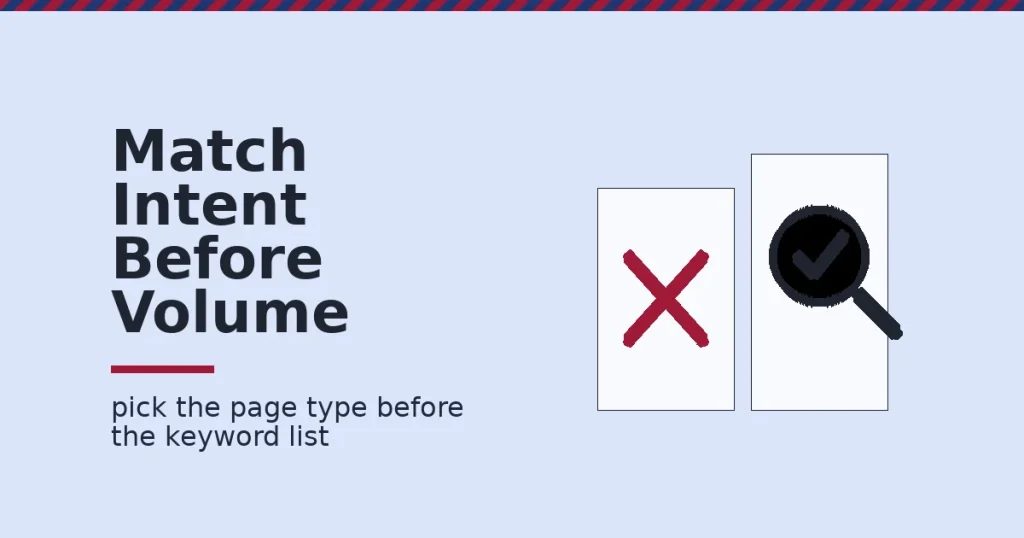
Match intent to page type before you look at search volume at all. A high-volume keyword with the wrong page type will underperform a lower-volume keyword matched correctly. The mismatch caps conversion no matter how much traffic arrives.
This rule holds even when the numbers look tempting in the other direction. A head term with ten times the search volume of a long-tail alternative can still produce fewer conversions overall, once the intent mismatch is factored in. Volume is an input to the decision, not the decision itself.
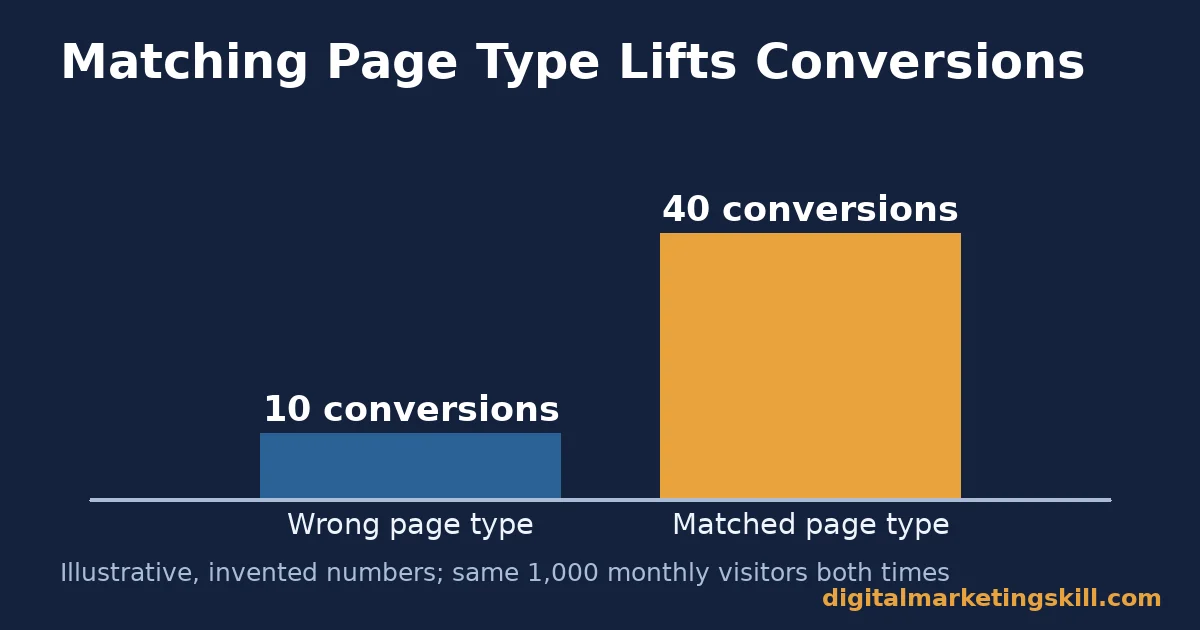
Illustrative, invented numbers to show the scale: a transactional page gets 1,000 monthly visitors at a 1% conversion rate because it was built as an informational article. That is 10 conversions.
Rebuilt to match transactional intent, with a direct path to action, the same traffic at a realistic 4% conversion rate would produce roughly 40 conversions. The page type change, not extra traffic, accounts for that gap.
A Real Case: Matching Content To What People Actually Search
Digital Marketing Skill Institute student Abimbola Fafiolu’s story, published on the Institute’s reviews page, makes the same point in plain terms. Fafiolu described being “able to use the skill to build a functioning website that rank in google,” naming the SEO module specifically as the most valuable part of the training.
Ranking is the visible result. The underlying skill is matching content to what a real searcher is actually looking for, which is the core of any working keyword strategy.
This is one published account of one student’s experience, not a guaranteed outcome for every site or niche. Results depend on the competitiveness of the niche and the quality of the content built around the keyword plan.
The lesson generalises beyond any one student or site. A keyword strategy is only as useful as the match between what it targets and what a visitor actually does once they arrive. Ranking without that match is a hollow win.
Frequently Asked Questions About Keyword Strategy
What is a keyword strategy?
A plan for which search terms to target, matched to the intent behind each one and the type of page built to answer it. A keyword list without intent matching is not yet a strategy.
Should I prioritise high search volume keywords?
Not by themselves. Roughly 93% of keywords get fewer than 10 searches a month. A strategy built only around high-volume terms ignores most real search behaviour, and usually converts worse than a well-targeted long-tail approach.
Why do some ranked pages get almost no clicks?
Zero-click results are growing fast. More than two in three US Google searches now end without a click. AI-generated answers and featured snippets now satisfy many searches before a visitor reaches any website, even one ranking first.
How do I know if a keyword matches my page’s intent?
Search the term yourself and look at what ranks for it today. If the top results are mostly guides, your page needs to inform. If they are mostly product or comparison pages, your page needs to sell or compare, not just explain.
Does a keyword strategy need to use the exact search phrase?
No. Google’s own guidance states its language systems can understand a page’s relevance to many queries even without exact keyword matches. Write naturally for the reader rather than repeating a phrase mechanically.
How often should a keyword strategy be reviewed?
Whenever search behaviour or your own conversion data shifts meaningfully, rather than on a fixed schedule. A quarterly check of the four KPIs above will usually catch an intent mismatch before it costs much traffic.
What is the biggest mistake in building a keyword strategy?
Choosing the keyword list before deciding what each page is for. Pick the intent and page type first. Then find the keywords that match it, not the other way round.
Can one page target more than one intent?
Rarely well. A page trying to inform, compare and sell all at once usually does all three badly, because each intent needs a different structure. It is better to build separate pages linked together than to force one page to serve every stage of the decision.
What is the difference between a keyword strategy and SEO in general?
A keyword strategy is one input into a wider SEO effort, not the whole of it. SEO also covers technical factors like site speed and crawlability, and off-site factors like backlinks. None of those fix a keyword strategy that targets the wrong intent, and a perfect keyword strategy cannot fully offset a technically broken site either; the two need to work together.
Do I need expensive tools to build a keyword strategy?
No. Google’s own free tools cover the core data most sites need. Search Console shows what you already rank for and what gets impressions but no clicks. The Keyword Planner inside Google Ads shows roughly how often a term is searched; our guide to using Google Keyword Planner walks through the setup. Paid tools add convenience and competitor data, which matter more as a site and its competition grow.
Should every piece of content target a new keyword?
No. Updating and re-mapping an existing page is often faster and cheaper than creating a new one, if that page already ranks for the keyword. It also avoids splitting your own authority across two competing pages for the same search.
How does a keyword strategy change for a brand-new site with no rankings yet?
Start with long-tail, lower-competition terms inside your core topic instead of competing for the broad head terms immediately. A new site rarely wins the most contested keywords early, and long-tail wins build the authority needed to compete for bigger terms later.
Turn This Into A Skill You Can Apply To Any Site
Matching intent to page type is one decision inside a much larger skill set: planning, building and measuring content that actually ranks and converts. Digital Marketing Skill Institute’s Master Diploma in Digital & AI Marketing is built around that kind of practical, execution-first training.
It offers four AI-powered tracks: AI-Powered WordPress and SEO Specialist, AI-Powered Social Media Management and Advertising, AI-Powered Lead Generation and Email Automation, and AI-Powered Google Specialist. Together they total ten courses, with a Full Stack option for completing all four. See the curriculum at digitalmarketingskill.com.
Every track includes unlimited 1-on-1 coaching and mentoring, plus a U.S. Project Internship with a verified U.S. Work Reference Letter. The program is dual US and UK accredited, recognised in more than 100 countries, and 100% online, so you can study wherever in your country you happen to be.
See the full program details on the Master Diploma page. Browse more guides on the blog, and when you are ready, apply here. Learn more at digitalmarketingskill.com.
Every figure in this guide was checked against its original source before publication. Figures marked as illustrative are invented examples, not real results.