
SEO for small businesses works best as three priorities, not twenty tasks. Ahrefs studied about 14 billion pages and found 96.55% get zero traffic from Google. Most of that traffic loss traces back to picking the wrong keywords, a slow site, or content too thin to rank. This guide to SEO for small businesses shows where limited time and budget actually pay off.
Key Takeaways
- Most pages fail before they start. Ahrefs found 96.55% of about 14 billion pages studied get no Google traffic at all. The usual causes are no search demand, no backlinks, or a mismatch with what searchers actually want.
- Long-tail keywords are most of the opportunity. Ahrefs found keywords with fewer than 10 monthly searches make up almost 93% of its 2.3 billion-keyword US database. That is exactly where small businesses can compete.
- Site speed has a measurable payoff. Google’s own Core Web Vitals case studies found Vodafone Italy raised sales 8% after improving load speed. Nykaa gained 28% more organic traffic after a similar fix.
- Fewer channels, done well, beat many channels done poorly. Biziq’s small business marketing research found businesses that focus on two or three proven channels report better outcomes. Those spread across six or more do worse.
- Most searches never reach your website at all. SparkToro’s analysis of Google searches found 58.5% in the US and 59.7% in the EU ended with no click to any website. SEO competes for a shrinking slice of total searches as a result.
In this guide
- What Most Small Business SEO Checklists Miss
- Why Most Small Business Pages Never Rank
- Three Places SEO for Small Businesses Should Spend Limited Budget
- How to Act on Each Priority
- A Four-Week Plan for SEO for Small Businesses
- SEO for Small Businesses Works the Same Way Everywhere
- How to Measure Whether It Is Working
- The One Rule: Fix the Leak Before You Add More Traffic
- Real Cases: What Site Speed Actually Changed
- How Much SEO for Small Businesses Actually Costs
- Frequently Asked Questions About SEO for Small Businesses
- Fix the Leak, Then Build the Habit
What Most Small Business SEO Checklists Miss
Most SEO for small businesses content is a checklist. Fix your titles, write a blog, build backlinks, get listed everywhere. None of it is wrong. None of it says which task to do first with three hours a week and no budget for an agency.
This guide ranks that trade-off directly. Every figure comes from Ahrefs, Google, SparkToro or Biziq, each named with scope and sample size where it is public. Treat the numbers as a snapshot, not a permanent ranking, since competitive search results shift constantly.
Why Most Small Business Pages Never Rank
A page needs three things to earn traffic. It needs real search demand for its topic. It needs enough backlinks to be trusted, and content that matches what the searcher actually wants. Ahrefs’ study of 14 billion pages found most failures trace back to one of those three, not to some secret ranking factor.
Small businesses usually get the demand step wrong first. They write about what they want to say, not what people search for. A beautifully written page about a topic nobody searches for will never rank. No amount of on-page polish creates search demand that was never there, however good the SEO underneath it is.
The fix is not more effort, then. It is picking a different, winnable keyword before you write a single word, since the keyword decides the ceiling before the writing even starts.
Three Places SEO for Small Businesses Should Spend Limited Budget
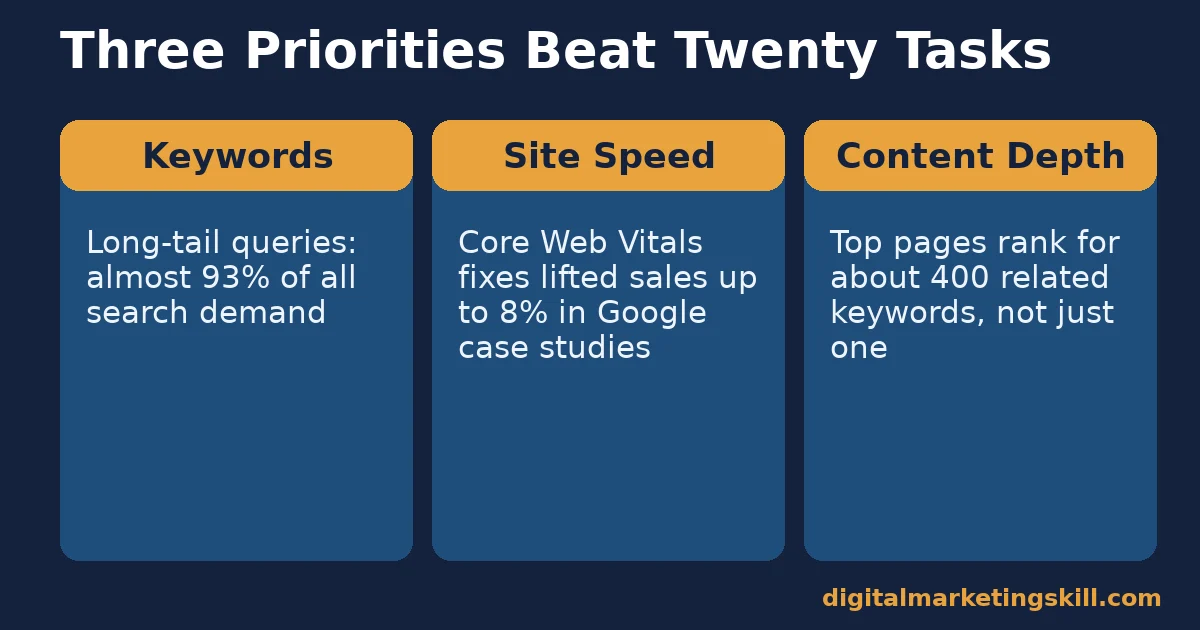
Three areas return the most for the time a small business can realistically spend. Everything else is secondary until these three are solid, because stacking tactics on a weak foundation rarely compounds the way a solid base does.
Keyword Selection: Built for Where Competition Is Thin
Big brands dominate short, high-volume keywords. Small businesses win on specific, lower-volume ones instead. Ahrefs found keywords under 10 monthly searches make up almost 93% of its US keyword database. Most real search demand lives in queries too small for large competitors to bother targeting individually. A quick SEO competitor analysis on your top keyword shows whether that gap is real for your market.
Site Speed: Built for Keeping the Visitor You Already Earned
A slow site loses visitors a ranking already won. Google’s own Core Web Vitals case studies show this is not theoretical: Redbus cut load and interaction delays and saw mobile conversion rise 80 to 100%, while AliExpress cut layout shift and load time and saw bounce rate fall about 15%.
Content Depth: Built for Owning a Topic, Not One Page
Ahrefs’ study of ranking pages found the average page ranking first for one keyword also ranks in the top 10 for nearly 1,000 other related keywords. The median is around 400. One well-built page rarely earns traffic alone. It earns traffic by covering a topic thoroughly enough to rank for hundreds of related searches at once.
How to Act on Each Priority
Each priority above has one starting action that matters more than the rest of the checklist.
Keyword Selection: Write Down Ten Things Customers Actually Ask
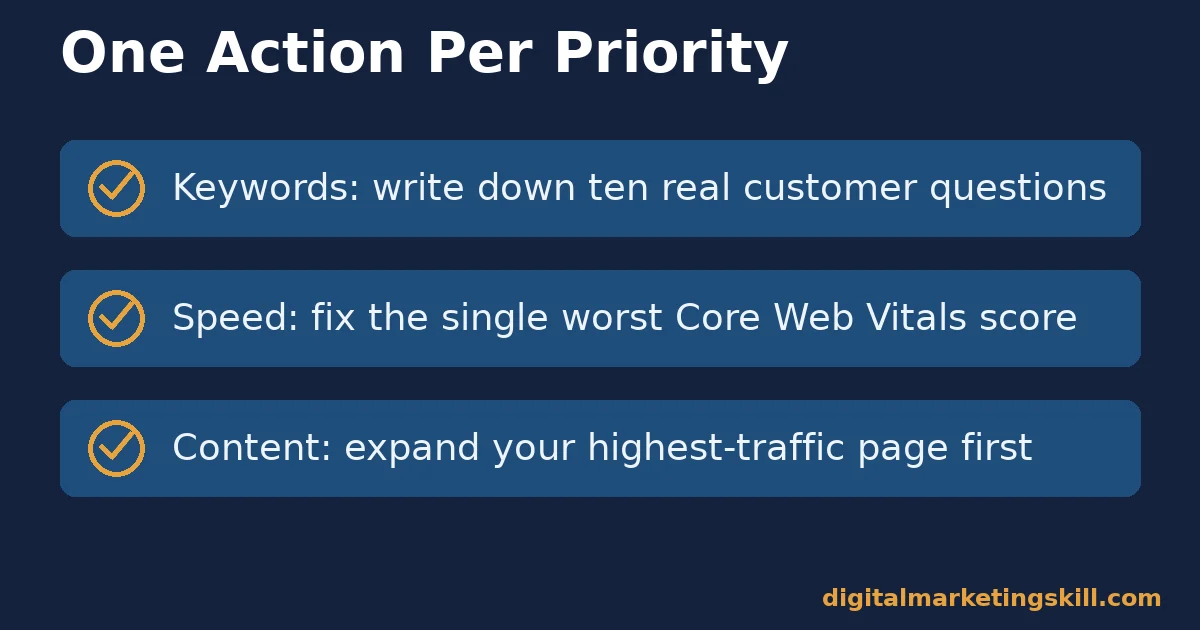
Before opening any keyword tool, write down the ten questions customers ask most often in calls, emails or in person. Turn each into a page or section. These questions are already proven demand, even before you check search volume.
This method works because it starts from real evidence, not guesswork. A keyword tool can tell you how often a phrase is searched. It cannot tell you whether it actually matters to your specific customers the way a repeated real question already does.
Site Speed: Test One Page, Fix the Worst Problem First
Run your homepage and your most important service page through a free Core Web Vitals checker. Fix the single worst score first, usually an oversized image or a slow-loading script, rather than trying to fix everything at once.
Most small business sites have one or two obvious culprits behind a slow load time. Common causes include an uncompressed hero image, a heavy page builder script, or a video that autoplays on every visit. Fixing that one thing is usually faster than it sounds, and often needs no developer at all.
Content Depth: Expand Your Best Page Before Writing a New One
Find your single highest-traffic page in Google Search Console. Add the sections, questions and detail it is still missing before starting a new page from scratch. Expanding a page that already ranks is usually faster than building authority from zero.
Look for related questions the page does not answer yet, using the same questions-from-customers method as the keyword step. Each new section is a small bet on an already-proven page, which carries far less risk than a page starting with no history at all.
A Four-Week Plan for SEO for Small Businesses
You do not need a big budget to start. This plan uses about an hour a week and mostly free tools.
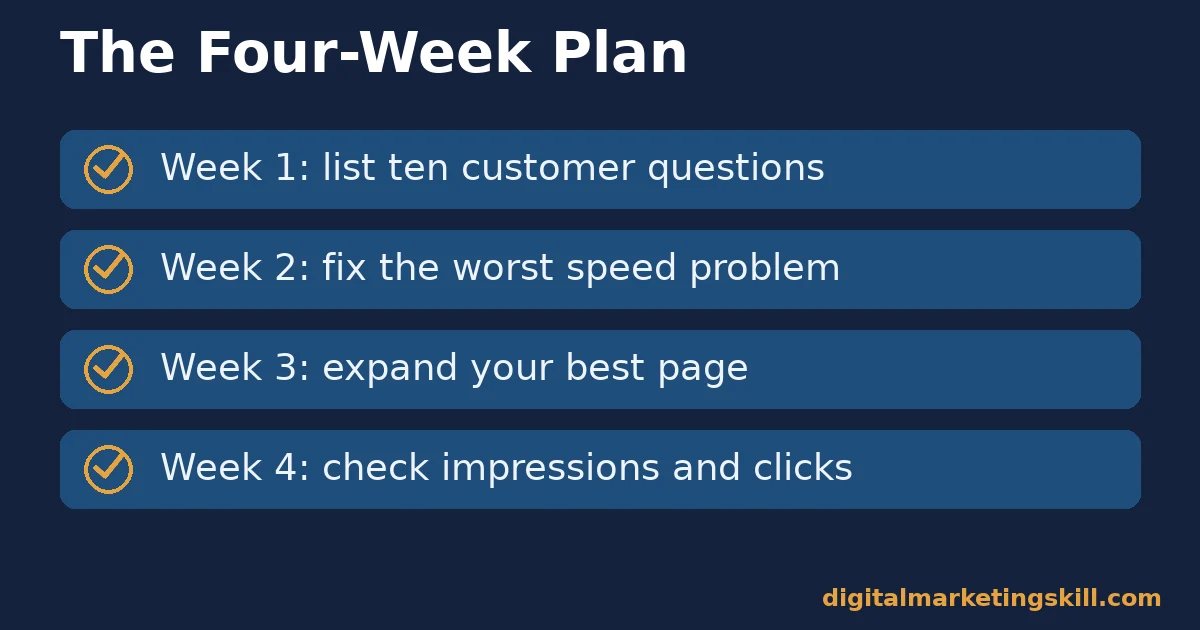
- Week one: list ten customer questions. Write down the ten questions customers ask most. Check which ones already have a page on your site.
- Week two: fix the worst speed problem. Run your two most important pages through a speed checker. Fix the single worst issue it finds.
- Week three: expand your best page. Find your highest-traffic page in Search Console. Add the missing sections and detail.
- Week four: check impressions and clicks. Review which queries are showing your pages. Note which ones need a better title or description.
At the end of the month, compare impressions, clicks and average position with the month before. Repeat the plan with a new page or a new speed fix each month after that.
SEO for Small Businesses Works the Same Way Everywhere
Every mechanism in this guide comes from Google’s own global ranking systems and from Ahrefs’ worldwide index: search demand, backlinks, content match and page speed. None of it is specific to one country or one language.
What changes locally is competition. A small business in a crowded market faces more competitors chasing the same long-tail keywords, so differentiation matters more there. A small business in a smaller market often finds real search demand with almost no competition at all, because fewer local sites are targeting it. Either way, the same three priorities for SEO for small businesses apply, wherever the business operates.
How to Measure Whether It Is Working
Small business SEO has a short list of metrics that actually matter, tracked in free tools.
- Search impressions by query. In Google Search Console, track which queries show your pages at all. Rising impressions on new topics mean Google is starting to understand what the page covers.
- Average position for target queries. Track whether your priority keywords are moving up, not just whether traffic is rising. Position often moves before traffic does.
- Click-through rate by query. A query with many impressions but few clicks usually means a weak title or description, not a ranking problem.
- Core Web Vitals pass rate. In Search Console’s Core Web Vitals report, track the share of pages passing. A falling pass rate often explains a traffic plateau that content alone cannot fix.
- Pages earning at least one click. Track what share of your published pages earn any organic click in a given month. A low share means you are publishing pages aimed at demand that does not exist.
Reading the Numbers Together
Read these together. Rising impressions with a falling click-through rate points to a title and description problem. Rising clicks with a falling Core Web Vitals pass rate points to a technical problem eating into the SEO gains you already earned.
A flat position with rising impressions often means the content is relevant but not yet trusted enough, which usually points back to backlinks rather than more writing. Check these signals monthly, not daily, since small business traffic is often too low in volume for daily swings to mean anything.
The One Rule: Fix the Leak Before You Add More Traffic
If you can only fix one thing in SEO for small businesses, fix whichever priority is actively losing you ground, not whichever one is easiest. A slow site that drives visitors away is a leak. Pouring more content into a leaking system wastes the content.
Illustrative, invented example: a small business publishes two blog posts a month but its site takes six seconds to load on mobile. Fixing the load time first, before publishing anything new, usually recovers more traffic than the next ten blog posts combined, because every existing page benefits at once. This is a reasoning example, not a documented case.
The same logic applies to keyword selection. A business chasing one broad, competitive keyword for months while ignoring twenty winnable long-tail questions is choosing the slower, harder path by habit, not by evidence.
Real Cases: What Site Speed Actually Changed
Google’s web.dev team published several company case studies on Core Web Vitals. Vodafone Italy improved its largest content paint time and saw an 8% rise in sales. Tokopedia improved the same metric by 55% and saw a 23% increase in average session duration.
Cdiscount improved all three Core Web Vitals metrics together and reported a 6% revenue uplift, while Flipkart’s Core Web Vitals work lowered its bounce rate by 2.6%. None of these businesses are small, but the mechanism they tested, faster pages keep more visitors, applies at any size.
A small business site usually has far less code and far fewer moving parts than any of these companies, which often means the same class of fix is quicker to find and cheaper to apply. The scale of the result will differ, but the direction will not.
How Much SEO for Small Businesses Actually Costs
The cost of SEO for small businesses depends on whether you trade time or cash. It can run on close to no cash and real time, or real cash and less time. Google Search Console and most Core Web Vitals checkers are free. Keyword research can start with the ten-questions method above before you ever pay for a tool.
When you do need outside help, Upwork’s own hiring page lists a median marketplace rate of $35 an hour for marketing consultants, with a typical range of $20 to $60. That is a useful anchor for pricing a few hours of focused technical or keyword work, rather than an open-ended retainer.
A fixed-scope project, such as a one-time speed audit or a batch of keyword research, usually costs less and delivers a clearer result than an ongoing monthly contract with no defined deliverable. Ask any contractor exactly what you will receive and by when, before agreeing to anything open-ended.
Frequently Asked Questions About SEO for Small Businesses
What is SEO for small businesses?
SEO for small businesses is the practice of improving a website so it ranks for searches its potential customers actually make. It uses the same core mechanics as any SEO. The difference is priority: limited time and budget, not an even spread across every possible task.
Why do most small business web pages get no traffic?
Ahrefs’ study of about 14 billion pages found 96.55% get zero Google traffic. The usual causes are a keyword with no real demand, missing backlinks, or content that does not match what the searcher wants, rather than any single technical mistake.
Should a small business target high-volume or long-tail keywords?
Long-tail keywords generally pay off faster. Ahrefs found keywords under 10 monthly searches make up almost 93% of its US keyword database, and competition for those specific queries is far lower than for broad, high-volume terms.
Does page speed really affect SEO results?
Yes. Google’s own Core Web Vitals case studies recorded real revenue and traffic changes from speed fixes alone, including an 80 to 100% mobile conversion increase at Redbus and a 28% organic traffic increase at Nykaa after Core Web Vitals improvements.
How much does SEO for small businesses cost?
It can cost very little if you do the keyword and content work yourself using free tools like Google Search Console. Outside help on a marketplace like Upwork has a median rate of $35 an hour, typically $20 to $60, which is enough for focused technical or keyword projects without a full retainer.
How many marketing channels should a small business focus on?
Biziq’s small business marketing research found businesses that concentrate on two or three proven channels report better outcomes than those spread across six or more. SEO is usually better paired with one or two other channels than run alongside everything at once. Adding a fourth or fifth channel before the first two are working well tends to dilute attention rather than add growth.
How long does small business SEO take to show results?
There is no fixed timeline. Fixing an existing, already-ranking page tends to show results faster than building a new page from zero, because the page already has some demand and trust signals in place. A brand-new page targeting a competitive keyword can take months to show any movement at all, while a well-targeted long-tail page can earn its first clicks within weeks.
Is SEO still worth it if most searches end without a click?
Yes, because SparkToro’s research found roughly 360 to 374 clicks still reach the open web for every 1,000 Google searches. That is a smaller slice than a decade ago, but still real, recurring traffic that costs nothing per click once a page ranks. For a small business with a tight budget, free, recurring traffic is still worth far more per visitor than most paid alternatives.
Fix the Leak, Then Build the Habit
Pick the one priority from this guide furthest behind: keyword selection, site speed or content depth. Fix it this week, measure the change for a month, then move to the next one. That simple cycle is the whole practice of SEO for small businesses, repeated until every priority is solid.
Digital Marketing Skill Institute’s Master Diploma in Digital & AI Marketing includes AI-powered search engine optimisation and content marketing among its ten practical, AI-powered courses.
Students get unlimited one-on-one mentoring and real project work inside a US partner company from day one. The diploma is dual accredited in the US and UK and recognised in more than 100 countries, delivered 100% online, so you can build these skills anywhere in your country.
Where to Go Next
See the full curriculum on the Master Diploma program page, read outcomes on the reviews page, or browse more guides on the blog. Go straight to the application page to start, or learn more at digitalmarketingskill.com.
For related reading: see our on-page SEO checklist for the technical fundamentals, what actually moves rankings in local SEO if you serve a specific area, the best keyword research tools for the ten-questions method, and what the data says about website SEO optimisation more broadly. Whatever you fix first, start at digitalmarketingskill.com.
Every figure in this guide was checked against its original source before publication. Figures marked as illustrative are invented examples, not real results.
