
To build backlinks that actually help a site rank, chase links from sites that already cover your topic. Skip the big raw count. Ahrefs found referring domains track top-20 rankings more closely than almost any other link metric it checked. A handful of relevant links can beat a pile of weak ones.
Key Takeaways
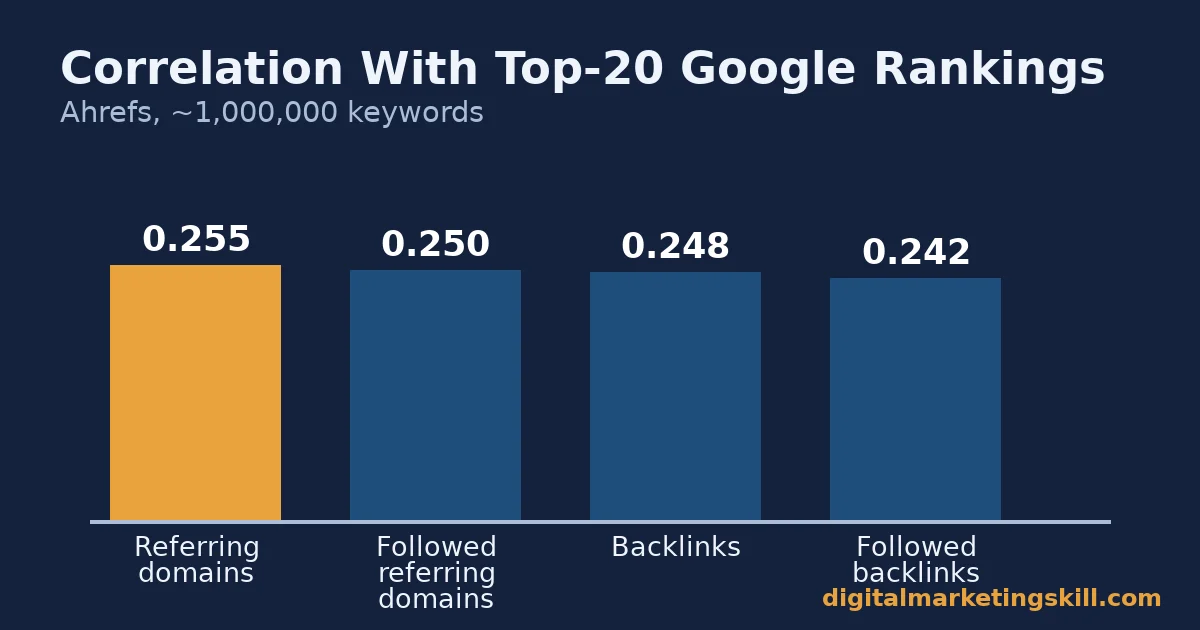
- Relevant links outrank raw numbers. Across roughly 1,000,000 keywords, Ahrefs found the number of referring domains tracks top-20 Google rankings more closely than most other link metrics it measured.
- Zero referring domains almost always means zero real traffic. Ahrefs found about 20 million indexed pages with no referring domains at all, and only 2,997 of them get more than 1,000 search visits a month.
- Most pages never get found anyway. Ahrefs studied about 14 billion pages and found 96.55% get no traffic from Google, so you still need topics people search for.
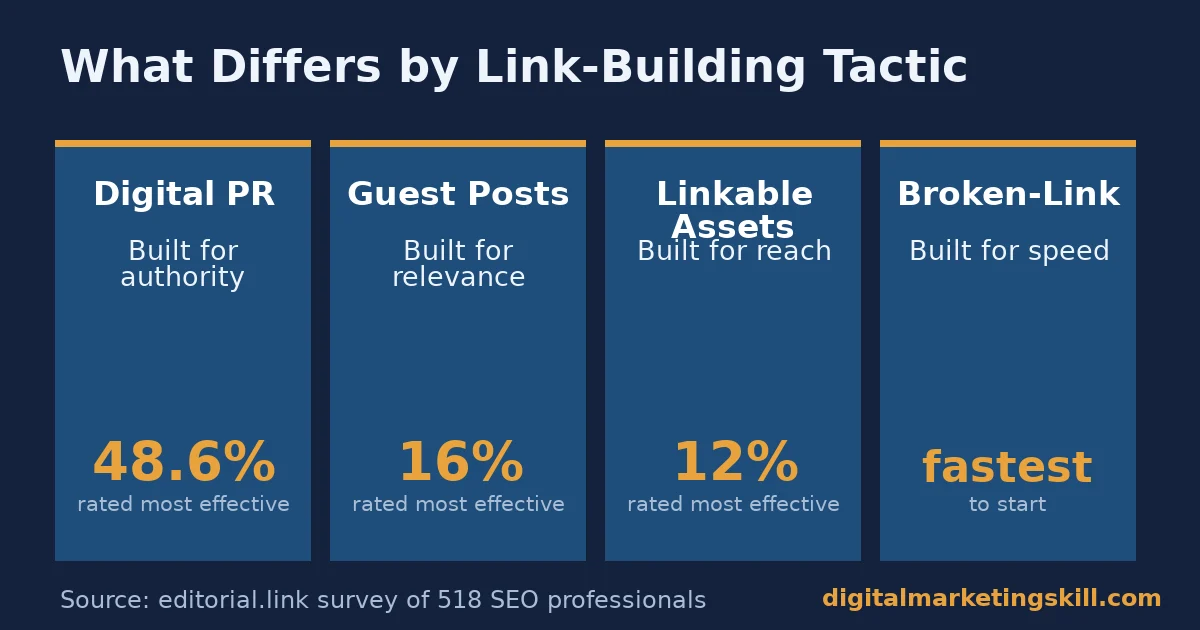
- Digital PR beats guest posting and linkable assets. In a survey of 518 SEO professionals by editorial.link, 48.6% rated digital PR the most effective link-building tactic, ahead of guest posting (16%) and linkable assets (12%).
- Cold outreach rarely gets a reply. Backlinko’s analysis of 12 million outreach emails, run with Pitchbox, found only 8.5% receive any response at all.
In this guide
- What Most Advice on How to Build Backlinks Gets Wrong
- How Backlinks Actually Work
- What Differs by Link-Building Tactic
- How to Build Backlinks With Each Tactic
- Measuring Backlink Progress
- The One Rule: Match the Tactic to the Link You Actually Need
- A Real Case: How Ahrefs Earned Links With a Stats Page
- Frequently Asked Questions About Building Backlinks
- Keep Building Skills, Not Just Links
What Most Advice on How to Build Backlinks Gets Wrong
Most articles on how to build backlinks hand you a list. Guest post here. Submit to a directory there. Leave comments everywhere. The list is not wrong. But it skips the part that decides whether any of it works: whether the link comes from a site your topic already belongs on.
This guide ranks tactics by what the data shows about relevance and effort, not by list length. The numbers below come from named, dated studies, including Ahrefs’ 1,000,000-keyword correlation study. Treat the correlation data as evidence of a pattern, not proof that one link caused one ranking.
Treat the survey figures as self-reported opinion from working SEOs, a useful signal rather than a lab result. Every figure is a snapshot of one study at one point, not a permanent scoreboard. Building backlinks also sits inside a wider set of common SEO mistakes worth ruling out first. A technically broken site wastes every link you earn.
Another reason people give up on link building too soon: they measure results after one outreach round, not after several months. Building backlinks is closer to compounding interest than a single transaction. A handful of relevant links earned this month can keep sending referral traffic and ranking signal for years, long after the outreach email is forgotten. Judge the work in quarters, not days.
How Backlinks Actually Work
A backlink is a link from another website to yours. Search engines read backlinks as a vote of confidence. If other sites point to a page, that page is probably worth showing to searchers. The vote does not count evenly, though. A link from a site that already ranks well for your topic carries more weight than ten links from unrelated, low-quality pages.
Ahrefs found roughly 20 million indexed pages with no referring domains at all. Only 2,997 of them get more than 1,000 search visits a month, in its search traffic study. That gap is what a backlink strategy exists to close. It is one of several off-page signals covered in a broader look at search engine optimization.
What Makes a Backlink Count
Three things decide how much a backlink helps: the authority of the linking site, how closely its topic matches yours, and whether the link passes ranking credit at all.
A link marked rel="nofollow" or rel="sponsored" tells search engines not to pass ranking credit. That is by design, under Google’s own spam policies. Those links can still send readers your way. They just will not move rankings the way a followed link does.
Google’s spam policies name exactly what to avoid: buying or selling links for ranking purposes, large-scale link exchanges, and automated link schemes. All three count as violations, marked or not. Read that policy once. It will save you from several tactics this guide deliberately leaves out.
Why Chasing Link Count Alone Fails
It is tempting to treat link building like a counting game: more links, better rankings. Ahrefs’ brand-visibility research looked at 75,000 brands and found something that complicates that idea. For showing up in AI-generated answers, Ahrefs found unlinked brand mentions correlate with visibility far more strongly (0.664) than raw backlink counts (0.218) in its brand visibility study.
That does not mean backlinks stopped mattering for classic search rankings. The correlation with referring domains there is still real. It means a mention of your brand, even without a link, does more work than most people assume. A strategy built only around link counts already misses half the picture.
What Differs by Link-Building Tactic
Not every way to build backlinks fits every site or every goal. The four tactics below differ in what they are built for: authority, relevance, speed, or compounding reach. Picking the wrong one for your situation is the most common reason link building stalls.
Digital PR: Built for Authority
Digital PR means pitching original research, data, or a newsworthy angle to journalists, in the hope they cover it and link to the source. In an editorial.link survey of 518 SEO professionals, 48.6% rated digital PR the single most effective link-building tactic, well ahead of guest posting at 16% and linkable-asset creation at 12%.
Digital PR is built for authority. It tends to land links on large, well-known publications, the kind that are hard to reach any other way. The trade-off is that it usually needs a genuinely newsworthy hook, like original data or a timely angle. It does not work for every topic on demand.
Guest Posts: Built for Topical Relevance
Guest posting means writing an article for another site in your niche in exchange for a link, usually inside the body content or an author bio. It rated second in the editorial.link survey, at 16%, behind digital PR.
Guest posting is built for relevance. You choose the publication, so you can target sites that already cover your exact topic. The trade-off is scale: each guest post takes real writing time, and most quality sites accept only a few outside contributors. Before you pitch, run your draft through the same checks in a guide to optimizing a blog post for search engines. Editors reject drafts that read like filler.
Linkable Assets: Built for Compounding Reach
A linkable asset is a free tool, calculator, template, or data page built specifically so other sites want to cite it. It rated third in the editorial.link survey at 12%, behind digital PR and guest posting.
Linkable assets are built for compounding reach because one asset can earn links for years without new outreach each time. The trade-off is upfront effort: a calculator or data study takes more work to build than a single guest post, and it may take months before other sites start linking to it on their own.
Broken-Link Building: Built for Speed
Broken-link building means finding dead links on other sites and suggesting your content as the replacement. It is quick to start, since the tools for finding broken links, including several covered in a roundup of free SEO tools, are widely available. But the numbers temper expectations. Backlinko’s 12-million-email analysis found an overall 8.5% response rate for cold outreach, and broken-link pitches follow the same math.
Broken-link building is built for speed. You can send a pitch the same day you find the gap. The trade-off is volume: because replies are rare, this tactic works best as a background activity you run continuously, not a one-time push.
How to Build Backlinks With Each Tactic
Knowing what each tactic is built for only helps once you know how to run it. Here is the first move for each.
Digital PR: Lead With a Newsworthy Angle
Start by producing something journalists can cite without extra work. That means an original survey, an analysis of public data, or a clear, defensible number nobody else has published. Pitch it to a short list of relevant journalists with the number in the first line, not buried in an attachment. A strong angle beats a long press list.
Guest Posts: Lead With Topical Fit
Start by listing sites that already rank for your target keywords. That groundwork is the same as any keyword strategy. Then check whether each site accepts outside writers. Pitch a specific headline, not a vague topic area, and make it one the editor could not easily assign to someone already on staff. Topical fit matters more than audience size.
Linkable Assets: Lead With One Real Use Case
Start small. Build one tool, template, or chart that solves one specific problem well, rather than a bloated resource that tries to do everything. Publish it, then tell a short list of sites that already link to similar tools that it exists. A narrow, genuinely useful asset earns more citations than a broad, generic one.
Broken-Link Building: Lead With Volume, Not One Email
Start by finding several broken links on resource pages in your niche, not just one. Send personalised pitches to all of them in parallel, since Backlinko’s data shows most will go unanswered. Follow up once. Treat a single reply as a win, because the response-rate math means most pitches will not land.
Anchor Text: What to Suggest When You Build Backlinks
Whenever you pitch a guest post or a resource link, you usually get to suggest the anchor text. That is the clickable words inside the link. Partial-match anchors use part of the target keyword naturally. The editorial.link survey of 518 SEO professionals found these are the top choice for 41.7% of respondents. Exact-match anchors came second at 25.1%. Branded anchors came third at 20.5%.
A simple rule follows from that data. Vary your anchor text across every link you build backlinks with. Lean on partial-match and branded phrasing most of the time. A page where every backlink uses the exact same anchor looks manufactured, to readers and search engines alike, even when each link was earned honestly.
Measuring Backlink Progress
Counting new links is not the same as measuring progress. When you build backlinks across several tactics at once, it becomes easy to lose track of what is actually working. A handful of indicators show whether your efforts are paying off.
Five Metrics That Show Real Progress
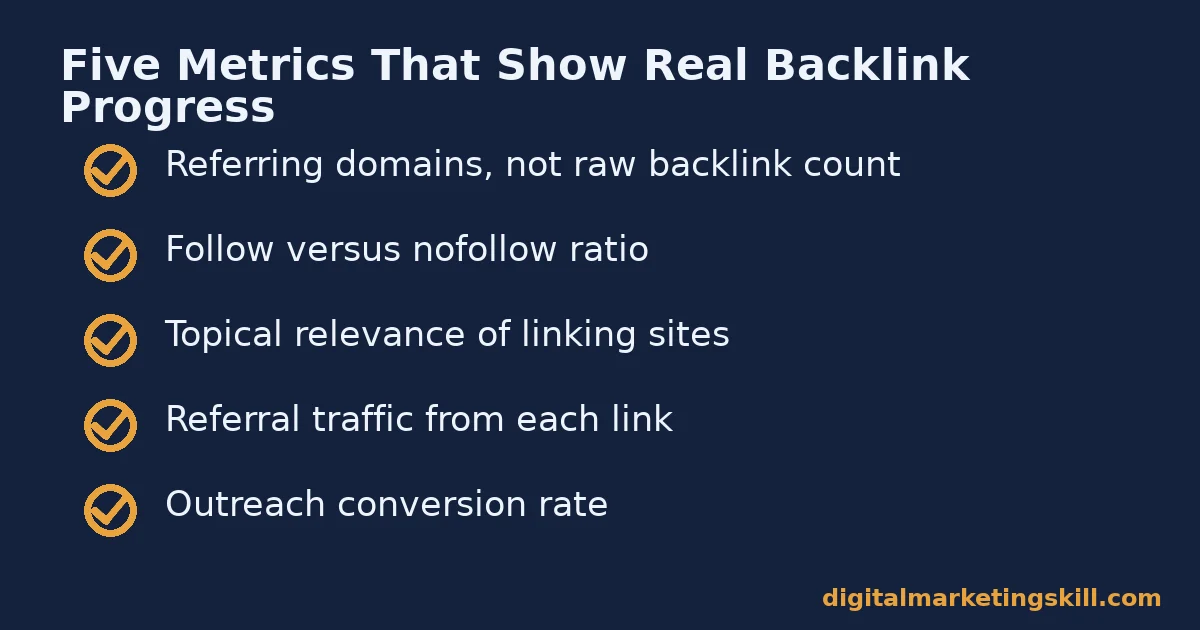
Referring domains. This counts unique websites linking to you, not total links. Ahrefs’ correlation data treats referring domains, not raw backlink count, as the stronger ranking signal. Watch this number first.
Follow versus nofollow ratio. This shows how many of your links can pass ranking credit at all. A page with many nofollow links can look impressive in a backlink tool while doing little for rankings.
Topical relevance of linking sites. This is a judgment call, not a single number. Does the linking site cover your subject, or is the link incidental? A smaller number of relevant links beats a larger number of unrelated ones.
Referral traffic from each link. This tracks visitors who click the link itself, separate from any ranking effect. A link that sends real readers is valuable even before it moves rankings.
Outreach conversion rate. This is backlinks earned divided by pitches sent. Backlinko’s benchmark of 8.5% overall response, and Ahrefs’ own case study conversion of 5.71%, give you a realistic range to compare your campaigns against, rather than guessing.
How to Read These Metrics Together
No single metric tells the whole story. A high referring-domain count with mostly nofollow links means less than it looks like. A low outreach conversion rate is normal, not a sign of failure, if the links you do land come from relevant, authoritative sites. Read the five together, over months, not after one outreach batch.
The One Rule: Match the Tactic to the Link You Actually Need
If you remember one rule from this guide, make it this: before you build backlinks, decide whether you need authority, relevance, speed, or compounding reach. Then pick the tactic built for that goal, instead of running every tactic at once.
As an illustrative, invented example: picture a small site that needs broad authority for a competitive keyword. It is better served by one strong digital PR placement than by ten unrelated directory links, even though the directory links are faster to get.
Now picture a site that already has authority but ranks for the wrong topics. It is better served by targeted guest posts on niche sites than by more PR, because its gap is relevance, not reach.
Here is how the math might play out, again as an illustrative, invented example. Say a team sends 100 broken-link pitches a month at an 8.5% reply rate, in line with Backlinko’s benchmark, and converts half of those replies into a live link. That is roughly four to five new links a month from one tactic alone.
Compare that with one digital PR placement that lands a single link on a major publication. The PR link may carry more authority than all five broken-link wins combined. That is exactly why matching the tactic to the goal matters more than running every tactic at full speed when you build backlinks.
A Real Case: How Ahrefs Earned Links With a Stats Page
Ahrefs published a case study of its own outreach campaign for a search-statistics page. The team sent 515 emails, of which 473 were delivered. They earned 36 backlinks from 32 unique websites. That is a 5.71% conversion rate from delivered emails to links, counting both direct responses and a handful of unsolicited links.
The page the campaign promoted now ranks first for “SEO stats.” Of the 32 linking sites, nine had a Domain Rating of 70 or higher, twelve sat in the 40 to 69 range, and eleven were lower.
Ahrefs itself noted a limit worth repeating: the team deliberately skipped automated follow-up emails. It estimated that following up could have lifted the conversion rate toward 11%. Treat this as one company’s campaign on one page, not a guaranteed formula, since results depend heavily on the strength of the content being pitched.
Frequently Asked Questions About Building Backlinks
How many backlinks do I need to rank?
There is no fixed number. Ahrefs’ 1,000,000-keyword study found referring domains correlate with top-20 rankings more than most other link metrics, but the exact count needed varies by keyword competitiveness. Focus on earning relevant links consistently rather than chasing a target count.
Are paid backlinks worth the risk?
Google’s own spam policies class buying or selling links for ranking purposes as a violation, whether or not the link carries a disclosure tag. Undisclosed paid links that pass ranking credit can lead to a manual penalty. The short-term gain rarely outweighs that risk.
Is guest posting still an effective way to build backlinks?
Yes, with limits. In the editorial.link survey of 518 SEO professionals, guest posting ranked as the second most effective tactic at 16%, behind digital PR. It works best when the publication already covers your exact topic, not as a volume play across unrelated sites.
What is the fastest way to build backlinks?
Broken-link building tends to move fastest, because the opportunities are easy to find. Speed does not mean a high success rate, though. Treat any outreach-based tactic as a numbers game: Backlinko’s research found an 8.5% average response rate across 12 million emails. Expect to contact many sites for each link earned.
Do internal links help the same way backlinks do?
Internal links do a different job. They spread authority between your own pages and help search engines and readers find related content. They cannot replace external votes of confidence from other websites. A strong page needs both earned backlinks and a clear internal linking structure.
How do I know if a backlink is hurting instead of helping?
Watch for links from sites with little topical relevance, a pattern of spammy outbound links, or low-quality content. Those are the exact red flags that 89.0% and 86.3% of SEO professionals in the editorial.link survey said they check before accepting a link placement. If a site you are considering fails those checks, skip it.
Can I build backlinks without any budget at all?
Yes. Broken-link building, guest posting on sites that take unpaid contributions, and building one small linkable asset all cost time rather than money. editorial.link’s survey found SEO professionals consider $508.95 an acceptable price for one high-quality paid placement, which is exactly why the free tactics matter if budget is tight.
Should I build backlinks to every page or just a few?
Focus on a few pages first. Pick the pages you most want to rank, usually your most useful guides or tools, and build backlinks to those before spreading effort across your whole site. Ahrefs’ correlation data applies page by page, not site-wide, so concentrated effort on fewer pages tends to beat thin effort spread everywhere.
Keep Building Skills, Not Just Links
Knowing how to build backlinks is one piece of a bigger skill set. If you want to learn SEO, digital PR outreach, and the other channels that drive traffic alongside it, the Master Diploma in Digital & AI Marketing at Digital Marketing Skill Institute can help.
It is built around four AI-powered tracks covering ten courses in total. One of those is the AI-Powered WordPress and SEO Specialist track, and a Full Stack option exists if you want all four. Every track includes unlimited 1-on-1 coaching and mentoring, plus a U.S. Project Internship with a verified U.S. Work Reference Letter.
The program carries dual US and UK accreditation. It is recognised in more than 100 countries and runs 100% online. You can study and practice how to build backlinks on real projects from anywhere in your country.
Explore the Master Diploma program, browse the digital marketing blog for more practical guides, or see real outcomes on the student reviews page before you apply, wherever you live. Learn more at Digital Marketing Skill Institute, and when you are ready, visit digitalmarketingskill.com to get started.
Every figure in this guide was checked against its original source before publication. Figures marked as illustrative are invented examples, not real results.
