
E-E-A-T stands for experience, expertise, authoritativeness and trustworthiness, the four qualities Google uses to describe helpful, reliable content. It comes from Google’s guidelines for its search quality raters, and Google says trust is the most important of the four. It matters because content that shows real experience and earns trust is the kind of content Google’s systems aim to reward, especially on topics that affect people’s money, health or safety.
Key Takeaways
- E-E-A-T means experience, expertise, authoritativeness and trustworthiness. Google added the first “E”, for experience, to the older E-A-T.
- Google says, “Of these aspects, trust is most important.”
- E-E-A-T is not a single ranking factor. Instead, Google uses a mix of signals that can identify content with these qualities.
- Quality raters use the guidelines to judge results, but Google says rater data “is not used directly in our ranking algorithms.”
- It carries the most weight on “Your Money or Your Life” (YMYL) topics, such as health, finance and safety.
What Is E-E-A-T?
Think of E-E-A-T as the questions a careful reader asks before trusting a page. Has the writer actually done this? Do they know the subject? Do others respect them? And can I rely on what they say?
Google explains the four parts in its guide to helpful content. It calls them “experience, expertise, authoritativeness, and trustworthiness, or what we call E-E-A-T.” Each one supports the others, although Google notes that content doesn’t need to show all of them.
For example, imagine two articles about a hiking boot. One comes from a writer who wore the boots on a long walk and shows photos. The other just repeats the product description. The first shows experience, so it is more helpful to someone deciding whether to buy.
How E-E-A-T Works
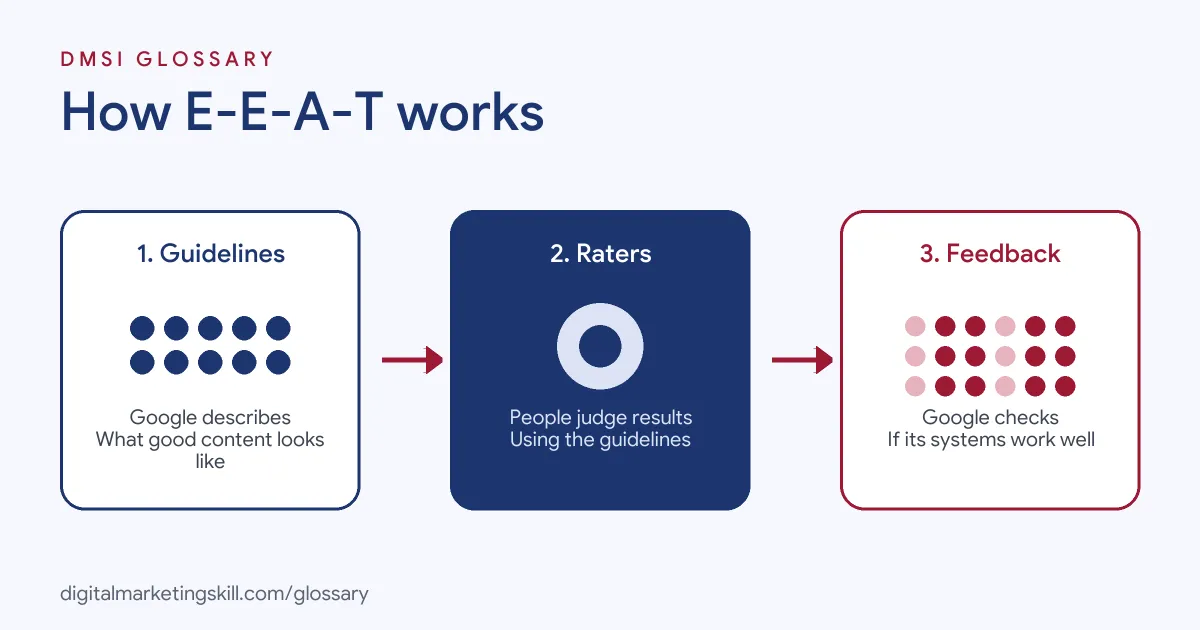
E-E-A-T works in three layers. First, Google’s guidelines describe what good content looks like. Next, human raters use those guidelines to judge sample results. Finally, Google uses that feedback to check whether its ranking systems are working well.
The Four Parts of E-E-A-T
- Experience: Google asks whether content was produced “with some degree of experience, such as with actual use of a product, having actually visited a place or communicating what a person experienced.”
- Expertise: the knowledge or skill of the creator. For instance, Google says that for tax returns you probably want “content produced by an expert in the field of accounting.”
- Authoritativeness: whether the creator or site is a known, respected source on the topic.
- Trustworthiness: whether the page is accurate, honest and safe. Google places trust at the centre.
The Role of Quality Raters
Google describes raters as people who give it feedback on whether its algorithms seem to produce good results. However, Google is clear that “Search raters have no control over how pages rank.” It also says the guidelines “don’t directly influence ranking.” Instead, they help Google check its systems and help creators assess their own content.
YMYL Topics
Some subjects carry more risk. Google says, “We call these ‘Your Money or Your Life’ topics, or YMYL for short.” These are topics that could significantly affect people’s health, financial stability or safety. On these pages, Google gives extra weight to content with strong E-E-A-T.
E-E-A-T and AI Content
Google does not ban AI-written content. Instead, it asks how and why you made it. For example, it suggests disclosing AI use where readers might wonder, “How was this created?” However, Google also says that using automation or AI mainly to manipulate rankings breaks its spam policies. So the safe path is simple: use AI as a helper, then add real experience, check every fact and put a named person behind the page.
E-E-A-T Examples
Here are three made-up examples of how a site can show these qualities:
- Health clinic (example): Each article names the doctor who reviewed it, lists their qualifications and links to medical sources.
- Travel blog (example): The writer shares original photos, routes and costs from a trip they actually took.
- Software review site (example): Reviewers explain how long they tested each tool and show screenshots of their own accounts.
In each case, the reader can see who made the content, how they made it and why they can be trusted. That is exactly what Google’s Who, How and Why questions ask for.
E-E-A-T Signals Compared
Here is a quick guide to what each part can look like on a real page:
| Part | The question it answers | How you can show it |
|---|---|---|
| Experience | Has the creator done this? | Original photos, test results and first-hand detail |
| Expertise | Does the creator know the subject? | Author bios, qualifications and accurate depth |
| Authoritativeness | Do others see them as a go-to source? | Mentions and links from respected sites |
| Trustworthiness | Can readers rely on the page? | Accurate facts, clear sources, contact details and a secure site |
In short, experience and expertise come from the creator, while authority and trust build up over time.
How to Improve E-E-A-T on Your Site
Google suggests thinking about “Who, How, and Why” for every page. Use these steps:
- Show who wrote it. Google asks, “Is it self-evident to your visitors who authored your content?” Add bylines and short author bios.
- Explain how you made it. For reviews, describe how you tested. If you used AI or automation, say so where readers would expect it.
- Check why you made it. Google says content should be made mainly to help people, not to attract search visits.
- Add first-hand detail. Include your own photos, data or results that others don’t have.
- Cite good sources. Link to the original research or official guidance behind your facts.
- Review YMYL pages closely. Ask an expert to check health, money or safety content.
- Keep pages accurate. Update facts when they change, rather than just changing the date.
Best Practices
- Use Google’s self-check. For example, Google asks, “Is this the sort of page you’d want to bookmark, share with a friend, or recommend?”
- Be honest about authors. Google warns that inventing authors, such as with AI headshots or false credentials, is deceptive.
- Focus on your main topic. A site with a clear purpose is easier to trust than one that covers everything.
- Make contact easy. An about page and clear contact details help readers trust you.
- Don’t write to a word count. Google says it has no preferred word count.
Common Mistakes to Avoid
A common mistake is treating E-E-A-T like a checklist of badges, such as adding a bio to thin content and hoping it ranks. Another is mass-producing pages on many topics, which Google lists as a warning sign. Some sites also change page dates to look fresh without real updates. Others publish large amounts of AI text with no human review, which Google says shows little effort. Finally, many forget that trust comes first, so one false claim can undo good work elsewhere.
Where You’ll Use E-E-A-T at Work
These principles shape daily work in SEO and content roles. For example, real remote job listings ask candidates to:
- “Partner with content and digital teams to align SEO strategy with E-E-A-T best practices.” (Senior Specialist, SEO/AEO).
- “Partner with PR and Brand on reviews, expert endorsements, and E-E-A-T signals.” (Sr. Manager, AI Search Visibility).
- “Produce content that reflects genuine expertise, authority and trust (E-E-A-T), citing reputable sources and reflecting current guidance.” (SEO Content Writer).
So if you want to work as an SEO Specialist or Website Manager, employers will expect you to build content that people and search engines can trust.
Learn It in the WordPress and SEO Track
You can learn to build trusted content in the AI-Powered WordPress and SEO Specialist track. It covers WordPress website and eCommerce development, search engine optimisation and content marketing. Your portfolio project is a WordPress site or store that you build and rank with an SEO content plan. You also get unlimited 1-on-1 mentoring and a U.S. Project Internship from day one.
Next, read our guide to SEO content writing, and see how pages compete on the SERP.
Frequently Asked Questions
What does E-E-A-T stand for?
It stands for experience, expertise, authoritativeness and trustworthiness. Google uses it to describe helpful, reliable content.
Is E-E-A-T a ranking factor?
Not directly. Google says it isn’t a specific ranking factor, but its systems use many signals that can identify content with these qualities.
Which part matters most?
Trust. Google says trust is the most important part, and the other three help support it.
What changed from E-A-T?
Google added experience. It values content from people with first-hand experience, such as someone who has actually used a product.
Can AI content have good E-E-A-T?
It can, if people review it, add real experience and are open about how it was made. However, mass-produced AI text with no oversight shows little effort.
Sources: Google Search Central: Creating helpful, reliable, people-first content; Google Search Central Blog: E-A-T gets an extra E for Experience; Google Search Central: A guide to Google Search ranking systems; remote job listings on Himalayas.