
Organic traffic is the visitors who reach your website from unpaid search results, rather than from ads or paid links. In other words, people find you because a search engine thinks your page answers their question. As a result, it is one of the clearest signs that your SEO work is paying off. It also tends to keep coming after you stop spending, which makes it valuable for any business.
Key Takeaways
- Organic traffic comes from unpaid listings in search engines such as Google and Bing.
- Paid clicks from search ads are not organic traffic, even when they appear on the same page.
- Google Analytics 4 groups these visits under the “Organic Search” channel.
- Google Search Console shows the clicks, impressions and queries behind your organic visits.
- You grow organic traffic with useful content, sound technical SEO and strong links.
What Is Organic Traffic?
When you type a question into Google, you see two kinds of results. First, there are ads, marked as sponsored. Then there are the normal listings that Google ranks for free. A visit from one of those free listings counts as organic traffic.
So organic traffic is earned, not bought. You can’t pay Google to move your page up the free results. Instead, you make the page more useful and easier for Google to understand. For that reason, it sits at the heart of search engine optimisation.
Think of a busy high street. Paid ads are like renting a billboard. On the other hand, organic traffic is like owning a shop that people walk into because friends recommend it. The billboard stops working when the rent ends. However, a good reputation keeps bringing people in.
Analytics tools define it in a clear way. For example, Google Analytics puts a visit in the Organic Search channel when the “Medium exactly matches organic” or the source is on its list of search sites. Also, some teams use “organic” more widely to include unpaid social visits. In this guide, it means unpaid search visits.
Why It Matters
Why do marketers care so much? Because these visitors are actively looking for something. In addition, you don’t pay for each click, so the cost per visit falls as traffic grows. Over time, a strong page can bring steady visits for months or years. Finally, organic traffic builds trust, since many people prefer results they know are not ads.
How Organic Traffic Works
Organic traffic follows a simple chain. First, a search engine finds and stores your page. Next, it ranks the page for related searches. Then a person sees your listing and clicks it.
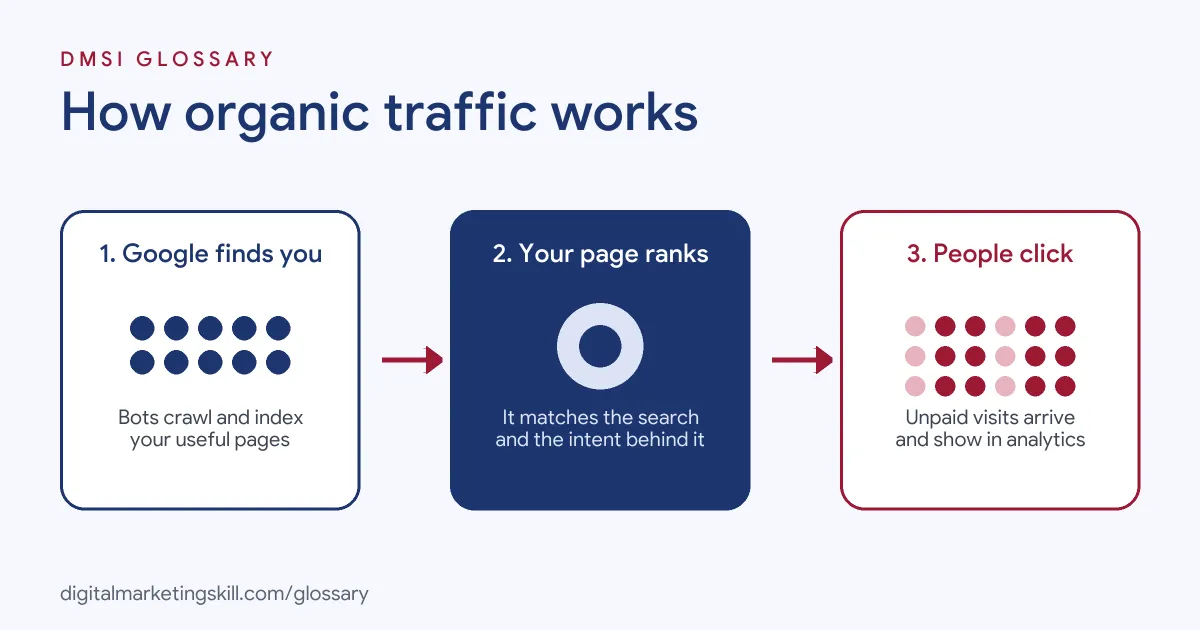
Step 1: Google finds your page
Search engines use bots to discover pages. Google says it “primarily finds pages through links from other pages it already crawled.” So pages with no links pointing to them are hard to find. After that, Google stores the page in its index, ready to show in results.
Step 2: Google ranks your page
Next, Google decides which pages best match each search. It looks at relevance, quality and the search intent behind the words. For example, someone typing “buy running shoes” wants a shop. By contrast, someone typing “how to choose running shoes” wants a guide. Pages that match the intent tend to rank higher.
Step 3: Someone clicks
A high position is only half the job. Your title and description must also tempt people to click. This share of clicks is called the click-through rate. In Search Console, Google defines it as “The click count divided by the impression count.” So a clear, honest title can lift traffic without any change in ranking.
Step 4: Analytics records the visit
Finally, your analytics tool spots that the visitor came from a search engine with no paid tag. Then it files the visit as organic. That is how you can later compare organic traffic with paid, social and email visits.
Measuring organic traffic
You need two tools to see the full picture. First, Google Search Console shows what happens before the click. For example, it reports clicks, impressions, average position and the queries people used. Google describes impressions as “How many times your site appeared in Search results.”
Second, Google Analytics 4 shows what happens after the click. For instance, you can see which pages visitors land on, how long they stay and whether they convert. Together, these tools tell you if your organic traffic is growing and if it brings real value.
Also, compare like with like. Seasonal shops, for example, often see traffic rise and fall at the same times each year. So compare a month with the same month last year, not only with the month before.
Examples of Organic Traffic
- A local bakery. The bakery writes a page about its custom birthday cakes. People nearby search for birthday cakes, find the page in the free results and visit. Each of those visits is organic traffic.
- An online software company. The team publishes a how-to guide that answers a common user problem. As a result, the guide ranks in Google and brings new readers every week, with no ad spend.
- A small online shop. The shop improves its product titles and descriptions. Then its category pages start to show for more searches. So organic visits rise while the ad budget stays the same.
Organic Traffic vs Paid Traffic
| Point | Organic traffic | Paid traffic |
|---|---|---|
| How you get it | Rank in the free search results | Pay for ads, often per click |
| Cost per click | No direct cost | You pay for each click or view |
| Speed | Slow to build | Can start the same day |
| Lasting effect | Often keeps going for a long time | Stops when the budget stops |
| Main skills | SEO, content, technical fixes | Bidding, targeting, ad copy |
Most businesses use both. For instance, pay-per-click ads can bring fast visits while your SEO work grows in the background.
How to Grow Organic Traffic
- Set up tracking. Connect Google Search Console and Google Analytics 4. As a result, you can see your starting point.
- Research keywords. Use keyword research to find what your audience types into search.
- Match the intent. Check the top results for each keyword. Then plan a page that answers the same need, only better.
- Write helpful content. Answer the question early, use clear headings and add real examples.
- Fix technical problems. Make sure Google can crawl and index your key pages. Also check page speed on mobile.
- Improve titles and descriptions. Write titles that match the search and give people a reason to click.
- Earn links. Share useful content so other sites link to it. Each good backlink helps Google find and trust your page.
- Review and update. Every month, check which pages gain or lose clicks. After that, refresh the ones that slip.
Best Practices for Organic Traffic
- Focus on people first. Write for your reader, not for a bot. Useful pages tend to earn more clicks and links.
- Track the right numbers. Watch clicks, impressions and conversions, not just total visits.
- Be patient. Google notes that “Every change you make will take some time to be reflected on Google’s end.”
- Link your own pages. Add internal links so visitors and bots can move between related pages.
- Keep content fresh. Update facts, examples and screenshots when they go out of date.
- Measure value, not volume. A small number of visitors who buy is worth more than a crowd who leave at once.
Common Mistakes to Avoid
- Chasing only big keywords. Broad terms are hard to win. Instead, start with longer, specific phrases.
- Mixing up paid and organic. Tag your ads properly, or paid clicks may be counted in the wrong channel.
- Ignoring conversions. More traffic is not the goal on its own. Check that visitors take the actions you want.
- Buying links. Paid link schemes break Google’s spam policies and can harm your rankings.
- Panicking at small dips. Traffic moves with seasons and news. So look at trends over several weeks.
- Forgetting AI answers. AI Overviews and other rich features can answer a search on the page. Therefore, track impressions as well as clicks.
Where You’ll Use Organic Traffic at Work
Organic traffic is a core goal in SEO, content and growth roles. For example, real remote job listings ask for:
- “You have 4+ years of hands-on experience in SEO, content marketing, or organic growth, ideally at a B2B SaaS or data company, and have owned measurable outcomes like organic traffic, rankings, or organic-sourced pipeline.” (Organic Growth Manager, SEO & AEO).
- “The role covers SEO and content strategy, technical performance, link-building strategy and the commercial impact of organic search.” (Principal SEO / SEO Lead for iGaming).
- “Hands-on practitioner experience in organic growth or SEO/AEO.” (SEO Expert – Organic Growth Specialist).
Learn It in the WordPress and SEO Track
You can learn how to grow and measure organic traffic in the AI-Powered WordPress and SEO Specialist track. Every track includes a U.S. Project Internship from day one, with unlimited 1-on-1 mentoring.
Frequently Asked Questions
Is organic traffic free?
You don’t pay per click. However, it still costs time and effort to create content and improve your site.
Where can I see my organic traffic?
In Google Analytics 4, look at the Organic Search channel. Also, use the Performance report in Google Search Console to see clicks and queries.
How long does it take to grow organic traffic?
It varies by site and topic. Often it takes several months, because Google needs time to find, test and rank your pages.
Does social media count as organic traffic?
Unpaid social visits are sometimes called organic social. In most SEO work, though, organic traffic means unpaid search visits.
Why did my organic traffic drop?
Common causes include ranking changes, technical errors, seasonal demand or tracking problems. So check Search Console first to see where clicks fell.
Sources: Google Search Central: SEO Starter Guide; Google Analytics Help: Default channel group; Search Console Help: Performance report; remote job listings on Himalayas, Himalayas and Himalayas.