A digital marketing sales funnel is the path a stranger follows on the way to becoming a paying customer. It has stages: awareness, interest, intent, and purchase. Each stage loses people. The real work is not drawing the funnel. It is finding the stage that leaks the most, then fixing it first.
Key Takeaways
- The average website converts about 5.13% of visitors into leads or sales, based on over 110 million tracked sessions across 13 industries (Ruler Analytics).
- Email open rates average 35.63% and click rates average 2.62% across billions of sends, though Apple’s privacy changes can inflate open-rate numbers (Mailchimp).
- The average online shopping cart is abandoned 70.22% of the time, a figure drawn from 50 separate studies (Baymard Institute).
- B2B buyers spend only about 17% of their total purchase journey talking directly with any one potential supplier, so most of the decision happens without a salesperson in the room (Gartner).
- 58% of B2B marketers say content marketing increased their sales or revenue, in a self-reported industry survey (Content Marketing Institute).
In this guide
- Why Most Funnel Advice Skips The Numbers
- How A Digital Marketing Sales Funnel Works
- How A Digital Marketing Sales Funnel Differs By Business Model
- How To Strengthen Each Funnel Type
- Common Mistakes That Quietly Break A Digital Marketing Sales Funnel
- Tools That Support A Digital Marketing Sales Funnel
- How To Measure Digital Marketing Sales Funnel Performance
- The One Rule For Fixing A Leaking Funnel
- A Real Funnel Fix, And What It Doesn’t Prove
- Frequently Asked Questions About Digital Marketing Sales Funnels
- Your Next Step With A Digital Marketing Sales Funnel
Why Most Funnel Advice Skips The Numbers
Search for “digital marketing sales funnel” and you will find dozens of diagrams. Awareness sits at the top. Purchase sits at the bottom. Most explanations stop there. They rarely say how many people actually drop off between stages. They rarely say which stage usually breaks first either.
That gap matters. A funnel is not a belief system. It is a measurement tool. Without stage-by-stage numbers, you are guessing which part of your marketing to fix. The audience at the top of that funnel is also larger than most people assume: more than 6 billion people are online worldwide, according to DataReportal’s global analysis.
A few ground rules before the detail. Funnel benchmarks vary by industry, channel, and price point. Treat every figure here as a reference point, not a target you must hit. Some of the data below is US or UK weighted; this guide flags that where it applies. Nothing here is a guarantee of income or sales results.
How A Digital Marketing Sales Funnel Works
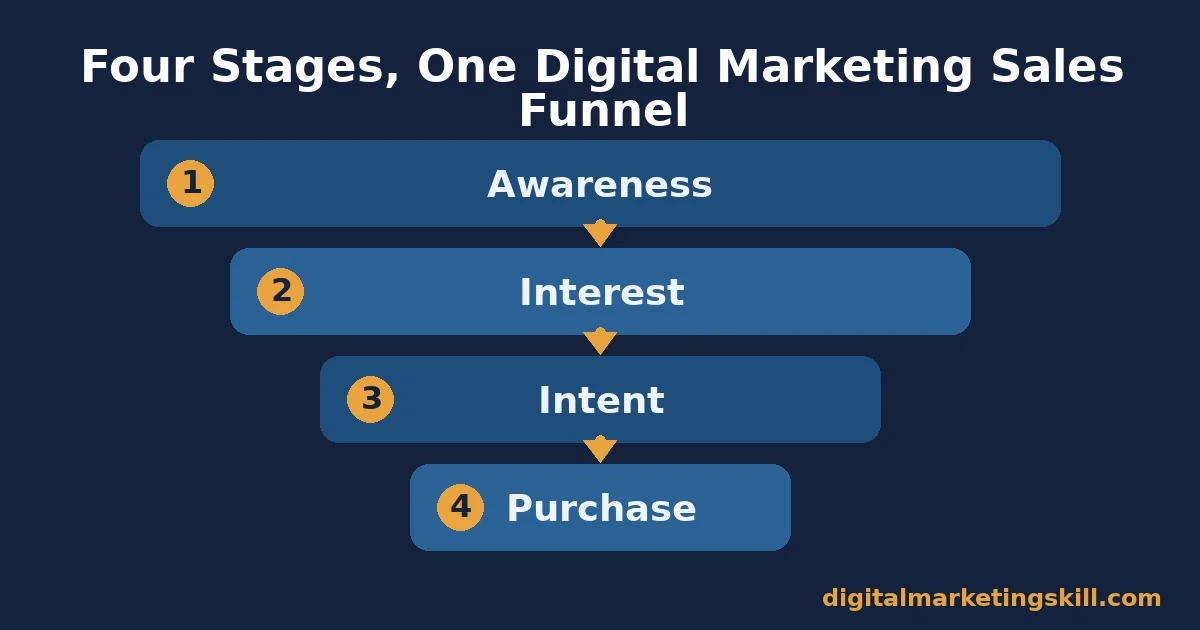
A digital marketing sales funnel describes the series of actions a visitor takes between first contact and conversion. Picture an actual funnel: wide at the top, narrow at the bottom. Every stage removes people who are not ready yet. That is normal. It is also expected, because not every stranger who sees your ad or post is a potential buyer today.
Awareness
At this stage, people learn your brand exists. Content, ads, search results, and social posts do the introducing, often guided by consumer research into where your audience already spends time. Nobody here is ready to buy. They are only ready to notice you. A single blog post, a short video, or a well-targeted ad can start this stage without any direct sales message at all.
Interest And Consideration
Once someone notices you, they start comparing. They read your high-quality content, check your pricing, and weigh you against competitors. This is where helpful information beats a hard sell. The visitor is still deciding whether you can solve their problem at all, so pushing a discount too early often feels premature and can push them away instead of closer.
Intent And Evaluation
Intent shows up as an action. It might be adding a product to a cart, booking a demo, or requesting a quote. Evaluation is the final weighing-up before a decision. Both stages respond well to specific proof, such as a case study, a demo, or a clear side-by-side comparison. Vague claims rarely move anyone at this point; specifics do.
Purchase And Advocacy
Purchase closes the funnel’s first lap. A healthy digital marketing sales funnel does not stop there, though. A satisfied customer refers others, which feeds the awareness stage again. That is why the funnel works better as a loop than a straight line, and why a good experience after the sale pays off long after the invoice is settled.
How A Digital Marketing Sales Funnel Differs By Business Model
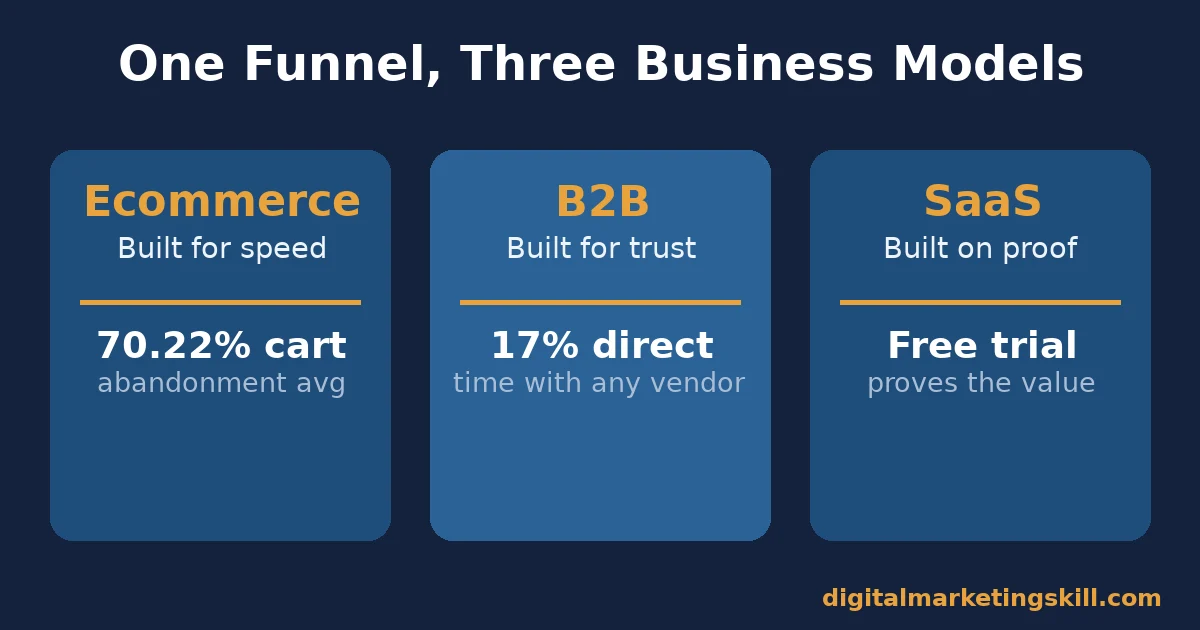
The stages above stay constant, but what moves people through them changes by business model. Here is how three common models differ in practice.
Ecommerce Funnels: Built For Speed And Cart Recovery
An ecommerce funnel is short and transactional. A visitor can go from first click to purchase in minutes. The biggest leak usually sits at checkout: the average online cart is abandoned 70.22% of the time, based on an average of 50 separate studies (Baymard Institute). Price surprises, slow shipping, and a forced account sign-up are common causes. Each one adds friction at the exact moment a buyer is ready to pay.
B2B Funnels: Built For Trust And Longer Cycles
A B2B funnel moves slower, because more than one person usually signs off on the purchase. Gartner’s research finds that B2B buyers spend only around 17% of their total purchase journey in direct contact with any single potential supplier. The rest goes to independent research and internal discussion. Trust-building content matters more here than a fast checkout ever could, since the buyer is convincing colleagues long before they talk to you.
SaaS Funnels: Built For Usage-Based Proof
A software funnel often adds a free trial or freemium tier between intent and purchase. The visitor needs to feel the product work before they pay for it. The funnel’s job shifts from persuading with words to proving value through a hands-on experience. A trial that takes too long to set up loses people fast, often before they ever reach the feature that would have convinced them.
How To Strengthen Each Funnel Type
Once you know your funnel’s weak point, the fix is specific to the model. It is not a generic checklist.
Ecommerce Funnels: Lead With Abandonment Recovery
Send a cart-recovery email within an hour of abandonment. Show the exact items left behind. Remove any surprise costs before the final step. A retargeting ad aimed at the same visitors adds a second nudge. Even a small drop in abandonment at this scale recovers meaningful revenue, because the traffic was already paid for once.
B2B Funnels: Lead With Content And CRM Discipline
Because so much of the B2B journey happens without a salesperson present, your content has to do convincing work on its own. An inbound marketing approach and a working email marketing checklist both help here. Pair that content with a lead-tracking system, even a simple spreadsheet, so no inquiry goes cold while buyers are still researching quietly on their own time.
SaaS Funnels: Lead With Activation Metrics
Track whether a trial user reaches a specific “activation” action, such as completing setup or inviting a teammate. Counting signups alone hides the real picture. A user who hits that activation action converts to paid far more often than one who only created an account and never returned.
Common Mistakes That Quietly Break A Digital Marketing Sales Funnel
Most funnel problems trace back to one of three habits, and all three are easy to fix once you see them.
Treating Every Visitor The Same
A first-time visitor and a returning lead are not ready for the same message. Showing both groups an identical homepage or the same cold email wastes the trust that a returning visitor has already built with your brand. Segment by stage, even with something as simple as a different email sequence for new subscribers versus engaged leads.
Ignoring The Handoff Between Marketing And Sales
Many funnels lose people at the exact point where marketing stops and sales starts. A lead who filled out a form expects a fast, relevant follow-up. A slow or generic response at this stage undoes weeks of careful nurturing in a single afternoon.
Measuring Vanity Metrics Instead Of Funnel Metrics
Page views and follower counts feel good to report, but they rarely explain why revenue is flat. A digital marketing sales funnel needs stage-by-stage numbers instead: how many visitors became leads, how many leads became customers, and where the biggest percentage of people disappeared.
Relying On A Single Channel For The Whole Funnel
A funnel built entirely on one ad platform or one social network is fragile. One policy change, one algorithm update, or a rising cost per click on that channel can quietly collapse the whole structure. Spreading awareness across two or three channels protects the funnel from a single point of failure, and it also gives you a fallback while you diagnose what went wrong on the one that slipped.
Stopping After One Follow-Up Message
Many buyers need several touches before they act, especially in a longer B2B cycle. A single follow-up email or call, with no planned second or third touch, leaves warm leads to go cold on their own. A short, planned sequence of follow-ups almost always outperforms one message sent once and never repeated. Three brief touches, spread over two weeks, often beat one long message sent on day one.
Tools That Support A Digital Marketing Sales Funnel
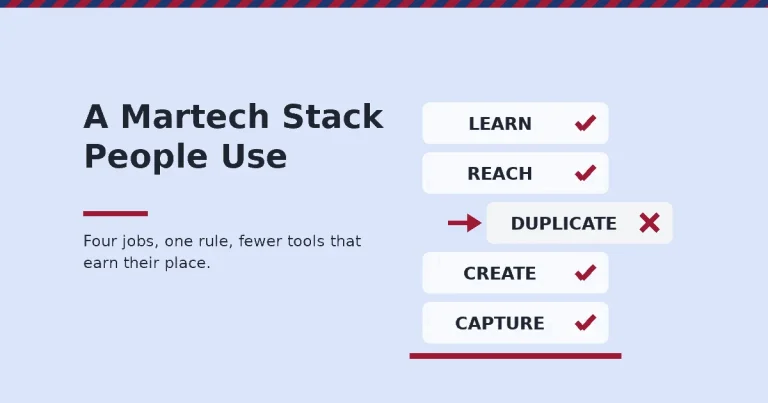
You do not need a large budget to run a working digital marketing sales funnel. You do need the right type of tool at each stage, even if the tool itself is simple at first.
Email And Automation Tools
An email tool handles the interest and consideration stages. It sends a welcome sequence, follows up after a download, and reminds a visitor about an abandoned cart. Most small teams can start with a free tier and grow into paid automation once volume justifies it.
Analytics And Tracking Tools
An analytics tool shows where visitors enter your digital marketing sales funnel and where they leave it. Google’s own documentation on funnel exploration reports explains how to build this view directly from site data, which is often enough for a small team before buying a separate paid tool.
CRM And Lead Management Tools
A CRM, or even a shared spreadsheet used consistently, tracks each lead from first contact through to purchase. This is the tool that prevents a warm lead from going cold simply because nobody followed up this week. The system matters less than the habit of using it every day. A busy team with a messy spreadsheet still outperforms a tidy CRM that nobody opens.
Picking Tools That Fit Your Stage
A small team rarely needs every tool at once. Start with one tool for email, one for analytics, and one simple way to track leads. Add complexity only when the existing setup is clearly the bottleneck, not before.
How To Measure Digital Marketing Sales Funnel Performance
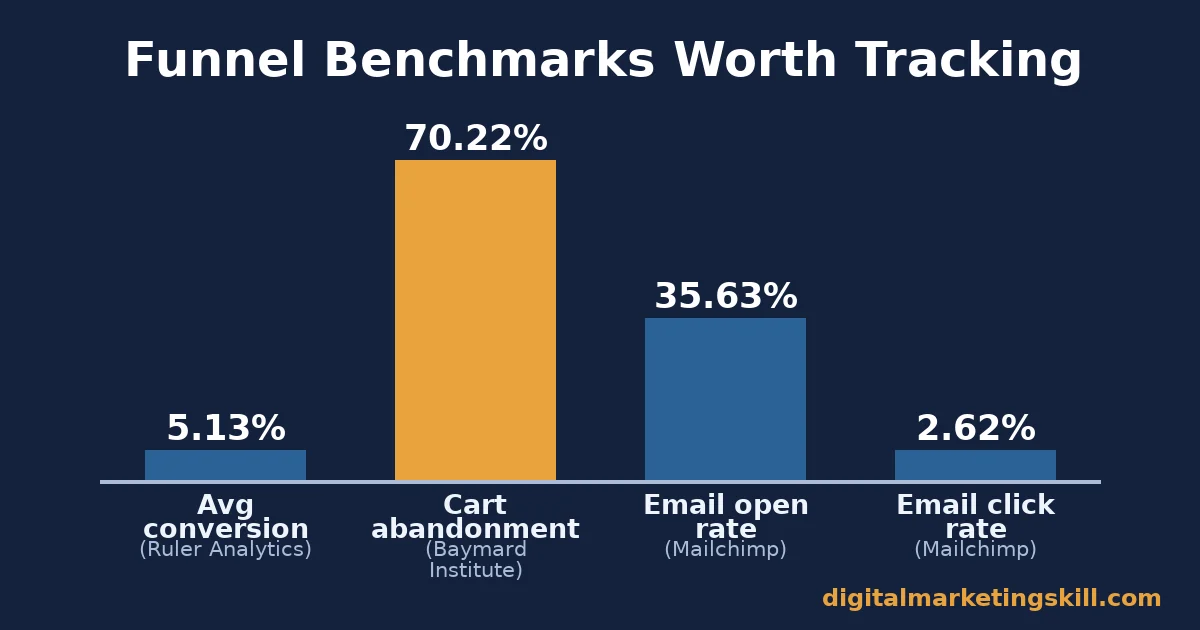
You cannot fix a stage you are not measuring. These are the core numbers to track, each defined simply below.
- Visitor-to-lead rate: the share of site visitors who take a lead action, like filling a form. Average rates run from about 5.13% down to well under 1%, depending on the industry, so most businesses have real room to close the gap between their own number and their sector’s top performers (Ruler Analytics).
- Lead-to-customer rate: the share of leads who become paying customers. A falling rate here usually points to a sales or nurture problem, not a traffic problem, so check your follow-up process before you spend more on ads.
- Email engagement rate: open and click rates on nurture emails. Average benchmarks sit near 35.63% opens and 2.62% clicks, though Apple’s Mail Privacy Protection can inflate open numbers. Treat opens as a softer signal than clicks for this reason (Mailchimp).
- Cart or form abandonment rate: the share who start checkout or a form and never finish. Ecommerce averages around 70.22% cart abandonment, so compare your own rate to your own history as much as to any outside benchmark (Baymard Institute).
- Cost per lead or customer: total spend divided by leads or customers gained. Rising cost per lead with a flat conversion rate is an early signal to fix the funnel before spending more on traffic.
The One Rule For Fixing A Leaking Funnel
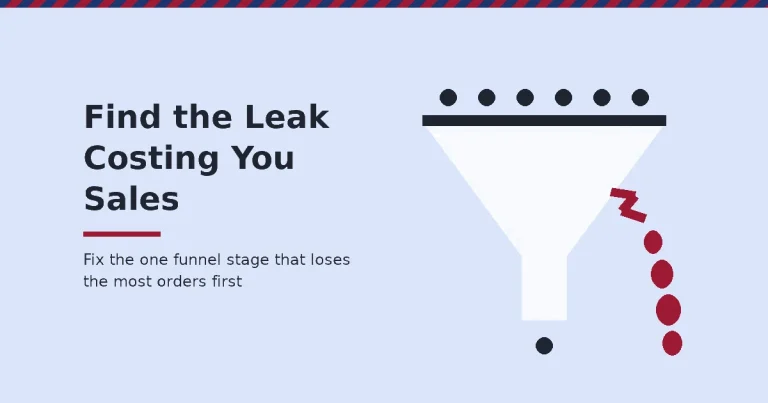
Here is the decision rule: find the single stage with the largest percentage drop in people, and fix only that stage before touching anything else.
Here is an illustrative, invented example to show the math, not a real result. Say 1,000 visitors reach your site. 100 become leads, a 90% drop. Of those, 80 reach the evaluation stage, a 20% drop. Of those, only 8 buy, a 90% drop. Two stages show a 90% drop. But the visitor-to-lead stage removed 900 people, while the evaluation-to-purchase stage removed only 72. Fix the visitor-to-lead stage first. That is where the volume is lost, even though the percentage looks identical at both stages.
This rule stops a common mistake: polishing the bottom of the funnel while the real leak sits near the top. For a closer look at each individual stage, see this guide to sales funnel stages.
A Real Funnel Fix, And What It Doesn’t Prove
Furniture retailer Flos USA raised its checkout conversion rate by 125% after a funnel audit found that customers were confused by a product option labeled “Choose Finish.” The team replaced the text option with visual color swatches and simplified the cart page header, according to a published case study from testing platform VWO. The lesson was not “add more ads.” It was “remove a point of confusion at the exact stage where people were already trying to buy.”
On a smaller scale, DMSI student Ayooluwa Osemi spent $14 on ads and generated $878 in revenue by tightening the offer and targeting on a single funnel stage, as published on the Institute’s reviews page. One result like this does not predict what anyone else will earn. Individual results vary, and no income is guaranteed; see the Institute’s earnings disclaimer for the full context. What the result does show is that a funnel fix does not have to be expensive to be worth measuring. Both examples, one large and one small, point to the same habit: look for the specific point of friction before spending more money on traffic.
The funnel describes the marketing side of this journey; once a lead is ready, the difference between sales and marketing determines who takes over and how.
Frequently Asked Questions About Digital Marketing Sales Funnels
What is a digital marketing sales funnel in simple terms?
It is the path a visitor follows from first noticing your brand to becoming a customer. Most models split that path into awareness, interest, intent, and purchase stages, with each stage narrowing the group of people who move forward.
How many stages does a digital marketing sales funnel have?
Most models use four to six stages. The names change between frameworks, but the direction never does: they move from broad awareness toward a narrow, specific action like a purchase or a signed contract.
What is the average funnel conversion rate?
Across 13 industries and over 110 million tracked sessions, the average website conversion rate is 5.13%, with software and finance sites performing above that average and others below it (Ruler Analytics). Always compare against your own sector where possible, since a single overall average hides a lot of variation.
Why do people drop out of a sales funnel?
Common reasons include unclear pricing, a confusing product page, a slow checkout, or simply not being ready to buy yet. Cart abandonment alone affects around 70% of online shopping attempts, which shows how much friction sits at just one stage.
Can a small business build a digital marketing sales funnel without paid ads?
Yes. Organic content, email nurture sequences, and referrals can fill the top and middle of a funnel on their own. Paid ads speed up the top stage, but they are not required to have a working funnel in place.
How often should a funnel be reviewed?
Review conversion rates at each stage on a regular schedule. Review again immediately after any major change to pricing, website design, or ad targeting, since those changes shift funnel behavior the fastest.
What is the difference between a marketing funnel and a sales funnel?
The terms overlap in everyday use. A marketing funnel usually covers the earlier stages, from first awareness through interest. A sales funnel usually picks up from intent through purchase, once a sales team gets involved. Many small teams simply treat the two as one connected digital marketing sales funnel, which is reasonable when the same people run both halves.
Does a digital marketing sales funnel work the same way for services and products?
The stages stay the same, but the pace changes. A low-cost product can move a visitor from awareness to purchase in one sitting. A service with a higher price tag usually needs more content, more proof, and more time at the interest and consideration stages before anyone is ready to commit.
Your Next Step With A Digital Marketing Sales Funnel
Understanding the stages is only the starting point. Building and fixing a digital marketing sales funnel that actually converts takes practiced skill in content, email automation, paid media, and analytics, all working together rather than as separate projects. Most people learn this the slow way, through trial and error on their own campaigns, which costs both time and ad budget along the way.
The Digital Marketing Skill Institute’s Master Diploma in Digital & AI Marketing is built around four AI-powered tracks covering ten courses in total, including the AI-Powered Lead Generation and Email Automation track, which maps directly onto the funnel stages in this guide. Students who complete all four tracks qualify for the Full Stack option. Every path includes unlimited 1-on-1 coaching and mentoring, a U.S. Project Internship with a verified U.S. Work Reference Letter, and a dual US and UK accredited diploma recognised in more than 100 countries. The program runs 100% online, so you can study from anywhere in your country.
See the full course structure on the Master Diploma program page, browse more guides on the digital marketing blog, or apply directly at digitalmarketingskill.com/apply/. Wherever you live, the skills in this guide work the same way: find the leak, fix it first, then measure again. Learn more at digitalmarketingskill.com, and start building funnels that hold up at digitalmarketingskill.com.
Every figure in this guide was checked against its original source before publication. Figures marked as illustrative are invented examples, not real results.