
An AI model is a program that has learned patterns from data so it can make predictions, decisions or new content without step-by-step human instructions. You give it an input, such as a question, a photo or a row of customer data, and it returns an output, such as an answer, a label or a score. It matters because almost every AI tool you use at work, from ChatGPT to an ad platform’s bidding system, runs on one or more models.
Key Takeaways
- An AI model is the trained result of an algorithm applied to data. The algorithm is the method; the model is what you use.
- Training sets the model’s internal values, called parameters. Inference is when you use the trained model to get an answer.
- Some models follow fixed rules. Most modern ones learn from examples through machine learning.
- Large language models, the engines behind chatbots, are one type of AI model. They use deep learning and need a lot of computing power.
- Providers usually offer several models, each with different speed, cost and skill. Choosing the right one is part of the job.
What Is an AI Model?
IBM defines an AI model as “a program that has been trained on a set of data to recognize certain patterns or make certain decisions without further human intervention.” In other words, it learns from past examples, then applies what it learned to new cases.
People often mix up the words “algorithm” and “model”. However, IBM explains that they are not quite the same. An algorithm is a procedure, a set of steps applied to a dataset. A model is the output you get when you run that algorithm on data. So the algorithm is the recipe, and the model is the finished dish you serve.
For example, a shop might feed thousands of past orders into a learning algorithm. The result is a model that predicts which products a visitor is likely to buy.
How an AI Model Works
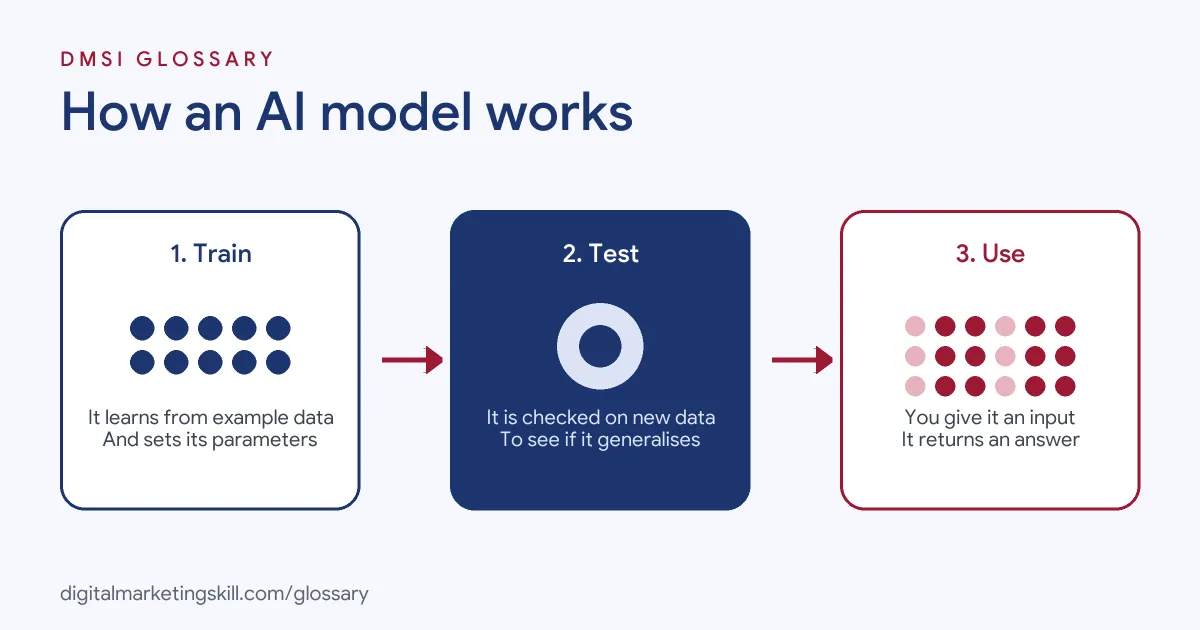
Every AI model goes through two broad stages. First, it learns through training. Then it goes to work through inference. Between the two, teams test whether it works on data it has never seen before.
Training
Google’s machine learning glossary describes training as “the process of determining the ideal parameters (weights and biases) comprising a model.” During training, the system reads examples and adjusts those parameters a little at a time. As a result, its guesses slowly get closer to the right answers.
Training is the slow, expensive part. That’s why most marketers never train a large model themselves. Instead, they use a model that a provider has already trained.
Inference
Inference is the moment you actually use the model. In large language models, Google says inference “is the process of using a trained model to generate a response to an input prompt.” So when you type a request into a chatbot and press enter, you are running inference.
Generalisation
A useful model must work on new data, not just on its training examples. Google calls this generalisation: “A model’s ability to make correct predictions on new, previously unseen data.” By contrast, a model that only memorises its training data is overfitting. It looks clever in testing but fails in real use.
Types of AI Models
IBM sorts AI models into a few broad families. Here is a quick comparison, with a marketing use for each:
| Type | How it learns | Marketing example |
|---|---|---|
| Rule-based | Follows if-then rules that a person writes | Send a discount code an hour after someone leaves a cart |
| Supervised learning | Learns from examples that humans have labelled | Sort leads into likely and unlikely buyers |
| Unsupervised learning | Finds patterns in data without labels | Group customers into segments; power product suggestions |
| Reinforcement learning | Learns by trial and error, with rewards for good results | Social media suggestions, according to IBM |
| Generative (such as LLMs) | Learns the patterns in data so it can create new content | Draft ad copy, captions or email subject lines |
IBM notes that only models capable of machine learning can improve their own performance over time. The simplest AI models are just a series of if-then-else statements.
Meanwhile, the newest tools rely on foundation models. IBM explains that these are pre-trained on large, unlabelled datasets and can handle many tasks. Teams can then fine-tune them for a specific job. For more on the text-based kind, see our entry on the large language model.
AI Model Examples
These three made-up examples show how different models fit different marketing jobs:
- Copywriting: A travel brand asks a generative AI model for ten headline ideas for a summer sale. A copywriter then picks the best two and edits them to match the brand voice.
- Lead scoring: A software company trains a supervised model on past leads, labelled “became a customer” or “did not”. The model then scores each new lead, so sales calls the likeliest buyers first.
- Segmentation: A clothing shop uses an unsupervised model to group customers by what and when they buy. As a result, it finds a group that only shops during sales and emails them differently.
In each case, a person still sets the goal, checks the output and decides what to do with it.
Choosing an AI Model from a Provider
Most AI providers offer a family of models rather than just one. For example, Anthropic’s model overview lists several Claude models side by side. Each has its own speed, price, context window and maximum output length. It describes its smallest model as suited “For high-volume, latency-sensitive tasks such as classification, extraction, and routing.”
The same page also lists a training data cutoff and a retirement date for each model. In practice, this means two things for you. First, a model doesn’t know about events after its cutoff. Second, providers retire older models, so keep your prompts and workflows easy to move.
So the biggest model isn’t always the best choice. A faster, smaller model can be cheaper and quicker for simple, repeated jobs, while a larger one may suit complex writing or analysis.
How to Use an AI Model at Work
You don’t need to code to use a model well. Follow these steps:
- Define the task. Write one clear sentence, such as “Draft five subject lines for our welcome email.”
- Pick the tool and model. Use a chat assistant for writing, or a built-in feature in your ad or email platform for predictions.
- Give good input. Share context, audience, tone and examples. Our guide on how to write ChatGPT prompts shows how.
- Check the output. Verify facts, numbers and claims before anything goes live.
- Test the result. For instance, run the AI-written subject line against your current one and compare open rates.
- Record what works. Save strong prompts and settings, so your team can repeat them.
Best Practices for Working with an AI Model
- Treat output as a first draft. Generative models can sound confident even when they are wrong.
- Match the model to the job. Use smaller, faster models for simple sorting tasks and larger ones for harder work.
- Protect customer data. Check your company’s rules before you paste personal details into any AI tool.
- Keep a human in the loop. A person should approve anything that customers will see.
- Measure the impact. Judge an AI model on results, such as time saved or conversions, not on how impressive it feels.
Common Mistakes to Avoid
Beginners tend to make the same few errors. First, they assume the model knows recent news, even though it has a training cutoff. Second, they give vague prompts and then blame the tool. Third, they publish output without checking facts. Finally, they build a whole process around one model and struggle when the provider retires it. Each of these is easy to avoid once you know about it.
AI Model vs Algorithm vs AI Tool
These three words often appear together, so here is how they differ:
| Term | What it is | Simple example |
|---|---|---|
| Algorithm | The method used to learn from data | A training procedure for a neural network |
| AI model | The trained result that makes predictions or content | A language model that writes text |
| AI tool | The app you use, built on one or more models | A chat assistant or an email platform’s writing helper |
In short, you work with tools, the tools run models, and the models come from algorithms.
Where You’ll Use AI Models at Work
AI models show up in technical job listings, and those roles shape the tools marketers use every day. For example, remote listings include duties such as:
- “Train, fine-tune, and deploy advanced generative AI models” (AV Simulation Domain Expert).
- Working on “the development and optimization of modern AI models and multi-model AI systems” (AI Engineer).
- Helping “enhance response quality through direct user interaction with the various AI models” (AI Product Evaluator).
Most marketing roles won’t ask you to build models. Instead, employers want a Digital Marketing Manager or Growth Marketer to choose the right AI tool, write clear prompts, check the output and prove that it helps.
Learn It in the Full Stack Track
AI fundamentals, covering strategy and planning, are part of every DMSI track. The Full Stack (all four tracks) option covers all ten courses, with one portfolio project from each track. So you practise using AI models across social media, email, Google Ads and SEO. Every track is about 90% hands-on, with unlimited 1-on-1 mentoring and a U.S. Project Internship from day one.
Want to understand how models learn in the first place? Read our entry on machine learning.
Frequently Asked Questions
What is an AI model in simple terms?
It is a program that has learned patterns from data. You give it an input, and it gives back a prediction, a decision or new content.
Is ChatGPT an AI model?
ChatGPT is an app that runs on large language models made by OpenAI. So the chat window is the tool, and the model works behind it.
What is the difference between training and inference?
Training is when the model learns by adjusting its parameters on example data. Inference is when you use the finished model to get an answer.
Do marketers need to build their own AI model?
Usually not. Most marketers use models that providers have already trained, either through chat tools or features inside ad and email platforms.
Why do AI models get replaced?
Providers release improved models and retire older ones. That’s why it helps to keep your prompts and processes easy to move to a newer AI model.
Sources: IBM: What is an AI model?; Google for Developers: Machine Learning Glossary; Anthropic: Models overview; remote job listings on Himalayas.