
Machine learning is a way to train software to spot patterns in data, so it can make predictions or create content without step-by-step rules. Instead of a person writing every instruction, the software learns from examples. It matters because most ad platforms, email tools and search engines you will use at work already run on it.
Key Takeaways
- It is a branch of artificial intelligence. In other words, it is one kind of AI, but not the only kind.
- The software that learns is a model. It learns from training data, then applies what it learned to new data.
- Google groups it into four types: supervised, unsupervised, reinforcement and generative AI.
- Google Ads Smart Bidding uses it to set a bid in every single auction.
- Your job is to feed it good data and clear goals, then check the results.
What Is Machine Learning?
Google’s ML course defines it as “a way to train software, called a model, to make predictions or generate content using data.” In other words, you don’t tell the computer the answer. Instead, you show it lots of examples, and it works out the pattern for itself.
IBM describes it as the part of artificial intelligence that focuses on algorithms which learn the patterns in training data. The goal is to make accurate predictions about new data the model has never seen.
Here is a simple way to picture it. A traditional program follows rules a person wrote, such as “if the email contains this word, mark it as spam.” A trained model, by contrast, studies thousands of emails already marked as spam or not spam. Then it learns which signals matter on its own.
How Machine Learning Works
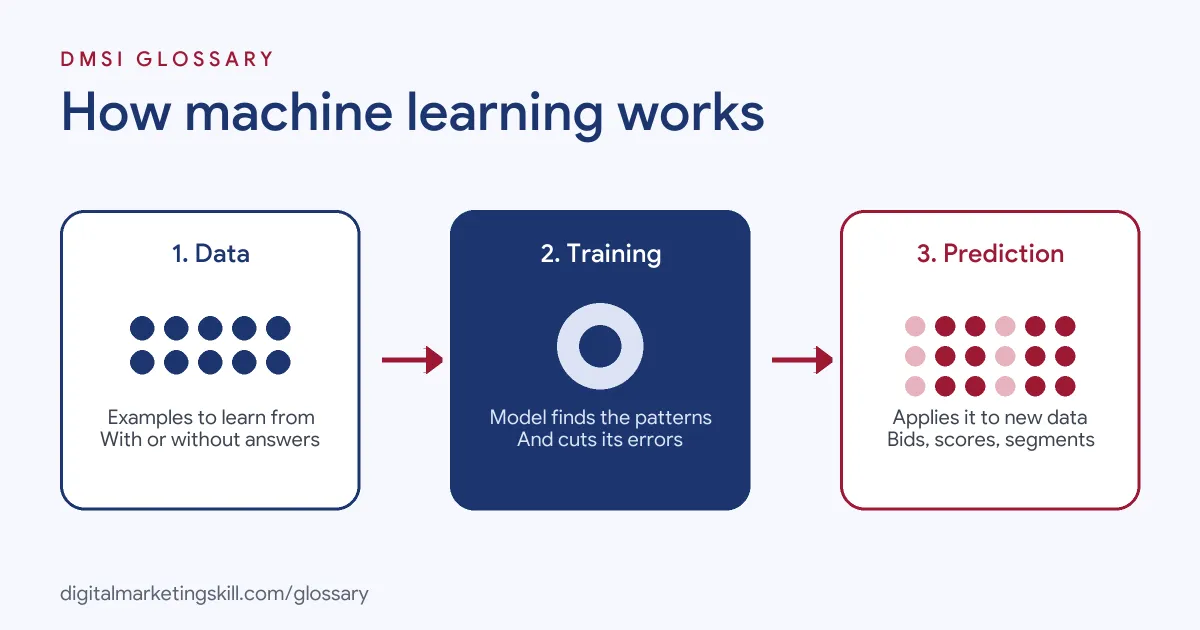
Every ML model goes through the same basic cycle. First, it gets data. Next, it trains on that data and adjusts itself to reduce its mistakes. Finally, it makes predictions on new data.
Data and Features
A model can only learn from what you give it. Each data point has features, which are the details that might matter. For a shopper, features could include device, location, pages viewed and past purchases. IBM notes that features have to become numbers, so the algorithm can process them.
Training the Model
During training, the model has settings it can adjust. These control how much weight it gives each feature. A loss function measures the gap between the model’s answer and the right answer. So training is really a long search for the settings that make that gap as small as possible.
Making Predictions
Once trained, the model applies its pattern to new data. For instance, it might predict whether a visitor will buy, which group a customer belongs to, or what bid will win a conversion. Then it keeps learning as fresh data arrives.
Types of Machine Learning
Google’s course lists four main types. They can overlap, but each one learns in a different way:
| Type | How it learns | Marketing example |
|---|---|---|
| Supervised | From examples with the correct answers attached | Predicting which leads will buy, based on past leads that did |
| Unsupervised | Finds patterns in data with no answers attached | Grouping customers into segments by behaviour |
| Reinforcement | Gets rewards or penalties for its actions | Software that tests actions and keeps what earns the reward |
| Generative AI | Creates new content from a prompt | Drafting ad copy or product images |
Supervised models handle two common jobs. Regression predicts a number, such as a house price. Classification, on the other hand, predicts a category, such as spam or not spam. Meanwhile, unsupervised models often use clustering, where you only name the groups after the model has found them.
Machine Learning Examples in Marketing
You will meet it in almost every channel. Here are three concrete examples:
- Smart Bidding in Google Ads: Google says Smart Bidding uses Google AI to optimise for conversions or conversion value “in every auction.” It looks at signals such as device, location, time of day, remarketing lists and the actual search query. Then it sets a bid for that one auction.
- Product recommendations: IBM notes that Amazon uses association models, a type of unsupervised learning, to power its recommendation engine. That is why online shops can show “customers also bought” lists.
- Customer segments: Clustering is often used for market segmentation. For example, an online store could group buyers by how often they buy and how much they spend, then send each group a different email.
In each case, the model does the pattern-spotting. However, a marketer still sets the goal, supplies the data and judges the outcome.
How to Use Machine Learning in a Google Ads Campaign
You rarely build models yourself as a marketer. Instead, you set up the tools so their models learn the right thing. Here is how that works with Smart Bidding:
- Set up conversion tracking. Google says you need conversion tracking turned on before you use Smart Bidding. Without it, the model has nothing to learn from.
- Decide what a good result is. Choose whether you care about the number of conversions or their value.
- Pick a matching strategy. Smart Bidding includes Target CPA, Target ROAS, Maximise conversions and Maximise conversion value.
- Give it enough data. Google suggests judging results over longer periods with at least 30 conversions, or 50 for Target ROAS, such as a month or more.
- Avoid constant changes. Each big edit gives the model a new problem to solve, so change one thing at a time.
- Review and report. Compare cost per conversion and conversion value against your goal, then adjust targets if needed.
Best Practices for Machine Learning at Work
- Feed it clean data. A model learns from what you track. So if you count every page view as a conversion, it will chase page views.
- Track the outcome that matters. For example, optimise for sales or qualified leads, not just clicks.
- Be patient. Models need enough examples before their predictions settle down.
- Keep a human check. Review automated choices, especially for brand safety and budget.
- Learn the basic terms. Knowing words like training data, model and prediction helps you talk to analysts and developers.
Common Mistakes to Avoid
Many beginners treat ML as magic. First, they switch on automated bidding with broken tracking, so the model learns from the wrong signals. Second, they judge results after a few days, before the model has enough data. Third, they change budgets and targets every day, which resets what it has learned. Finally, they forget that a model only reflects its data. If past data has gaps or bias, the predictions will too.
Machine Learning vs AI vs Deep Learning
People often mix up these terms, so here is a quick guide:
| Term | What it means | Relationship |
|---|---|---|
| Artificial intelligence | Computer systems that do tasks linked to human thinking | The broadest field |
| Machine learning | Models that learn patterns from data | A part of AI |
| Deep learning | Machine learning with large, layered neural networks | A part of machine learning |
IBM adds that deep learning needs large amounts of data and computing power. Large language models, such as the ones behind chatbots, are a type of deep learning.
Where You’ll Use Machine Learning at Work
Employers expect marketers to understand how these systems work. For example, remote job listings mention it in lines such as:
- “machine learning concepts applied to marketing is a plus” (Data Engineer, Marketing).
- “we combine deep API integrations, advanced AI, and machine learning with human expertise” (Specialist, Creator Management).
So even in roles such as Google Ads Specialist or PPC Specialist, you need to know how automated bidding learns. In addition, you need to explain to a client why results shift while a model learns.
Learn It in the Google Specialist Track
AI fundamentals, including strategy and planning, is part of every DMSI track. You can see it at work most clearly in the AI-Powered Google Specialist track. There, you launch and measure a Google Ads campaign with conversion tracking, which is exactly the data Smart Bidding learns from. You also work on a U.S. Project Internship from day one, with unlimited 1-on-1 mentoring.
Want to see how AI already shapes customer conversations? Read our guide to chatbot marketing.
Frequently Asked Questions
What is machine learning in simple terms?
It is software that learns from examples instead of following fixed rules. It spots patterns in past data, then uses them to make predictions about new data.
Is machine learning the same as AI?
No. It is one part of artificial intelligence. Some AI systems use hand-written rules instead of learning from data.
What are the main types of machine learning?
Google lists four: supervised, unsupervised, reinforcement and generative AI. Supervised learning uses labelled examples, while unsupervised learning finds patterns on its own.
Do marketers need to code to use machine learning?
Usually not. Most marketers use ML through tools such as Smart Bidding. Still, you need to set up tracking, choose goals and read the results well.
How does Google Ads use machine learning?
Smart Bidding uses it to set bids at auction time. It weighs signals such as device, location, time of day and the search query to aim for conversions or conversion value.
Sources: Google for Developers: What is machine learning?; IBM: What is machine learning?; Google Ads Help: About Smart Bidding; remote job listings on Himalayas.