
Chatbot marketing is the use of automated chat assistants on websites and messaging apps to start conversations, answer questions, capture leads and guide people towards a purchase. The bot follows set rules or uses AI to reply, and it can hand the chat to a person when needed. It matters because it lets a business respond instantly at any hour, which helps turn more visitors into leads and customers.
Key Takeaways
- Chatbots can run on your website, Facebook Messenger, Instagram, WhatsApp and other channels.
- Rule-based bots follow a script. AI bots understand free-form questions and write their own replies.
- Common jobs include qualifying leads, booking meetings, answering FAQs and creating support tickets.
- Each channel has rules. Messenger, for example, gives businesses up to 24 hours to respond to a user.
- The best bots make it easy to reach a human when the conversation needs one.
What Is Chatbot Marketing?
Imagine a visitor lands on your pricing page at midnight. A small chat window asks, “Can I help you choose a plan?” The visitor types a question, gets an answer and books a demo. No one on your team was awake. That is chatbot marketing in action.
At its core, it turns a one-way page into a two-way conversation. Instead of hoping a visitor fills in a form, the bot asks questions one at a time. As a result, people often share more, and they get help straight away.
For a wider look at the strategy, read our guide to chatbot marketing on the blog.
How Chatbot Marketing Works
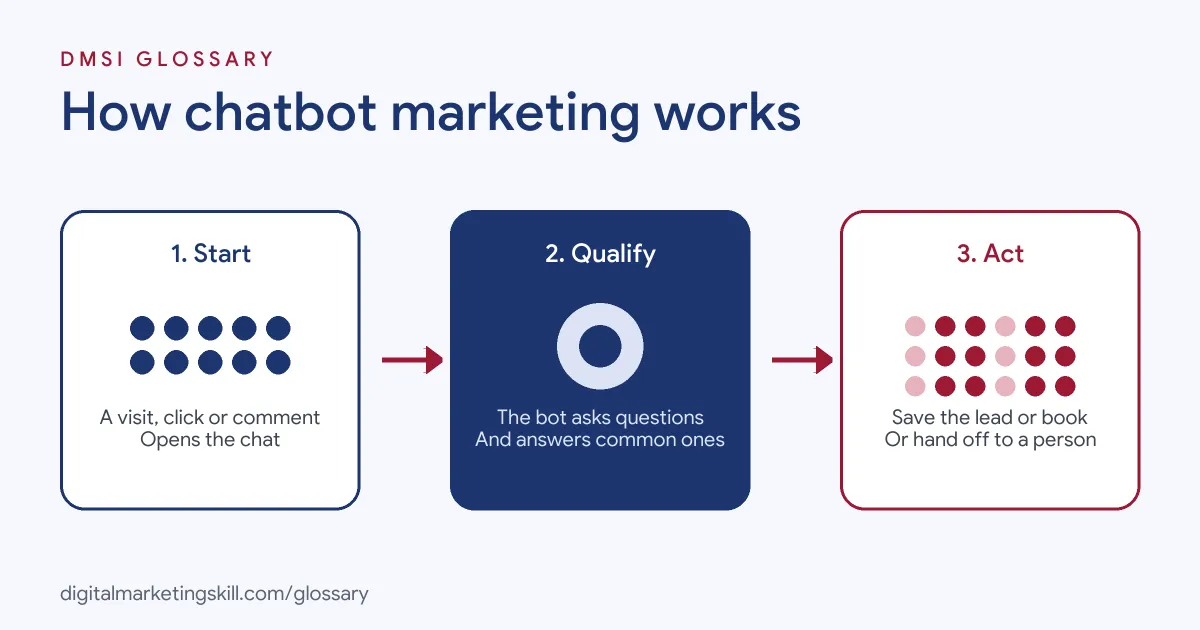
Most set-ups follow three steps. First, something starts the chat, such as a page visit, an ad click or a keyword in a comment. Next, the bot asks questions and gives answers. Finally, it takes an action, such as saving a lead to the CRM, booking a meeting or passing the chat to a person.
Rule-Based and AI Bots
There are two main kinds of bot. A rule-based bot follows a decision tree with buttons and set replies. HubSpot’s knowledge base says its rule-based chatbot “can help qualify leads, book meetings, or create support tickets.” An AI bot, by contrast, reads free-form questions and writes its own replies, often using your help content as its source.
What a Bot Can Do
Bots work through actions. In HubSpot, for example, “you can use different bot actions to gather information about the visitor.” Its templates include one to “share a meeting link with a visitor so they can book time with you or your team” and one to “share knowledge base articles with visitors.” Bots can also “route the conversation to member of your live team.”
Channel Rules
Each messaging app has its own rules, so check them before you launch. Meta’s Messenger policy says “businesses will have up to 24 hours to respond to a user.” It adds that “messages sent within the 24 hour window may contain promotional content.” On WhatsApp, meanwhile, you may only contact people who have given you their number and opted in.
Outside the Messenger window, options are limited. The policy says message tags “enable sending important and personally relevant updates to users outside the 24-hour Standard messaging window.” It also describes a Human Agent tag “that allows businesses to manually respond to user messages within a 7-day period.” So plan your follow-ups with these limits in mind.
Chatbot Marketing Examples
Here are three made-up examples of how businesses might use a bot:
- Software company: A website bot asks visitors about team size and goals. Qualified visitors get a meeting link, while others get a helpful guide.
- Creator: An Instagram post asks people to comment a keyword. Each person who comments gets a direct message with a free checklist and an email sign-up link.
- Online shop: A Messenger bot answers sizing and delivery questions. If a customer asks something complex, the bot passes the chat to a support agent.
In each case, the bot handles the simple, repeated part of the conversation. People step in only when it adds value.
Chatbot Types Compared
Choosing the right type depends on your goal and budget. Here is a quick comparison:
| Type | How it replies | Best for |
|---|---|---|
| Rule-based bot | Buttons and scripted answers in a set flow | Lead qualification, booking and simple FAQs |
| AI chatbot | Understands free text and writes its own answers | Varied questions and support at scale |
| Live chat | A person replies in real time | Complex sales and sensitive issues |
Many teams combine all three. The bot answers first, AI handles open questions and a person takes over when needed. To learn more about the AI side, see our glossary entry on the AI chatbot.
How to Set Up a Marketing Chatbot
- Pick one clear goal, such as booking demos or collecting email sign-ups.
- Choose your channel: your website, Messenger, Instagram or WhatsApp.
- Map the conversation. Write the opening message, the questions and the possible answers.
- Connect the bot to your CRM or email tool, so leads are saved automatically.
- Add a hand-off to a person, with clear hours, for questions the bot can’t answer.
- Test every path yourself before you launch.
- Review chat logs each week, and fix the points where people drop out.
Chatbot Marketing Best Practices
- Say it is a bot. Being upfront about this sets the right expectations from the first message.
- Keep messages short. One idea per message is easier to read on a phone.
- Use buttons for common answers. They are faster than typing and reduce errors.
- Offer a way out. Always let people reach a person or leave the chat.
- Follow channel rules. Respect messaging windows, opt-in and opt-out on every platform.
How to Measure Results
A bot is only useful if it moves people forward. So track a few numbers from the start:
- Chats started: how many people open a conversation. Low numbers can mean a weak opening message.
- Completion rate: the share of people who reach the end of the flow.
- Leads and bookings: the real results, such as email sign-ups or demos booked.
- Hand-off rate: how often people ask for a person. A high rate shows where the bot needs better answers.
For example, imagine 400 chats start in a month and 100 people finish the flow. If 40 of them book a call, the bot turns one in ten chats into a booking. You can then test a new opening line and compare.
Common Mistakes to Avoid
Many bots fail for simple reasons. First, they try to do too much, so the flow becomes long and confusing. Second, they hide the human option, which frustrates people with real problems. Third, they send promotions outside the rules of the channel. Finally, nobody reviews the chats, so the same dead ends stay in place for months. A bot needs regular care, just like an email sequence or an ad campaign.
Where You’ll Use Chatbot Marketing at Work
Bots are now a common part of social, content and lead generation roles. For example, recent remote job listings ask candidates to:
- “Use tools like ManyChat and the company’s CRM to manage dynamic chatbots, automate workflows, and enhance campaign efficiency.” (Content Marketing Manager).
- “Set up and manage ManyChat automation workflows.” (Content Operations & Marketing Assistant).
- Manage “ManyChat work flows: Posting reels, with a lead magnet attached which relates to the video content” (Social Media Manager).
So as a Digital Marketing Manager, Growth Marketer or Freelance Digital Marketer, you may design bot flows, connect them to a CRM and report on the leads they bring in.
Learn It in the Full Stack Programme
Chatbot marketing mixes social media, lead generation and automation skills. That’s why it fits the Full Stack (all four tracks) option, which covers all ten courses and includes one portfolio project from each track. Every track is about 90% hands-on, with unlimited 1-on-1 mentoring and a U.S. Project Internship from day one.
Frequently Asked Questions
What is chatbot marketing in simple terms?
It means using an automated chat assistant to talk with potential customers, answer their questions and collect their details. The bot works around the clock and can pass chats to a person.
Do I need AI to run a chatbot?
No. Rule-based bots with buttons and scripted replies work well for booking and qualifying leads. AI helps when people ask varied, open questions.
Where can a marketing chatbot run?
It can run on your website and on messaging apps such as Messenger, Instagram and WhatsApp. Each channel has its own rules.
Can a chatbot send promotions?
Sometimes. On Messenger, messages sent within the 24-hour window may contain promotional content. On WhatsApp, you need opt-in first.
How do I measure chatbot marketing?
Track how many chats start, how many people finish the flow, how many leads or bookings you get and how often people ask for a human.
Sources: HubSpot Knowledge Base: Create a bot; Meta for Developers: Messenger Platform policy overview; WhatsApp Business Messaging Policy; remote job listings on Himalayas.