
Demand generation is the marketing work of creating interest in your product among people who are not yet looking for it, so that more of them want to buy over time. It covers brand campaigns, helpful content, events and ads that teach a market why your solution matters. It matters because most buyers are not ready to buy today, and the brands they already know get the first call when they are.
Key Takeaways
- Demand generation builds future interest. Lead generation captures interest that already exists.
- LinkedIn’s B2B Institute finds that 95% of potential buyers are not in the market right now.
- So strong programmes reach the whole market, not only people filling in forms today.
- Typical tactics include video, social content, webinars, podcasts, research reports and thought leadership.
- Google Ads even has a campaign type called Demand Gen, which serves ads on YouTube, Discover, Gmail and more.
What Is Demand Generation?
Imagine a firm that sells payroll software. Only a few companies switch payroll tools each month. If the firm only targets those few, it competes with every rival for the same tiny group. Instead, it can teach the wider market about payroll problems, so more firms think of it first when the time comes.
That is the heart of the idea. You create demand, rather than just harvesting it. In practice, the term is used most in B2B, but consumer brands do the same thing when they build awareness before a launch.
The phrase is often mixed up with lead generation. The two are linked, yet they do different jobs. Demand work grows the pool of interested buyers. Lead work then turns some of those buyers into named contacts for sales.
How Demand Generation Works
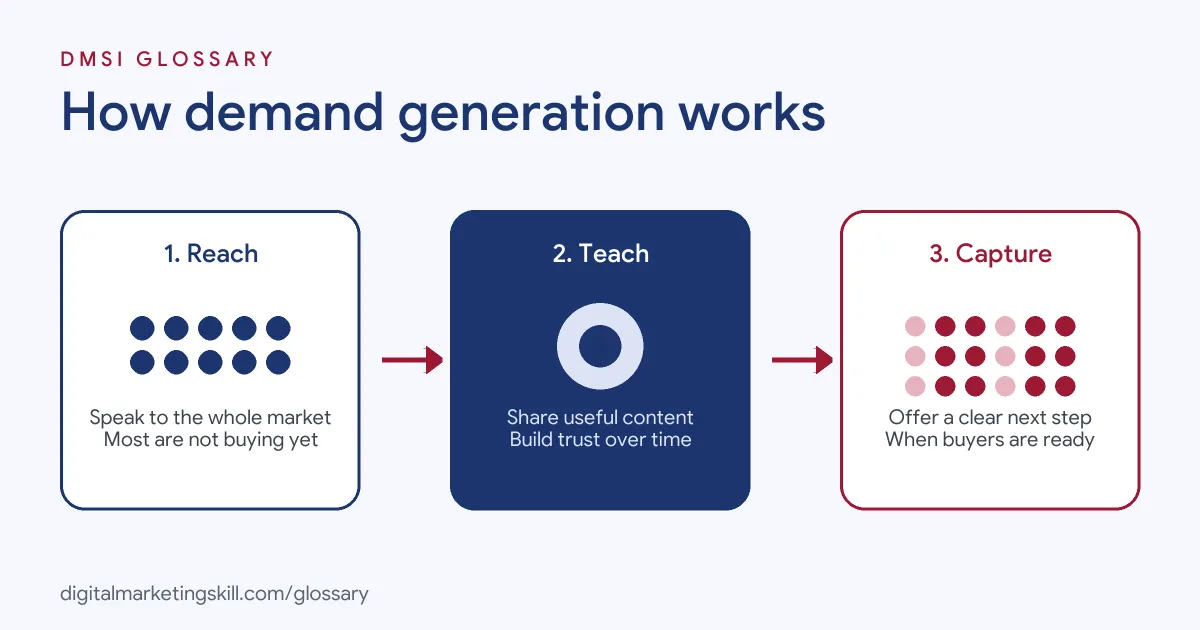
Most programmes move through three stages. First, you reach the people who could buy one day. Next, you teach them something useful and build trust. Finally, when they are ready, you make it easy for them to raise their hand.
Reach the Whole Market
LinkedIn’s B2B Institute calls this the 95-5 rule. It says “95% of your potential buyers aren’t ready to buy today.” They are “out-market” now, but they will be “in-market” later. Its joint research with the Ehrenberg-Bass Institute found that 75% of companies buy computers only once every four years.
So the institute’s advice is clear. Invest in lead generation for the 5% who are ready, but “invest far more heavily in reaching the entire category with brand advertising.” That wider reach is the core of demand generation.
Build Trust With Content
Buyers learn mostly on their own. Gartner found that when B2B buyers are considering a purchase, “they spend only 17% of that time meeting with potential suppliers.” The rest goes on research and internal discussion.
That’s why useful content matters so much. Guides, videos, webinars and reports answer buyers’ questions while they research. As a result, your brand becomes the trusted voice in the category.
Different formats suit different moments. Short videos and social posts catch attention quickly. Longer guides and webinars suit people who want depth. Meanwhile, original research gives the press and other writers a reason to mention you. Mix a few formats, then double down on the ones your buyers actually use and share.
Capture Demand When It Appears
Eventually, some buyers move in-market. They search, compare and ask colleagues. At this point, you need clear offers: a demo, a free trial, a pricing page or a sales call. In other words, demand creation and demand capture work as a pair.
Demand Generation Examples
Here are three made-up examples that show the approach:
- Software company: A project tool publishes a free benchmark report on team productivity. It promotes short clips from the report on LinkedIn to managers across its market.
- Agency: A design agency runs a free monthly webinar on brand strategy. It never asks for a sale on the call, but many attendees later book a project.
- Consumer brand: A plant-based snack firm runs YouTube and Shorts videos about simple healthy lunches. It builds awareness months before it reaches supermarket shelves.
In each case, the content helps people first. Sales follow later, sometimes much later.
Demand Generation vs Lead Generation
These two ideas work best together. Here is how they differ:
| Factor | Demand generation | Lead generation |
|---|---|---|
| Goal | Grow future interest in the category and brand | Collect contact details from ready buyers |
| Audience | The whole market, mostly out-market | People in-market now |
| Content | Mostly ungated: videos, posts, podcasts, reports | Often gated: guides and trials behind a form |
| Main measures | Reach, brand search, engagement, pipeline over time | Leads, cost per lead, conversion to sales |
In short, demand work fills the well. Lead work draws from it.
How to Build a Demand Generation Plan
- Define the market. Describe every type of buyer who could buy from you one day, not only the ones buying now.
- Find the problems. List the questions and pains your buyers have before they ever search for a supplier.
- Pick a few themes. Choose two or three topics you can own with expert content.
- Choose channels. For example, LinkedIn for B2B, YouTube for video, and email for regular readers.
- Publish consistently. Release content on a steady schedule, so buyers keep seeing you.
- Add clear next steps. Offer a demo, trial or call for people who are ready.
- Measure over months. Track brand search, direct traffic, engagement and pipeline, not only form fills.
For content ideas, see our guide to lead generation content strategy, which shows how content moves buyers from interest to action.
Best Practices for Demand Generation
- Give value away. Much of your best content should be free to read, with no form in the way.
- Be patient. Long buying cycles mean results can take months to show in revenue.
- Repeat your message. Buyers forget, so keep the same core ideas in front of them.
- Work with sales. Ask sales which questions prospects raise, then answer them in content.
- Use video. Google says Demand Gen campaigns can reach more than 3 billion monthly users across its surfaces, including YouTube Shorts.
Common Mistakes to Avoid
First, teams call every lead form “demand generation”, then judge it only on cost per lead. Second, they gate almost everything, so few people ever see the content. Third, they stop campaigns after a few weeks because sales have not jumped yet. Finally, they create content about their product rather than the buyer’s problem. Each habit cuts off future demand before it can grow. The fix is simple: give more away, wait longer and judge the work on the right signals.
How to Measure Demand Generation
Measuring this work is harder than counting leads, so use a mix of signals. Watch branded search volume, which shows more people looking for you by name. Also track direct traffic, content engagement and how many new deals mention your content or brand. Over a longer period, compare pipeline and win rates with earlier periods. Taken together, these signals show whether you are growing future demand.
Where You’ll Use Demand Generation at Work
Many remote marketing roles include this work. For example, job listings ask for:
- “5 years of experience in marketing, campaign management, or demand generation (B2B preferred)” (Marketing Campaign Manager, Life Sciences).
- “Success requires experience with B2B demand generation, outbound marketing, and sales-aligned growth strategies.” (Growth Marketing Consultant).
- A plan “across B2C acquisition and B2B demand generation” (Director, Digital Marketing).
So if you aim to be a Growth Marketer or Digital Marketing Manager, expect to plan campaigns that build demand as well as capture it. Many roles also pair it with account-based marketing.
Learn It in the Full Stack Programme
Demand work uses social, video, email, search and analytics together, so the best fit is the Full Stack programme (all four tracks). You take all ten courses and complete one portfolio project from each track. You also get unlimited 1-on-1 mentoring and a U.S. Project Internship from day one.
Frequently Asked Questions
What is demand generation in simple terms?
It is marketing that makes more people want what you sell, even before they are ready to buy. It builds interest over time.
What is the difference between demand generation and lead generation?
Demand work grows future interest across the whole market. Lead work collects contact details from people who are ready now.
Which channels work best for demand generation?
Video, social content, podcasts, webinars and research reports are common choices. The best mix depends on where your buyers spend time.
How long does demand generation take to work?
Usually months rather than weeks. Buyers move in-market on their own schedule, so the benefit builds slowly.
What is Google Ads Demand Gen?
It is a Google Ads campaign type. Google says it serves ads across YouTube, including Shorts, Discover, Gmail, Maps and the Google Display Network. Read more in our Demand Gen campaigns entry.
Sources: LinkedIn B2B Institute: The 95-5 rule; Gartner: The B2B buying journey; Google Ads Help: About Demand Gen campaigns; remote job listings on Himalayas.