
Cost per mille (CPM) is the price an advertiser pays for every 1,000 times an ad is shown. “Mille” is Latin for thousand, so CPM is also called cost per thousand impressions. It matters because it is the standard way to compare the cost of reaching people across platforms, and it is the basis of many awareness campaigns.
Key Takeaways
- The formula is total cost ÷ impressions × 1,000.
- Google Ads describes CPM bidding as “a way to bid where you pay per one thousand views (impressions).”
- Viewable CPM (vCPM) means you only pay for impressions that can actually be seen.
- On Google, a display ad counts as viewable when 50% of it is on screen for at least 1 second, or 2 seconds for video.
- A low CPM is not always good. Cheap impressions only help if they reach the right people.
What Is Cost per Mille?
Every time an ad appears on someone’s screen, that counts as an impression. Because a single impression costs a tiny amount, platforms price them in blocks of 1,000. That price is the CPM.
For example, if a campaign spends $50 and gets 10,000 impressions, the CPM is $50 ÷ 10,000 × 1,000 = $5. In other words, every 1,000 impressions cost $5. These numbers are an example only.
The metric appears in two ways. Sometimes it is a pricing model, where you bid or pay per 1,000 impressions. In other cases, it is simply a reporting metric, showing what your impressions cost even when you paid per click or per result.
How Cost per Mille Works
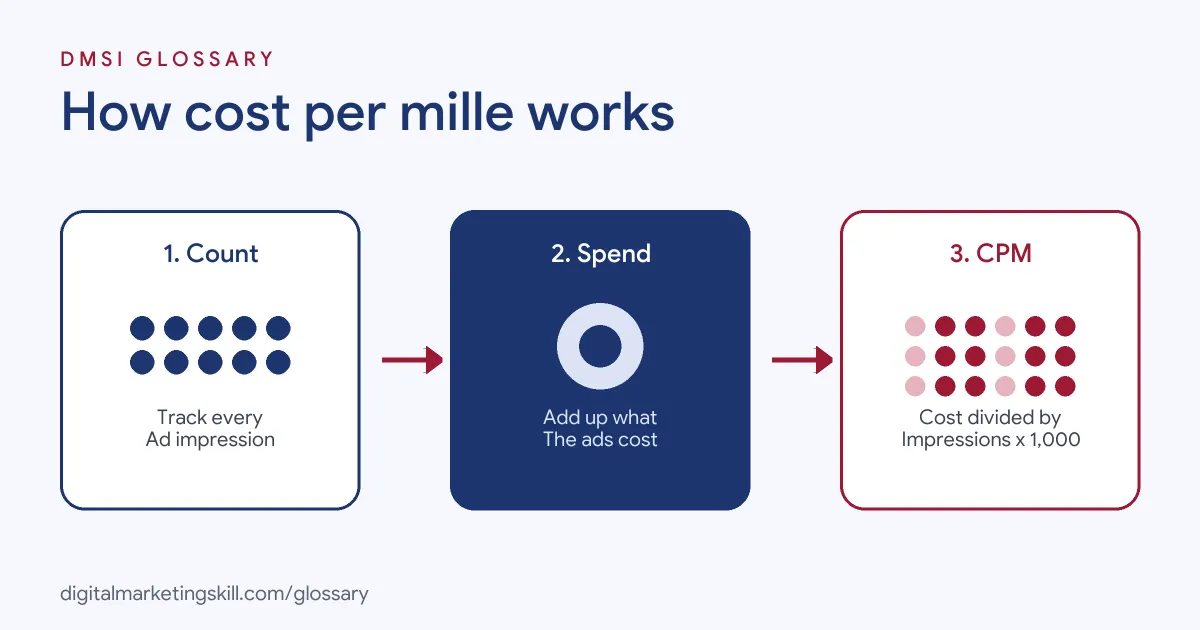
The idea is simple. First, the platform counts how many times your ad was shown. Next, it adds up what you spent. Finally, it divides the cost by the impressions and multiplies by 1,000.
CPM Bidding
With CPM bidding, you set how much you will pay for 1,000 impressions. Google Ads describes it as “a way to bid where you pay per one thousand views (impressions) on the Google Display Network.” This suits campaigns where the goal is to be seen, such as a brand launch.
Viewable CPM
Not every impression is actually seen. An ad might load at the bottom of a page that nobody scrolls to. That’s why Google offers viewable CPM. It says vCPM bidding “ensures that you only pay when your ads can be seen.”
Google explains that an ad counts as “viewable” when 50 percent of it “shows on screen for 1 second or longer for Display ads, or plays continuously for 2 seconds or longer for video ads.” It also notes that existing CPM bids “will be converted to vCPM automatically.”
Fixed CPM Buying
Some platforms let you lock in a price. For example, TikTok’s Reach & Frequency buying type lets you “plan and reserve campaigns in advance” at “a fixed CPM.” By contrast, its standard auction buying type is “delivered through dynamic auction bidding,” so the CPM can change.
Cost per Mille Examples
Here are three made-up examples of how marketers use CPM:
- Brand launch: A drinks brand runs a video campaign on CPM bidding to reach as many people in one city as possible. It judges success by reach and CPM.
- Platform comparison: A fashion retailer compares the CPM of the same ad on two social platforms. As a result, it moves more budget to the one that reaches its audience for less.
- Creative check: A software company sees its CPM rise on a tired ad. After that, it refreshes the creative and watches whether the cost comes back down.
Reading Cost per Mille With Other Metrics
CPM only tells you part of the story. Here is a made-up comparison of two ads, each with a $500 budget:
- Ad A: a $4 CPM, so it gets 125,000 impressions. It brings 250 clicks and 5 sales.
- Ad B: a $10 CPM, so it gets 50,000 impressions. It brings 400 clicks and 16 sales.
At first glance, Ad A looks better because it is cheaper to show. However, Ad B costs about $31 per sale, while Ad A costs $100 per sale. So the more expensive impressions were actually the better buy, because they reached people who were more interested.
This is why experienced media buyers read CPM next to click-through rate and cost per result. A rising CPM is worth investigating, but it is not a problem on its own if sales grow too. Likewise, a falling CPM is only good news if the quality of the audience stays the same.
CPM vs CPC vs CPA
These three pricing metrics measure different things. This table compares them:
| Metric | You pay or measure per | Best for |
|---|---|---|
| CPM | 1,000 impressions | Awareness and reach campaigns |
| CPC | One click | Driving traffic to a website |
| CPA | One conversion, such as a sale or lead | Campaigns focused on results |
In short, CPM tells you the price of being seen, CPC the price of a visit, and CPA the price of a result. Most campaigns track all three, because a low CPM with no sales is not a win.
How to Measure and Improve Cost per Mille
Follow these steps to manage CPM well:
- Find the metric. Add CPM (or cost per 1,000 impressions) as a column in your ads platform.
- Set a baseline. Note your average CPM for each platform, audience and placement.
- Prefer viewable impressions. On the Google Display Network, use viewable CPM so you only pay for ads that can be seen.
- Refine targeting. Very narrow or very popular audiences can cost more, so test a few sizes.
- Refresh creative. Rotate new images and videos so people do not tire of the same ad.
- Test placements. Compare feeds, stories and video placements, since costs vary.
- Judge it with results. Finally, read CPM next to click-through rate and cost per result.
Best Practices for Cost per Mille
- Compare like with like. CPMs differ by platform, country, audience and format, so compare similar campaigns.
- Watch frequency too. A low CPM can hide the same people seeing your ad again and again.
- Use CPM for awareness goals. For sales goals, focus on cost per result instead.
- Track trends. A sudden rise can point to tired creative, stronger competition or a narrow audience.
- Report it clearly. Show CPM with reach, so clients see both cost and scale.
Common CPM Mistakes
A few errors lead to wasted budget. First, advertisers chase the lowest CPM and end up with cheap, low-quality impressions. Second, they compare CPM across platforms without allowing for different formats. Third, they pay for impressions that nobody could see, when a viewable option exists. Finally, they judge a sales campaign on CPM alone, rather than on what those impressions delivered.
Where You’ll Use Cost per Mille at Work
CPM appears in almost every paid media job listing. For example, recent remote roles ask candidates to:
- “Analyze key performance metrics, including CPA, ROAS, CTR, CPM, and conversion rates, to evaluate campaign effectiveness” (Media Buyer).
- “Track ad performance metrics (CTR, ROAS, CPM, CPA) to optimize content for better results” (Paid Ads Content Strategist and Creator).
- Talk “about results in terms of cost per lead, cost per booked appointment and revenue per patient, not just CTR and CPM” (Senior Paid Media Specialist).
That last line is a useful lesson. Employers want Paid Social Specialists and Social Media Managers who understand CPM, but who also connect it to business results.
Learn It in the Social Media Track
You can learn to plan, buy and report on paid social in the AI-Powered Social Media Management and Advertising track. There, you plan, create and run a paid social campaign for a real brand, so you can show real costs and results. You also work on a U.S. Project Internship from day one, with unlimited 1-on-1 mentoring.
For more on paid social, read our guide to social media advertising.
Frequently Asked Questions
What does cost per mille mean?
It means the cost of 1,000 ad impressions. “Mille” is Latin for thousand.
How do you calculate CPM?
Divide the total cost by the number of impressions, then multiply by 1,000. For example, $50 for 10,000 impressions is a $5 CPM.
What is the difference between CPM and vCPM?
CPM counts all impressions. Viewable CPM only counts impressions that could be seen, which on Google means at least half the ad on screen for a set time.
Is a lower CPM always better?
No. A low CPM is only good if it reaches the right people and leads to results. Always read it alongside clicks and conversions.
When should I use CPM bidding?
Use it when your main goal is awareness or reach, such as a launch or brand campaign, rather than clicks or sales.
Sources: Google Ads Help: Cost-per-thousand impressions (CPM); Google Ads Help: Bid on viewable impressions using viewable CPM; TikTok Ads Help: About Reach & Frequency; remote job listings on Himalayas.