
Creator marketing is when a brand partners with social media creators to make content that promotes its products, often for both the creator’s channel and the brand’s own ads. The focus is on the creator’s skill at making content people want to watch, not just on the size of their audience. It matters because creator-made videos and posts often feel more natural than polished brand ads, so people are more likely to stop, watch and trust them.
Key Takeaways
- Brands pay or reward creators for content, which can run on the creator’s account, the brand’s account or as paid ads.
- Platforms have built tools for it. For example, TikTok’s Spark Ads let brands run a creator’s organic post as an ad, with the creator’s permission.
- YouTube’s Creator Partnerships programme connects brands with eligible YouTube Partner Programme creators for brand deals.
- Rewards of any kind count as payment in the UK, so creator posts must be clearly labelled as ads.
- Agree content rights in writing before you reuse a creator’s work in your own ads.
What Is Creator Marketing?
A creator is anyone who makes and shares content online, from video tutorials to recipe posts and podcasts. Many creators have loyal audiences. Just as importantly, they know how to make content that works on each platform.
This approach overlaps with influencer marketing, and many people use the terms interchangeably. However, there is a useful difference in focus. Influencer marketing often centres on reach: who can put your brand in front of their followers. Creator marketing puts more weight on the content itself, which a brand may reuse across ads, product pages and emails.
For example, a kitchenware brand hires three cooking creators to film short recipe videos with its new pan. Each creator posts on their own channel. The brand then runs the best-performing video as a paid ad, with the creator’s name still on it.
How Creator Marketing Works
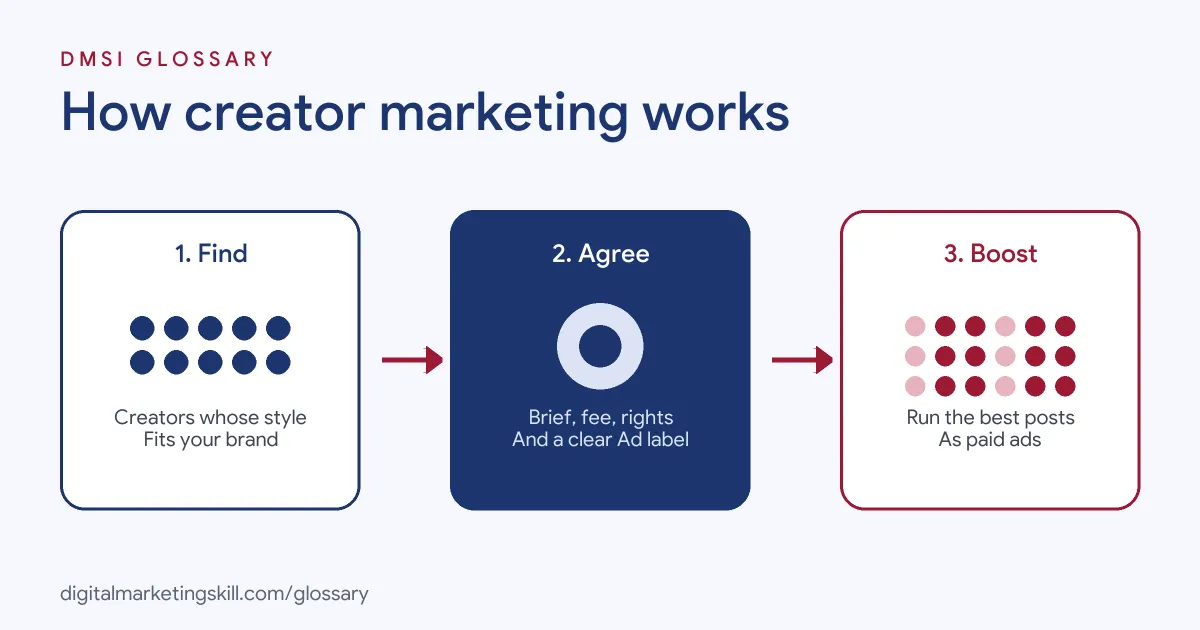
Most partnerships follow four stages. First, you find creators whose style and audience fit your brand. Second, you agree a brief, a fee and usage rights. Third, the creator makes and posts the content with a clear ad label. Finally, you measure results and, if it performs, put paid budget behind it.
Platform Tools for Creator Marketing
The big platforms offer built-in ways to work with creators:
- TikTok Spark Ads: TikTok describes Spark Ads as “a native ad format that allows you to leverage organic TikTok posts”. You can use your own posts or “organic posts made by other creators (with their authorization)”. Views, likes, comments, shares and follows from the ad are credited to the original post.
- YouTube Creator Partnerships: YouTube says the programme “enables brands to partner with eligible YouTube Partner Programme creators for brand deals.” To be visible to brands, creators must be at least 18 and in the YouTube Partner Programme.
The Shift to Smaller Creators
Brands increasingly spread budget across many smaller creators. Influencer Marketing Hub’s benchmark report points to “a continued shift toward nano/micro and UGC-driven production.” In practice, that means more, cheaper pieces of content, tested quickly to find what works.
Labels and Rules
The UK Competition and Markets Authority (CMA) says “Any form of incentive or reward” counts as payment, including gifts and commission. Whenever a creator has been incentivised, the content “must be clearly labelled as an advert or ad”. This applies to creators at every size.
Creator Marketing Examples
Here are three made-up examples:
- App launch: A budgeting app pays ten finance creators to film “how I saved my first £1,000” videos. It runs the top three as Spark Ads.
- Product pages: A trainer brand licenses creator try-on videos and adds them to its product pages and emails.
- Long-term partner: A travel company signs a creator for a year-long series. Each video follows one trip, labelled as an ad.
Creator Marketing vs Influencer Marketing vs UGC
These terms overlap, but each has a slightly different focus:
| Approach | Main focus | Where the content runs |
|---|---|---|
| Influencer marketing | Reaching the creator’s audience | Mostly the creator’s own channel |
| Creator marketing | Content made by skilled creators | The creator’s channel, brand channels and paid ads |
| UGC (user-generated content) | Content from customers or paid UGC creators | Often brand channels and ads, not the creator’s feed |
In short, the more you plan to reuse the content, the more you are doing creator marketing.
How to Start a Creator Marketing Programme
- Set a clear goal, such as sales, app installs or fresh ad creative.
- Find creators in your niche by searching hashtags, platform marketplaces and competitors’ tagged posts.
- Check each creator’s audience quality and past brand work.
- Agree the fee, the number of posts, deadlines and how long you can use the content.
- Write a short brief with key messages and proven claims. Leave room for the creator’s style.
- Make sure every post carries a clear “Ad” label.
- Set up tracking, such as unique links, codes or platform ad reporting.
- Boost the winners with paid budget and rebook the creators who perform best.
How to Measure Creator Content
Judge each piece of content on two levels. First, how it performs on the creator’s own channel, through views, saves, comments and clicks on tracked links. Second, how it performs as an ad, through cost per result and return on ad spend. A video that does well organically doesn’t always win as an ad, and the reverse is true too. So test several creators and hooks side by side, then put more budget behind the clear winners. Over time, you build a library of proven content and a shortlist of creators you trust.
Best Practices for Creator Marketing
- Trust the creator’s craft. They know what works on their platform better than a brand brief does.
- Get rights in writing. State where and for how long you can use the content.
- Use platform tools. Formats such as Spark Ads keep the creator’s name and engagement on the ad.
- Check audiences. In the benchmark report, fake or bot followers made up 56.5% of reported fraud and quality issues.
- Build long-term partnerships. Repeat creators get to know your product and sound more natural.
Common Creator Marketing Mistakes
Brands often write scripts so tight that the content sounds like a standard advert. Others forget to agree usage rights, then can’t run the best video as an ad. Some skip the ad label because the creator was “only” gifted a product. Many judge creators on follower count rather than the quality of their content. Finally, some never test different creators, hooks or formats, so they miss what really drives results.
Where You’ll Use Creator Marketing at Work
Creator partnerships now sit inside many social and growth roles. For example, recent remote job listings ask for:
- Someone who “understands how to orchestrate creator/influencer marketing functions to achieve strategic and operational excellence” (Associate Director, Integrated Strategy).
- A person “comfortable working with different teams, creators, and external partners” (Social Media and Partnerships Coordinator).
- “Experience with UGC, influencer marketing and creator partnerships” (Growth Marketing Manager).
So if you want to work as a Social Media Manager, Paid Social Specialist or Content Creator, expect to brief creators, manage rights and turn their content into ads.
Learn It in the Social Media Track
You can learn to plan and run creator content in the AI-Powered Social Media Management and Advertising track. It covers AI fundamentals, content creation with graphics and video, social media marketing and analytics, and social media advertising. Your portfolio project is a paid social campaign that you plan, create and run for a real brand. You also get unlimited 1-on-1 mentoring and a U.S. Project Internship from day one.
Next, read our guides to being a content creator on TikTok and a digital creator. You may also like our glossary entries on micro-influencers and user-generated content.
Frequently Asked Questions
What is creator marketing in simple terms?
It is a brand working with social media creators to make content that promotes its products, on the creator’s channel and often in the brand’s ads.
Is creator marketing the same as influencer marketing?
They overlap a lot. Creator marketing puts more focus on the content and how the brand can reuse it, while influencer marketing focuses more on reach.
What are Spark Ads?
Spark Ads are a TikTok format that lets brands run organic posts, including creators’ posts with their permission, as ads.
Do creators need to label paid posts?
Yes. In the UK, the CMA says incentivised content must be clearly labelled as an ad, whether the reward is money, gifts or commission.
Can I reuse a creator’s video in my own ads?
Only if you agree it in advance. Set out where, how and for how long you can use the content in your contract.
Sources: TikTok Ads Help: About Spark Ads; YouTube Help: Get started with Creator Partnerships; CMA: Social media endorsements guide; Influencer Marketing Hub: Benchmark report; remote job listings on Himalayas.