
A key performance indicator (KPI) is a number you track to see whether you are making progress towards an important goal. It is one of the few measures a team agrees matter most, with a clear target and a time frame. It matters because it turns a vague aim, such as “grow the business”, into something you can check, discuss and improve.
Key Takeaways
- A KPI is a measure linked to a goal. It is not the goal itself.
- Every KPI is a metric, but only a few metrics are important enough to be KPIs.
- Good KPIs follow the SMART idea: specific, measurable, achievable, relevant and time-bound.
- Leading indicators help you act early, while lagging indicators show final results.
- Too many KPIs, or the wrong ones, can push a team to chase numbers instead of real value.
What Is a Key Performance Indicator?
A KPI is a type of performance measurement. In plain terms, it tells you whether an activity, a team or a whole business is on track. For example, an online shop that wants more sales might track its monthly revenue, its conversion rate and the number of repeat buyers.
The word “key” is important. Most marketing tools show you dozens of numbers. However, only a handful link directly to what the business is trying to achieve. Those are your KPIs. The rest are supporting metrics that help explain why a KPI moved.
In other words, a KPI is a signal, not a target in itself. As one definition puts it, “an indicator is a measurable variable used to show whether progress is being made towards a goal.” So you always start with the goal, then choose the number that best shows progress.
How a Key Performance Indicator Works
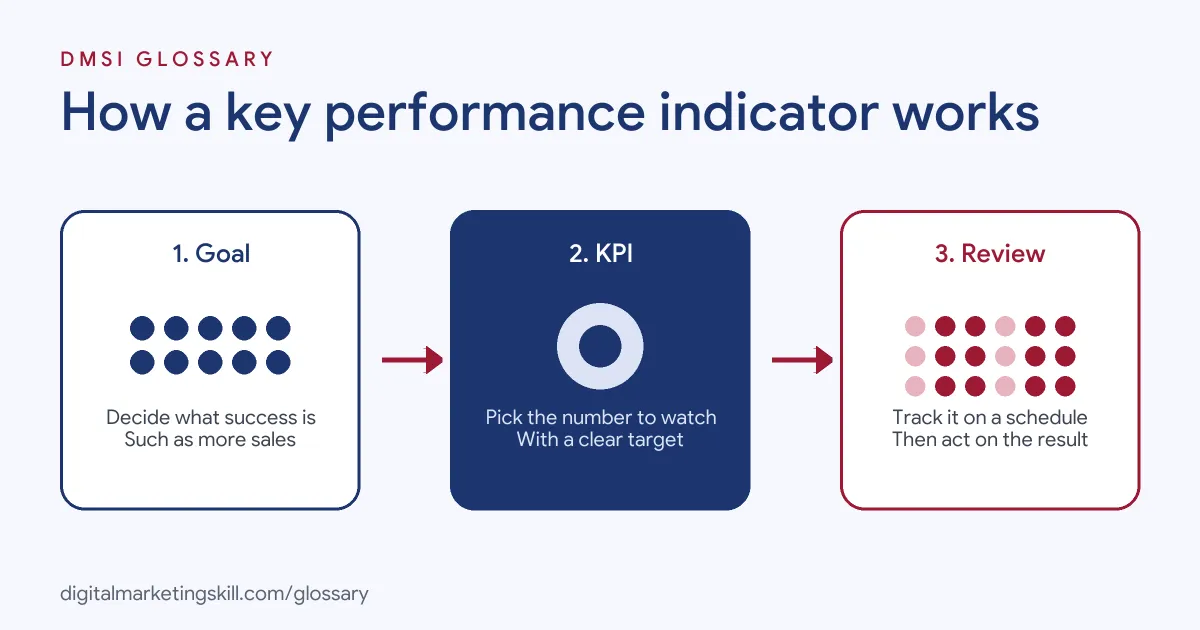
Every KPI follows a simple loop. First, you set a goal. Next, you choose the measure that shows progress and give it a target. Finally, you review the number on a schedule and act on what it tells you.
Start With the Goal
Begin with what the business needs. For instance, a training school might want more enrolments, while a software company might want fewer customers to cancel. The goal shapes everything else.
Choose Leading and Lagging Indicators
There are two kinds of indicator. Lagging indicators are “outcome-oriented”, measuring the results of past work, such as sales last month. They are easy to measure but hard to change directly. Leading indicators, by contrast, are “predictive measures that influence future outcomes”, such as demo bookings this week. They are easier to act on but harder to link to final results.
A good set of KPIs usually mixes both. That way, you can spot problems early and still judge the end result.
Numbers and Opinions
Most marketing KPIs are quantitative. They give you an objective number, such as leads or revenue. Some, however, are qualitative. These capture opinions and feelings, usually through surveys and interviews. A customer satisfaction score is a common example. Both types are useful, as long as each one links to a real goal.
Track It in Your Tools
Many marketing KPIs come from your analytics. In Google Analytics, you can mark important actions as key events. Google says these “measure actions that are important to your business.” Standard properties allow up to 30 key events. Furthermore, you can turn them into Google Ads conversions, so your ads learn from the same goals.
Key Performance Indicator Examples
Here are three examples from different marketing teams:
- Online shop: The goal is more profitable sales. The KPI is revenue from returning customers, with a monthly target. Supporting metrics include email clicks and basket size.
- Lead generation: The goal is more sales calls. The KPI is qualified leads per month. Supporting metrics include landing page conversion rate and cost per lead.
- Social media: The goal is stronger brand awareness in a new city. The KPI is reach among local followers. Supporting metrics include engagement rate and profile visits.
In each case, one main number tells the team whether it is winning. The other metrics explain why.
Here is how the lead generation example might look in a weekly report. The team wants 200 qualified leads this quarter, so it needs roughly 15 a week. Its leading indicator is landing page visits, because fewer visits today mean fewer leads next week. If visits drop on Monday, the team can fix the ads before the KPI slips. That is the real value of a KPI: it tells you when to act.
Common Marketing KPIs by Channel
Different channels lead to different KPIs. This table shows typical choices:
| Channel | Common KPIs | Supporting metrics |
|---|---|---|
| Paid search | Conversions, cost per conversion, return on ad spend | Clicks, click-through rate, Quality Score |
| SEO | Organic leads or sales, organic traffic to key pages | Rankings, impressions, backlinks |
| Revenue or leads from email | Click rate, list growth, unsubscribes | |
| Social media | Leads, sales or reach in a target audience | Engagement rate, follower growth, shares |
Notice that the supporting metrics are useful but rarely the point. For instance, a rise in clicks only matters if conversions follow.
How to Choose a Key Performance Indicator
Use these steps to set up KPIs for a campaign or a team:
- Write down the goal. Keep it short, such as “double qualified leads from the website”.
- Pick one main KPI for that goal. Choose the number that moves when the goal moves.
- Make it SMART. Add a target and a deadline, and check that it is achievable.
- Add one or two leading indicators. These warn you early if you are off track.
- Set up tracking. Mark the right actions as key events or conversions, and test them.
- Agree who owns it. Every KPI needs a person who reports on it and acts on it.
- Review on a schedule. Look weekly or monthly, then decide what to change.
Best Practices for KPIs
- Keep the list short. Three to five KPIs per team are easier to follow than twenty.
- Link each KPI to money or a clear outcome. Otherwise, it may be a vanity number.
- Use the same definitions everywhere. Agree exactly what counts as a “lead” or a “sale”.
- Show trends, not just totals. A number is more useful when you compare it with last month.
- Retire KPIs that no longer fit. As goals change, your measures should change too.
Common Mistakes to Avoid
Teams often get KPIs wrong in predictable ways. First, they track what is easy rather than what matters. Research on performance indicators warns of a shift “to what is easily measurable rather than what is substantively important.” Second, they set targets that reward the wrong behaviour. For example, a target for leads alone can bring in many poor leads. This is a form of Goodhart’s law: once a measure becomes a target, people may game it. Third, they track too many numbers and act on none of them.
Where You’ll Use KPIs at Work
KPIs appear in almost every marketing job listing. For example, recent remote listings ask candidates to:
- “Partner with marketing teams to define KPIs, establish measurement frameworks, and provide data-driven recommendations” (Data Analyst, Marketing Analytics).
- Show “experience leading multi-channel campaigns with clear KPIs and ROI tracking.” (Director of Marketing)
- Take on a role that “optimizes ROI by establishing KPIs and reporting frameworks to measure campaign effectiveness” (Senior Demand Generation Manager).
So whether you aim to be a Digital Marketing Manager, Growth Marketer, Freelance Digital Marketer or Agency Owner, you will be asked to set KPIs and report on them.
Learn It in the Full Stack Programme
You can learn to set and track KPIs across every channel in the Full Stack (all four tracks) programme. It includes all ten courses and one portfolio project from each track, so you practise measuring social, email, Google Ads and SEO work. You also join a U.S. Project Internship from day one, with unlimited 1-on-1 mentoring.
For more ideas, read our guide to digital marketing KPIs, which shows how to pick the few that matter.
Frequently Asked Questions
What is a key performance indicator in simple terms?
It is a number that shows whether you are on track to reach an important goal. Teams pick a few and review them regularly.
What is the difference between a KPI and a metric?
A metric is any number you can measure. A KPI is a metric that you have chosen because it links directly to a key goal.
How many KPIs should a team have?
There is no fixed rule. However, most teams find three to five main KPIs easier to manage and act on than a long list.
What does SMART mean for KPIs?
SMART stands for specific, measurable, achievable, relevant and time-bound. It is a checklist for writing clear targets.
Is ROI a key performance indicator?
It can be. Many teams use return on investment as a main KPI, because it links marketing spend directly to results.
Sources: Wikipedia: Performance indicator; Google Analytics Help: About key events; Google Ads Help: About conversion tracking; remote job listings on Himalayas.