
A SWOT analysis is a simple planning tool that lists a business’s strengths, weaknesses, opportunities and threats, usually in a four-box grid. Strengths and weaknesses are internal, while opportunities and threats come from outside the business. It matters because it gives you an honest picture of where you stand before you set a marketing strategy or launch a campaign.
Key Takeaways
- SWOT stands for strengths, weaknesses, opportunities and threats.
- Strengths and weaknesses are internal and mostly within your control. Opportunities and threats are external and mostly outside it.
- The aim is action. A good analysis ends with clear choices, not just four lists.
- Keep each list short and specific. Long, vague lists are a common mistake.
- Repeat it regularly, since a SWOT is a snapshot and markets change.
What Is a SWOT Analysis?
Wikipedia describes it as “a decision-making technique that identifies the strengths, weaknesses, opportunities, and threats of an organization or project.” It is also known as a SWOT matrix or situational analysis. Results are often shown as a 2 × 2 grid, with one box for each letter.
MindTools sums up the value well. It says a SWOT analysis “can help you to challenge risky assumptions, uncover dangerous blindspots, and reveal important new insights.” In other words, it forces you to look at both the good and the bad before you commit to a plan.
For example, a small bakery is thinking about selling online. Its strengths include loyal local customers and award-winning bread. A weakness is that it has no website. An opportunity is that more people now want local delivery. A threat is a new supermarket bakery nearby. Seeing all four together helps the owner decide what to do first.
How a SWOT Analysis Works
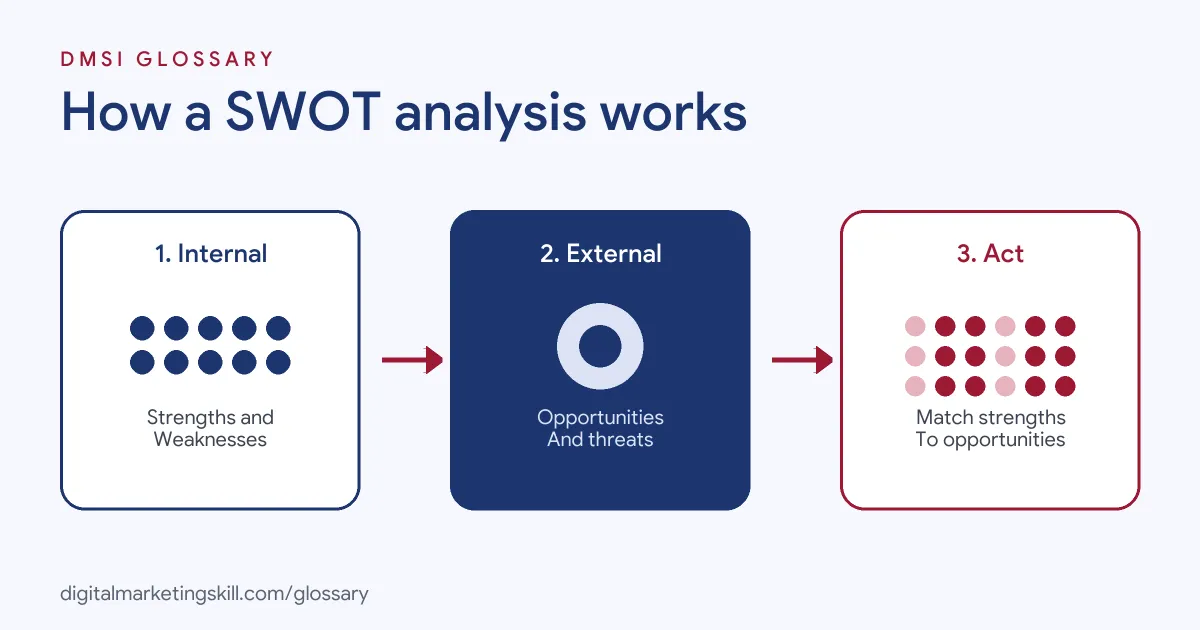
The tool splits factors along two lines: internal versus external, and helpful versus harmful. That gives four boxes.
Internal Factors in a SWOT Analysis
Wikipedia notes that “Strengths and weaknesses are usually considered internal.” These are things you can change, such as your skills, products, name, budget and tools. SumUp’s guide suggests questions like “What does my business do well?” and “What are the unique features or benefits of my products or services?”
External Factors
Opportunities and threats “are usually considered external.” These include market trends, rivals, new tech, new rules and shifts in what customers want. MindTools adds a useful tip: use a PEST analysis, which looks at political, economic, social and technological factors, so you don’t overlook threats.
Matching Strengths to Opportunities
The real value comes when you connect the boxes. Wikipedia explains that the degree to which internal strengths match external opportunities “is known as its strategic fit.” For instance, if your strength is video content and the opportunity is growth in short-form video, that’s a strong fit worth investing in.
SWOT Analysis Example
Here is a made-up example for a freelance social media manager who wants to grow:
| Helpful | Harmful |
|---|---|
| Strengths: strong video editing skills; three happy clients with results to show; fast turnaround | Weaknesses: no paid ads experience; small portfolio; no case studies on a website |
| Opportunities: local businesses want short-form video; clients asking about paid social; referrals from existing clients | Threats: cheaper competitors on freelance sites; AI tools lowering the price of basic content; one client making up most of the income |
From this, the freelancer might decide to learn paid social, publish two case studies and win one more client to reduce the risk of relying on a single account.
A Quick SWOT for One Campaign
You don’t have to analyse a whole company. You can run a quick SWOT on one campaign in ten minutes. Here is how it might look for a made-up email launch. Strength: a list of people who bought before. Weakness: no time to make new images. Opportunity: a holiday sale period is coming up. Threat: rivals send lots of offers at the same time. The plan writes itself. Send early, lean on past buyers and reuse your best images. Small, fast checks like this are often more useful than one big report a year.
SWOT vs TOWS vs PEST
These tools are often used together. Here is how they differ:
| Tool | Focus | When to use it |
|---|---|---|
| SWOT | Strengths, weaknesses, opportunities, threats | A quick overview of your position |
| TOWS | The same factors, starting with the external ones | Turning findings into specific strategies |
| PEST | Political, economic, social and technological factors | Scanning the outside world in more depth |
MindTools explains that while SWOT “puts the emphasis on the internal environment”, TOWS “forces you to look at your external environment first.” In most cases, you do a SWOT first, then follow up with TOWS.
How to Do a SWOT Analysis
- Define the subject. It could be your whole business, one product or one campaign.
- Gather people with different views, such as sales, support and marketing.
- List strengths. Focus on what you do better than competitors, not just what you do.
- List weaknesses honestly. Include gaps in skills, budget or data.
- List opportunities from the market, such as trends, new channels or unmet needs.
- List threats, such as competitors, costs or changes in rules.
- Rank each list and keep the top three to five items.
- Turn the findings into actions, with an owner and a deadline for each.
Turning Findings Into Actions
A simple way to do this is to pair the boxes. Use strengths to grab opportunities. Use strengths to reduce threats. Fix weaknesses that stop you taking opportunities. Finally, avoid situations where a weakness meets a threat. This turns four lists into a short plan you can actually follow. Keep it to a few clear moves. Too many actions at once means none get done well.
Best Practices for a SWOT Analysis
- Be specific. “Strong brand” is vague. “Rated highly by repeat customers” is useful.
- Use evidence. Back up points with data, such as reviews, sales figures or search trends.
- Compare with competitors. A strength only counts if it sets you apart.
- Keep lists short. MindTools names “Making your lists too long” as a common mistake.
- Revisit it. Update your analysis when the market or your business changes. Put a date in the diary to check it again.
Common SWOT Analysis Mistakes
Many teams mix up internal and external factors, listing “new competitor” as a weakness rather than a threat. Others write long lists with no priorities. Some only include positives, which defeats the purpose. Another mistake is stopping at the grid and never turning it into actions. Finally, many treat the analysis as permanent. Wikipedia notes that SWOT has been criticised for limitations such as its static nature, so it needs regular updates.
Where You’ll Use SWOT Analysis at Work
Job listings rarely use the acronym itself. Even so, many marketing roles ask for the competitive analysis that sits behind it. For example, recent remote listings ask candidates to:
- “Conduct keyword research, audience targeting, and competitor analysis to maximize campaign performance” (Marketing Ads Specialist).
- “Oversee the creation of SEO-optimized, conversion-focused product listings using keyword research and competitor analysis” (Amazon Brand Development and Launch Manager).
So whether you aim to be a Digital Marketing Manager, Growth Marketer or Agency Owner, you will need to size up a business and turn what you find into a plan. A SWOT is often the first page of that plan.
Learn It in the Full Stack Track
Strategy work spans every channel, so the best fit is the Full Stack option, which covers all four tracks. You take all ten courses, starting with AI fundamentals for strategy and planning, and complete one portfolio project from each track. You also work on a U.S. Project Internship from day one, with unlimited 1-on-1 mentoring.
Next, read our guide to a digital marketing strategy audit and our small business marketing plan guide. You may also like our glossary entries on marketing strategy and the marketing mix.
Frequently Asked Questions
What does SWOT stand for?
Strengths, weaknesses, opportunities and threats. The first two are internal, and the last two are external.
What is the purpose of a SWOT analysis?
It helps you understand your position, so you can build on strengths, fix weaknesses, chase opportunities and prepare for threats.
Can I do a SWOT analysis on my own?
Yes, but it works better with input from others. Different people spot different strengths and risks. Even a short chat with a client or a friend can help.
How often should you update it?
Review it at least before each major plan or launch, and whenever your market changes in a big way.
Is a SWOT analysis enough to build a strategy?
Not on its own. It is a starting point. You still need goals, a target audience, a budget and a plan for each channel. Think of it as the map you check before you choose a route.
Sources: Wikipedia: SWOT analysis; MindTools: SWOT analysis; SumUp: SWOT analysis for small business; remote job listings on Himalayas.