
Net Promoter Score (NPS) is a customer loyalty metric based on one question: how likely are you to recommend us to a friend or colleague, on a scale from zero to ten? You subtract the percentage of unhappy customers (detractors) from the percentage of enthusiastic fans (promoters) to get a single score. It matters because it gives teams a simple, trackable number for loyalty, which links closely to repeat sales and referrals.
Key Takeaways
- NPS asks one question and scores answers from 0 to 10.
- Promoters score 9 or 10, passives score 7 or 8 and detractors score 0 to 6.
- Your score is the percentage of promoters minus the percentage of detractors.
- Because of that sum, a score can range from -100 to +100.
- Fred Reichheld, a partner at Bain & Company, created the metric, and Bain says promoters account for more than 80% of referrals in most businesses.
What Is Net Promoter Score?
Bain describes NPS as “the key metric of the Net Promoter System.” It is measured by asking what Bain calls “the ultimate question”: “How likely are you to recommend us to a friend or colleague?” Customers answer on “a simple zero-to-ten scale.”
The idea is simple. People who would recommend you are likely to stay, buy again and bring others. People who wouldn’t are at risk of leaving. So the balance between the two groups tells you a lot about future growth.
According to Bain, the metric was created by Fred Reichheld, a partner at the firm, who then “shared the methodology so anyone could apply it.” NPS is a part of the wider customer experience picture.
How Net Promoter Score Works
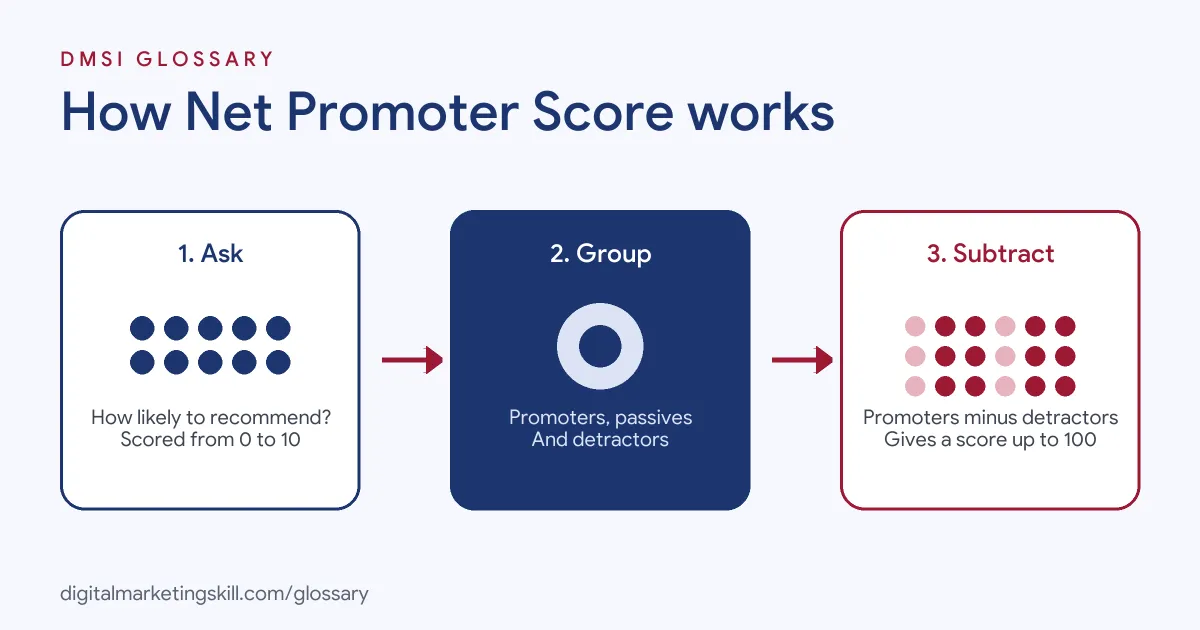
The method has three steps. First, you ask customers the recommend question. Next, you sort their answers into three groups. Finally, you subtract the share of detractors from the share of promoters.
The Three Groups
Bain defines each group clearly. Promoters, who score 9 or 10, “are loyal, enthusiastic fans.” They “are far more likely than others to remain customers and to increase their purchases over time.”
Passives score 7 or 8. Bain calls them “passively satisfied” because “this group is satisfied—for now.” Their repurchase and referral rates, it says, are “as much as 50% lower than those of promoters.”
Detractors score 0 to 6. According to Bain, “detractors are unhappy customers” who “have high rates of churn and defection.” In other words, they are the people most likely to leave.
The Calculation
Bain puts it this way: “Your Net Promoter Score is simply the percentage of customers who are promoters (those who scored 9 or 10)” minus “the percentage who are detractors (those who scored 0 to 6).” Passives count towards the total number of answers, but they are not added or subtracted.
Why NPS Links to Growth
Bain argues that the score is more than a survey result. It says its research “has established a strong link between organic growth and a company’s Net Promoter Score.” It also reports that “sustained value creators have Net Promoter Scores two times higher than the average company.”
For B2B firms, Bain says NPS “correlates closely with greater market share, better employee engagement and higher profitability.” In addition, the same idea has been applied to staff. Bain notes that the approach is the basis for Employee NPS, which asks employees a similar question about their workplace.
Net Promoter Score Examples
Here are three made-up examples that show how the sum works:
- Online shop: 200 customers answer. 120 are promoters (60%), 50 are passives (25%) and 30 are detractors (15%). The score is 60 minus 15, which equals 45.
- Software company: 100 users answer. 30 are promoters, 40 are passives and 30 are detractors. The score is 30 minus 30, which equals 0.
- Gym: 50 members answer. 10 are promoters (20%) and 25 are detractors (50%). As a result, the score is -30, a clear warning sign.
In each case, the score is a percentage difference, not an average of the answers.
NPS Groups at a Glance
Here is a quick summary of the three groups:
| Group | Score | What Bain says about them |
|---|---|---|
| Promoters | 9 or 10 | Loyal, enthusiastic fans who are far more likely to stay and buy more |
| Passives | 7 or 8 | Satisfied for now, with repurchase and referral rates as much as 50% lower than promoters |
| Detractors | 0 to 6 | Unhappy customers with high rates of churn and defection |
How to Measure Net Promoter Score
- Decide what you want to measure, such as the whole brand, one product or one support team.
- Choose when to ask. For example, ask a set time after purchase, or after a support case closes.
- Send the standard question with a 0 to 10 scale.
- Add one open follow-up question, such as “What is the main reason for your score?”
- Sort the answers into promoters, passives and detractors.
- Subtract the detractor percentage from the promoter percentage.
- Track the score over time and read the comments to find what to fix.
Bain notes that you can track the score “not only for a whole company but also for each business, product, store or customer-service team.” You can also track it by customer segment or region.
Using NPS in Marketing
The score is useful well beyond the support team. Here is how marketers often put each group to work:
- Promoters: ask them for a review, a testimonial or a referral. They are your most willing advocates.
- Passives: send them helpful content or a small reason to come back, so they move up a group.
- Detractors: pass them to support first. Then hold back sales emails until the problem is fixed.
For example, imagine a shop tags every promoter in its email tool. A week later, it sends them a short email asking for a review. As a result, its review count grows from the customers most likely to say good things.
Writing a Good Survey
Keep the survey short, because long forms put people off. Use the standard question, then one open question. Send it soon after a key moment, while the experience is fresh. Finally, make it easy to answer on a phone, with one tap for the score. Then thank people for their time, and tell them what you will do with their answers.
Best Practices
- Always ask why. The number shows where you stand. The comments show what to change.
- Close the loop. Follow up with detractors to fix problems, and thank promoters.
- Ask at consistent moments. That way, changes in the score reflect real changes, not timing.
- Compare like with like. Track your own trend, and compare teams or products on the same basis.
- Turn promoters into referrals. Since promoters drive most referrals, invite them to review or refer.
Common Mistakes to Avoid
Many teams average the scores instead of subtracting detractors from promoters, which gives the wrong number. Others survey only happy customers, which inflates the result. Some collect the score but ignore the comments, so nothing improves. Finally, many treat one score as the whole truth. It works best alongside behaviour data, such as repeat purchases and churn rate.
Where You’ll Use Net Promoter Score at Work
NPS appears often in client and customer success roles. For example, recent remote job listings ask for:
- “Client satisfaction and advocacy, measured through Net Promoter Score (NPS) or an equivalent measure.” (Account Director).
- “Monitor key customer success metrics, including Net Promoter Score (NPS) and customer adoption trends” (Customer Success Manager).
- “Tracking and analyzing client satisfaction and service metrics, such as net promoter score (NPS) and churn rate” (Client Services Manager).
So as a Digital Marketing Manager or Growth Marketer, you may use NPS to shape referral campaigns, testimonials and retention emails.
Learn It in the Full Stack Programme
NPS connects marketing, email and customer experience, so it fits the Full Stack (all four tracks) option. It covers all ten courses, with one portfolio project from each track. Every track is about 90% hands-on, with unlimited 1-on-1 mentoring and a U.S. Project Internship from day one.
Frequently Asked Questions
What is a good Net Promoter Score?
Any score above zero means you have more promoters than detractors. Beyond that, the most useful comparison is your own trend over time and similar businesses.
How do you calculate NPS?
Take the percentage of promoters (9 or 10) and subtract the percentage of detractors (0 to 6). Passives (7 or 8) are not added or subtracted.
What is the NPS question?
Bain’s version is: “How likely are you to recommend us to a friend or colleague?” Customers answer from 0 to 10.
Can NPS be negative?
Yes. If you have more detractors than promoters, the score is below zero. It can range from -100 to +100.
Who created the Net Promoter Score?
Bain says it was created by Fred Reichheld, a partner at Bain & Company.
Sources: Bain: Measuring your Net Promoter Score; Bain: About the Net Promoter System; remote job listings on Himalayas and Himalayas.