
Churn rate is the percentage of customers who stop using or paying for your product during a set period, such as a month or a quarter. If you start with 100 subscribers and 5 cancel, your churn for that period is 5%. It matters because you must replace every lost customer before you can grow, so even a small rise in churn can stall a business.
Key Takeaways
- The basic formula is customers lost during a period, divided by customers at the start, multiplied by 100.
- Always state the period. A monthly figure and an annual figure tell very different stories.
- Voluntary churn happens when a customer chooses to leave. Involuntary churn happens when a payment fails.
- Revenue churn tracks lost income rather than lost customers, which matters when plans have different prices.
- Recurly’s research found that voluntary churn made up most of total churn in every industry it measured.
What Is Churn Rate?
Picture a bucket with a small hole in it. You keep pouring water in, which is your marketing. But water keeps leaking out, which is your churn. If the hole grows, you have to pour faster just to keep the level steady.
Amplitude defines churn as “the rate at which customers stop using a product, service, or subscription over a given period.” The idea applies to any business with repeat customers, from software to streaming to meal kits. However, it is most common in subscription businesses, because a cancellation is easy to see.
The opposite measure is retention. If 5% of customers churn in a month, then 95% stayed. Both numbers come from the same data, so teams often track them side by side.
How Churn Rate Works
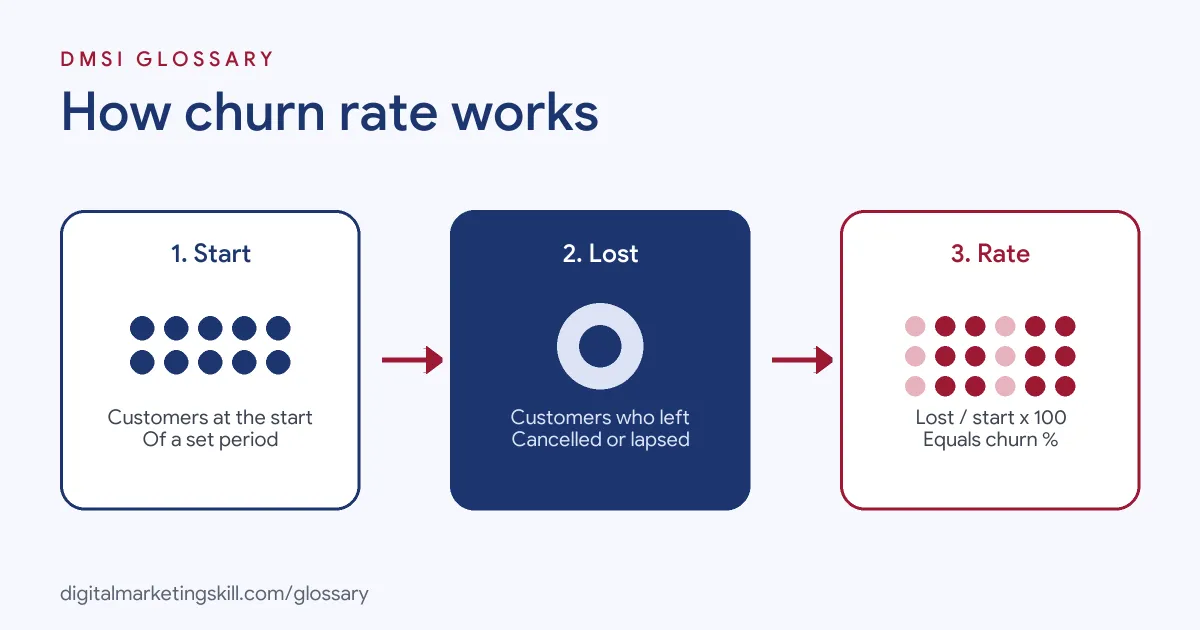
You need three things to work it out. First, the number of customers at the start of the period. Next, the number who left during it. Finally, a simple division to turn that into a percentage.
The Churn Rate Formula
Amplitude gives the standard formula: churn rate = (customers lost during period ÷ customers at start of period) × 100. In its worked example, a software product starts a quarter with 500 customers and loses 25. So the churn for that quarter is (25 ÷ 500) × 100 = 5%.
This calculation leaves out new customers who join during the period. That keeps the number focused on the people you already had.
Revenue Churn
Counting people isn’t always enough. If one large client leaves, you might lose more income than if ten small ones did. That’s why many teams also track revenue churn. Amplitude’s version is monthly recurring revenue lost during the period, divided by monthly recurring revenue at the start, multiplied by 100.
Some teams go a step further and track net churn. This subtracts expansion revenue, such as upgrades and add-ons, from the revenue you lost.
Here is a simple worked example. A business starts the month with 20,000 in monthly recurring revenue. Cancellations and downgrades remove 1,500 of it, so revenue churn is 1,500 ÷ 20,000 × 100 = 7.5%. Meanwhile, existing customers upgrade and add 500. Net revenue lost is therefore 1,000, which gives a net churn of 5%. If upgrades ever exceed losses, net churn turns negative, which means your existing customers are growing revenue on their own.
Voluntary and Involuntary Churn
Recurly splits churn into two types. Voluntary churn is when a subscriber actively cancels. Involuntary churn is when a subscriber loses access because a payment fails. The two need very different fixes, so it pays to measure them separately.
Churn Rate Examples
- Meal-kit service: It starts the month with 2,000 subscribers and 140 cancel. Its monthly churn is 7%. A survey shows most leave after the third box, so it improves the recipes in that box.
- Online course membership: It loses 30 of its 600 members in a month, which is 5%. On closer inspection, a third of those losses come from expired cards. As a result, the team sets up automatic payment reminders.
- B2B software: It loses only 4 of 200 accounts in a quarter, a 2% customer churn. However, one of those accounts was its largest client. So its revenue churn is much higher than 2%.
We made up these figures for illustration. Even so, they show why you should look beyond a single headline number.
Customer Churn vs Revenue Churn vs Retention Rate
| Metric | What it measures | When to use it |
|---|---|---|
| Customer churn rate | Share of customers lost in a period | When most customers pay similar amounts |
| Revenue churn rate | Share of recurring revenue lost in a period | When plan sizes vary a lot |
| Net churn | Revenue lost minus expansion revenue | When upgrades and add-ons are common |
| Retention rate | Share of customers who stayed | When you want the positive side of the same story |
In short, customer churn shows how many people leave, while revenue churn shows how much it costs you.
How to Measure and Reduce Churn Rate
- Define “churned”. Amplitude advises starting with a clear definition for your business, such as a cancelled plan or 60 days with no purchase.
- Pick a fixed period. Use the same month or quarter length every time, so your trend is fair.
- Split voluntary and involuntary churn. Failed payments need a different fix from unhappy customers.
- Segment by cohort. Group churned users by plan, channel or behaviour to see patterns.
- Fix the cause. Amplitude points to stronger onboarding, faster time to value and outreach to at-risk users.
- Recover failed payments. Payment retries, dunning emails and card update flows can win back involuntary churn.
- Test and repeat. Run controlled experiments, then measure churn again in the next period.
Monthly vs Annual Churn
Small monthly numbers add up. Recurly gives the example that 2% monthly churn is roughly 22% a year. The losses build on each other, month after month. So a number that looks tiny on a monthly dashboard can mean losing about a fifth of your customers over a full year. That’s why you should always state the period when you share a churn figure.
Best Practices for Churn Rate
- Track it alongside lifetime value. Lower churn means customers stay longer, which raises what each one is worth.
- Compare like with like. Recurly notes that B2B churn generally runs lower than B2C because of longer contracts and higher switching costs.
- Treat retention as a growth lever. A Harvard Business Review article cites Bain research that raising retention by 5% can lift profits by 25% to 95%.
- Ask leavers why. A short exit survey often reveals fixable problems.
- Watch the first few weeks. If many people leave soon after joining, look at your onboarding before you change the product.
Common Mistakes to Avoid
Teams often mix new sign-ups into the calculation, which hides real losses. Others compare a monthly figure with a competitor’s annual one. Many also lump all churn together and miss easy wins from failed payments. Finally, some only look at customer counts and miss that their biggest clients are leaving.
Where You’ll Use Churn Rate at Work
Churn is a core metric in growth, retention and account roles. For example, remote job listings ask candidates to:
- Run “regular iterations and experiments to increase our sales and limit churn rate” (Growth Specialist).
- “Monitor key retention metrics, including subscriber churn, renewal rates, repeat purchases, customer lifetime value, and reactivation performance” (Head of Retention).
- Manage “renewals, retention, churn risk, expansion opportunities, and complex customer requirements” (Customer Account Manager).
So if you want to work as a Growth Marketer or Digital Marketing Manager, you will need to calculate churn, explain what drives it and run campaigns that bring it down.
Learn It in the Full Stack Programme
Churn sits across every channel, so it fits the Full Stack (all four tracks) option. You take all ten courses and complete one portfolio project from each track, including an automated email sequence that converts. You also work on a U.S. Project Internship from day one, with unlimited 1-on-1 mentoring.
Next, read our guides to customer retention rate and customer retention strategies. You can also see how churn shapes customer lifetime value.
Frequently Asked Questions
How do you calculate churn rate?
Divide the number of customers lost during a period by the number you had at the start, then multiply by 100.
What is a good churn rate?
It depends on your industry, price and contract length. B2B businesses tend to see lower churn than B2C ones, so compare yourself with similar companies.
What is the difference between voluntary and involuntary churn?
Voluntary churn is when a customer chooses to cancel. Involuntary churn is when they lose access because a payment fails.
Is churn rate the opposite of retention rate?
Broadly, yes. If 5% of your customers leave in a period, 95% of them stayed.
How can email marketing reduce churn?
Email helps with onboarding, reminds people of value they haven’t used yet and recovers failed payments through dunning messages.
Sources: Amplitude: What is churn?; Recurly Research: Churn rate benchmarks; Harvard Business Review: The value of keeping the right customers; remote job listings on Himalayas.