
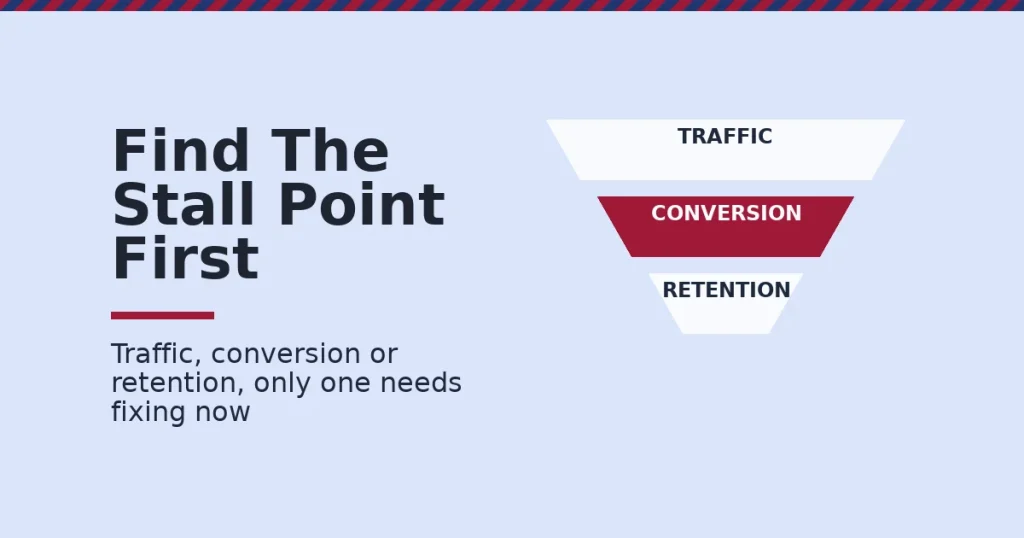
Most advice to grow online business treats every growth lever as equally urgent. It is not. A business with no visitors needs traffic first. A business with visitors but no sales needs trust first. Picking the wrong lever wastes months. This guide shows how to diagnose which one is yours.
Key Takeaways
- Conversion varies hugely by industry. A benchmark study of over 5 million tracked conversions found an overall average website conversion rate of 5.13%, ranging from 1.9% in travel up to 7.9% in legal and automotive.
- Acquisition costs keep climbing. A customer acquisition cost benchmark report puts median enterprise sales-led B2B SaaS CAC at $11,400, up 9% year over year and 16 times the $702 median for self-serve products.
- Email still outperforms paid acquisition. Industry ROI data puts average email marketing ROI at $36-$42 returned per $1 spent, compared with about $8 per $1 for Google Ads.
- Retail and ecommerce sit below average. The same conversion study found retail and ecommerce converting at 2.4%, below the 5.13% all-industry average.
- Enterprise acquisition costs the most. B2B SaaS benchmarks put median customer acquisition cost at $702 for self-serve products, rising to $11,400 for enterprise sales-led deals.
In this guide
- What Most “Grow Online Business” Advice Skips
- The Three Places an Online Business Usually Stalls
- What Differs By Growth Stage
- How To Pull the Right Lever First
- How To Measure Which Stall Point You Have
- The One Decision Rule: Which Lever to Pull First
- A Real Case: What CAC Benchmarks Reveal Across Business Types
- Common Mistakes That Stall Growth Longer Than Needed
- A Simple First Month to Grow Online Business Revenue
- Frequently Asked Questions About How to Grow Online Business
- Where To Learn These Levers Properly
What Most “Grow Online Business” Advice Skips
Most lists like this name seven or eight strategies. They tell you to do them all. That advice is not wrong. It is just incomplete.
Doing seven things at once, with limited time and budget, means doing all seven poorly. A business with no traffic does not need a better checkout page yet. A business with strong traffic and weak sales does not need a bigger ad budget yet. Our guide to picking a profitable online business model covers the choices that shape which lever matters first.
A few ground rules. The figures below come from industry benchmark reports. They are aggregated across many businesses, so treat them as useful ranges, not predictions for your business. Costs and rates shift by season and platform. Nothing here guarantees a result.
One more rule worth stating plainly: there is no single universal way to grow online business revenue. The right first move depends entirely on where your specific stall point sits, which is exactly what the next section helps you diagnose before you spend another dollar on a tactic that may not even address your real problem.
The Three Places an Online Business Usually Stalls
Growth almost always stalls in one of three places. Finding which one applies to you matters more than adding a new tactic.
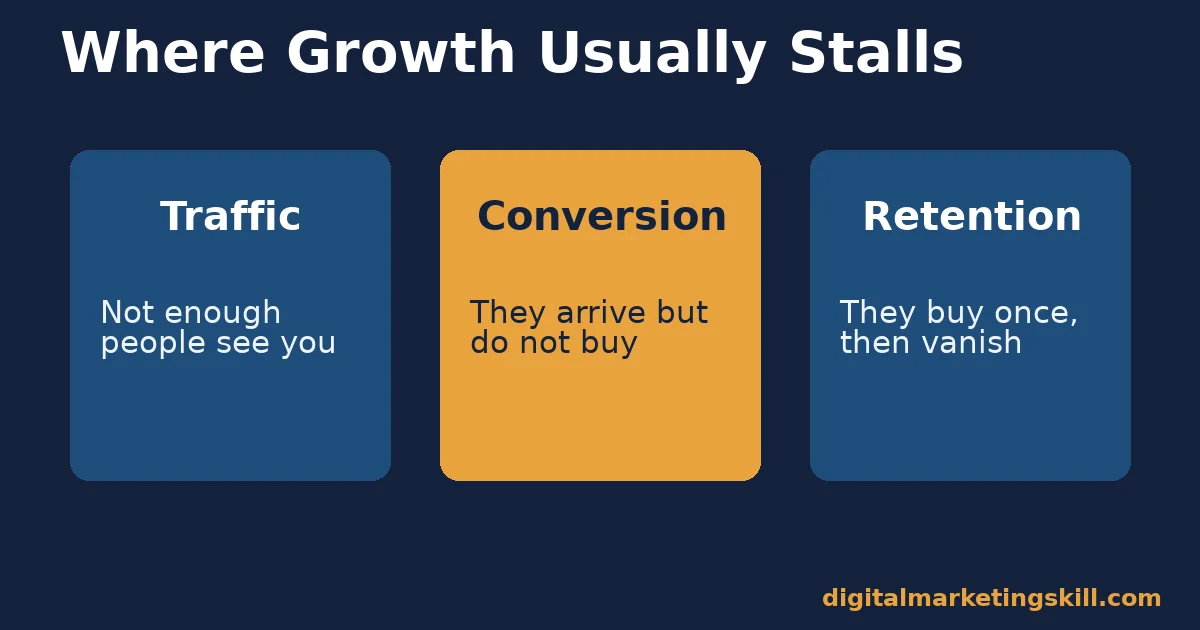
The first stall point is traffic. Not enough people see the business at all. The second is conversion. People arrive but do not buy, sign up or enquire. The third is retention. People buy once but do not come back, so every sale starts from zero again.
Each stall point needs a different fix. Fixing the wrong one wastes effort. More traffic sent to a page that does not convert just produces more visitors who leave. A retention campaign aimed at customers who never had a reason to trust you in the first place will not get opened.
Most online businesses actually pass through all three stages over time. Few grow online business revenue by fixing every lever at once. They grow it by fixing the current bottleneck, then moving to the next one once that bottleneck clears.
This is also why copying a competitor’s exact playbook so often disappoints. A competitor who has already solved their traffic problem is working on conversion or retention, while you might still be working on visibility. The tactic that worked for them was aimed at a different stall point than the one holding your business back right now.
A Worked Example of the Diagnosis
Illustrative, invented numbers: a business gets 500 monthly visitors and 25 sales. That is a 5% conversion rate, close to the 5.13% industry average. Its real problem is traffic volume, not conversion.
Doubling visitors to 1,000 at the same rate would roughly double sales. Optimising the checkout page further would barely move the number, since the rate is already near the benchmark.
What Differs By Growth Stage
The right lever changes as a business grows. The three stages below map to the three stall points above.
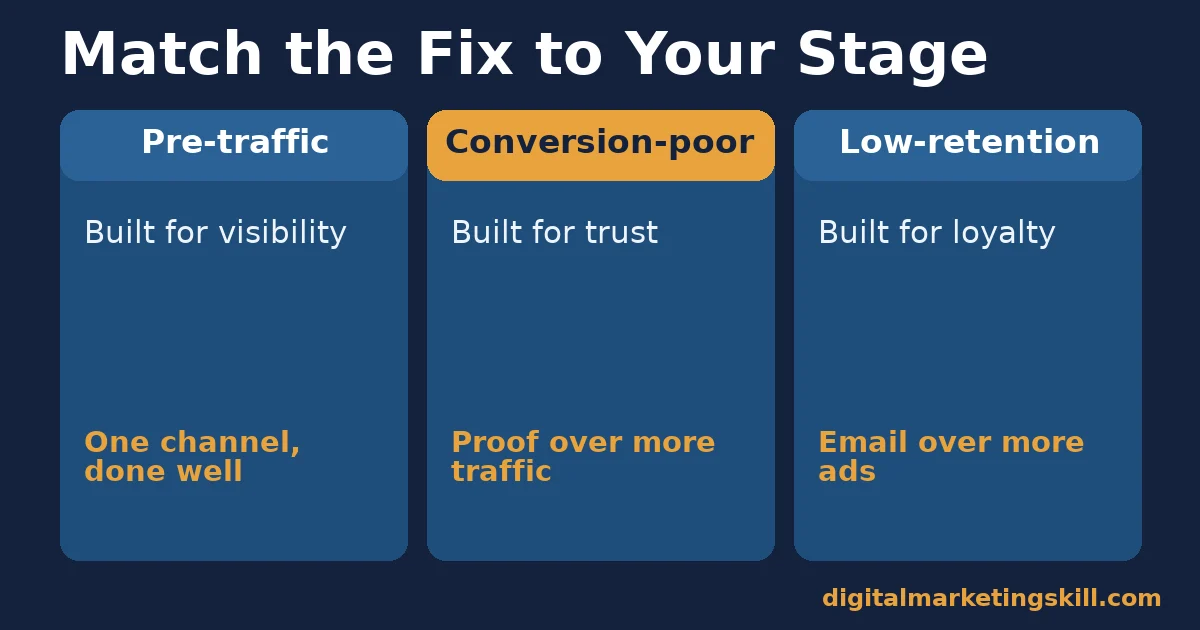
Pre-Traffic Businesses: Built For Visibility
A new or small online business usually has no traffic problem to solve yet. It has barely been found. The priority is visibility: getting in front of the right people at all, through one channel done well rather than five channels done thinly.
Traffic-Rich, Conversion-Poor Businesses: Built For Trust
A business with steady visitors but weak sales usually has a trust problem, not a traffic problem. Visitors are not convinced the product solves their problem. Or the path to buying is confusing. More traffic here just means more people leaving unconvinced.
Converting But Not Retaining Businesses: Built For Loyalty
A business that converts well but rarely sees repeat customers is leaving its cheapest growth lever unused. Acquiring a new customer costs far more than keeping one. Research from Bain & Company, reported in Harvard Business Review, found that increasing customer retention rates by just 5% increases profits by 25% to 95%. That is why rising acquisition costs make repeat revenue so valuable once a business has customers to retain.
This is also the stage where the phrase “grow online business” stops meaning “find more strangers” and starts meaning “sell more to the people who already trust you.” The two goals need different budgets and different skills, and confusing them is one of the most common ways growth stalls here.
How To Pull the Right Lever First
These fixes mirror the three stages above. Apply the one that matches your actual stall point, not the one that feels most urgent.
Pre-Traffic Businesses: Lead With One Channel, Not Five
Pick the single channel most likely to reach your specific audience. That might be search, a social platform or referrals. Commit to it for several months before adding a second. Spreading thin effort across many channels usually means none of them reach the volume needed to matter. If search is your chosen channel, Google’s own SEO starter guide covers the fundamentals worth getting right before anything more advanced. Our guide to growing a business with digital marketing channels walks through how to pick that first channel.
Conversion-Poor Businesses: Lead With Proof, Not More Traffic
Add specific proof close to the point of decision. Real reviews, a clear guarantee, or a demonstration of the product in use all work. Simplify the path to purchase before spending more on traffic. A 2.4% retail conversion rate still means most visitors are already arriving and leaving unconvinced. If sales never really took hold, our guide on why online businesses fail covers the trust gaps that most often cause it.
Low-Retention Businesses: Lead With Email, Not More Ads
Build an email or messaging list from the first purchase, not as an afterthought. Average email ROI is reported at $36-$42 per $1 spent. Paid search ads return about $8 per $1 by the same measure. Retention spend usually outperforms acquisition spend once a customer base exists.
How To Measure Which Stall Point You Have
A few metrics show which lever to pull before you commit budget to a fix.
Conversion rate is sales or leads divided by visitors, as a percentage. Compare yours against your industry’s benchmark, not the all-industry 5.13% average, since the range runs from 1.9% to 7.9% by sector.
Customer acquisition cost (CAC) is total marketing and sales spend divided by new customers gained. Track the trend, not just the number, since benchmark data shows CAC rising roughly 2% to 12% a year across most tracked categories.
LTV:CAC ratio is a customer’s lifetime value divided by their acquisition cost. A widely used SaaS benchmark treats 3:1 as the minimum for sustainable growth. A ratio near or below 1:1 means retention, not acquisition, is the more urgent lever.
Repeat purchase rate is the share of customers who buy more than once. A low rate alongside a healthy conversion rate points straight at the retention stall point.
Read these four together. A business that looks fine on conversion rate but weak on repeat purchase rate is not actually done growing; it has just moved its stall point from traffic to retention without noticing.
Write these four numbers down somewhere you will actually look at them again, even a simple spreadsheet updated monthly. The goal is not perfect measurement from day one. It is catching a shift early enough to grow online business revenue by fixing the new bottleneck before it costs another quarter of wasted spend.
The One Decision Rule: Which Lever to Pull First
Check traffic volume first. If monthly visitors are low relative to your market size, fix visibility before anything else. Conversion and retention fixes have nothing to work with yet.
If traffic is healthy but conversion sits well below your industry’s benchmark, fix trust and the buying path next. Do this before adding more spend to bring in even more unconvinced visitors.
If conversion is on par with your industry but repeat purchase rate is low, shift budget from acquisition to retention. The data above suggests that is usually the highest-return move once a customer base exists.
Notice what this rule does not say. It does not say to grow online business revenue by adding more tactics at once, or by copying whatever a competitor is doing this quarter. It says to check three numbers, in order, and let the weakest one tell you where to spend your next dollar.
A Real Case: What CAC Benchmarks Reveal Across Business Types
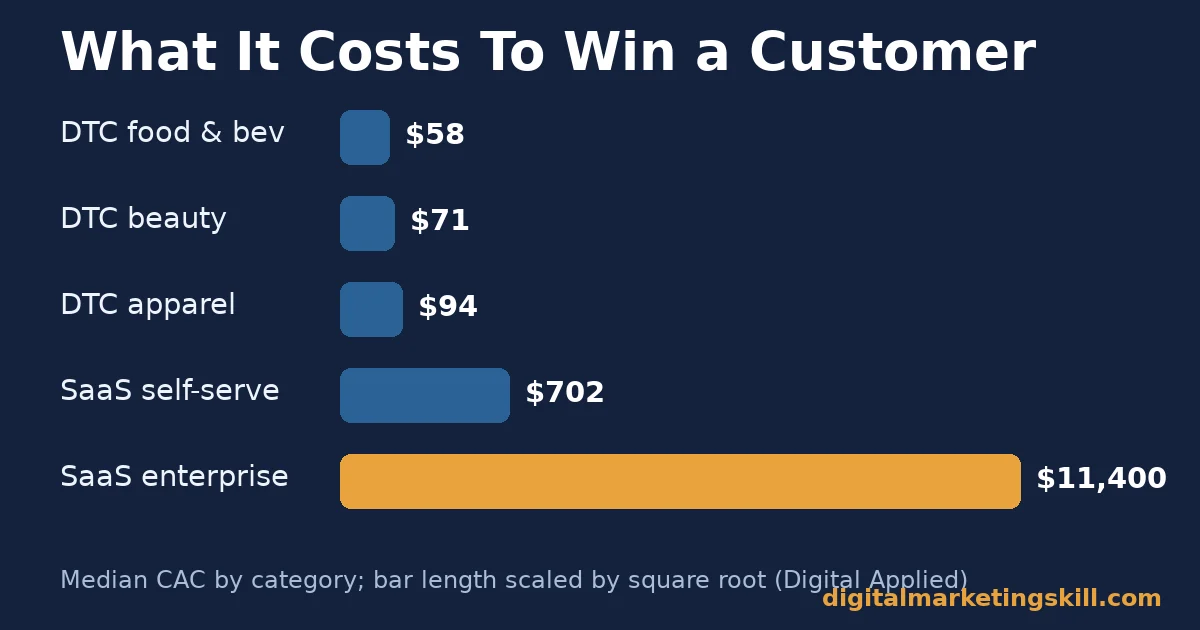
Customer acquisition cost benchmark data across business types shows a pattern worth learning from. B2B SaaS sold through self-service pricing shows a median CAC of $702. Enterprise sales-led SaaS shows $11,400, over fifteen times higher. Longer sales cycles and dedicated sales staff add direct cost per customer at that end.
Ecommerce categories sit far lower: DTC apparel around $94, beauty and personal care around $71, food and beverage around $58. A pattern our guide to starting and growing an ecommerce business explores by model.
The gap shows that acquisition cost is not a fixed number to beat. It reflects how complex the buying decision is for that product. The limits are real: these are median figures aggregated across many businesses and reporting methods, not a single audited study. Treat them as a range to benchmark against, not an exact target.
The practical takeaway for anyone trying to grow online business revenue on a modest budget: a simpler product with a shorter buying decision is usually cheaper to acquire customers for than a complex one, all else being equal. That is not a reason to avoid a complex offer, but it is a reason to expect a higher acquisition cost and plan your pricing and retention strategy around it from the start.
Common Mistakes That Stall Growth Longer Than Needed
A few habits keep a business stuck at a stall point far longer than the underlying problem requires.
Running Five Channels Before One Works
Splitting a small budget across five untested channels means none of them reach the volume needed to prove anything. One channel, run properly for a few months, teaches far more than five channels run thinly for the same period.
Comparing Against the Wrong Benchmark
A 3% conversion rate looks weak against the 7.9% legal industry average, but strong against the 1.9% travel industry average. Always compare against your own sector’s benchmark, not the all-industry figure. Businesses that try to grow online business revenue by chasing an unrealistic benchmark from an unrelated sector often conclude they have a conversion problem when they actually do not.
Spending Only on Acquisition Once Customers Exist
Once a business has paying customers, every dollar spent only on acquisition ignores the cheaper lever sitting right next to it. Retention spend, at roughly a fifth to a twenty-fifth the cost of acquisition, usually has room left to grow before acquisition spend does.
Chasing Traffic That Was Never Going to Convert
Traffic from an audience outside your niche inflates visitor counts without helping conversion rate or revenue. A smaller, well-matched audience usually outperforms a larger, loosely related one on every metric that matters.
Never Re-Checking Which Lever Applies
A business that diagnoses its stall point once and never again tends to keep applying last quarter’s fix to this quarter’s problem. The lever that will help you grow online business revenue today is rarely the same one that helped a year ago, so the three core metrics above deserve a regular, scheduled check, not a one-time audit.
A Simple First Month to Grow Online Business Revenue
Turning the diagnosis above into action does not require a complicated plan. A short, focused first month usually surfaces more useful information than a long, vague one.
Week One: Diagnose, Don’t Guess
Pull your actual numbers: visitor count, conversion rate and repeat purchase rate, even rough ones from whatever analytics tool you already have. Compare conversion rate against your specific industry’s benchmark, not the all-industry average. This single step usually makes the real stall point obvious.
Weeks Two and Three: Apply the Matching Fix
Apply only the fix that matches your diagnosed stall point, from the three sections above. Resist the pull to also tweak something else at the same time; mixing fixes makes it impossible to tell which change actually moved the number.
Week Four: Measure and Decide
Re-check the same metric you diagnosed in week one. If it moved meaningfully, keep going and let the fix run longer before judging it finished. If it barely moved, revisit the diagnosis; the stall point may be different from what you first assumed, or the fix may need more time than one month to show up in the numbers.
Frequently Asked Questions About How to Grow Online Business
What is the fastest way to grow online business revenue?
There is no single fastest way; it depends on your stall point. A traffic-starved business grows fastest by fixing visibility. A high-traffic, low-conversion business grows fastest by fixing trust and the buying path instead.
Should I focus on SEO or paid ads to grow online business traffic?
Paid ads produce traffic faster but stop the moment spend stops. Organic channels take longer to build but keep producing traffic afterwards. Many businesses use paid traffic to validate a message, then invest in organic channels once it is proven to convert.
How do I know if my conversion rate is good?
Compare it against your specific industry’s benchmark, not an all-industry average. Benchmarks range from under 2% in travel to near 8% in legal and automotive. A 3% rate could be strong or weak depending on your sector.
Is customer acquisition cost rising for every business?
Most categories tracked in recent benchmark data show CAC rising year over year, commonly by 2% to 12%. The size of the increase varies by sector and channel.
Why does retention matter more as a business grows?
Acquisition cost is paid every time. A retained customer buys again without that cost repeating. As acquisition costs climb, the math increasingly favours keeping existing customers over constantly chasing new ones.
What’s the easiest online business lever to start with?
For most new businesses, visibility on one well-chosen channel is the easiest and most urgent lever. Conversion and retention fixes only pay off once there is traffic to convert and customers to retain.
How often should I re-check which lever to grow online business with?
Revisit the three metrics, conversion rate, CAC trend and repeat purchase rate, every quarter. A business that fixed its traffic problem previously may now have a conversion or retention problem instead.
Can I work on more than one lever at the same time?
You can, but it dilutes both efforts, especially with a limited team or budget. Most businesses that grow online business revenue fastest fix one bottleneck at a time, confirm the metric moved, then shift full attention to the next one.
Does the stall-point framework apply to a service business as well as ecommerce?
Yes. The three stall points, traffic, conversion and retention, apply whether you are selling a physical product, a service or a subscription. Only the specific tactic for each lever changes, not the underlying diagnosis.
Where To Learn These Levers Properly
Diagnosing a stall point and fixing the right lever is a trainable skill, not a one-time checklist. Everything in this guide, reading a conversion funnel, pricing a retention campaign, choosing the first channel to commit to, is teachable, and learning it properly tends to save far more money than it costs in wasted ad spend on the wrong lever.
The Master Diploma in Digital & AI Marketing from Digital Marketing Skill Institute is built around four AI-powered tracks: AI-Powered Social Media Management and Advertising, AI-Powered Lead Generation and Email Automation, AI-Powered Google Specialist, and AI-Powered WordPress and SEO Specialist. Together they total ten courses, with a Full Stack option for completing all four tracks.
The programme includes unlimited one-on-one coaching and mentoring, plus a U.S. Project Internship with a verified U.S. Work Reference Letter. It carries dual US and UK accreditation, recognised in more than 100 countries, and runs fully online.
Visit Digital Marketing Skill Institute to see the full curriculum. Read more on the Master Diploma programme page, browse more guides on the blog, or go straight to the application page, wherever you live.
You can also read real outcomes on the reviews page, alongside the earnings disclaimer: individual results vary and no income is guaranteed. Whichever lever your business needs next, there is a path to learn it properly, wherever in your country you run your business. The first step is at digitalmarketingskill.com.
Every figure in this guide was checked against its original source before publication. Figures marked as illustrative are invented examples, not real results.
