A lead conversion strategy turns inquiries into paying customers. It combines fast response, steady follow-up and a nurture sequence that fits how the lead arrived. Most businesses lose leads because of slow, patchy follow-up, not weak offers. Fix the process first.
Key Takeaways
- Speed decides more than skill. The Lead Response Management study found the odds of reaching a new lead are 100 times higher within 5 minutes than within 30 minutes.
- Most companies respond too slowly. A Harvard Business Review analysis of 2,241 US companies found the median first response time was 42 hours. Yet firms that replied within an hour were about 7 times more likely to hold a real talk with a decision-maker.
- One follow-up email roughly doubles replies. Woodpecker studied over 20 million cold emails. Sequences with a follow-up earned an 8.3% reply rate versus 4.1% for a single send. 42% of all replies came from the follow-up.
- Persistence has a limit. Data on nearly 3.5 million leads showed 93% of eventual conversions happen by the sixth call. A sixth attempt is usually worth it. A twentieth rarely is.
- Scoring and routing compound. Grammarly added AI lead scoring and lifted its qualified-lead conversion rate by 30%. Its typical deal-closing time dropped from 60-90 days to 30 days, per a published Salesforce customer story.
In this guide
- What Most Lead Conversion Strategy Advice Skips
- How Lead Conversion Actually Works
- A Lead Conversion Strategy Differs by How the Lead Arrived
- How to Build a Lead Conversion Strategy for Each Lead Type
- How to Measure Your Lead Conversion Strategy
- The One Rule: Fix Speed Before You Fix Volume
- Common Lead Conversion Strategy Mistakes
- A Real Case: Grammarly’s Lead Scoring Shift
- Frequently Asked Questions About Lead Conversion Strategy
- A Simple Rollout for Your First Month
- Put Your Lead Conversion Strategy to Work
What Most Lead Conversion Strategy Advice Skips
Search for lead conversion strategy and you get long tip lists. Send a thank-you email. Add a FAQ page. Offer a discount. None of that is wrong. But it treats every lead the same way. It skips the one variable that moves the needle most: timing.
This guide fills that gap. It shows why speed and follow-up beat almost every other lever. The right tactic also changes depending on how the lead arrived. Finally, it shows how to measure whether your lead conversion strategy actually works.
A few ground rules first. The studies below are named, with real sample sizes. Treat the exact multipliers as a snapshot from those samples, not a universal law for every industry. When a figure comes from one company’s own test, that is flagged, because one result is a data point, not a benchmark.
How Lead Conversion Actually Works
A lead conversion strategy has three moving parts: contact, qualification and nurture. Contact means reaching the person. Qualification means confirming they have the budget, authority, need and timeline to buy. Nurture means keeping leads warm until they are ready.
Each part decays on its own clock. Contact odds fall within minutes, because intent peaks the moment someone fills out a form. Qualification odds fall over hours and days, as urgency cools or a rival reaches the lead first. Nurture runs on the longest clock, sometimes months, because it targets people who are not ready yet.
The Lead Response Management study measured this decay directly. Researcher James Oldroyd tracked three years of data from six companies and over 15,000 leads. The odds of making contact were 100 times higher when the first call came within 5 minutes, not 30. The odds of qualifying that lead were 21 times higher on the same comparison.
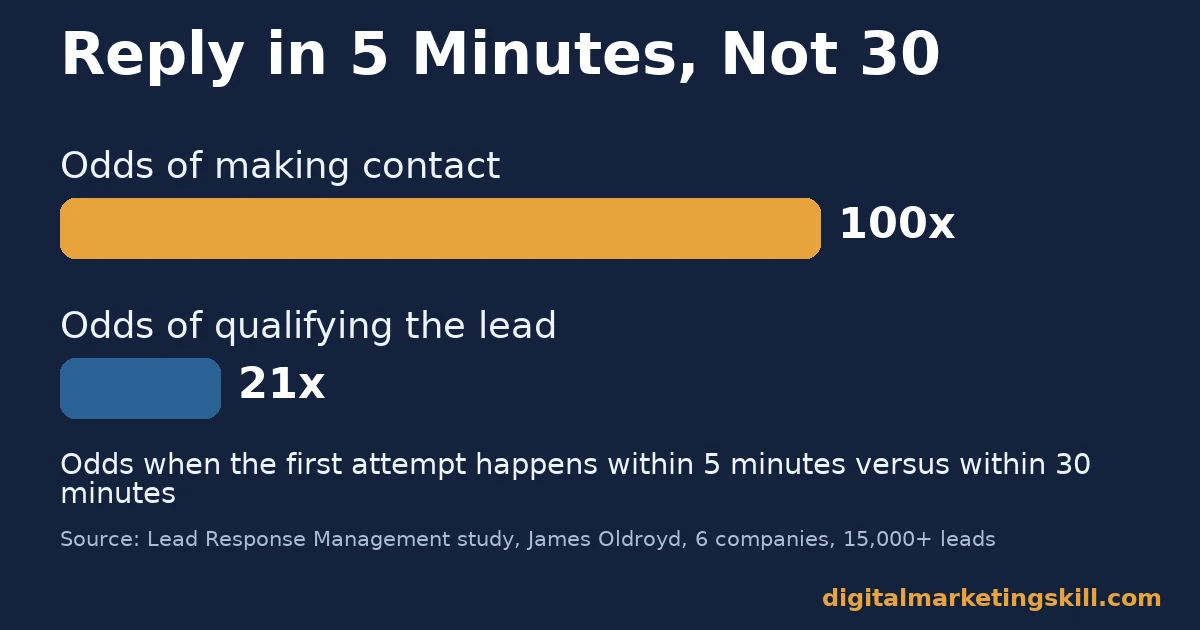
That gap is the real cause behind most lead conversion strategy failures. A great script delivered on day three cannot save a lead a rival reached in minute three.
A Lead Conversion Strategy Differs by How the Lead Arrived
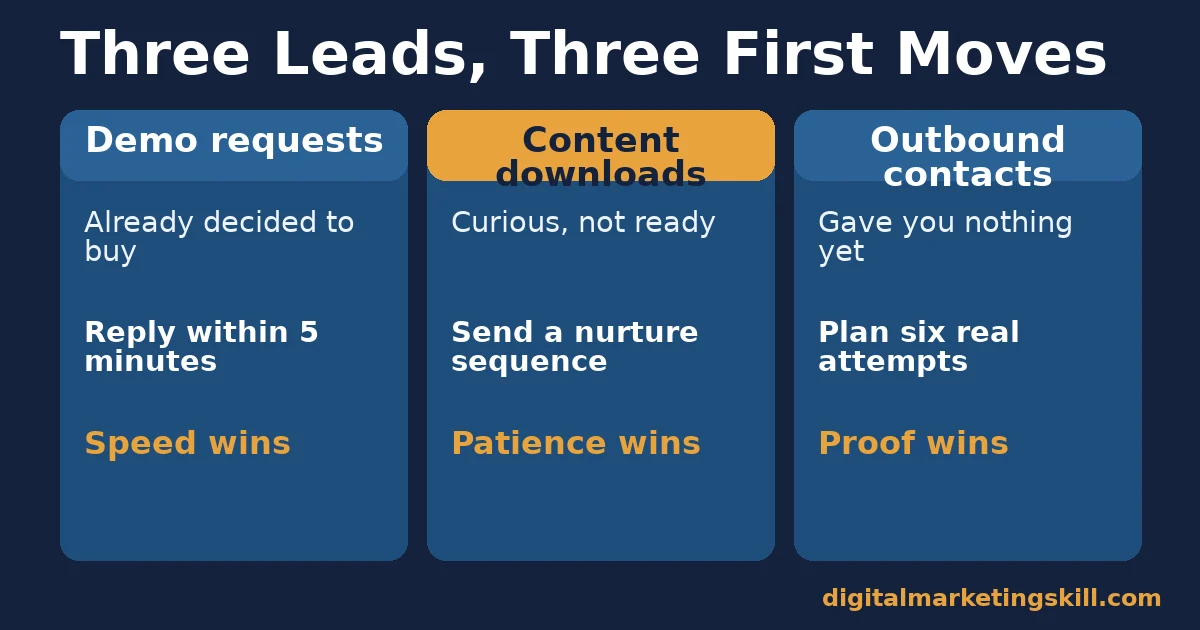
Not every lead deserves the same first move. Someone who just requested a demo is in a different mindset than someone who downloaded a checklist weeks ago. Both differ from a cold contact pulled from a list. Treat all three the same and you waste the first group’s urgency while annoying the other two.
Demo and Pricing Requests: Built for Immediate Response
Someone who asks for a demo or a quote has already decided they might buy. They are comparing you against whoever else they contacted that day. Often the deciding factor is simply who replies first with something useful. This is the highest-value, most time-sensitive lead type you have.
The Harvard Business Review analysis of 2,241 US companies found firms that replied within an hour were about 7 times more likely to hold a real conversation with a decision-maker than firms that waited one more hour. Yet the median response time in that same study was 42 hours. Most businesses lose this lead type by default.
Content Downloads: Built for Patience
A person who downloaded a guide is curious, not necessarily ready. They gave you an email, not a buying signal. Treat them like a demo request, with an immediate sales call, and it usually backfires. It reads as pushy.
This group needs proof spread over time, not speed. They respond to a sequence that teaches something new in each message, because that is the deal they signed up for. Rush them to a sales call before they trust you, and you skip a step most of them still need.
Outbound and Cold Contacts: Built for Proof
A name you found yourself, through a list or a tool, has given you nothing yet. They did not ask to hear from you. So the first message must earn attention on its own, with a specific reason to reply, not a generic pitch.
Persistence matters more here than speed, because there is no decay clock running from a form. Data on nearly 3.5 million leads found 93% of eventual conversions happen by the sixth contact attempt. Only 7% convert after that. That argues for a fixed number of tries, not one attempt followed by giving up.
Referral Leads: Built on Borrowed Trust
A referral arrives with someone else’s credibility attached. A friend, a colleague or a past customer already vouched for you, so a referral usually skips straight past the scepticism a cold contact feels. That borrowed trust is valuable, but it is also easy to waste.
Referrals expect to be treated as a known quantity, not a stranger. If your first reply reads like a generic sales script, it breaks the trust the referrer built for you. The lead conversion strategy here is less about speed or proof, and more about matching the warmth of the introduction.
How to Build a Lead Conversion Strategy for Each Lead Type
Each lead type needs a different first move. These three sections mirror the three above. Start with whichever type brings the most volume today. A fix there moves your numbers fastest.
Demo and Pricing Requests: Lead With Speed
Set a target of contacting demo and pricing requests within 5 minutes during working hours. That is the window the Lead Response Management study measured. If a live call is not possible that fast, send an immediate, specific reply instead of an autoresponder. It still beats a same-day callback.
RAIN Group’s sales research found it takes an average of 8 touchpoints to land a first meeting with a new prospect. Speed on the first touch buys you room for the touches that follow. Route hot leads to whichever rep is free right now, not a fixed owner, and track the clock from form submission to first human reply.
Content Downloads: Lead With a Nurture Sequence
Build a fixed sequence of 4 to 7 emails. Each one should teach a single idea tied to what they downloaded, before any sales ask appears. Woodpecker’s analysis of over 20 million emails found sequences built around follow-ups beat single sends. 42% of all replies came from a follow-up, not the opening message.
Score engagement as the sequence runs. Opens and clicks signal rising interest. A lead who engages with three messages in a row is ready to move into the faster, demo-request track above. Our guide to lead generation strategy covers how to build the content that starts this sequence.
Outbound and Cold Contacts: Lead With Evidence
Plan for six genuine contact attempts across different channels: email, a call, a short message. That sixth-attempt mark is where most eventual conversions happen. Each attempt should add a new, specific reason to reply, not repeat the last message.
Swap generic claims for named evidence in the first message. A specific, sourced detail about the prospect’s situation beats a broad pitch. It also proves you did real research instead of running a mass campaign. A clear content marketing strategy makes that research easier, because it already maps what each audience segment cares about.
Referral Leads: Lead With the Connection
Open by naming the person who referred them, and thank that referrer separately, in a short note or call. This single step confirms the referral worked and keeps your referral pipeline alive for future leads. Skip it, and your best, lowest-cost source of leads quietly dries up.
Ask one light question about what the referrer told them, then build your first offer around that answer. A referral who feels remembered converts faster than one who gets the same script as a stranger.
How to Measure Your Lead Conversion Strategy
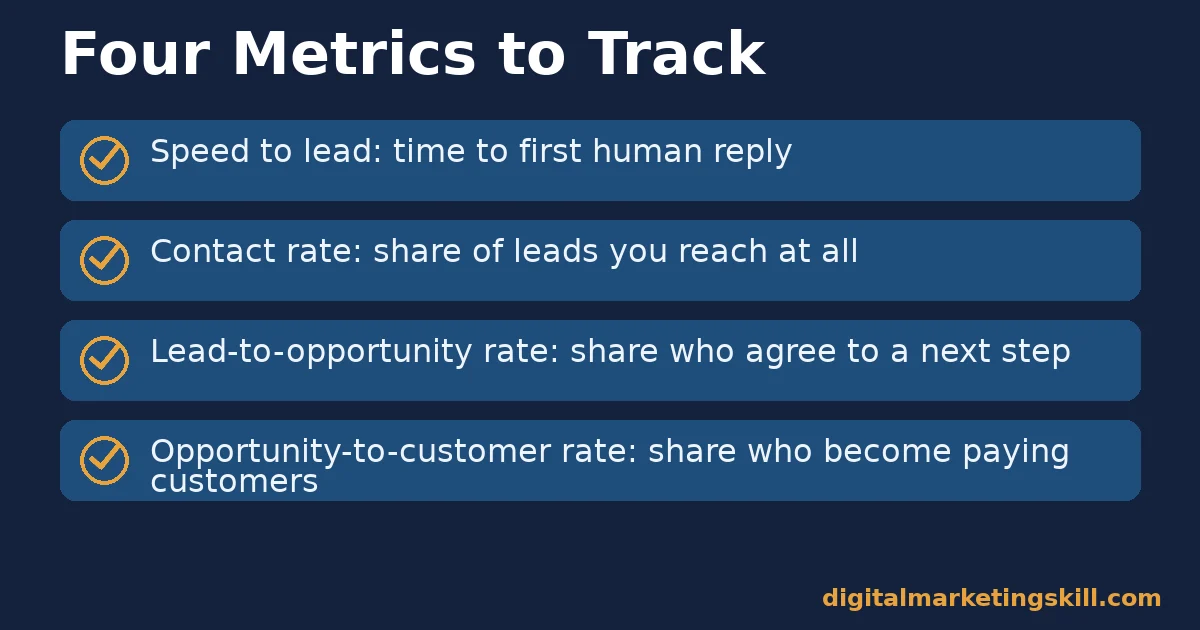
Four metrics show whether a lead conversion strategy works. Each one means something different. Track them together, not just your one favourite number.
- Speed to lead: the time between a lead arriving and your first human reply. Measure it in minutes for demo and pricing requests, since contact and qualification odds both fall fast after the first half hour.
- Contact rate: the share of leads you reach at all, by any channel, inside your set attempt window. A low contact rate usually points to a speed or channel problem, not a messaging one.
- Lead-to-opportunity rate: the share of contacted leads who agree to a next step, such as a call or a demo. This is where qualification happens. It depends heavily on how well your first message matches what the lead asked for.
- Opportunity-to-customer rate: the share of qualified leads who become paying customers. If this number is healthy but lead-to-opportunity is weak, the problem sits earlier in your lead conversion strategy, not in closing.
Read these four together. A fast speed-to-lead number paired with a weak lead-to-opportunity rate means you are reaching people quickly with the wrong message. The reverse pattern means a good message is reaching people too late to matter.
The One Rule: Fix Speed Before You Fix Volume
If you change only one thing this month, fix how fast you respond to your highest-intent leads. Do that before spending more on generating new ones. Faster response does not cost extra leads. It converts more of the leads you already have.
Here is an illustrative, invented-numbers example to show the scale. Picture two teams, each handling 100 identical demo requests in a month. Team A answers within 5 minutes on average. Team B answers within roughly 2 hours.
Apply the qualification multiplier from the Lead Response Management study as a rough guide. Team A could plausibly qualify several times as many of those leads as Team B, using the exact same script. The script was never the variable that mattered most.
Volume still matters. But volume without speed wastes a growing share of what you already paid to generate. Fix the response clock first. Then invest in more leads once you know you can convert the ones you have.
Common Lead Conversion Strategy Mistakes
Four mistakes show up again and again when a lead conversion strategy stalls. Check your own process against each one.
- One owner, no backup. If only one person can respond to hot leads, every leave day or busy afternoon becomes a lost lead. Build a rotation so someone is always free to reply fast.
- A single follow-up, then silence. Most lost leads are not rejected. They are simply never followed up a second or third time. Set a fixed number of attempts and stick to it.
- One script for every lead type. A demo request, a content download and a referral all need a different opening line. Reusing one script for all three wastes the context each lead already gave you.
- Tracking clicks instead of outcomes. Clicks and opens show attention, not conversion. Build your lead conversion strategy around the four metrics in this guide instead, so you measure what actually changed.
A Real Case: Grammarly’s Lead Scoring Shift
Grammarly, the writing assistant company, used to sort roughly 400 leads a month by hand. It switched to sending its sales team around 200 higher-quality, AI-scored leads a month, according to a published Salesforce customer story. The shift used account engagement data and automatic scoring to flag which prospects were actually ready, instead of relying on raw volume.
The result: a 30% rise in marketing-qualified-lead conversion. Typical deal-closing time dropped from 60-90 days to about 30 days. The limit to note: this is one company’s result, with its own tools, team and market. It is not a guarantee for every business that adds scoring. But the direction matches the mechanism in this guide. Better-timed, better-targeted contact converts more of the same leads, without needing more of them.
Frequently Asked Questions About Lead Conversion Strategy
What is a lead conversion strategy?
A lead conversion strategy is how a business turns a lead into a paying customer. It combines response speed, follow-up cadence and nurture content, matched to how ready that lead is to buy.
How fast should I respond to a new lead?
Aim to contact high-intent leads, such as demo or pricing requests, within 5 minutes during working hours. Research on web leads found contact and qualification odds both fall fast once that window passes, with the steepest drop after about 30 minutes.
How many times should I follow up before giving up on a lead?
Plan on roughly six genuine contact attempts, across different channels, for a cold or outbound lead. Data on nearly 3.5 million leads found 93% of eventual conversions happen by the sixth attempt. Stopping after one or two tries gives up on leads that were still reachable.
Does lead scoring actually improve conversion?
It can. In one published case, a company that added AI lead scoring saw its qualified-lead conversion rate rise by 30%. Its average deal-closing time fell by roughly half, because the sales team spent its time on the leads already showing the strongest signals.
Should every lead get a sales call right away?
No. A lead who requested a demo is ready for a fast, direct call. A lead who only downloaded a guide usually needs a short nurture sequence first. Push every lead into an immediate sales call, no matter how they arrived, and trust and reply rates tend to fall.
What is the single biggest mistake in most lead conversion strategies?
Slow, patchy first response. A widely cited analysis of over two thousand companies found the median first response time was 42 hours. That is well past the window where contact and qualification odds are highest. The lead is often gone before anyone tries.
Do follow-up emails actually get replies, or do they annoy people?
Analysis of tens of millions of cold emails found sequences with at least one follow-up earned roughly double the reply rate of a single send. 42% of all replies came from the follow-up, not the first message. A well-spaced follow-up usually helps more than it annoys.
Can a small business compete with a bigger rival on lead conversion?
Yes, often more easily than on advertising budget. Response speed and a consistent follow-up cadence cost time and discipline, not a large team. A small business that replies in minutes will usually beat a larger rival whose reply takes two days, regardless of which company has the bigger marketing budget.
What tool do I need to run a good lead conversion strategy?
You do not need an expensive platform to start. A shared inbox with a visible timer, a simple spreadsheet tracking contact attempts, and a written follow-up sequence cover the basics. A CRM helps once volume grows, mainly by automating the routing and reminders this guide describes.
A Simple Rollout for Your First Month
Spread the change across four weeks so your team can adjust without being overwhelmed. Each week builds on the one before it.
- Week 1: Pick one lead source and write down your current average response time. You cannot fix a number you have not measured.
- Week 2: Set a speed target for that source and assign a rotation so someone is always free to respond. Track every reply time for the week.
- Week 3: Build or fix the follow-up sequence for that source, with a fixed number of attempts and a different reason to reply each time.
- Week 4: Pull the four metrics from this guide and compare them against week one. Keep what improved, and apply it to your next lead source.
Put Your Lead Conversion Strategy to Work
Start with one lead source. Fix its response speed and follow-up cadence using the rules above. Measure the four metrics for a month. Then apply what works to your next lead source. A lead conversion strategy improves fastest when you fix the clock before you fix the copy.
If you want to build this skill properly, the Digital Marketing Skill Institute’s Master Diploma in Digital & AI Marketing includes an AI-Powered Lead Generation and Email Automation track. It is one of four AI-powered tracks in the program, with a Full Stack option covering all four.
The program adds unlimited 1-on-1 coaching and mentoring, plus a U.S. Project Internship with a verified U.S. Work Reference Letter. It is dual US and UK accredited and recognised in more than 100 countries. It runs 100% online through digitalmarketingskill.com, so you can study it anywhere in your country.
See the full Master Diploma program details. Read student reviews. Browse the digital marketing blog for more guides like this one, or go straight to apply wherever you live. Learn more about the Institute at digitalmarketingskill.com, and start building your own lead conversion strategy today.
Every figure in this guide was checked against its original source before publication. Figures marked as illustrative are invented examples, not real results.