
Paid media means any advertising you pay to place: search ads, social ads, display banners and sponsored content. You pay for guaranteed visibility right now, instead of waiting to earn it. Done well, it turns a fixed budget into predictable, trackable leads and sales.
Key Takeaways
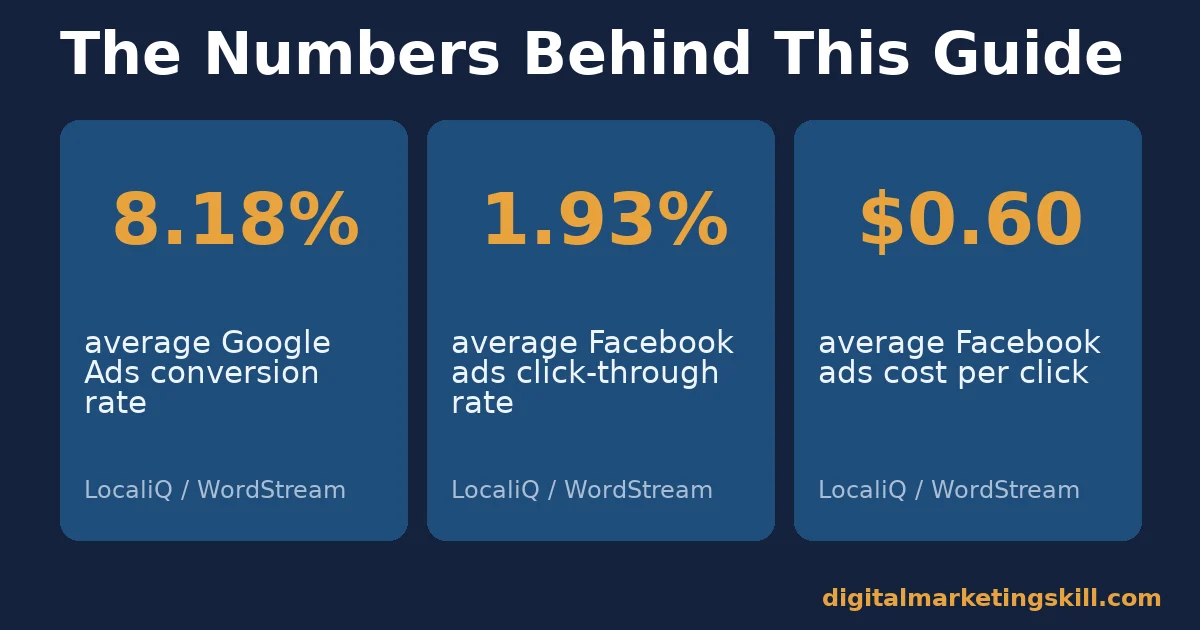
- Average conversion rates sit near 8.18% across industries on Google and Microsoft search ads. The source: aggregated customer data from the agency network LocaliQ/WordStream.
- Facebook traffic campaigns average a 1.93% click-through rate and a $0.60 cost per click. That’s across all industries, per the same LocaliQ data.
- 6.12 billion people are online. That’s 73.8% of the world’s population (DataReportal), the pool every paid media campaign draws from.
- Mobile devices generate 51.6% of global web traffic (DataReportal). A paid ad that looks broken on a phone loses more than half its audience.
- Average email marketing ROI sits at $36 to $42 per $1 spent (Litmus data, via Omnisend’s report). That’s a useful contrast to what you pay for in paid media.
In this guide
- Why Paid Media Budgets Get Wasted
- How Paid Media Actually Works
- Which Paid Media Channel Fits Your Goal
- How To Lead With Each Paid Media Channel
- Measuring Paid Media Results
- The One Decision Rule For Your Paid Media Budget
- A Real Paid Media Case, And Its Limits
- Frequently Asked Questions About Paid Media
- Where To Learn Paid Media Properly
Why Paid Media Budgets Get Wasted
Most paid media advice jumps straight to platform tips. Bid higher here. Use this ad format there. It skips the harder question: how do you know if the money is actually working?
In practice, many small businesses turn an ad on, watch the budget drain and judge success by gut feeling. As a result, they can’t tell whether a slow month means the offer is weak, the audience is wrong, or the campaign simply hasn’t run long enough to get real data.
Consequently, two businesses can spend the exact same amount on paid media and walk away with opposite conclusions. One scales up because a handful of lucky early sales looked like a trend. The other quits too early, right before the campaign’s algorithm had gathered enough data to actually perform. Neither verdict was based on real evidence.
This matters because paid media, unlike many organic efforts, can feel urgent in a way that pushes quick decisions. The budget is visibly draining every day. That pressure is real. But it shouldn’t replace a basic check: did the campaign run long enough, and reach enough people, for the numbers to mean anything yet?
Two ground rules apply here. First, every benchmark below is an informed guide, not a guarantee for your business; your numbers depend on industry, offer and market. Second, these figures are a snapshot. Auction prices shift constantly as other advertisers join or leave, so treat them as a starting point, not a fixed target.
How Paid Media Actually Works
Paid media runs on an auction. You and other advertisers bid for the same space, whether that’s a search results page, a social feed or a website banner slot. The platform doesn’t just award the spot to the highest bidder, though.
Most platforms also score your ad’s expected relevance to the person seeing it. A highly relevant ad can win a spot over a higher bid that’s a poor match. That’s why the same budget can perform very differently depending on how tightly your ad, audience and landing page line up.
In other words, the auction rewards good targeting, not just deep pockets. A smaller advertiser with a sharply relevant ad can regularly beat a bigger competitor’s broad, generic one. This is good news for a small business testing paid media for the first time: the platform itself is built to favour relevance over raw spend.
Once your ad wins a spot and someone clicks, you pay. Usually it’s a cost per click, though some formats charge per thousand impressions instead. From there, what happens on your site, or in your app, determines whether that paid visit turns into revenue.
Why The Landing Page Decides The Payoff
For example, picture two businesses running the exact same search ad with the exact same budget. One sends the click to a generic homepage. The other sends it to a page built specifically around that search term, with a clear offer and an obvious next step.
Typically, the second business converts far more of those paid clicks, even though both paid the platform the same price to win them. The auction decides who gets the click. Your own page decides what that click is worth.
Which Paid Media Channel Fits Your Goal
Paid media isn’t one channel. It’s a family of channels, each suited to a different kind of demand.
Paid Search: Built For Capturing Existing Intent
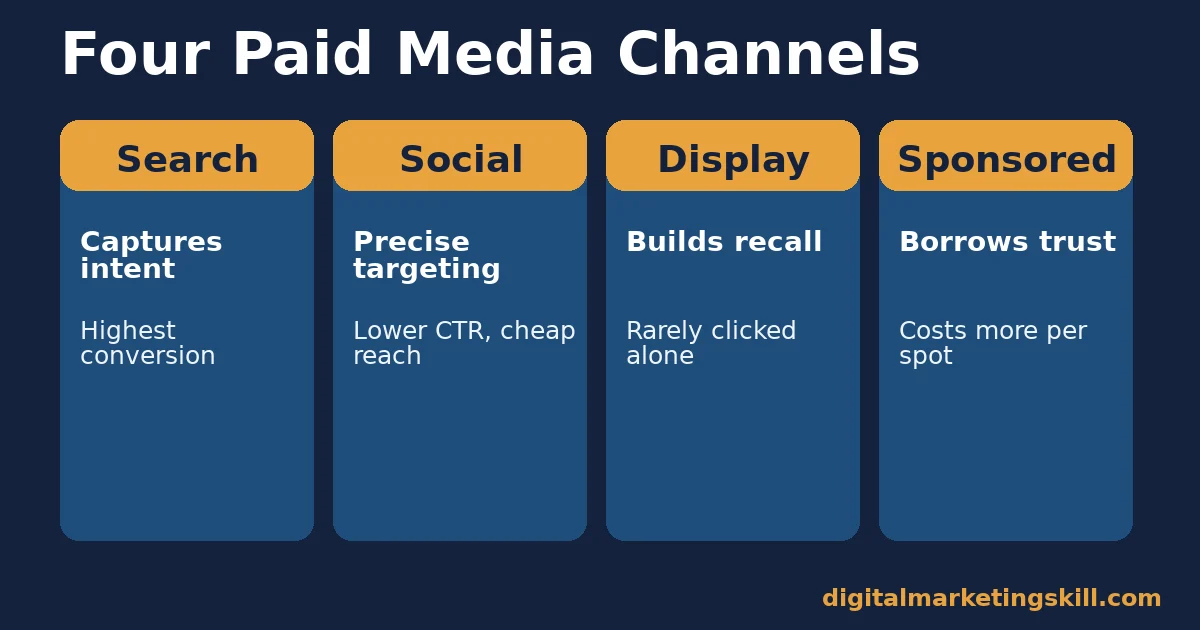
Paid search ads appear when someone actively searches for something related to what you sell. This is demand that already exists; you’re just winning the click. Average conversion rates sit near 8.18% across industries, which is high compared to most other formats, because the visitor already wants what you’re offering.
Paid Social: Built For Discovery and Precise Targeting
Paid social ads interrupt a feed rather than answer an active search. In exchange, you get detailed audience targeting by interest, behaviour and demographic.
Facebook traffic campaigns average a 1.93% click-through rate, lower than search, because fewer viewers are in active buying mode at that exact moment. In the US, Pew Research Center survey data puts YouTube usage among adults at 84% and Facebook at 71%, which is part of why these platforms remain common paid social destinations, even though usage patterns vary a lot by country.
Display Advertising: Built For Reach and Brand Recall
Display ads are the banners and visuals that follow you around the web. They rarely drive an immediate click, but they’re cheap per impression and good at keeping a brand name familiar, which supports every other channel’s conversion rate later.
Think of display as the quiet partner in a paid media plan. On its own, a low click-through rate can look like failure. Paired with search, though, display often lifts results indirectly: someone who saw your banner last week is more likely to click your search ad this week, simply because the name already looks familiar.
Sponsored Content: Built For Borrowed Trust
Sponsored content runs inside a publisher’s or creator’s own feed, formatted to match their usual posts. It borrows some of that publisher’s credibility, which can outperform a plain ad for awareness, though it usually costs more per placement than a standard display buy.
How To Lead With Each Paid Media Channel
Knowing what a channel is good at is step one. Here’s the specific move that makes each one perform.
Paid Search: Lead With Tight Keyword-to-Ad Match
Group keywords into small, specific ad groups rather than one broad group for everything. A visitor who searches “affordable running shoes” should see an ad that uses that exact phrase, not a generic shoe ad. Google’s own Ads Help documentation notes that ad rank and cost are driven partly by this kind of expected relevance.
Paid Social: Lead With Native Creative and Fast Testing
Build ads that look like normal posts on that platform, not obvious banners. Then test several versions at once rather than one ad for weeks. Paid social creative tends to wear out fast, so a steady stream of fresh variations usually beats a single “best” ad run too long.
In practice, that means swapping the headline, the opening line, or the visual every week or two, even when the current version is still performing. Waiting until an ad clearly fails means you’ve already lost several days of weaker results you could have avoided with a fresher variation in rotation.
Display Advertising: Lead With Frequency Caps
Limit how often the same person sees your display ad in a day. Beyond a handful of views, extra impressions mostly waste budget and can even annoy a potential customer. A frequency cap protects your spend without cutting your reach.
Sponsored Content: Lead With Genuine Usefulness
Write or brief sponsored content that would be worth reading even without the brand mention. Readers can tell when sponsored content is just an ad in disguise, and they tune it out fast. Usefulness is what keeps them reading to the part that mentions you.
A simple test before you publish: would this piece still be worth someone’s time if the brand name were removed? If the honest answer is no, the content needs another pass before it earns the placement fee you’re paying for it.
Measuring Paid Media Results
Four numbers matter most in paid media.
Cost per click (CPC) is what you pay, on average, each time someone clicks. It shows whether a channel is getting more or less competitive over time.
Click-through rate (CTR) is the percentage of people who see your ad and click it. It shows whether your ad creative and targeting are actually relevant to the audience seeing them.
Conversion rate is the percentage of clicks that complete your goal action, like a purchase or a form. It shows whether the traffic you’re buying matches what your landing page offers.
Cost per acquisition (CPA) is your total spend divided by the number of conversions. It’s the number that tells you, in plain terms, what a new customer actually cost you through that channel.
Track all four together, not CPC alone. A cheap click that never converts is more expensive than an expensive click that reliably does.
For instance, a $0.50 click that never converts costs you infinitely more per customer than a $3 click that converts one time in twenty. Looking at CPC by itself would make the cheap click look like the better deal. Looking at CPA, the number that actually matters, usually tells a very different story.
Review Weekly, Decide Monthly
Check these numbers weekly so you catch a broken campaign early, such as a tracking error or a landing page that stopped loading. However, save bigger decisions, like pausing a channel or shifting budget, for a monthly review. A single bad week is usually noise, not a verdict on the channel itself.
This distinction matters more than it sounds. Weekly checks exist to catch something obviously broken, not to react to normal ups and downs. Monthly checks exist to spot a genuine trend. Mixing the two up, reacting weekly to numbers that are still noisy, is one of the most common ways advertisers waste a working campaign before it has a fair chance to prove itself.
The One Decision Rule For Your Paid Media Budget
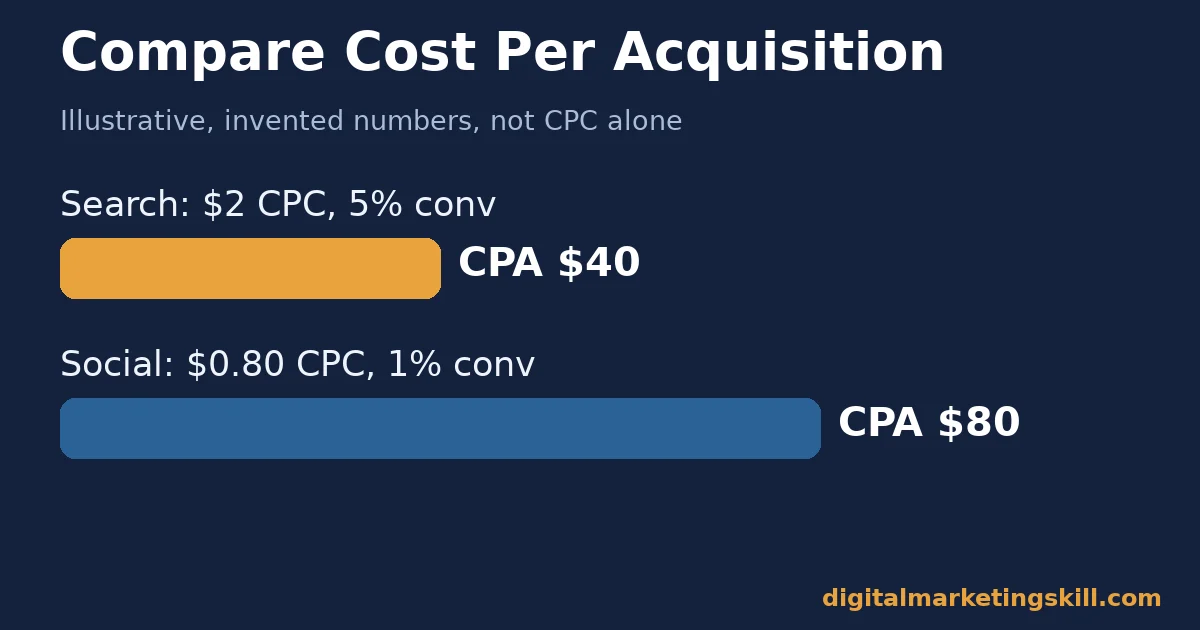
Put your next dollar wherever your cost per acquisition is lowest, not wherever your cost per click is lowest. A channel with a higher CPC but a much higher conversion rate often produces cheaper customers overall.
Illustrative, invented numbers: imagine paid search costs $2 per click with a 5% conversion rate, giving a CPA of $40. Paid social costs $0.80 per click with a 1% conversion rate, giving a CPA of $80. Even though social looks cheaper per click, search is actually the better buy here, because it converts those clicks into customers at half the cost.
Add A Second Channel Once The First One Works
Once one channel shows a CPA you’re comfortable with, add a second channel that targets a different part of the buying journey. Don’t just duplicate the first one.
For example, a business that proved paid search works can often add display next. That supports the brand recall search alone doesn’t build. A business already winning with paid social can often add email next. It keeps nurturing the leads that ad spend first attracted, at almost no extra cost per send.
A Real Paid Media Case, And Its Limits
Ayooluwa Osemi, a graduate of the Digital Marketing Skill Institute, spent $14 on Facebook and Instagram ads and made $878 in sales from that single campaign, as published on the Institute’s reviews page. That’s roughly a 62x return on ad spend, on a budget small enough that the downside risk, if it hadn’t worked, was minimal.
The limits matter here. This is one named, published result from a small test budget, not a typical outcome. A tiny spend can swing wildly in either direction before the numbers settle into a reliable pattern. Read it alongside the Institute’s earnings disclaimer, not as a promise of similar returns.
Still, the pattern is instructive. A small, cheap test came first. Only after it worked would scaling the budget make sense. Testing small before committing a large budget is the single habit that separates paid media that pays for itself from paid media that just burns cash.
Notice, too, that the result came from a single, narrow campaign rather than a wide, scattered one. A small test with a clear, single offer is easier to read correctly than a broad campaign spread across several products or audiences at once. Clarity, more than budget size, is usually what separates a useful first test from a confusing one.
A single campaign, a single offer, a single audience. That narrow focus is what made the result easy to trust and easy to repeat.
Frequently Asked Questions About Paid Media
What is the difference between paid media and organic reach?
Paid media is visibility you pay for directly, like a search ad or a sponsored post. Organic reach is visibility you earn without paying per view, like a page ranking in search results or a post spreading through shares. Most strong marketing plans use both together. Neither one fully replaces the other, since paid buys speed while organic builds a lasting asset.
How much should a small business spend on paid media to start?
There’s no fixed minimum. A small, defined test budget, enough to generate a few dozen clicks, is usually enough to learn whether an offer converts before you commit more. Scaling up only makes sense once that first test shows a workable cost per acquisition. Rushing to a large budget before that signal exists is the most common way small businesses overspend on paid media.
Which paid media channel converts best?
Paid search usually converts at the highest rate, since it captures people already searching for what you sell. However, “best” depends on your cost per acquisition, not conversion rate alone, so compare the full numbers before choosing a channel. A channel with a lower conversion rate can still win if its clicks cost far less.
How long does a paid media campaign take to show results?
Clicks and early data appear almost immediately, often within hours of launch. Reliable, stable results typically take one to two weeks, once the platform’s algorithm has enough data to optimise delivery and your sample size is large enough to trust. Judging a campaign before that window closes usually leads to the wrong conclusion.
Is paid media worth it if I already rank well organically?
Often, yes. Paid and organic results can appear together on the same results page, and owning both spots can increase total clicks beyond what either channel earns alone. It’s also useful for terms you don’t rank for yet, or for promoting a time-limited offer that organic content can’t move fast enough to support.
What causes paid media costs to rise over time?
More advertisers bidding for the same audience is the most common cause. A lower expected-relevance score, an outdated ad, or a landing page that no longer matches the ad’s promise can also push your effective cost up even if your bid stays the same. Refreshing creative and tightening targeting regularly helps keep costs from drifting upward unnoticed.
Can paid media work with a very small budget?
Yes, especially for highly specific, local or niche audiences where competition is lower. The key is matching your budget to a narrow, well-defined test rather than spreading a small amount across a broad, generic audience. A tightly targeted small budget usually teaches you more than a broad one of the same size.
Where To Learn Paid Media Properly
Given everything above, the real skill in paid media isn’t picking a platform. It’s reading the numbers correctly and knowing when to scale, pause or rework a campaign. That judgment comes from running real budgets, not just reading about them. No amount of reading replaces the pattern recognition that comes from watching dozens of real campaigns rise, stall and recover.
Start Wherever You Are
The Digital Marketing Skill Institute’s Master Diploma in Digital & AI Marketing is built around that kind of hands-on practice. It has four AI-powered tracks: AI-Powered Social Media Management and Advertising, AI-Powered Lead Generation and Email Automation, AI-Powered Google Specialist, and AI-Powered WordPress and SEO Specialist. Together they total ten courses, with a Full Stack option for completing all four tracks.
Every track includes unlimited 1-on-1 coaching and mentoring, a U.S. Project Internship with a verified U.S. Work Reference Letter, and dual US and UK accreditation recognised in more than 100 countries. It is 100% online, so you can study from anywhere in your country.
Explore the Master Diploma program, browse more guides on the digital marketing blog, or go straight to the application page. Whatever your starting point, the team at digitalmarketingskill.com is there to help you turn a paid media budget into a repeatable system, wherever you live. Start today at digitalmarketingskill.com.
Every figure in this guide was checked against its original source before publication. Figures marked as illustrative are invented examples, not real results.
