An SEO expert makes a website easier to find in search results and proves it with numbers. No licence or exam grants the title. You earn it by learning how search works, choosing one specialism and showing a measured result on a real website.
Key Takeaways
- Most pages never get found. An Ahrefs study of about 14 billion pages found that 96.55% get zero traffic from Google, and fixing the reasons behind that silence is what sets an SEO expert apart.
- Nobody can promise the top spot. Google says no one can guarantee a number one ranking, so an honest SEO expert sells a process and a measured result, not a position.
- Specialise before you generalise. Technical, content, local and authority SEO each act on a different stage of search. Each needs its own first project.
- AI answers change the scoreboard. Pew Research Center found that US users clicked a regular result in 8% of visits with an AI summary, against 15% without one. Clicks alone now undersell good work.
- Refreshing old pages is a fast proof. HubSpot reported that updating older blog posts raised their organic search views by 106% on average. That makes a content refresh a strong first case study.
In this guide
- Most Guides List Skills, but an SEO Expert Is Judged on Proof
- Three Stages of Search Decide Where an SEO Expert Can Help
- Four SEO Specialisms, Four Different Jobs
- How to Prove Each Specialism With One Small Project
- AI Answers Change the Scoreboard, Not the Fundamentals
- How an SEO Expert Measures Progress
- The Decision Rule: Start Where the Feedback Loop Is Shortest
- What Proof Looks Like: HubSpot’s Old-Post Refresh
- Frequently Asked Questions About Becoming an SEO Expert
- Your Next Step Toward Becoming an SEO Expert
Most Guides List Skills, but an SEO Expert Is Judged on Proof
Search for advice on this career and you will find the same list again and again. Learn keyword research, learn the tools, build links, write well. None of that is wrong, but it skips the question every client and employer actually asks. What did you change, and what happened next?
That gap matters because the title has no gatekeeper. Google’s guide on whether you need an SEO states that no one can guarantee a number one ranking. It also tells site owners to ask any SEO for previous work, a timeline and a way to measure success. In other words, Google tells buyers to judge you on evidence, so this guide is built around producing that evidence.
Ground Rules for This Guide
First, the split into four specialisms is our framework, not an official standard. It is an informed inference from how Google describes its own systems, not a settled fact. Second, most job and pay data here comes from the United States, and we say so each time. Third, search tools and market shares move, so treat every figure as a snapshot, not a permanent ranking.
How we checked this: the Digital Marketing Skill Institute team opened every source linked below before quoting it. If a vendor paid for a study or it covers one country, the text says so next to the number.
Three Stages of Search Decide Where an SEO Expert Can Help
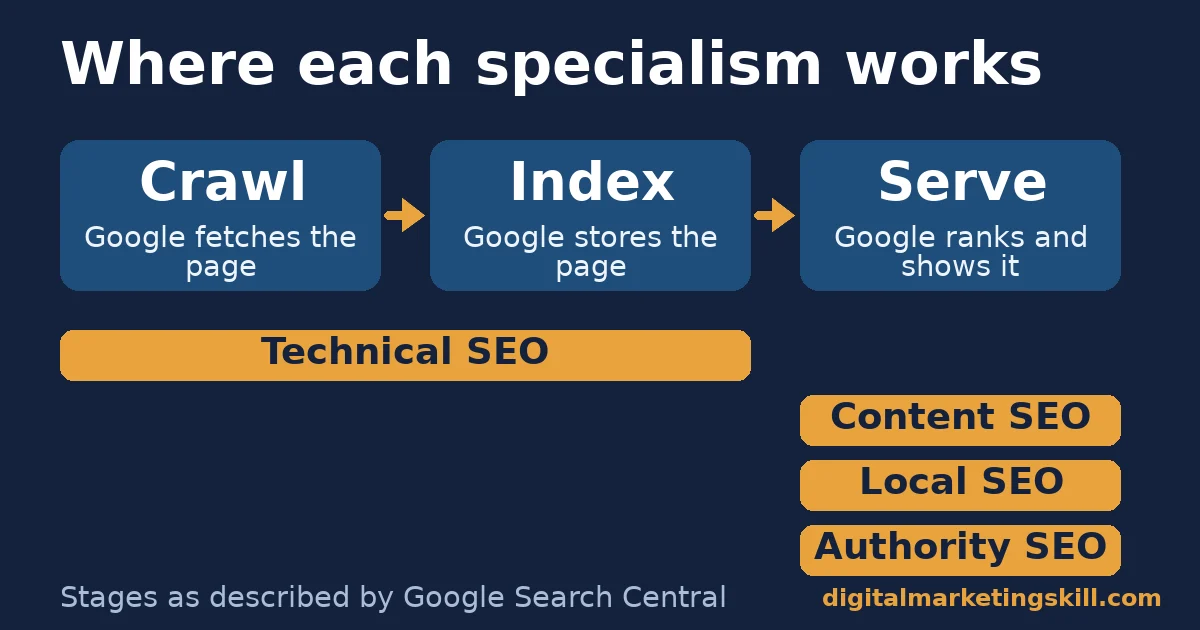
Every fix you make works on one of three stages. Google’s explanation of how Google Search works describes them in plain terms. Crawling is when automated programs download text, images and videos from pages. Indexing is when Google analyses those files and stores them in a large database. Serving is when Google returns the pages it judges most relevant to a search.
Google adds two limits that shape the whole job. It does not accept payment to crawl a site more often or to rank it higher. And it does not guarantee that it will crawl, index or serve any page, even one that follows its rules. So an SEO expert improves the odds at each stage, while the final call stays with the search engine.
Google is also where most searchers are, which is why any SEO expert learns it first. StatCounter’s worldwide search engine market share data gives Google about 91.1% of searches, with Bing at about 4.5%. Those shares shift from month to month, but the gap is still so large that most SEO work targets Google first.
Why Most Pages Fail at One of the Three Stages
The scale of the problem is striking. Ahrefs ran a search traffic study of about 14 billion pages. It found that 96.55% of pages get no traffic from Google at all, and another 1.94% get between one and ten visits a month. The sample leans towards pages Ahrefs chose to store, so it is not a census of the whole web.
Ahrefs gives three main reasons. Some pages cover topics nobody searches for. Others have no backlinks, which are links from other websites that act like votes of trust. The rest miss search intent, meaning the page does not match what the searcher wanted. Each reason points to a different specialism, which is why a beginner who tries to fix everything at once usually fixes nothing well.
Four SEO Specialisms, Four Different Jobs
Google’s own list of SEO services is long. It runs from site reviews and technical advice to content, keyword research and optimising for generative AI. That range is too wide for one beginner. So it helps to group the work by the stage of search it affects and the evidence it produces.
Technical SEO: Built for Crawlers and Speed
Technical SEO makes sure search engines can reach, read and store your pages. It covers crawl errors, redirects, broken links, sitemaps, mobile layout and page speed. Its home stage is crawling and indexing, because a page that Google cannot fetch never gets the chance to rank.
Speed is part of this job. Google’s Core Web Vitals guidance on web.dev sets clear targets. A page’s main content should load within 2.5 seconds. It should respond to a tap within 200 milliseconds, and its layout shift score should stay at 0.1 or less at the 75th percentile of visits.
Content SEO: Built for Search Intent
Content SEO matches pages to what people actually want when they type a query. It starts with keyword research, but the real skill is reading intent. Someone searching “best running shoes” wants a comparison, while someone searching a shoe’s model name may want a product page. Its home stage is serving, because relevance decides which indexed page Google returns.
This is also where writing matters most. A content SEO expert often edits more than they write, tightening titles, answering the question sooner and cutting sections that wander. Our guide to SEO writing for beginners covers the craft side in more detail.
Local SEO: Built for the Map Results
Local SEO helps a business with a physical location or service area appear in map results and local listings. Google’s help page on how local ranking works names three factors. Relevance is how well a Business Profile matches the search. Distance is how far the business is from the searcher. Prominence is how well known the business is, including links, reviews and ratings.
Google also states that there is no way to request or pay for a better local ranking. That makes local SEO a good training ground, because the levers are visible. You can complete a profile, fix inconsistent addresses and ask happy customers for reviews, then watch what changes.
Authority SEO: Built for Trust Signals
Authority SEO earns the signals that tell search engines other people trust a site. Backlinks are the best-known signal, but mentions, reviews and citations in AI answers now sit in the same family. The Ahrefs study found that only about 1 in 6,671 pages with no backlinks gets more than 1,000 visits a month. Even so, Ahrefs warns that correlation is not causation.
This specialism is slow and the easiest to get wrong. Buying links for ranking breaks Google’s spam policies, so honest authority work looks more like public relations than trading. For practical methods, our guide on how to build backlinks the safe way lists them step by step.
How to Prove Each Specialism With One Small Project
Knowing a specialism is not the same as proving it. Each of the four needs a different first project, because each changes a different number. Aim for a project you can finish on a real site within eight weeks, then write it up with a before figure, an after figure and a next step.
Technical SEO: Lead With an Audit You Fixed
Crawl a small site with a free tool. Then list every broken link, redirect chain and missing page title. Fix the top ten issues, or hand the list to the developer and track what gets fixed. Your proof is the error count before and after, plus the change in the number of indexed pages shown in Google Search Console.
Many small sites run on WordPress, so learning its settings pays off early. Our list of free SEO tools for growing website traffic includes crawlers and speed testers that cost nothing to try.
Content SEO: Lead With a Refreshed Page
Pick one older page that already gets impressions but few clicks. Check what the top results for its main query have in common. Then rewrite the title, answer the question in the first paragraph and fill the gaps the top pages cover but yours does not. Your proof is the page’s impressions, clicks and click-through rate for the same period length before and after the change.
Local SEO: Lead With a Business Profile
Offer to fix the Business Profile of a local shop, clinic or trade. Complete every field, choose accurate categories, add real photos and set up a simple way to ask customers for reviews. Your proof is the profile’s own views, calls and direction requests, alongside the number and average rating of reviews.
Authority SEO: Lead With a Linkable Asset
Create one thing other sites want to cite, such as a small survey, a free calculator or a clear guide. Then contact ten relevant websites that already write about the topic. Your proof is the number of new referring domains, meaning separate websites that link to you. Also track whether the asset ranks for its main query.
AI Answers Change the Scoreboard, Not the Fundamentals
AI summaries at the top of results have made clicks harder to win. Pew Research Center tracked the real browsing of 900 US adults who agreed to share their data. It found that about 18% of their Google searches produced an AI summary. When a summary appeared, users clicked a regular result in 8% of visits, compared with 15% when there was none.
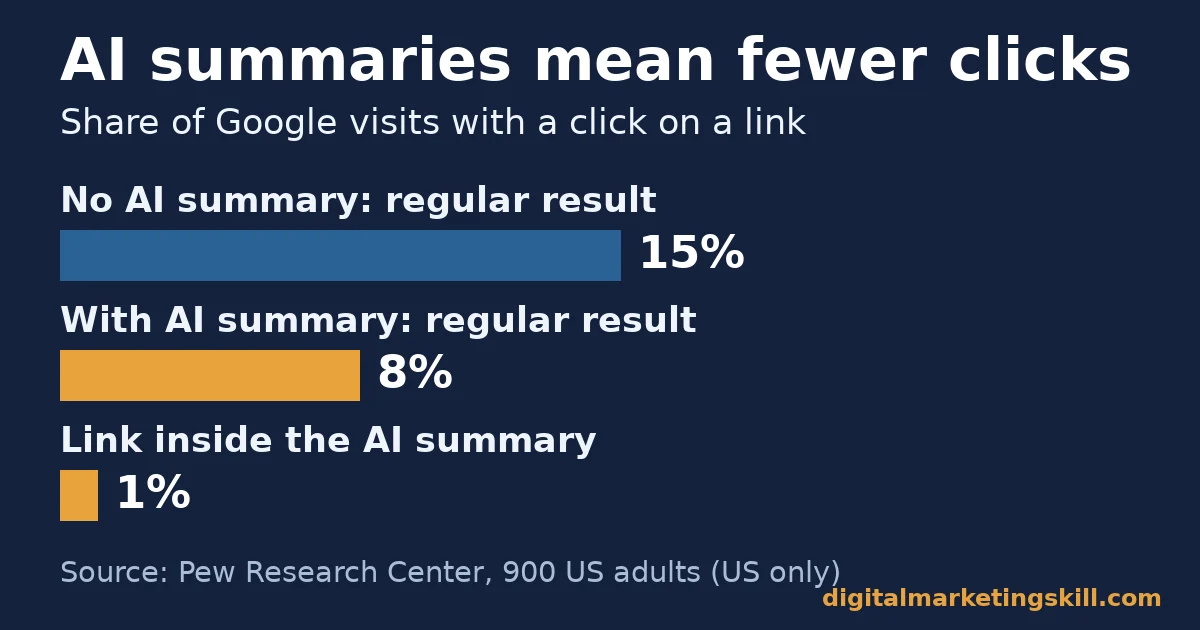
Pew also found that users clicked a link inside the AI summary in just 1% of visits. And they ended their browsing session on 26% of result pages with a summary, against 16% without one. You can read the full Pew Research Center analysis of AI summaries and clicks. It is a US-only study of one search engine, so treat it as a strong signal rather than a global rule.
Google’s guidance points the other way on method. Its page on AI features and your website says no special optimisations are needed to appear in AI Overviews or AI Mode. Search Console also counts traffic from those features in its normal performance report.
So an SEO expert does not need a separate playbook for AI search. Instead, they need better reporting, because impressions and on-page actions now tell more of the story than clicks alone.
How an SEO Expert Measures Progress
Measurement is where most beginner case studies fall apart. They show a traffic chart with no baseline, no time frame and no link to business results. Use these definitions, and compare equal periods before and after each change.
- Impressions: the Search Console performance report help defines this as how often someone saw your link on Google. Rising impressions mean Google is testing your page for more searches, even before clicks follow.
- Clicks: how often someone clicked a link from Google to your site. Read clicks next to impressions, because clicks can fall while visibility grows when AI summaries answer part of the question.
- Click-through rate: clicks divided by impressions. A low rate on a busy page usually means the title does not match what searchers want.
- Average position: a relative ranking where one is the top position. Treat it as a direction of travel. It averages many queries, so it can drop when a page starts showing for new, harder searches.
Two Numbers That Tie SEO to the Business
Search Console shows what happens on Google. These two show what happens after the click, on your own site.
- Engaged sessions: Google Analytics counts a session as engaged if it lasts over ten seconds, has a key event or has two or more page views. This shows whether search visitors found what they came for.
- Key events: the actions that matter to the business, such as a form sent, a call or a sale. This is the number that turns an SEO report into a business case.
A useful habit is to report all six in one short table every month. Then you read a fall in one number next to the others. Nobody panics over a single line on a chart.
The Decision Rule: Start Where the Feedback Loop Is Shortest
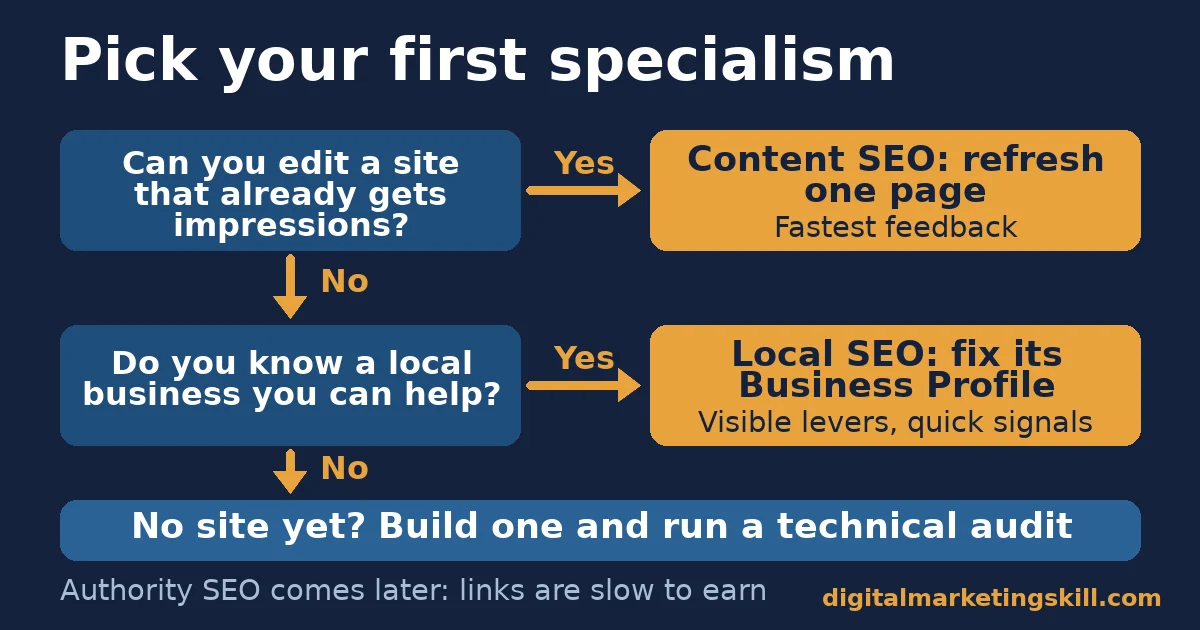
The most useful rule in this guide: choose your first specialism by how fast you can see a result on a site you control. Ignore which one sounds most impressive. A fast feedback loop means more attempts, more mistakes you can learn from and a case study sooner.
Google’s SEO Starter Guide explains why timing matters. It says some changes take effect in a few hours, while others could take several months. Link-driven authority work tends to sit at the slow end. Title rewrites, profile fixes and crawl repairs on an existing site tend to show up sooner, because Google already knows those pages.
A Worked Example With Invented Numbers
Here is an illustrative example, with invented numbers. A beginner has access to a small bakery website with twenty pages. Its menu page shows up 4,000 times a month in search but gets only 40 clicks. That is a click-through rate of 1%. The bakery also has a Business Profile with three reviews and no photos.
The beginner rewrites the menu title to match real searches, such as “Birthday Cakes to Order”, and also fixes the profile. Four weeks later, impressions sit at 4,200 and clicks rise to 126, a rate of 3%. The profile now has eleven reviews. That is a small, honest case study with a baseline, a change and a result. It is exactly what a client wants to see.
Had the numbers stayed flat, the beginner would still have learned something useful. They would check whether the page ranked for the right searches at all, then test a second change. That loop of test, measure and adjust is what turns a learner into an SEO expert.
What Proof Looks Like: HubSpot’s Old-Post Refresh
A well-documented real case comes from HubSpot’s own marketing blog. Pamela Vaughan reported that 76% of the blog’s monthly views came from older posts. So did 92% of its monthly leads. The team then updated and republished older posts that already had traffic.
The results are specific. HubSpot’s report on historical blog optimisation says the updated posts gained 106% more organic search views on average, and monthly leads from those posts doubled. The method was simple. Find posts with traffic, match them to keywords, update them, then promote them again.
What This Case Does Not Show
The limits matter as much as the numbers. HubSpot is a large, well-linked site with thousands of posts, so smaller sites should expect smaller gains. The figures come from HubSpot’s own reporting on its own blog, not an independent audit. Still, the method scales down well, and it is the same one used in the content project above.
Students at the Digital Marketing Skill Institute describe a similar first step. On our student reviews page, Abimbola Fafiolu wrote about building a working website that ranks in Google. They named the SEO module as the best lecture. That is a self-reported comment without traffic figures, so read it as one learner’s experience, not a benchmark.
Frequently Asked Questions About Becoming an SEO Expert
How long does it take to become an SEO expert?
You can learn the basics in a few weeks, but becoming an SEO expert takes longer because proof needs time. Google says some changes show within hours and others take months. So plan on several months of real projects before you show solid results.
Do I need a degree to become an SEO expert?
No degree is required to do SEO work, but some employers still ask for one. O*NET reports that 48% of surveyed search marketing strategists said their job needs a bachelor’s degree. That is why freelance work and small businesses are often easier first doors.
How much does an SEO expert earn?
Pay varies widely by country, sector and experience, and there is no reliable global figure. In the US, O*NET’s profile of search marketing strategists lists SEO consultant as a sample job title and reports a median wage of $78,760 a year for the wider marketing specialist group.
Is SEO still worth learning now that AI answers appear in search?
Yes. Google says pages need no special optimisation to appear in its AI features, so the same SEO skills apply. The difference is in reporting, since Pew Research Center found fewer clicks on regular results when an AI summary appears.
Which specialism should a beginner choose first?
Choose the specialism where you can see a result fastest on a site you can edit. For most beginners that means content refreshes or local profiles. Authority building usually comes later, because links take longer to earn.
Can an SEO expert guarantee first place on Google?
No. Google states that no one can guarantee a number one ranking and warns site owners about anyone who claims a special relationship with Google. An honest expert promises a clear process, regular reports and measured changes instead.
Your Next Step Toward Becoming an SEO Expert
Every SEO expert started with one small, measured win. Start with one specialism, one site and one change. Record the baseline, make the fix, wait long enough to measure it, then write it up in a short case study. That single piece of proof will do more for your career than another list of tools.
If you want structure and feedback while you build that proof, the Digital Marketing Skill Institute offers the Master Diploma in Digital & AI Marketing. Its ten practical courses include AI-Powered Search Engine Optimisation and Content Marketing, AI-Powered Google Analytics and AI-Powered WordPress Website and eCommerce Development. You also get unlimited one-on-one coaching and mentoring, plus real project work inside a U.S. company.
The diploma is dual US and UK accredited, recognised in more than 100 countries and taught 100% online. That means you can study from anywhere in your country.
Wherever you live, you can apply for the Master Diploma, or browse more guides on the Digital Marketing Skill Institute blog. For more on the basics first, read our guide to what search engine optimisation is and how it works, or return to the Digital Marketing Skill Institute homepage.
Every figure in this guide was checked against its original source before publication. Figures marked as illustrative are invented examples, not real results.
![9 Amazing Digital Marketing Skills to Make Money Online [With Proof]](https://digitalmarketingskill.com/wp-content/uploads/2019/07/9-Amazing-Digital-Marketing-Skills-to-Make-Money-Online-With-Proof-17.png)