
Affiliate marketing only pays when a handful of mechanics line up: honest disclosure, a commission structure that fits the niche, and traffic that actually converts. Most guides skip straight to “promote products” without naming any of this. This guide names the mechanics, the research behind each one, and the specific fixes that turn a dead affiliate site into one that earns real, measurable money.
Key Takeaways
- Disclosure is not optional, and it is checked per page. The FTC’s own influencer guidance requires a clear disclosure placed with each endorsement, not just once on an About page.
- Commission rates vary by category, not by platform alone. Amazon’s own Associates rate card ranges from 1% to 10% depending on the product category, with most categories sitting near 3-4%.
- The attribution window is short by default. Amazon’s standard affiliate cookie lasts 24 hours, though an item added to the cart can extend credit for that item.
- Most affiliate content earns nothing. Ahrefs’ study of about 14 billion pages found 96.55% get no traffic from Google at all, and an affiliate page with no traffic earns no commission.
- A documented plan beats a casual hobby. Content Marketing Institute’s benchmark research found 65% of the most successful B2B content marketers have a documented content strategy, against 14% of the least successful.
In this guide
- What Most Affiliate Marketing Guides Get Wrong
- Why Most Affiliate Sites Earn Almost Nothing
- Affiliate Marketing Runs on Four Mechanics
- The Exact Fixes for Each Mechanic
- Three Mistakes That Undo Good Affiliate Marketing
- How to Measure Whether Your Fixes Worked
- The One Fix to Make Before Any Other
- A Real Case: Niche Focus Changed the Numbers
- Frequently Asked Questions About Affiliate Marketing
- Start by Auditing Your Highest-Traffic Page
What Most Affiliate Marketing Guides Get Wrong
Search for affiliate marketing and you get the same ten steps everywhere. Pick a niche. Join a program. Add links. Drive traffic. None of these steps are wrong. What is missing is the mechanics underneath each one, and the specific reason most affiliate sites earn close to nothing.
This guide groups affiliate marketing into four mechanics. Those mechanics are disclosure, commission structure, traffic and trust. Each section names the research behind it. Each one also names the failure it prevents, plus the fix to apply this week. None of the fixes require rebuilding a site from scratch. Most take a single afternoon to apply to a page that already exists.
A few ground rules first. Amazon’s rate card is one program among thousands, so treat it as a reference point, not a universal rate. The FTC guidance applies to US audiences specifically. Most reputable programs worldwide expect similar disclosure anyway, since the underlying trust problem is the same everywhere.
Everything else here is a practical framework built from that evidence, which makes it an informed approach rather than a settled formula.
Why Most Affiliate Sites Earn Almost Nothing
An affiliate site rarely fails because the niche was wrong. It fails because one of four mechanics was skipped. Skip disclosure, and trust erodes. Skip traffic, and nobody sees the links. Commission structure gets ignored, so effort goes into low-paying categories. Credibility signals go missing, so even the traffic that arrives does not convert.
No Traffic Means No Commission, No Matter the Niche
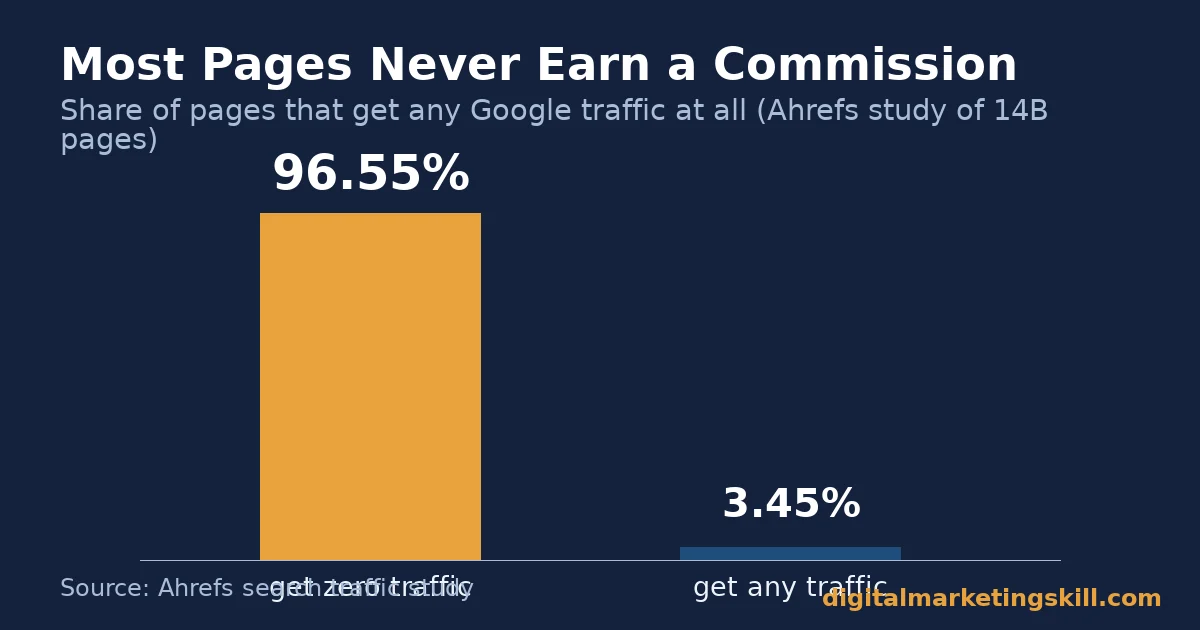
Affiliate marketing is a traffic business before it is anything else. Ahrefs’ search traffic study of around 14 billion pages found that 96.55% get no traffic from Google at all. An affiliate page with zero visitors earns zero commission, regardless of how generous the program’s rates are.
Most of that traffic failure traces back to content built for no one in particular. Google’s own guidance on helpful, people-first content asks whether a specific reader would “leave feeling they’ve learned enough” to act. An affiliate page stuffed with generic product mentions rarely clears that bar.
Undisclosed Links Cost Trust Before They Cost Rankings
The FTC’s Disclosures 101 guide sets a clear bar. Any financial relationship with a brand, including a commission on a sale, needs a disclosure. It must be “placed so it’s hard to miss,” next to the specific link, not buried on a separate page. A single About-page disclaimer does not cover every post.
Skipping this is not just a compliance risk. A reader who later realizes a “recommendation” was a paid link stops trusting every future recommendation from that site, which quietly kills repeat traffic long before any legal issue appears.
Affiliate Marketing Runs on Four Mechanics
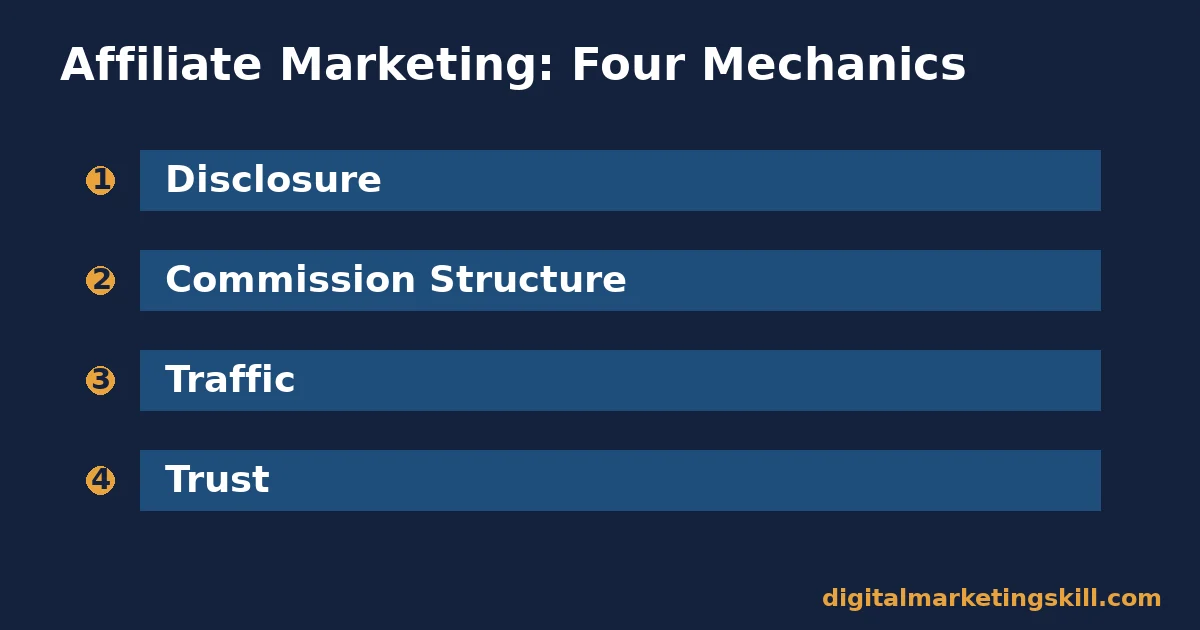
Every genuine affiliate marketing fundamental protects one of four things. Those things are how transparent the relationship is, how well the commission structure is understood, how much qualified traffic arrives, and how much that traffic trusts the site enough to click through and buy.
Illustrative, invented numbers: imagine a site getting 2,000 monthly visitors to its affiliate pages. At a typical 1% click-through rate on poorly placed links, that is only 20 clicks a month. Fixing placement and trust signals can double or triple that click-through rate without adding a single new visitor, which is why these mechanics matter as much as traffic volume itself.
Disclosure: Built to Stop Trust Erosion
Disclosure questions exist because an undisclosed commission, once discovered, taints every other claim on the site. The FTC’s guidance is specific about placement and plain language, not legal jargon, precisely because vague disclosures fail the same test as no disclosure at all.
Commission Structure: Built to Stop Wasted Effort
Commission questions exist because not all affiliate products pay the same for the same amount of traffic. Promoting a 1% category as hard as a 10% category wastes identical effort for a fraction of the return. The same applies to cookie duration: a program with a longer attribution window forgives a slower, more thoughtful buyer, while a short window rewards content that drives an immediate decision.
Traffic: Built to Stop Empty Pages
Traffic questions exist because a page nobody finds cannot convert anybody, no matter how well the affiliate links are placed on it. This is the mechanic most new affiliates underestimate, treating content creation as the finish line instead of the starting point.
Trust: Built to Stop Clicks That Never Convert
Trust questions exist because a visitor who does not believe the recommendation is genuine will not click through, even after finding the page. Stanford’s Web Credibility Project, based on research involving more than 4,500 people, lists real expertise and honest sourcing among the clearest ways to earn that belief.
The Exact Fixes for Each Mechanic
Knowing the four mechanics matters less than knowing exactly what to check and fix inside each one. Here is the specific action for each, plus what to check when the first fix is not enough. None of these fixes require new traffic, a new niche or a new program; they work on the content already published.
Disclosure: Put It Next to Every Link, Every Time
Add a short, plain-language disclosure near the top of any page with affiliate links, and repeat it near the links themselves if the page is long. Avoid vague terms; say plainly that a purchase through the link may earn a commission. Google’s own guidance on qualifying outbound links also recommends marking paid or commission links with the sponsored attribute, which keeps the technical side honest alongside the reader-facing disclosure.
Commission Structure: Check the Rate Card Before You Write
Before building content around a product category, check its actual commission rate. Amazon’s own rate card, for example, pays 10% on some categories and close to 0% on others such as gift cards and video game consoles. Building a whole content strategy around a near-zero category is a common, avoidable mistake. Comparing a shortlist of affiliate marketing programs before committing to one saves months of effort in the wrong category.
Traffic: Write for One Specific Reader, Not Everyone
Pick one specific question a real buyer is asking, and answer it directly in the first few sentences. Generic “best products” roundups compete against thousands of similar pages. A page that answers one precise question has a narrower, winnable target. The full process for how to start affiliate marketing from scratch covers this step in more depth.
Trust: Show the Product, Not Just the Link
Include specifics only a person who actually used or closely researched the product would know: a measurement, a limitation, a comparison. Generic praise reads as unresearched, and readers who sense that rarely click through. Strong affiliate marketing content leans on this kind of specific detail far more than on adjectives.
A One-Page Affiliate Audit Template
Illustrative, invented numbers: a workable audit needs four short lines. Disclosure: “added a plain-language notice near the top and above each product block.” Commission: “swapped two low-paying categories for one that pays 4% instead of 1%.”
Traffic: “rewrote the opening to answer one specific buyer question instead of a generic overview.” Trust: “added one specific limitation of the product instead of only praise.” Four lines like these, filled in honestly, do more work than rewriting an entire site from scratch.
Three Mistakes That Undo Good Affiliate Marketing
Even a site that gets the four mechanics right can still underperform if these three mistakes creep in. Each one is easy to name and easy to fix once you see it.
Linking Every Mention Instead of the Right Mention
Turning every product name into a link, several times per paragraph, reads as spam rather than recommendation. It also spreads click intent thin across too many options. A reader who sees ten identical links has no signal about which one actually matters most. Link the product once per section, at the point a reader is ready to decide, not at every passing mention.
Leaving Reviews and Prices Stale After Publishing
A product review that still describes a discontinued model, or a price that has not matched the real one in months, quietly damages trust the moment a reader notices the mismatch. It also signals to search engines that the page has gone stale. That can quietly drag down rankings over time, even without an obvious penalty. Revisit high-traffic pages on a schedule, not only when a program sends a complaint.
Relying on a Single Program for All Revenue
A site built entirely around one affiliate program is one policy change away from losing most of its income. Programs change commission rates, cookie windows and terms without much notice. Spreading revenue across two or three reputable programs in the same niche protects against any single change wiping out earnings overnight. It also gives a direct comparison when deciding which program genuinely pays best for a specific audience.
How to Measure Whether Your Fixes Worked
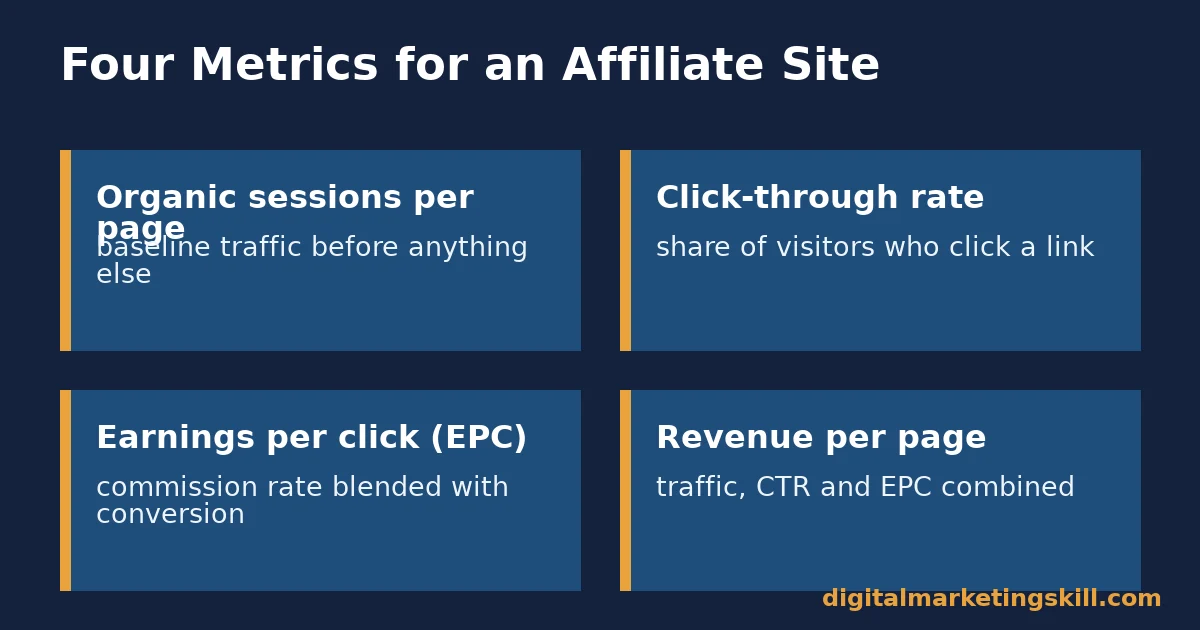
Fixing these mechanics is only half the job. The other half is checking, with numbers, that the fixes actually moved the outcome they targeted. Four metrics show this clearly across an affiliate site, and all four are available in free analytics tools or inside most affiliate program dashboards.
Four Metrics That Show a Healthier Affiliate Site
Organic sessions per page is the baseline traffic metric; without it, nothing downstream matters. Click-through rate on affiliate links is the share of page visitors who actually click a link, which reflects how convincing and well-placed the recommendation is.
Earnings per click (EPC) blends commission rate and conversion rate into one number comparable across programs. Revenue per page ties traffic, click-through and EPC together into the number that actually matters for deciding which pages to expand or retire.
How to Read These Numbers Together
Read these four metrics together, not alone. High traffic with a low click-through rate often means the content answers the question but does not connect it clearly to a specific product. A high click-through rate paired with a low EPC usually means the commission category itself pays poorly, not that the content failed.
When revenue per page improves after a fix, you have evidence that specific mechanic mattered for that specific page, not just in general research. Track all four numbers in the same spreadsheet or dashboard every month, so a slow decline in any one of them is visible long before it shows up as a drop in total revenue.
The One Fix to Make Before Any Other
If you only have time to fix one thing in affiliate marketing, make it this: rewrite your highest-traffic page. Answer one specific buyer question in the opening sentences, with the disclosure placed immediately after it. Traffic without disclosure risks trust, and disclosure without traffic earns nothing. Fixing the page that already gets visitors compounds both at once.
As a worked example: a site’s top page gets 500 monthly visitors but a 1% click-through rate on its affiliate link. That is 5 clicks a month. Rewriting the opening to answer one specific question and moving the link higher on the page lifts click-through to 3%, or 15 clicks. That is triple the revenue from that single page without any new traffic at all.
A Real Case: Niche Focus Changed the Numbers
Picking one niche and executing it consistently shows up in real outcomes beyond affiliate sites specifically. Digital Marketing Skill Institute student Damola Akanbi reported charging $1,500 per client for digital marketing campaign work. He credits learning to focus his offer instead of spreading effort across many services at once.
That figure is one student’s self-reported result, not a guaranteed income, and results vary by market, niche and program. See the earnings disclaimer for full context. The lesson is directional, not universal: a narrow, well-executed focus tends to outperform a broad, shallow one, whether the business model is affiliate content or client services.
The same pattern shows up across affiliate sites that succeed. A site covering one precise topic area in real depth tends to out-earn a broad site that briefly touches dozens of unrelated categories. That holds even when the broad site publishes far more pages. Depth signals real expertise, and expertise is exactly what Stanford’s credibility research found readers respond to.
Frequently Asked Questions About Affiliate Marketing
What is the single most important affiliate marketing fix to make first?
Fix your highest-traffic page first. Rewrite it to answer one specific buyer question. Place a clear disclosure right after it, since that page already has the traffic the rest of the fixes depend on.
Does a disclosure on the About page count for every post?
No. The FTC’s own guidance requires the disclosure to appear with the specific endorsement or link, not only once on a separate page a reader may never visit.
Why do commission rates matter more than most beginners think?
Because identical effort can produce very different returns. Amazon’s own rate card ranges from near 0% to 10% depending on category. Promoting a low-paying category as hard as a high-paying one wastes the same work for a fraction of the result.
How much traffic does an affiliate page actually need to earn money?
Enough to be found for a specific, answerable question. Ahrefs’ research found 96.55% of pages get no Google traffic at all. The real bar is clearing that threshold, not hitting a specific visitor count. A page with even a modest 50 monthly visitors and a trustworthy recommendation often earns more than a page with 500 visitors and no clear reason to click.
What does a short cookie window mean for affiliate strategy?
It means timing matters. With a 24-hour standard window like Amazon’s, content that gets a reader to click and buy on the spot earns more reliably. Content that hopes for a delayed purchase days later earns far less consistently.
Do I need to buy or test every product I promote?
Not always. Including specific, checkable details, a measurement, a limitation, a direct comparison, builds far more trust than generic praise. Trust is what converts a click into a sale. When you genuinely have not used a product, say so plainly. Base the recommendation on verifiable specifications instead of invented experience.
Should a beginner pick one niche or promote many products at once?
One niche. A focused site can answer specific buyer questions precisely, which performs better in both search visibility and reader trust than a broad site spread thin across many unrelated products. A narrow start also makes every one of the four mechanics easier to execute well. There is simply less surface area to get wrong.
Is it risky to rely on a single affiliate program?
Yes. Programs change commission rates, cookie windows and terms without much notice. A site built around only one program can lose most of its income overnight. Spreading revenue across two or three reputable programs in the same niche protects against that.
Start by Auditing Your Highest-Traffic Page
Pick your single highest-traffic page and run it through all four mechanics: disclosure, commission structure, traffic intent and trust signals. Fix what is missing there before touching anything else on the site. One well-fixed page that already has traffic will almost always out-earn five new pages built from scratch.
The Digital Marketing Skill Institute’s Master Diploma in Digital & AI Marketing offers structured practice building content and traffic strategies like this. It includes AI-Powered Search Engine Optimisation and AI-Powered Content Creation among its ten execution-first courses across four AI-powered tracks, covering exactly this kind of traffic and trust work.
The program also includes unlimited 1-on-1 coaching and mentoring, and a project-based internship with a U.S. company that comes with a verified U.S. Work Reference Letter. It is dual US and UK accredited, recognised in more than 100 countries, and 100% online, so you can study and apply these affiliate marketing mechanics from anywhere in your country.
Browse the digital marketing blog for more practical guides, check real outcomes on the reviews page, or go straight to the application page to get started. Wherever you live, affiliate marketing rewards the mechanics above more than it rewards luck. Visit Digital Marketing Skill Institute to learn more, or start today at digitalmarketingskill.com.
Every figure in this guide was checked against its original source before publication. Figures marked as illustrative are invented examples, not real results.
