
To start affiliate marketing, you need three things: a product to recommend, an audience that trusts you, and a disclosed link that pays a commission. This guide covers the real mechanics and honest income ranges. It also covers the legal disclosure rule most beginners skip.
Key Takeaways
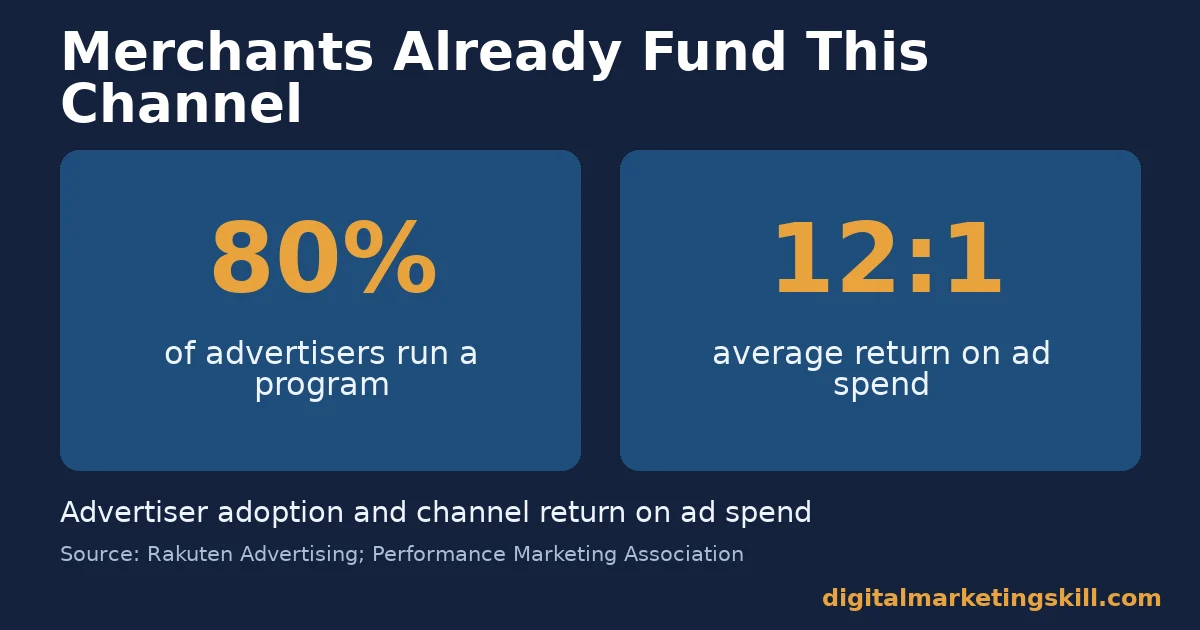
- 80% of advertisers report running an affiliate program, according to Rakuten Advertising. The supply of programs to join is not the bottleneck for most beginners.
- Affiliate marketing generates a 12:1 return on ad spend, per the Performance Marketing Association’s industry study of seven affiliate networks and sixteen publishers. That efficiency is why merchants keep funding these programs.
- Commission rates commonly range from 5% to 30%, and vary sharply by niche, so niche choice changes your ceiling before you write a single word.
- The FTC requires you to disclose affiliate links “clearly and conspicuously,” not buried in a footer or behind a hyperlink alone, per the FTC’s own endorsement guidance.
- Income varies enormously and is never guaranteed; treat every number in this guide as a range, not a promise.
In this guide
- What Most “Start Affiliate Marketing” Guides Skip
- How Affiliate Marketing Actually Works
- What Differs By Traffic Model
- How To Start Affiliate Marketing, In Order
- Common Mistakes That Stall Beginners
- How To Measure Whether It’s Working
- The One Decision Rule: Match The Model To Your Time Budget
- A Real Case: Building An Online Asset From Scratch
- Frequently Asked Questions About How To Start Affiliate Marketing
- Start Affiliate Marketing The Right Way This Week
What Most “Start Affiliate Marketing” Guides Skip
Search this topic and you get a list of platforms, sorted by payout. The list rarely explains why one platform fits your situation and another does not.
Most guides list platforms to join and call it done. They skip the legal disclosure requirement. Commission tracking gets glossed over too, along with what happens when a cookie expires before a buyer checks out.
This guide fills that gap. It names the mechanism first, then the decision that matters most: which niche and which traffic source you build around. More than 15% of all digital media revenue already comes from affiliate partnerships, according to Impact.com’s affiliate marketing guide, so the mechanics are worth getting right.
That same mechanism works the same way everywhere. Whether your readers are in one country or spread across many, the merchant, network, affiliate and customer relationship does not change shape.
None of this is a guaranteed formula. Results depend on niche, audience size, and consistency. Figures below carry their source and scope; illustrative numbers are labeled as such, never presented as real results.
How Affiliate Marketing Actually Works
Understanding this mechanism before you start affiliate marketing saves you from the most common early mistake: picking a platform before understanding how it actually pays you. Skip this step and a program’s terms will feel like fine print instead of the rulebook they actually are.
Four parties sit inside every affiliate sale. The merchant sells a product, and the network tracks that sale and pays out. You, the affiliate, send a reader. That reader becomes the customer who buys.
Tracking happens through a unique link, usually carrying a cookie or an ID tag. A visitor clicks it, then buys within that program’s own stated tracking window. You earn the agreed commission.
That tracking window is the quiet detail most beginners miss. A reader who clicks today but buys next month, after the cookie expires, pays the merchant nothing to you. This is why content that ranks and gets revisited matters more than a single viral spike.
This also explains why timing your content around an actual buying decision matters more than timing it around a trend. A reader researching a purchase right now is far more likely to buy inside the tracking window. A merely curious reader is not.
What Differs By Traffic Model
Anyone can start affiliate marketing with a free blog and a single link. What separates a hobby from an income source is choosing the right traffic model deliberately, not accidentally.
Three ways to start affiliate marketing dominate in practice. Each rewards a different skill and a different timeline. Pick one deliberately instead of drifting between all three. That choice is what separates beginners who build momentum from beginners who stay stuck switching tactics.
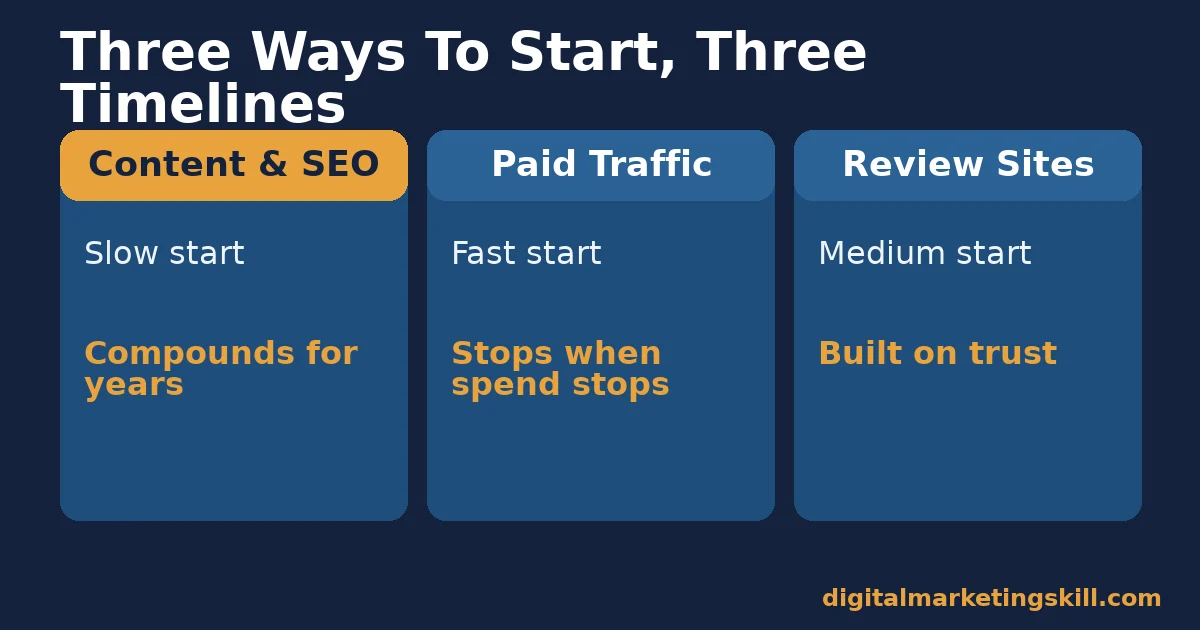
Content and SEO: Built For Compounding Traffic
A comparison or how-to page that ranks in search keeps sending buyers for years. This is the slowest model to start and the cheapest to sustain once it works.
The constraint is time to rank. Expect months before meaningful organic traffic, so this model alone cannot fund a launch. Picking the right keyword first shortens that wait considerably; our guide to effective SEO keywords covers how. Blogging is the usual home for this content; our guide to making money from blogging covers the broader model.
Paid Traffic: Built For Speed, Not Compounding
Running ads straight to an affiliate offer can produce a sale the same day. It also stops the moment you stop paying, and many merchants restrict paid traffic entirely in their program terms.
This model suits someone who already has an advertising budget and wants to validate an offer quickly, more than someone starting from zero capital.
Read the program’s terms before spending a cent on ads. Some networks ban bidding on the brand’s own name, and violating that can get you removed with commissions unpaid.
Paid traffic also demands a tighter budget discipline than content does. A page that loses money for a week of content writing costs you time. Losing money for a week on a paid campaign costs cash you cannot get back.
Review and Comparison Sites: Lead With Trust, Not Reach
This model is the one most beginners picture when they imagine how to start affiliate marketing, and for good reason: it rewards research and honesty over production speed or ad budget.
A page that honestly compares three real options converts better than a generic banner ad. That page answers the exact question a buyer already has in mind. 97% of consumers read reviews before choosing a business, per BrightLocal’s Local Consumer Review Survey. The same trust-seeking behavior drives readers to comparison pages before a purchase.
This model depends on genuinely trying or researching the products. A review that reads as copied marketing copy erodes the trust the whole model depends on. Name a real limitation for each option, not only its strengths. A review with zero downsides reads as an ad, not an honest comparison.
How To Start Affiliate Marketing, In Order
This is the exact sequence to start affiliate marketing without wasting the first few months on the wrong first move.
Follow these steps in sequence. Each one narrows the next decision, so skipping ahead usually means redoing an earlier step once the gap becomes obvious.
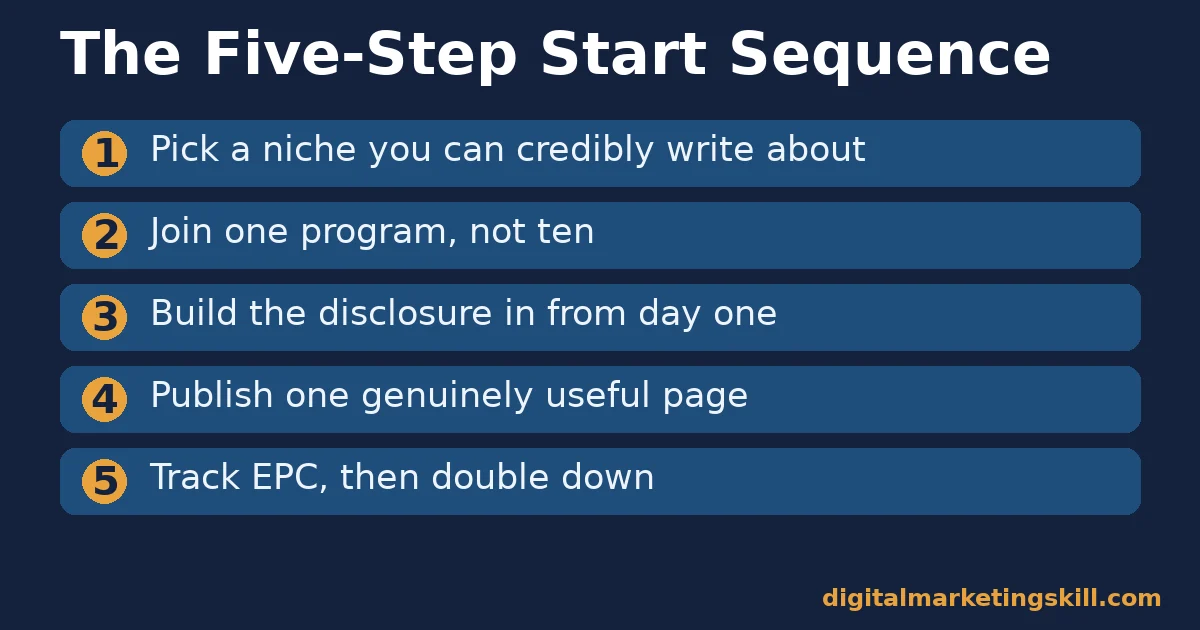
Step 1: Pick A Niche You Can Credibly Write About
Choose a topic where you already have real experience or can get it quickly. Credibility shows in specific detail that a generic writer cannot fake.
A narrow niche beats a broad one at the start. “Budget hiking gear for beginners” earns more trust and ranks faster than “outdoor products.” Both the reader and the search engine can tell exactly who the page is for.
Test the niche with one question before committing: would you still research and write about this topic if nobody paid you for it? A genuine yes is a strong signal the content will hold up over the months it takes to start earning.
Step 2: Join One Program Before Ten
Pick one merchant or network that fits your niche and read its terms fully. Joining ten programs before publishing anything splits your attention without adding income.
Check the cookie window, the payout threshold, and whether paid traffic is restricted before you commit. These details decide whether the program actually fits the traffic model you picked in the previous section. Reading them now, before any content exists, costs minutes; discovering a conflict after months of writing costs those months.
A program with a high advertised commission but a long payout delay, or a high minimum payout threshold, can leave you waiting months for your first real payment even after your first sale.
Step 3: Build The Disclosure In From The Start
Add a clear, plain-language disclosure near the top of every page with affiliate links, not just in a hidden policy page. The FTC’s own guidance says a disclosure “should be placed where it easily catches consumers’ attention and is difficult to miss.”
A simple sentence works: “This page contains affiliate links; we may earn a commission if you buy through them, at no extra cost to you.” Treat this as a permanent part of the page template, not a one-time task to remember later.
Step 4: Publish One Genuinely Useful Page
Answer the exact question a buyer has before purchasing, with specific detail a generic page would skip. One excellent page beats ten thin ones. Once it is live, you still need readers to find it; see our list of ways to increase website traffic for free.
Resist the urge to publish five thin pages this week instead of one thorough one. A thin page rarely ranks and rarely converts, so five of them usually produce less than one page done properly.
Step 5: Track Clicks And Earnings Per Click, Then Double Down
Once you have data, put more effort into whatever page already converts rather than spreading effort evenly across everything you have published.
Give any single page a few months of real traffic before judging it a failure. A page can look dead for a long stretch and then start converting once it earns enough search trust to rank for its target question.
Common Mistakes That Stall Beginners
Every mistake below has the same root: skipping a foundational step to chase a faster-looking shortcut.
Most people who fail at affiliate marketing are not missing a platform to join. They are repeating one of these five mistakes, often without realizing it until months in.
- Joining ten programs before publishing anything. Spreading early effort across many unrelated offers means no single page gets enough content or promotion to actually convert.
- Skipping the disclosure, then adding it as an afterthought. A disclosure bolted on after launch, buried in a footer, does not meet the FTC’s “clearly and conspicuous” standard and damages trust once readers notice the gap.
- Writing reviews for products never actually used. Readers can tell generic, copied description from first-hand detail, and that gap is exactly what review and comparison pages depend on to convert.
- Chasing the highest advertised commission rate alone. A high rate on a product nobody buys earns less than a modest rate on a product your specific audience actually wants.
- Giving up before the content model has time to rank. Content-based affiliate pages often take months to show meaningful traffic, and quitting at week four looks identical to quitting right before it would have worked.
Watch for these patterns in your own work, not just in theory. Most beginners recognize at least two of the five once they look honestly at their first few weeks.
How To Measure Whether It’s Working
Three numbers show whether an affiliate page is worth your time, each defined in one sentence. Pull them from your affiliate network’s own dashboard, not from guesswork or your website’s visitor count alone.
Checking these numbers weekly in the first month, then monthly after that, catches a broken link or a paused program fast, before weeks of traffic get wasted on a dead offer.
- Click-through rate: the share of readers who click your affiliate link, out of everyone who saw the page.
- Conversion rate: the share of clicks that turn into an actual sale, which the merchant’s network reports, not your own page analytics.
- Earnings per click (EPC): total commission earned divided by total clicks sent. This is the single best number for comparing two different offers against each other.
A page with high traffic but low EPC is often solving the wrong problem; the content attracts readers who are not close to buying. Turning that traffic into a list you can message again helps; our email marketing guide for beginners covers the setup.
The One Decision Rule: Match The Model To Your Time Budget
Most people trying to start affiliate marketing pick a model based on what looks exciting, not what fits their actual time and cash. That mismatch is the real reason many quit before any model had a fair chance to work.
If you can commit real hours weekly for months before seeing income, content and SEO return the best long-term economics. If you need income inside weeks, a paid-traffic test on a narrow, proven offer is the faster path, with the terms read first. Neither path is wrong; the mistake is choosing one without first being honest about which time budget you actually have.
Illustrative, invented numbers to show the method. A content page that takes 10 hours to research and write, then earns $40 a month in year one, looks like a poor return hour for hour at first.
By year three, with no extra hours spent, that same page can still be earning $40 a month. Its effective hourly return by then is far higher than it looked at first, because the original 10 hours never needed repeating.
A Real Case: Building An Online Asset From Scratch
Reading the steps above is one thing. Actually building the asset is another. The case below shows what that gap looks like closed.
A Digital Marketing Skill Institute student, Eunice Bolaji, built a full online business from scratch while still learning, as published on the Institute’s reviews page. This was an ecommerce business, not an affiliate site, so treat it as evidence for the underlying skill, building and monetizing an online asset from nothing, rather than as an affiliate-specific income claim.
The sequence matches this guide: build the asset first, add the monetization and disclosure mechanics second. Outcomes vary by niche, effort and market, consistent with the Institute’s earnings disclaimer.
Nothing here promises the same result for every reader. The point of the case is the order of operations, not a specific dollar figure to expect.
Frequently Asked Questions About How To Start Affiliate Marketing
How much money do I need to start affiliate marketing?
You can start affiliate marketing with close to no money if you choose the content model and use a free or low-cost website, since the main cost is your time. A paid-traffic test adds real cash cost from the start.
How long does it take to earn your first affiliate commission?
It varies widely by niche, traffic source and effort. Content-based sites often take months to rank before any commission arrives, while a well-targeted paid test can produce a sale within days.
Do I need a website to start affiliate marketing?
No, a website is not strictly required; some affiliates work through social platforms or email lists instead. A website you control is still the most durable asset, since social reach is never fully yours. A list of subscribers you can message directly sits somewhere in between, durable but slower to build than a single social post.
What happens if I don’t disclose my affiliate links?
You risk FTC enforcement action and loss of reader trust, which is harder to rebuild than almost anything else in this business. A clear disclosure near the top of the page is the minimum standard.
How many affiliate programs should a beginner join?
One or two, chosen deliberately, beats joining ten. Spreading early effort across many unrelated programs usually means none of them gets enough content or attention to convert.
Can you start affiliate marketing on social media instead of a blog?
Yes, platforms like YouTube and Instagram support affiliate links directly, and some creators build entirely there. The tradeoff is durability: a blog post keeps ranking for years, while social reach depends on an algorithm you do not control.
What is a good commission rate for a beginner to target?
There is no single number, since rates commonly range from 5% to 30% and vary sharply by niche. Compare earnings per click across offers in your specific niche rather than chasing the highest advertised percentage.
Can you start affiliate marketing with no audience at all?
Yes, though it is slower. Building the audience and the content at the same time is normal for beginners; the two grow together rather than one needing to exist before the other starts.
Start Affiliate Marketing The Right Way This Week
Pick one niche, join one program, build the disclosure in from day one. Publish one genuinely useful page before worrying about the next ten. That sequence, done properly, is exactly what the Digital Marketing Skill Institute’s Master Diploma in Digital & AI Marketing is built to teach.
It runs across four AI-powered tracks, including AI-Powered Lead Generation and Email Automation and AI-Powered WordPress and SEO Specialist. That is ten courses in total, with a Full Stack option to complete all four.
The content and SEO skills behind every step in this guide, from niche research to the page that actually ranks, are taught in depth across these tracks, not just mentioned in passing.
You also get unlimited 1-on-1 coaching, plus a U.S. Project Internship with a verified Work Reference Letter. The program is dual US and UK accredited, 100% online, and recognised in more than 100 countries.
Explore the Master Diploma program, browse more guides on the blog, or go straight to apply.
Learn more at digitalmarketingskill.com, wherever you live. The program runs fully online and works the same way no matter which affiliate networks are available in your country. Visit digitalmarketingskill.com to get started today.
Every figure in this guide was checked against its original source before publication. Figures marked as illustrative are invented examples, not real results.
![9 Amazing Digital Marketing Skills to Make Money Online [With Proof]](https://digitalmarketingskill.com/wp-content/uploads/2019/07/9-Amazing-Digital-Marketing-Skills-to-Make-Money-Online-With-Proof-17.png)






