Generative engine optimization is the work of shaping your content so AI answer tools can find it, trust it and cite it. Those tools include Google AI Overviews, ChatGPT search, Copilot and Perplexity. GEO does not replace SEO. Instead, it changes how you write each page, and the right change depends on the content format.
Key Takeaways
- Researchers at Princeton and IIT Delhi tested 10,000 queries. Adding quotations raised a page’s visibility in AI answers by about 41%, while keyword stuffing gave little or no gain.
- Pew Research Center found that US Google users clicked a regular result in 8% of visits with an AI summary, against 15% without one. So a citation now matters as much as a ranking.
- Ahrefs studied 863,000 keyword results and found that only 38% of pages cited in AI Overviews also ranked in the top 10. A page outside the top 10 can still win the quote.
- OpenAI’s own usage study found that “Seeking Information” grew from 14% to 24% of ChatGPT use in a year. That means chat is taking over part of the job search used to do.
- AI visitors are few but valuable. AI tools sent about 0.17% of visitors across 3,000 sites, yet on Ahrefs’ own site 0.5% of traffic produced 12.1% of sign-ups.
In this guide
- The Gap in Most Generative Engine Optimization Advice
- How AI Answers Pick Sources: Fan-Out, Retrieval, Then Citation
- What Differs by Content Format
- Generative Engine Optimization in Practice: How to Lead With Each Format
- Distribution Still Decides What AI Tools Can Find
- Four Generative Engine Optimization Mistakes That Waste Good Pages
- How to Measure Generative Engine Optimization
- The One Decision Rule: Fix What Is Seen Before You Publish More
- A Real Case: Small AI Traffic, Outsized Sign-Ups
- Frequently Asked Questions About Generative Engine Optimization
- Your Next Step: Learn to Build Content That AI Tools Quote
The Gap in Most Generative Engine Optimization Advice
Most guides to AI search are organised by engine. They explain how ChatGPT differs from Perplexity, or how Copilot differs from Google. That helps, but it is not how a content team plans. You plan by format: a how-to guide, a definition page, a comparison or a research piece. This guide fills that gap with generative engine optimization by content format.
Three ground rules apply. First, no AI company publishes its full ranking logic. So the format advice here is an informed inference from public studies, not a settled fact. Second, the numbers move fast, so treat every figure in this generative engine optimization guide as a snapshot, not a permanent ranking.
Third, the best documented signal is plain. Google says there are “no additional requirements” to appear in AI Overviews beyond being indexed and eligible for a snippet. In other words, the basics of good SEO still carry most of the weight.
How We Checked the Evidence in This Guide
The Digital Marketing Skill Institute team opened every study below at its source. We noted each sample and its limits, and we left out any figure we could not trace. When a number comes from a vendor or covers only the US, we say so.
How AI Answers Pick Sources: Fan-Out, Retrieval, Then Citation
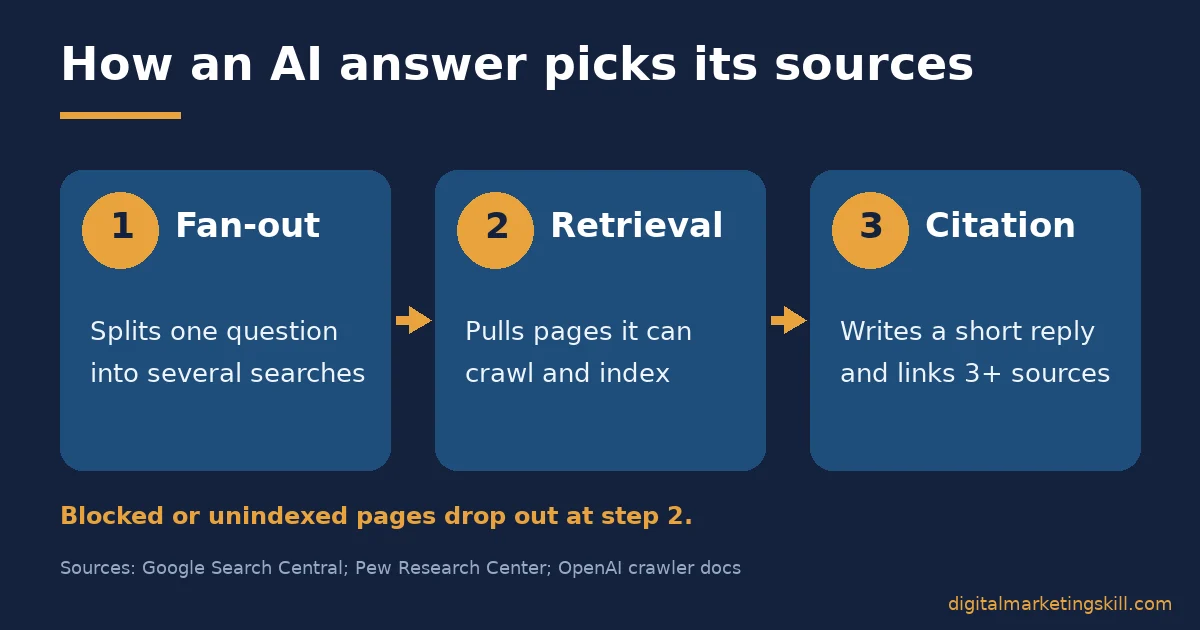
An AI answer is not a list of ten links. It is a short reply built from a handful of pages. To see where generative engine optimization fits, look at the three steps that lead to a citation. Each step can drop your page.
- Fan-out. The tool splits one question into several smaller searches. Google’s guide to AI features and your website calls this query fan-out. It runs “multiple related searches across subtopics and data sources.”
- Retrieval. The tool pulls candidate pages from its index. People call this retrieval-augmented generation, or RAG. It simply means the model looks up fresh pages before it writes, instead of relying only on its training.
- Citation. The model writes its reply and links the pages it leaned on. Pew Research Center found the median Google AI summary ran 67 words, and 88% cited three or more sources.
Fan-out explains a surprising result. Ahrefs analysed 863,000 keyword results and 4 million cited URLs. It found that 38% of AI Overview citations ranked in the top 10 for the original query. Another 31.2% ranked between 11 and 100, and 31.0% ranked lower still. Because Google also searches sub-questions, a page can win a citation for a question it never ranked for.
Crawler Access Comes Before Generative Engine Optimization
Access is the other half of retrieval. OpenAI’s crawler documentation says sites that block OAI-SearchBot “will not be shown in ChatGPT search answers.” So check your robots.txt file before you rewrite a single page. A page the crawler cannot reach never makes the shortlist, however good it is.
What Differs by Content Format
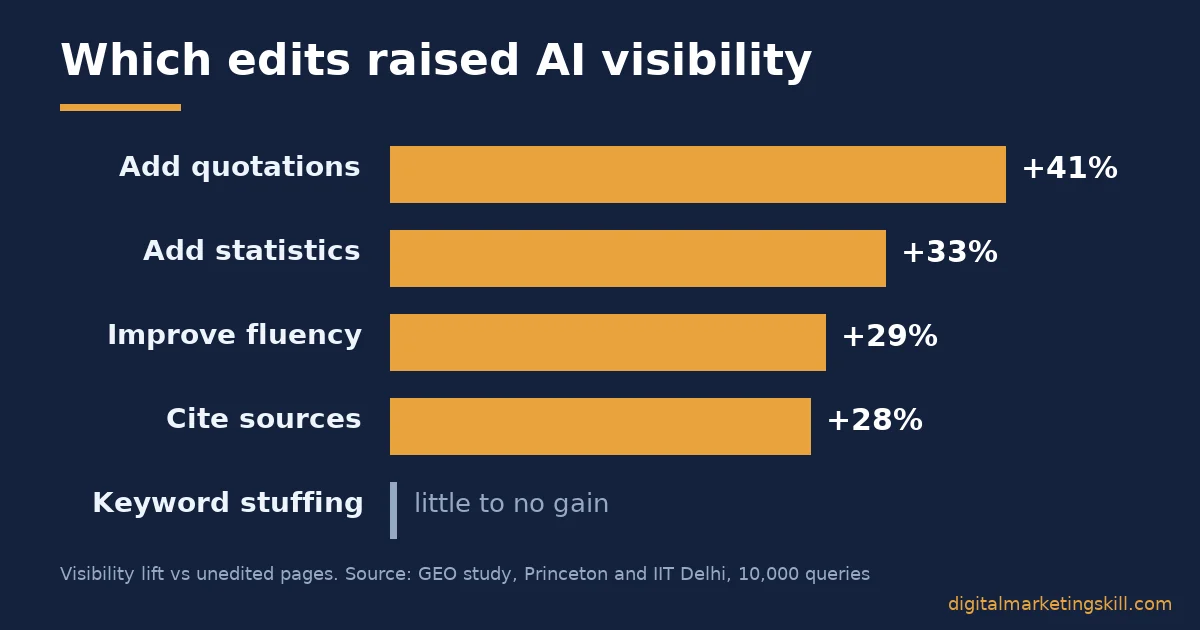
The best public evidence on citations comes from the GEO study by researchers at Princeton and IIT Delhi. The team presented it at the KDD data science conference. They tested nine ways to edit pages across 10,000 queries in 25 subject areas. Quotations lifted visibility by about 41%, statistics by 33%, fluency by 29% and cited sources by 28%.
The same study adds a warning. Keyword stuffing, the old habit of repeating a phrase, gave “little to no improvement.” Results also varied by subject area, which is why generative engine optimization works best when you match the edit to the format you are writing. Below, each of four common formats suits a different kind of extraction.
How-To Guides: Built for Step-by-Step Extraction
How-to questions are a core use of chat tools. OpenAI’s How People Use ChatGPT study found that “Practical Guidance,” which includes how-to advice, held steady at about 29% of usage. AI tools answer these questions with numbered steps, so they favour pages whose steps are already clean, complete and in the right order.
Definition Pages: Built for the First Sentence
Definition queries are short, so the tool needs one quotable line. In Pew’s US browsing study, 60% of question-style Google searches produced an AI summary, against about 18% of searches overall. When a summary appears, the definition usually comes from a page whose first sentence says what the term means. There is no warm-up.
Comparison Pages: Built for Named Criteria
Comparison questions, such as “X or Y for a small team,” make the tool weigh options. It looks for pages that name the criteria and give a verdict on each. A page that says “it depends” without saying on what gives the model nothing to quote. As a result, the tool tends to cite a rival page that commits.
Original Research Pages: Built for Statistics
Research pages carry the facts other pages repeat. In the GEO study, citing sources raised visibility by 115.1% for pages ranked fifth in normal search. That suggests evidence can lift a smaller site past bigger ones. Original numbers are also the hardest format to copy, which is why a good research page keeps earning citations long after launch.
Generative Engine Optimization in Practice: How to Lead With Each Format
Knowing what each format suits is half the job. The other half is the edit. Each section below mirrors one above. So you can open a page you already have, name its format and apply the matching fix in under an hour.
How-To Guides: Lead With the Numbered Answer
Put the full answer in a numbered list near the top, then explain each step below it. Start every step with a verb and keep it to one action. Also state the outcome and the time it takes, for example “Set up conversion tracking in about 20 minutes.” Because the tool can lift your list whole, it has less reason to stitch steps from three other pages.
Definition Pages: Lead With a One-Sentence Definition
Write the first sentence as “[Term] is [category] that [does what], so that [result].” Then add one plain example in the next sentence. Next, keep the term’s name exact across the page, because the model matches names rather than guessing synonyms. Finally, close with a short FAQ that answers the follow-up questions people actually ask.
Comparison Pages: Lead With the Verdict and the Criteria
Open with a verdict sentence that names who each option suits. Then add a short table that scores every option on the same criteria, such as cost model, learning curve and best use. Microsoft’s Bing Webmaster Tools team recommends clear headings, tables and FAQs to help pages earn citations in Copilot answers.
Original Research Pages: Lead With Sourced Statistics
Put your headline figure in a self-contained sentence that names the subject, the number and the source. For example: “In our survey of 400 online stores, 62% had no product reviews.” That example uses illustrative, invented numbers. Then give the sample size, method and limits right after it. A figure with its context can travel alone, while a bare number gets dropped.
Across all four formats, one guardrail applies. Google’s guide to creating helpful, people-first content asks who made a page, how and why. It calls “Why” perhaps the most important question. So never hide who wrote a page or why it exists. Our guide to the weak links in a content programme shows where that trust usually breaks.
Distribution Still Decides What AI Tools Can Find
Older content advice said to create first and distribute second. That advice still holds, with a twist. AI tools draw on the wider web, not just your site, so the places that mention you shape what they say.
Pew found that Wikipedia, YouTube and Reddit made up 15% of the sources in Google’s AI summaries. Ahrefs found that YouTube was the most-cited single domain in its AI Overview data, at 5.6% of all cited URLs. In short, video and community answers are part of the citation pool.
Three Distribution Moves for a Small Team
Here is what that means in generative engine optimization terms when your team is small. First, turn each strong how-to guide into a short video with the same steps and the same names. Second, answer real questions in your buyers’ communities. Third, keep facts consistent across your site, profiles and videos. Bing lists consistency across text, images and video as one of its own recommendations.
This is also where skills meet strategy. Writing quotable pages, recording clean video and reading analytics are separate crafts. Our guide to using AI across digital marketing shows how these jobs fit together in one plan.
Four Generative Engine Optimization Mistakes That Waste Good Pages
Most failed attempts at generative engine optimization share a few causes. Each has a quick check.
- Blocking the crawler by accident. Some sites block every AI bot, then wonder why ChatGPT never cites them. OpenAI separates training (GPTBot) from search (OAI-SearchBot), so you can block one and allow the other.
- Repeating keywords instead of adding evidence. The GEO study found keyword stuffing gave little or no gain, while quotations and statistics gave the biggest lifts. So spend your editing time on facts, not phrases.
- Hiding answers behind tabs or images. Google’s AI features guide advises keeping important content in text form. If the key answer only appears inside an image, the model may never read it.
- Judging the work by raw traffic. With AI tools sending well under 1% of visits on average, a traffic chart will look flat even when citations grow. Measure citations and conversions first, as the next section explains.
How to Measure Generative Engine Optimization
You cannot manage citations you cannot see. Fortunately, most of what you need sits in tools you may already use. Track these five measures each month next to your usual traffic and conversions. That way you can see whether AI visibility adds value or just moves it around.
- AI referral sessions: visits from chatgpt.com, perplexity.ai, copilot.microsoft.com and similar domains, found in your analytics referral report. Read it as a trend, not a total, because some AI tools hide the referrer.
- Total citations: Bing defines this as how often your pages appear as sources in AI answers across Copilot and Bing summaries. If citations rise while clicks stay flat, people read your facts without visiting.
- Grounding queries: the phrases Bing’s AI used when it fetched your page. Compare them with the questions your page answers, since a gap shows where to add a section.
- Search Console impressions: Google counts AI Overview and AI Mode appearances inside the normal Web performance report. So watch impressions on question queries, where Pew found summaries appear most.
- AI visitor conversion rate: sign-ups or sales from AI referrals divided by AI referral sessions. Compare it with organic search, because a small channel that converts well can still earn its place.
Read AI Traffic at the Right Scale
Keep the scale in view. The Ahrefs AI traffic study of 3,000 websites found that AI tools sent about 0.17% of visitors on average. ChatGPT sent about half of that. So judge this work on citations and conversions, not raw visits. For the wider scorecard, see our guide on how to measure content marketing results.
The One Decision Rule: Fix What Is Seen Before You Publish More
If you take one thing from this guide, take this rule. It tells you where to spend your next hour. It also stops you writing new pages when old ones sit closer to a citation.
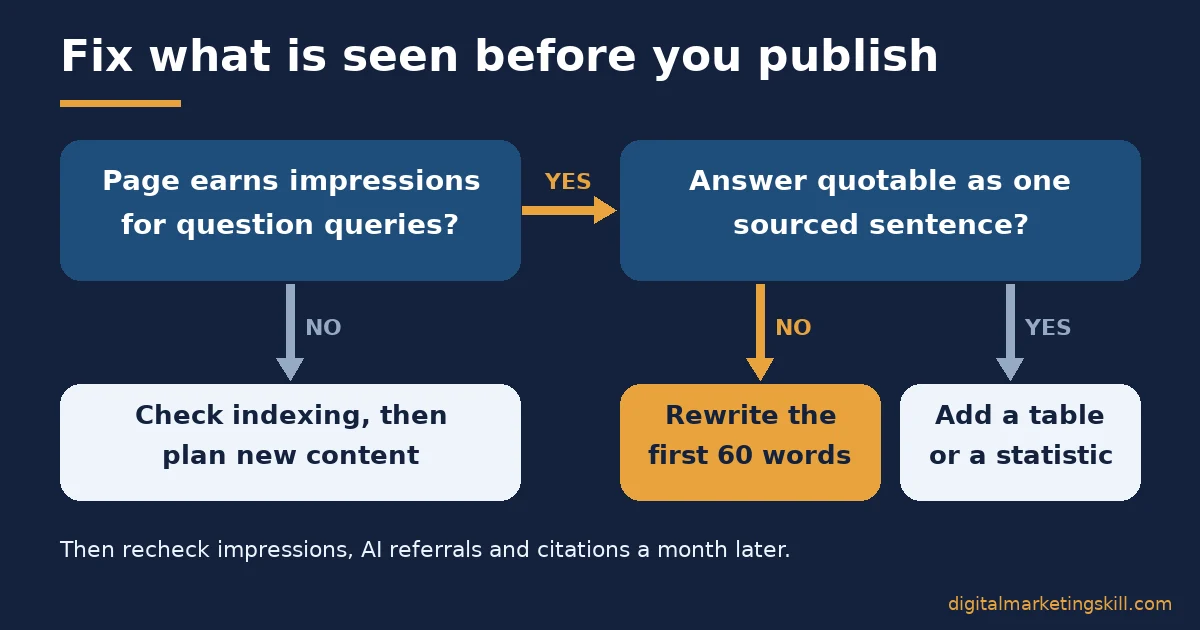
Decision rule: if a page already earns impressions for question queries, but you cannot lift its answer as one sourced sentence, rewrite its first 60 words before you create anything new.
The logic is simple, and it comes straight from Google’s own documentation. Those impressions prove that Google has indexed the page and can show it, which is its only stated requirement. What the page lacks is a quotable answer. Rewriting an opening takes an hour, while a new page takes days and still has to win attention.
Worked Example: Nine Openings in Nine Hours
Here is a worked example with illustrative, invented numbers. A training blog has 40 pages. In Search Console, 12 of them earn more than 500 monthly impressions from queries that start with “how,” “what” or “which.” Only 3 of those 12 open with a direct answer. So the rule says to rewrite the other 9 openings first, which is about 9 hours of work.
A month later, the team checks those 9 pages for impressions, AI referrals and Bing citations. Pages that improve keep their new openings, while pages that stall get the next fix in line, such as a table or a sourced statistic. A simple content audit keeps this list in order, so new content returns to the plan only once the list is done.
A Real Case: Small AI Traffic, Outsized Sign-Ups
Ahrefs, the SEO software company, published its own numbers. In its analysis of its own site, AI search sent about 0.5% of visitors over 30 days. Yet those visitors produced 12.1% of sign-ups. By the company’s count, AI visitors converted about 23 times better than visitors from organic search.
Why would that happen? My reading is that a person who clicks from an AI answer has already read a summary and compared options. In other words, the AI tool did the early research, so the click comes later in the buying journey.
The limits matter as much as the result. This is one company, measured by itself over a short window, with an audience that uses AI heavily. It shows what is possible, not what to expect. Still, the case backs the advice above: count conversions from AI referrals before you judge the channel by size. That habit separates a working SEO expert from someone who only reports rankings.
Frequently Asked Questions About Generative Engine Optimization
What is generative engine optimization in simple terms?
Generative engine optimization means editing your pages so AI tools can find them, quote them and link to them. Those tools include ChatGPT, Copilot, Perplexity and Google AI Overviews.
Is generative engine optimization different from SEO?
It builds on SEO rather than replacing it. Search engines still need to crawl and index your page. GEO then adds quotable answers, sourced statistics and a clear structure that a model can lift into a short reply.
Do I need special code or files to appear in AI Overviews?
No. Google states there are no extra requirements to appear in AI Overviews or AI Mode beyond being indexed and eligible for a snippet. Any structured data should still match what the page shows.
Does keyword stuffing help pages get cited by AI tools?
No. In the Princeton and IIT Delhi GEO study, keyword stuffing gave little or no improvement. By contrast, adding quotations, statistics and cited sources raised visibility by roughly 28% to 41%.
How can I tell if ChatGPT is sending visitors to my site?
Check the referral report in your analytics tool for chatgpt.com. Also make sure your robots.txt file does not block OAI-SearchBot. Some AI visits arrive without a referrer, so treat the count as a minimum.
Can a small website get cited in AI answers?
Yes. Ahrefs found that most AI Overview citations came from pages outside the top 10. The GEO study also found that citing sources helped lower-ranked pages most. Clear, sourced answers can beat a bigger brand.
Which content format should I optimise first?
Start with how-to guides that already earn impressions, because chat tools get many how-to questions and a numbered answer is the fastest fix. Move on to definitions, comparisons and research pages once you can see results.
Your Next Step: Learn to Build Content That AI Tools Quote
Start small. Pick one format and rewrite the openings of the pages that already earn impressions for the questions your buyers ask. Then track citations and AI referrals for a month. Once you see what moves, expand to the next format. That loop is generative engine optimization in practice, and it works wherever you live, because every engine above serves a worldwide audience.
If you want guided practice, the Master Diploma in Digital & AI Marketing from the Digital Marketing Skill Institute covers this work across nine practical courses. They include AI-Powered Search Engine Optimisation & Content Marketing and AI-Powered Google Analytics. You also get unlimited 1-on-1 coaching and mentoring, plus real project work inside a U.S. company.
The programme is 100% online, so you can study from anywhere in your country. It holds dual US and UK accreditation and is recognised in more than 100 countries. Read what graduates say on the reviews page, browse more guides on the digital marketing blog, or apply for the Master Diploma when you are ready. You can also start from the Institute’s homepage.
Every figure in this guide was checked against its original source before publication. Figures marked as illustrative are invented examples, not real results.
![9 Amazing Digital Marketing Skills to Make Money Online [With Proof]](https://digitalmarketingskill.com/wp-content/uploads/2019/07/9-Amazing-Digital-Marketing-Skills-to-Make-Money-Online-With-Proof-17.png)