
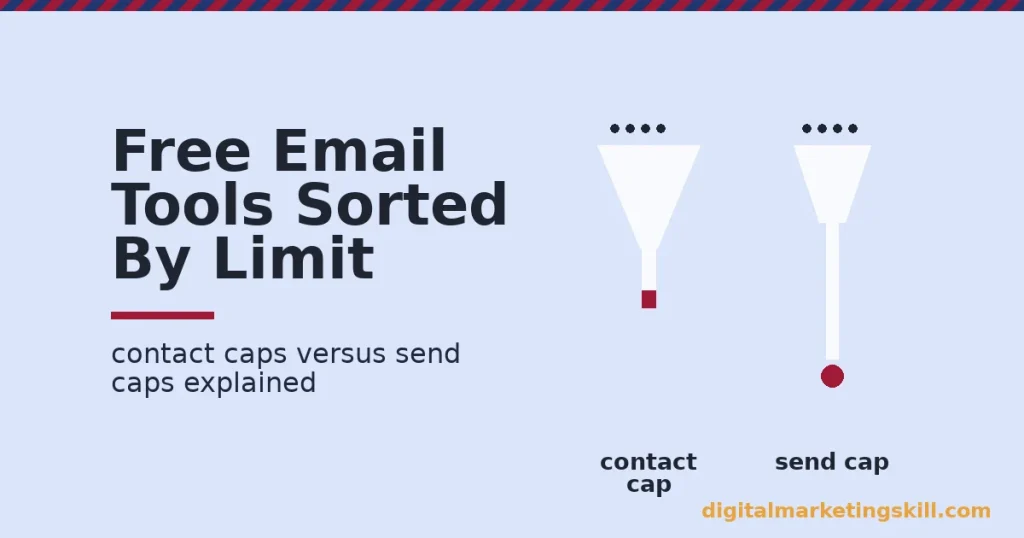
Free email marketing services let you send real campaigns before you pay for anything at all. But “free” means something different at every provider. Some cap how many contacts you store. Others cap how many emails you send. This guide groups the major free email marketing services by that one difference, so you can pick the right limit for your list.
Key Takeaways
- Free email marketing services fall into two groups: contact-capped and volume-capped. The right group depends on your list size and how often you actually send.
- Mailchimp’s free plan currently caps you at 250 contacts and 500 emails a month. This is verified directly on Mailchimp’s own pricing page.
- MailerLite’s free plan currently allows 250 subscribers and 2,500 emails a month. This is also verified directly on MailerLite’s own pricing page.
- Average open rate across industries sits near 35.6%, per Mailchimp’s own benchmark data. Apple’s Mail Privacy Protection can inflate that number, so treat it as directional.
- Free plans almost always strip out automation, custom reporting, or branding removal. Budget for an upgrade before you actually hit the send limit, not after.
In this guide
- The Gap Most “Free Email Marketing Services” Lists Miss
- How Free Email Marketing Services Actually Make Money
- What Differs By Your List Shape
- How To Actually Pick Between Them
- How To Measure Whether Your Free Plan Is Working
- The One Decision Rule
- A Real Case: Why The Limit You Pick Matters
- Frequently Asked Questions About Free Email Marketing Services
- Turn A Free Plan Into A Real Email Marketing Skill
The Gap Most “Free Email Marketing Services” Lists Miss
Most roundups just list ten logos and call it a day. They rarely say what “free” actually restricts. Free-tier limits also change often, so a list from even a few months ago can be wrong already.
This is a snapshot, verified directly against each provider’s own pricing page, not a permanent ranking. Treat the exact numbers below as a starting point. Recheck the provider’s page yourself before you commit a growing list to one plan.
A third thing most lists skip: not every free email marketing service is built for the same kind of sender. An ecommerce store, a local service business, and a solo newsletter writer all technically qualify as “small businesses,” but they send at wildly different frequencies and to wildly different list sizes. A ranking built for one of those senders can actively mislead the other two, even with accurate numbers.
There is also a second, quieter gap. Most lists treat every free plan as interchangeable, as long as the price is zero. They are not. A contact-capped plan and a volume-capped plan solve different problems, for different people, even when both cost nothing. Picking the wrong shape wastes time later, when you discover the limit you actually hit was never the one you planned for.
How Free Email Marketing Services Actually Make Money
Every free plan is a funnel, not a gift. A provider needs you to hit a wall eventually. So it picks one of two levers to pull.
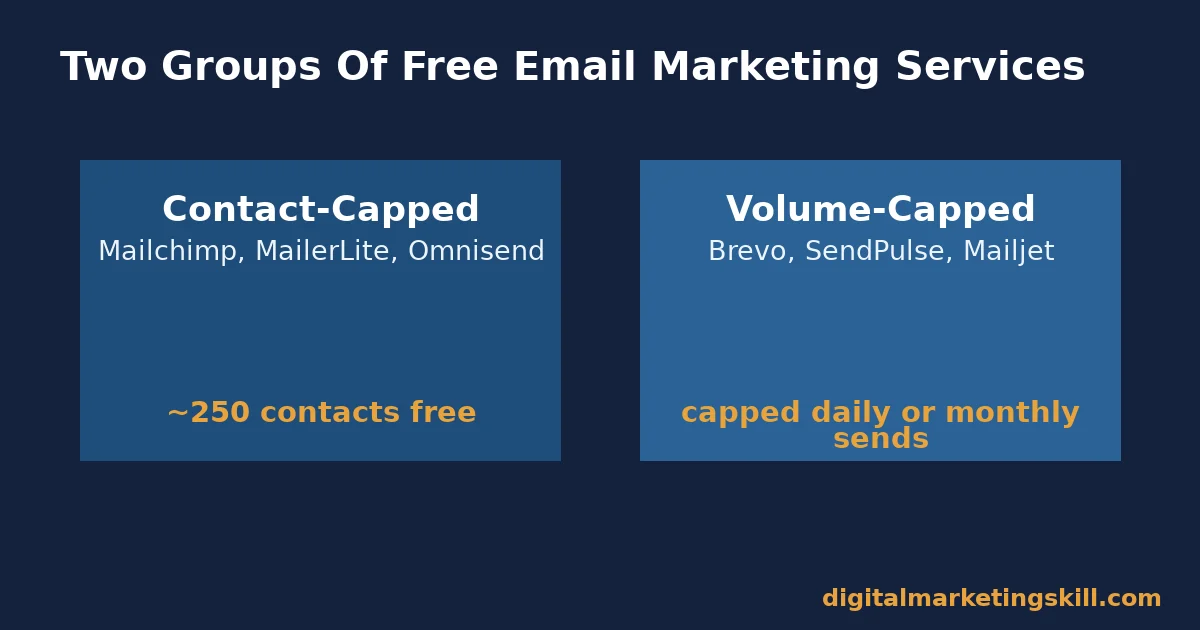
The first lever is your contact count. Mailchimp, MailerLite, and Omnisend all cap free users around 250 contacts. Grow your list past that number, and you must upgrade. It does not matter how rarely you actually email them.
The second lever is your send volume. Brevo instead caps how many emails you send per day. It lets you store far more contacts for free in exchange. This suits someone with a large but rarely-emailed list. It is the opposite shape of problem from the contact-capped group above.
Knowing which lever a provider pulls tells you more about fit than any feature list does.
There is a practical reason both levers exist, beyond just upselling you. Every email a provider sends costs them a small amount in infrastructure and deliverability reputation. A contact-capped provider accepts that cost per stored contact, betting that most free accounts send often enough to be worth converting to paid. A volume-capped provider instead accepts the cost per send, betting that a large stored list will eventually need to email more often than the free cap allows. Neither bet is wrong. They just fit different kinds of senders.
What Differs By Your List Shape
Ten tools is too many to compare line by line. Group them by the lever above instead. Then pick the group that matches your list today, since not every free email marketing service on a typical “best of” list actually fits the way you work, and the two groups below are the fastest way to narrow ten names down to two or three worth testing.
Contact-Capped Services: Built For Small, Growing Lists
This group fits anyone with a short list who emails often. Think of a newsletter writer, or a local business sending weekly updates.
- Mailchimp: 250 contacts and 500 emails a month on the free plan. You get one user seat and one audience. Verified directly on Mailchimp’s own pricing page.
- MailerLite: 250 subscribers and 2,500 emails a month. You get two user seats and a 14-day trial of premium features. Verified directly on MailerLite’s own pricing page.
- Omnisend: 250 contacts and 500 emails a month, built for ecommerce. You get full access to automation and segmentation even on the free plan. Verified directly on Omnisend’s own pricing page.
Every tool in this group gives you the same practical ceiling. Once your list crosses roughly 250 contacts, the free plan stops being free. HubSpot also belongs loosely in this group: its free marketing tools include a usable email sender, but its own pricing and help pages are the only reliable place to check the current contact and send caps, since third-party blogs report conflicting numbers for it. Treat any HubSpot figure you read elsewhere, including older versions of this guide, as unverified until you confirm it on hubspot.com directly.
Volume-Capped Services: Built For Large, Quiet Lists
This group fits anyone with a bigger list who emails rarely. Think of a transactional sender, or a business that only emails monthly.
- Brevo (formerly Sendinblue) caps sends per day rather than contacts stored. A large list that emails occasionally can stay on the free plan far longer here than elsewhere. Unused daily sends do not roll over, and Brevo branding appears in every free-plan email. Recheck Brevo’s own pricing page for the current daily cap before relying on it for a large one-off send.
- SendPulse and Mailjet both lean the same direction. Each pairs a higher contact allowance with a monthly or daily send cap, instead of a hard contact wall. Confirm the current numbers on each provider’s own pricing page, since both have changed their free-tier limits before.
Mailjet is worth a specific note, because it began as a transactional email service before adding marketing features. That history shows in its interface: the automation and segmentation tools feel newer and sparser than a tool built marketing-first from day one, even though the free sending allowance itself is competitive. SendPulse, by contrast, bundles email with SMS, web push, and chatbot channels on the same free account, which suits someone who wants one dashboard for several channels rather than the single best email experience.
If your list is large but your sending cadence is low, this group stretches further than the contact-capped group above.
Both groups share one more trait worth naming: the free plan is usually missing at least one feature you will eventually want. Advanced automation, custom reporting, and removing the provider’s own branding from your emails are the three most common features locked behind a paid tier, across almost every service here.
How To Actually Pick Between Them
Contact-Capped Services: Lead With Your Growth Rate
Before you pick a contact-capped tool, estimate how many new subscribers you add each month. If that pace means you cross 250 contacts within a quarter, price out the first paid tier now. Do this before the limit hits, not after. A surprise upgrade mid-launch is worse than planning for it.
Volume-Capped Services: Lead With Your Send Frequency
Before you pick a volume-capped tool, count how many emails you actually send in a typical week. Use a real week, not a launch week. If your real cadence is low, a volume-capped free plan can carry a much larger list than any contact-capped option above. The price is the same either way: nothing.
How To Measure Whether Your Free Plan Is Working
Three numbers show whether a free email marketing service is serving you, or quietly holding you back. Track them from your very first campaign, not after you upgrade, so you have a real baseline for comparison.
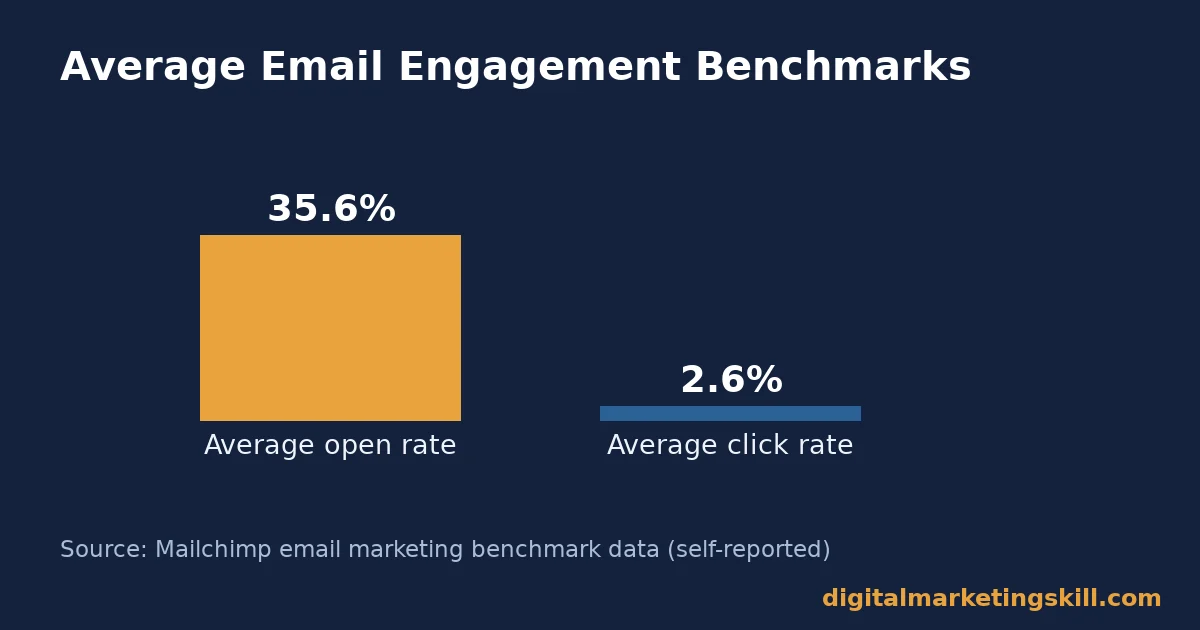
- Open rate: the share of delivered emails that get opened. Mailchimp’s own benchmark data puts the average across industries at roughly 35.6%. Apple’s Mail Privacy Protection can inflate this figure by counting automatic opens. Treat it as directional, not exact.
- Click rate: the share of delivered emails that get a click. The same Mailchimp benchmark data puts this at roughly 2.6% on average. It is harder to artificially inflate than open rate, so weight it more heavily.
- Time-to-limit: how many weeks or months until you hit your plan’s contact or send cap, at your current growth rate. This number tells you when to budget for an upgrade. Most “best free tools” lists never mention it at all.
A fourth, softer number is worth watching too: unsubscribe rate. A rising unsubscribe rate on a free email marketing service usually means your sending frequency outpaced what your list actually asked for, not that the tool itself is broken. Catching that early, while the list is still small and free, is far cheaper than catching it after you have paid to grow the list further.
The One Decision Rule
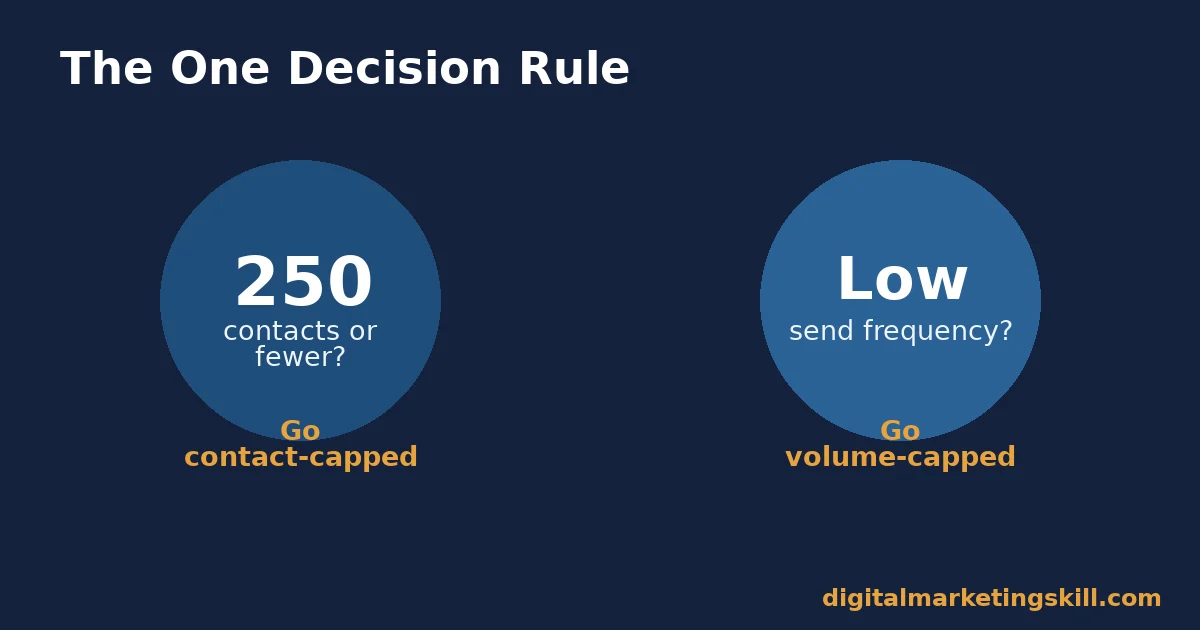
If your list will stay under about 250 contacts for the next few months, pick a contact-capped service. If your list is already larger but you send only occasionally, pick a volume-capped service instead. Everything else, templates, automation depth, support quality, is a tie-breaker, not the deciding factor.
Illustrative, invented numbers: imagine two small businesses starting from zero. Business A adds 40 new contacts a month and emails weekly. On a 250-contact cap, it would need to upgrade in roughly 6 months. Business B already has 2,000 contacts from an old customer list, but emails only once a quarter. A volume-capped plan could carry that list indefinitely at a low send frequency, for no monthly cost. Same starting budget, two different right answers.
The same logic holds at almost any scale. A fast-growing newsletter and a slow-moving transactional list are not competing for the same free plan, even if they are the same size in dollars spent today. Match the lever, contacts or volume, to your actual pattern, and the free tier can carry you much further than a generic “best overall” pick would.
One more detail worth planning for: the upgrade trigger rarely arrives on a convenient day. A contact cap gets hit mid-campaign, often right when a sign-up form goes slightly viral. A send cap gets hit mid-month, often right before an important announcement. Decide, before either happens, what your first paid tier will be and roughly what it costs, so the moment you cross the free line is an easy decision instead of a scramble.
A Real Case: Why The Limit You Pick Matters
Digital Marketing Skill Institute student Olajire Jacob has described charging an average of $500 to set up email marketing flows for clients. He later scaled that side of his business to around $5,000 a month. Part of that work is choosing the right plan and limit for each client’s actual list size and sending cadence. It is not just picking the best-known tool.
The case reflects one person’s reported experience, not a guaranteed outcome, and results vary by effort, market, and offer. See the Institute’s earnings disclaimer for the full context. The lesson generalises: a free plan chosen to match the actual list, not the most familiar logo, is what keeps a client’s monthly cost at zero for longer. That is exactly the kind of advice that turns a one-off setup into repeat, paid work.
It also explains why a freelancer or small agency benefits from knowing both groups well, not just one favorite tool. A client with a fast-growing waitlist needs a different free email marketing service than a client re-engaging an old, dormant list once a quarter. Recommending the wrong shape of free plan does not just cost the client money later. It costs you credibility the next time they need advice, and credibility is most of what keeps a client paying for ongoing help instead of one setup fee.
Frequently Asked Questions About Free Email Marketing Services
Which free email marketing service has the highest sending limit?
Among the services covered here, volume-capped providers like Brevo generally allow more total contacts than contact-capped providers. That is because they limit you by daily or monthly send volume instead. Confirm the current cap on the provider’s own pricing page, since free-tier limits change.
Can I switch free email marketing services later without losing my list?
Yes. Most services let you export contacts as a CSV file, which you can then import into a new provider. Check each platform’s export and import tools before you commit a large list to one you are unsure about. None of the services named in this guide require a credit card to start, and none charge automatically if you do nothing.
Do free email marketing services hurt deliverability?
Not inherently, but some free plans add their own branding to your emails. They also offer less deliverability support than paid tiers, which can indirectly affect open rates over time. If inbox placement is critical from day one, check each provider’s deliverability documentation before choosing.
Is Mailchimp still a good free choice for beginners?
Mailchimp’s free plan works well for a small, slow-growing list, since it still includes core campaign and reporting tools. Its 250-contact cap means a fast-growing list will outgrow it quickly. Pair it with a growth estimate before you build a campaign around it.
What happens when I hit my free plan’s limit?
Most providers pause sending once you cross your contact or send limit, rather than deleting data, and prompt you to upgrade. Confirm this behavior on your chosen provider’s own help documentation, since the exact handling varies.
Are free email marketing services suitable for ecommerce?
Some are built specifically for it. Omnisend, for example, includes ecommerce-focused automation, such as abandoned cart and post-purchase flows, even on its free plan. General-purpose tools often reserve these for paid tiers.
How many free email marketing services should I test before choosing?
Two or three is usually enough. Pick one contact-capped and one volume-capped option that match your list shape. Send a small real campaign through each, and compare the actual sending experience rather than reading feature lists alone. Pay attention to how each free email marketing service handles the signup confirmation step, too, since a clunky double opt-in flow loses subscribers before you ever get to test the sending experience itself.
Why do free email marketing services keep changing their limits?
Providers adjust free-tier limits as their own costs and competition shift, often without much announcement. That is the core reason this guide verifies every number directly against each provider’s current pricing page, instead of repeating older figures that may no longer hold. Build the habit of rechecking the provider’s page yourself every few months, especially before a big send.
What’s the real difference between a free and a paid email marketing plan?
Beyond the contact or send cap, paid plans typically add deeper automation, custom reporting dashboards, priority support, and the removal of the provider’s own branding from your emails. Free email marketing services are not a stripped-down demo; they are a genuinely usable starting tier, just with fewer of those extras and a hard ceiling on scale.
Can a business run entirely on free email marketing services long-term?
A very small, slow-growing list can, in theory, stay on a free plan for years. In practice, most businesses that grow at all will outgrow either the contact cap or the send cap within a year or two, so treat free email marketing services as a strong starting point rather than a permanent home.
Turn A Free Plan Into A Real Email Marketing Skill
Picking the right free email marketing service solves this month’s budget problem, and Digital Marketing Skill Institute teaches the strategy layer that sits on top of whichever tool you choose. Learning to run the strategy behind it, segmentation, automation, and copy that gets opened and clicked, solves a bigger one. It is a skill you can build from anywhere in your country. Digital Marketing Skill Institute’s Master Diploma in Digital & AI Marketing includes the AI-Powered Lead Generation and Email Automation track, where you practice building the exact kind of flows and campaigns this guide compares tools for.
Every track includes unlimited 1-on-1 coaching and mentoring, plus a U.S. Project Internship with a verified U.S. Work Reference Letter. The program is dual US and UK accredited, and it is recognised in more than 100 countries, 100% online. You can specialize in this track, or complete the Full Stack option across all four. Either way, you will leave knowing not just which free email marketing service to open an account with, but how to turn that account into client work, the way Olajire Jacob’s case above shows is possible.
Start wherever you live by visiting digitalmarketingskill.com. Review the Master Diploma program, read more on the blog or in student reviews, and apply directly at digitalmarketingskill.com/apply/, wherever you live.
Every figure in this guide was checked against its original source before publication. Figures marked as illustrative are invented examples, not real results.
