
Event marketing is the use of live, virtual or hybrid events to build relationships, generate leads and move prospects toward a sale. It works when a team treats the event itself as only the middle step, not the whole plan. The follow-up after the event usually decides whether any of it pays off.
Key Takeaways
- B2B exhibitors put 40.8% of their marketing budget into exhibitions. That is more than any other channel, according to CEIR’s Marketing Spend Decision Report (Trade Show Executive). Budget share alone does not guarantee a return.
- Exhibitor sentiment toward trade shows has recovered sharply: CEIR’s own Net Promoter Score for exhibitions has climbed from -6 to 35 over recent years (Trade Show Executive). That is a swing from net negative to solidly positive.
- CEIR also found that sales metrics dominate how management judges whether an event marketing budget was worth it. Lead volume and post-show closed deals matter most (Trade Show Executive). Attendance numbers rarely make that list.
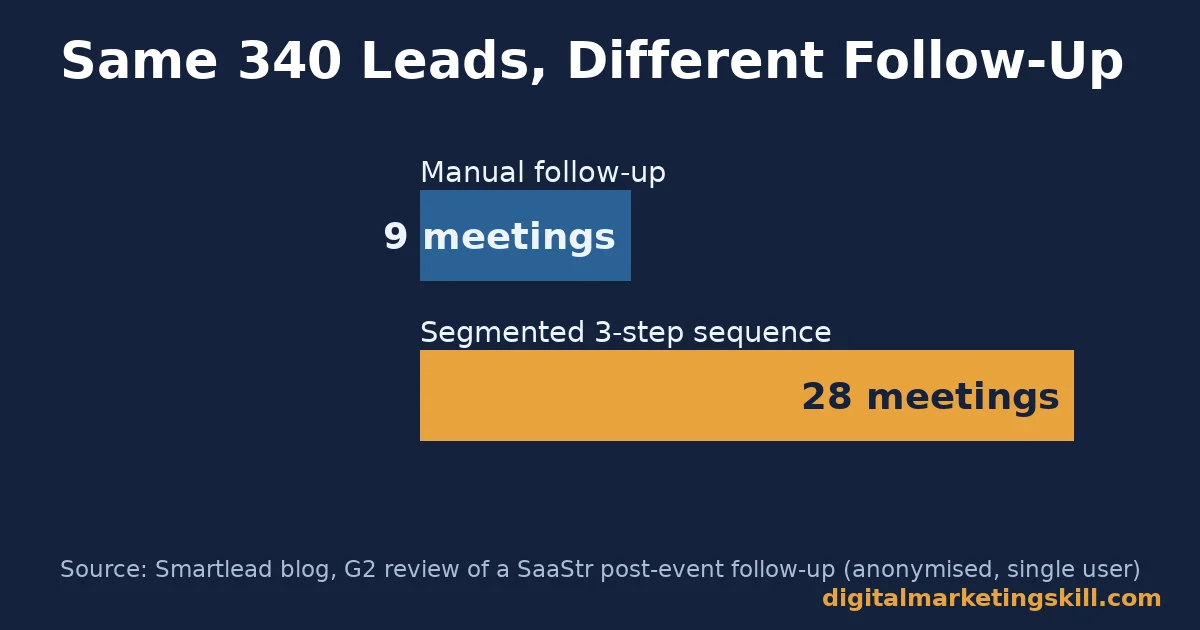
- In one published example, a team loaded 340 post-event leads into a segmented hot, warm and cold follow-up sequence. That sequence booked 28 meetings in 10 days. Their old manual follow-up process, on a similar lead volume, had produced only 8-10 meetings (Smartlead). The event did not change. The follow-up did.
- 67% of European event planners increased their budgets for in-person and hybrid events, according to a Cvent survey of more than 600 planners across six European countries (Cvent). This figure is Europe-specific; treat it as regional, not global.
In this guide
- The Gap: Why Event Marketing Advice Stops At The Event Itself
- How Event Marketing Works: The Three-Phase Mechanism
- What Changes The Results: Goal Clarity, Targeting And Follow-Up Speed
- How To Lead With Each Lever For Your Next Event
- Measuring Event Marketing Performance: The KPIs That Matter
- The One Decision Rule: When To Keep Investing In An Event, And When To Cut It
- A Real Case: Turning The Same Leads Into Three Times The Meetings
- Frequently Asked Questions About Event Marketing
- Where This Fits In A Digital Marketing Career
The Gap: Why Event Marketing Advice Stops At The Event Itself
Most event marketing guides focus on the day of the event. Booth design, speaker slots, swag. All of that matters less than two things most guides skip: a clear goal set before the event, and a fast, segmented follow-up after it. This guide covers both, plus how to measure whether an event marketing budget is actually earning its place.
A few ground rules first. No event format fits every goal. Some events exist to generate leads, others to deepen existing relationships, and a few exist purely for brand visibility. Treat the benchmarks below as a starting point, not a universal target, because budgets, formats and industries vary widely. Nothing here promises a fixed return, because event performance depends heavily on execution, not just the decision to attend or host. Two teams can run the exact same event format, at the exact same cost, and walk away with very different results. The difference almost always traces back to how clearly the goal was defined before a single invitation went out.
How Event Marketing Works: The Three-Phase Mechanism
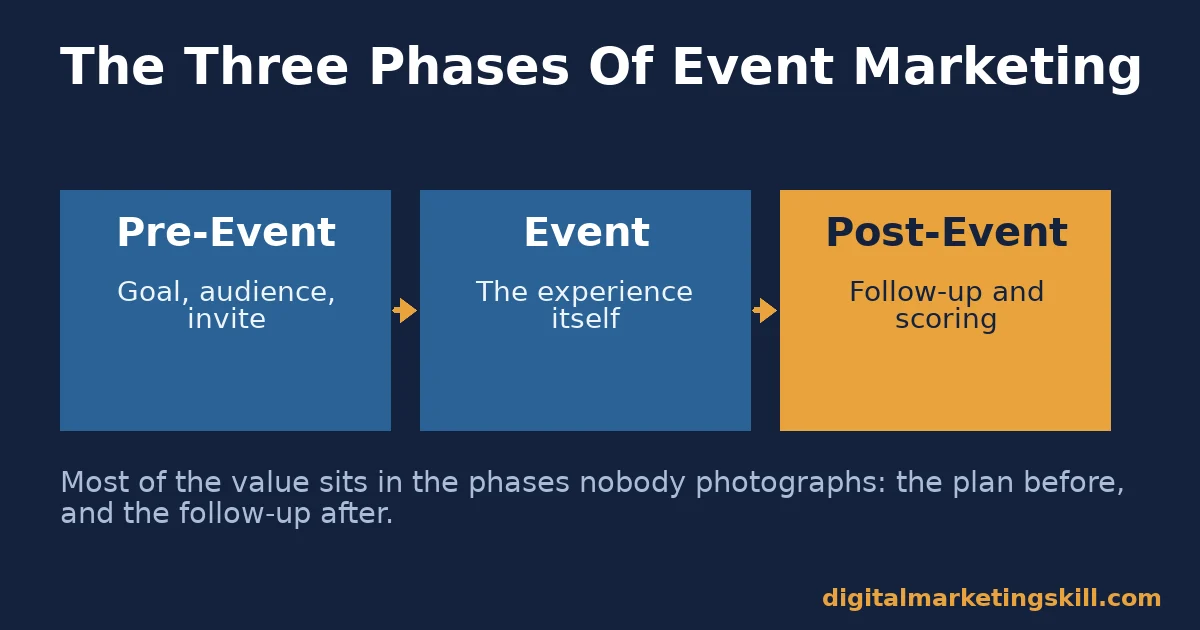
Event marketing runs in three phases, and most of the value sits in the phases nobody photographs. Pre-event work sets the goal, picks the audience, and builds the invitation or promotion plan. The event phase itself delivers the experience, whether that is a trade show booth, a webinar or a hosted dinner. Then post-event work turns attendees into contacts, contacts into leads, and leads into pipeline.
Start the pre-event phase by knowing exactly who you want in the room — see how to identify your target audience if that step is still undefined. A clear audience definition shapes everything downstream: the venue, the content, and the follow-up sequence.
- Pre-event. Goal, audience and invitation. Decide what success looks like before you book anything.
- Event. The experience itself. This is the part most teams over-invest in relative to its share of total impact.
- Post-event. Follow-up, scoring and handoff to sales. This is where most leads quietly die.
CEIR’s research backs this up from the budget side. Sales metrics, not attendance, dominate how management actually judges whether an event marketing spend was worth it (Trade Show Executive). A packed room with no real follow-up still fails that test.
In-person events earn their cost specifically in situations where trust is hard to build remotely. Digital and virtual sales channels make B2B selling more efficient. But they can also leave relationships brittle. This is especially true when the stakes are high and a buyer’s needs are genuinely unclear, Harvard Business Review has argued (Harvard Business Review). That is the specific case for showing up in person: not every sale, but the complicated ones.
This does not mean every event should be in person. It means the format decision should follow the goal, not the other way around. A simple product demo or a top-of-funnel awareness push rarely needs the cost of a physical room. A high-stakes, ambiguous deal involving multiple stakeholders often does. The Harris Poll ran this research on behalf of Freeman. They found that 95% of attendees trust a brand more after attending one of its in-person events (Freeman). The release does not disclose the survey’s full sample size. Treat the figure as directional, not exact.
What Changes The Results: Goal Clarity, Targeting And Follow-Up Speed
Goal Clarity: Built For Everything At Once
Event marketing built around a vague goal, such as “get our name out there,” cannot be measured afterward. Every decision, from booth location to follow-up content, gets made on instinct instead of a target. Nobody can say afterward whether the event marketing spend worked, because nobody defined what “worked” meant.
Targeting: Built For Headcount Over Fit
A team built around maximising attendee count fills seats with whoever will show up, not necessarily whoever can buy. Registration numbers look good in a recap deck. Pipeline numbers do not follow, because the room was never filled with the right people in the first place. This pattern repeats across formats. A webinar with thousands of sign-ups but almost no attendees from the target industry looks impressive in a dashboard and produces almost nothing in pipeline. The headline number hides the real problem.
Follow-Up: Built For “Eventually”
A follow-up plan built around “we’ll get to it after the event” usually means three to five days of silence while the lead’s memory of the conversation fades. By the time an email arrives, the prospect barely remembers the conversation, and the reply rate reflects that. The team is not being lazy in most cases. They are simply exhausted after the event itself, and follow-up gets queued behind a dozen other post-event tasks: expense reports, debriefs, and the next event already being planned.
How To Lead With Each Lever For Your Next Event
Goal Clarity: Lead With One Metric Before You Book Anything
Pick one primary metric before committing budget: qualified leads, meetings booked, or pipeline influenced. Let that single metric shape the invite list, the booth or session content, and the follow-up sequence. A brand-visibility event and a lead-generation event should look different from the planning stage onward, not just in how you report on them afterward. Write the metric down somewhere the whole team can see it before planning starts. A goal that only lives in one person’s head tends to drift as other people make smaller decisions that quietly pull the event in a different direction.
Targeting: Lead With A Fit Filter, Not A Headcount Target
Build your invite or promotion list around your actual buyer profile, not the broadest possible audience. A smaller room of the right people converts better than a packed room of the wrong ones. If you already have a documented target audience, use it directly to filter the guest list rather than inviting everyone who might plausibly be interested. This feels counterintuitive to teams used to judging success by registration count. A room of 50 well-matched prospects will almost always produce more pipeline than a room of 500 people who were never going to buy.
Follow-Up: Lead With Segmentation And Speed
Segment attendees immediately after the event by how engaged they actually were: hot, warm or cold, based on what they said or did, not just whether they scanned a badge. Send the first follow-up within 24 hours while the conversation is still fresh. Vary the message by segment, because a hot lead who asked for a demo needs a different email than a cold contact who only grabbed a flyer. Assign the sequencing work before the event starts, not after, so there is no gap where everyone assumes someone else is handling it. A named owner for post-event follow-up is one of the simplest, least glamorous fixes available, and one of the most effective.
Measuring Event Marketing Performance: The KPIs That Matter
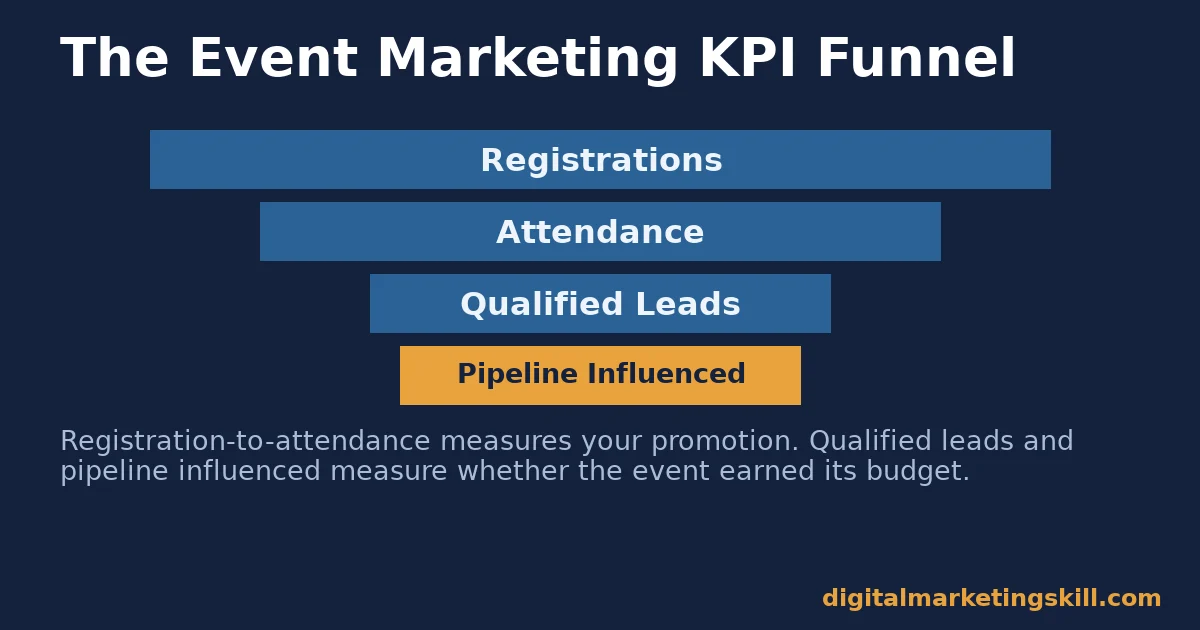
Four metrics describe most of what an event marketing program needs to show. Each is defined below in one line.
- Registration-to-attendance rate. The share of registrants who actually showed up. Low rates signal a promotion or reminder problem, not an event-quality problem.
- Qualified leads per event. Attendees who match your buyer profile and showed real interest, not just a badge scan. Salesforce’s own definition of a sales-qualified lead requires both an ICP fit and a high-intent action, such as booking a demo (Salesforce). The same bar should apply to an event lead worth counting. This is the first number that connects an event to pipeline.
- Cost per qualified lead. Total event cost divided by qualified leads. This is the number that makes events comparable to other channels on a level footing.
- Pipeline influenced. The value of deals where the event played any role, even if it was not the final touch before closing. Without this, events that build trust early get undervalued the same way earned content channels do.
Track cost per qualified lead against your other channels, not in isolation. An event that costs more per lead than paid search can still be worth running. That happens when its leads are larger or close faster. Pipeline-influenced reporting shows this. A simple lead count does not. The same four metrics also expose a weak event quickly. A high registration-to-attendance rate with a low qualified-lead count usually means the invite list was too broad. A low registration-to-attendance rate with strong engagement from the people who did show up usually means the promotion, not the event content, needs work.
The One Decision Rule: When To Keep Investing In An Event, And When To Cut It
Decision rule: keep investing in a recurring event only if its cost per qualified lead has stayed flat or improved for two consecutive editions. Cut or redesign it if cost per lead has worsened for two editions in a row with no clear external cause. Recurring events develop a kind of institutional momentum that outlasts their actual performance.
Illustrative, invented numbers: say a quarterly webinar series cost $40 per qualified lead in its first two editions, then $38 in the third. That is flat or improving, so it is worth continuing as planned. Now say an annual trade show booth cost $220 per qualified lead in its prior edition and $310 in its most recent edition, with no major change in booth size, staffing or the show’s own attendance. That is a worsening trend worth investigating before committing to the same booth again.
Notice what the rule does not say. It does not say cut every event that costs more than last time. Costs rise for reasons that have nothing to do with the event’s quality: venue price increases, a smaller show floor, a competitor buying up the best booth locations. The rule asks for two consecutive editions of decline with no clear external cause, specifically so a single bad year does not end a program that was otherwise working.
A Real Case: Turning The Same Leads Into Three Times The Meetings
A published example describes a team that attended the SaaStr conference and came away with 340 leads (Smartlead). Previously, their manual follow-up process on a similar lead volume produced roughly 8 to 10 booked meetings. This time, they segmented the 340 leads by engagement level into hot, warm and cold groups, then ran a three-step follow-up sequence tailored to each group.
The result: 28 meetings booked within 10 days (Smartlead). A few limits are worth noting. The example comes from a vendor’s own blog, built around a G2 review from a single anonymised user, so there is no independent audit of the numbers. The exact event size, industry and lead quality are not disclosed. Still, the comparison is useful precisely because the lead volume was similar across both periods — what changed was segmentation and speed, not the event itself.
That is the transferable lesson here. The event produced 340 contacts either way. The gap between roughly 9 meetings and 28 meetings came entirely from what happened after people went home. Nothing about the booth, the pitch or the swag changed between the two periods described. The only variable was what the team did with the list once everyone had flown home and the leads sat waiting in a spreadsheet.
Frequently Asked Questions About Event Marketing
What is the difference between event marketing and event management?
Event management covers the logistics: venue, catering, scheduling, run of show. Event marketing covers the strategy around who attends, why, and what happens afterward. A well-managed event can still be a marketing failure if the audience or follow-up were wrong.
Are virtual events as effective as in-person events for lead generation?
It depends on the goal. Virtual events generally cost less per attendee and scale further, while in-person events tend to build deeper trust and produce higher-intent conversations. Match the format to the goal you picked before planning, rather than defaulting to whichever format happens to be trendy. Momentum has shifted back toward in-person and hybrid formats in several markets. A Cvent survey of more than 600 European planners found 67% had increased budgets for in-person and hybrid events (Cvent). That figure is regional. Do not read it as a global trend.
How quickly should you follow up with event leads?
As close to 24 hours as realistically possible, while the conversation is still fresh for the attendee. A segmented, prompt sequence consistently outperforms a single generic “great meeting you” email sent days later.
What counts as a qualified lead from an event?
Someone who both matches your buyer profile and showed genuine interest, such as asking a specific question or requesting a follow-up, not simply anyone who scanned a badge or entered a raffle. Badge scans alone inflate lead counts without reflecting real pipeline potential.
How much of a marketing budget should go toward events?
There is no universal percentage. B2B exhibitors put an average of 40.8% of marketing budget into exhibitions, per CEIR, but that reflects exhibitor-specific data, not every business model. Size your event marketing budget against your own cost per qualified lead, compared honestly with your other channels.
Why do events get kept in the budget even when they underperform?
Institutional momentum. A recurring event becomes a habit, defended by relationships and sunk cost rather than current performance. The decision rule above exists specifically to catch this pattern before it repeats for yet another edition.
Does a bigger booth or bigger budget guarantee more leads?
No. Targeting and follow-up typically matter more than scale. A smaller, well-targeted presence with a fast, segmented follow-up sequence regularly outperforms a larger presence with a slow or generic one.
Who should own post-event follow-up: marketing or sales?
Decide this before the event, not during the scramble afterward. A common split works well: marketing owns the first, broad segmented sequence, and sales takes over once a lead replies or meets a qualification bar. Without a named owner on each side, follow-up tends to fall into a gap neither team feels responsible for.
Where This Fits In A Digital Marketing Career
Want to plan events and run the lead-generation and follow-up systems behind them professionally? Digital Marketing Skill Institute’s Master Diploma in Digital & AI Marketing is built around four AI-powered tracks, including AI-Powered Lead Generation and Email Automation. Together the tracks cover ten courses, with a Full Stack option for students who want all four. Every student gets unlimited 1-on-1 coaching and mentoring, plus a U.S. Project Internship with a partner company from day one and a verified U.S. Work Reference Letter on completion. The diploma is dual US and UK accredited, recognised in more than 100 countries, and the whole program runs 100% online. You can study from anywhere in your country.
No income or job outcome is guaranteed by completing any course. See the earnings disclaimer for how DMSI frames student outcomes. Read real student experiences on the reviews page. Explore the full Master Diploma program. Browse more guides on the digital marketing blog, or go straight to apply when you are ready. Learn more at Digital Marketing Skill Institute, wherever you live, or start now at digitalmarketingskill.com.
Every figure in this guide was checked against its original source before publication. Figures marked as illustrative are invented examples, not real results.
