
User generated content, or UGC, is any photo, video, review, or post about a brand made by a real customer, not the brand itself. People trust it more than ads, because it comes from someone with nothing to sell. This guide shows how UGC actually earns that trust, and how to collect and measure it without the common legal and quality traps.
Key Takeaways
- 69% of people trust a recommendation from a friend, family member, or relatable person more than one from a brand directly. That is from a Matter Communications survey of over 1,000 US consumers.
- 93% of shoppers say ratings and reviews affect whether they purchase a product. 45% will not buy at all if a product has no reviews, per PowerReviews’ survey of 8,153 US consumers.
- The FTC requires disclosure whenever a material connection exists between a brand and a creator, but genuine, unpaid customer content needs no disclosure at all.
- 91.1% of adult internet users watched online video in the past seven days, the single most common weekly media activity, per DataReportal’s global analysis.
- Shoppers who interact with ratings and reviews convert at more than double the rate of those who do not, per PowerReviews’ analysis, though the exact study behind that figure is not independently named.
In this guide
- The Gap In Most UGC Advice
- How User Generated Content Actually Works
- What Differs By UGC Format
- How To Lead With Each UGC Format
- How To Measure Whether UGC Is Working
- The One Decision Rule For What To Collect First
- A Real Case: Turning Student Outcomes Into UGC
- Common Mistakes With User Generated Content
- Frequently Asked Questions About User Generated Content
- Where To Build Real UGC And Content Skills
The Gap In Most UGC Advice
Most user generated content guides are tactic lists. Run a contest. Use a hashtag. Repost customer photos. What they skip is the part that actually determines whether UGC works: trust, not volume.
Volume is easy to chase and easy to measure, which is exactly why so many guides focus on it. Trust is harder to see directly, so it gets ignored even though it is the actual mechanism doing the work.
Matter Communications found that 69% of people trust a friend, family member, or relatable person’s recommendation more than a brand’s own message. PowerReviews found that 93% of shoppers say reviews affect their purchase decision, and 45% will not buy at all without any reviews present. Both numbers point the same direction. The content works because a real person made it, not because a brand posted it.
Treat the figures in this guide as self-reported survey data, mostly US-based and vendor-funded. That does not make them wrong. It means you should read them as a strong signal, not a universal law.
The same caution applies to any claim about a specific conversion lift from UGC. Numbers like that vary by industry, price point, and how the content gets displayed, so treat a single figure as a direction, not a guarantee for your own product.
How User Generated Content Actually Works
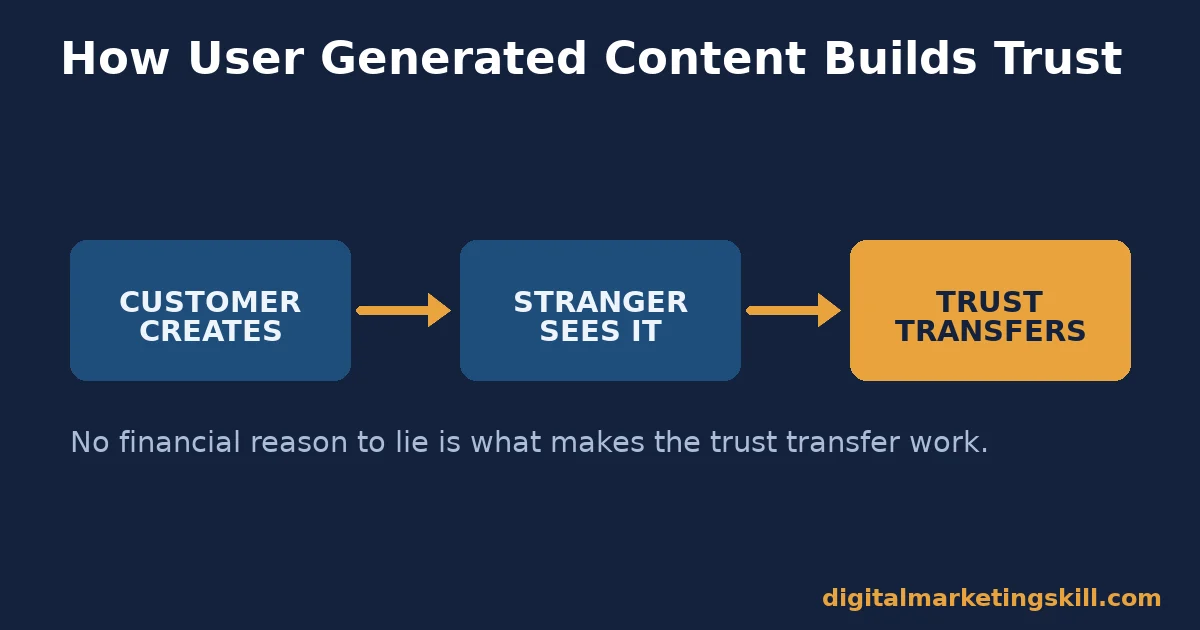
UGC works through a simple chain. A real customer creates something. Other potential customers see it. They trust it more than an ad, because the creator has no financial reason to lie.
That chain breaks easily, though. If the content looks staged, or if a brand edits it too heavily, the trust signal disappears. So the goal is not more content. It is content that still reads as genuinely unscripted once it reaches a stranger.
Why Trust Transfers From Strangers
People do not need to know the reviewer personally for trust to transfer. They just need to believe the reviewer is a real, unpaid customer. That belief breaks the moment a review looks staged, overly polished, or identical to ten others on the same page. Once a reader suspects one review is fake, they stop trusting the whole page. Not just that single entry.
Because that belief is fragile, small details matter more than they seem to. A typo, a slightly awkward photo angle, or an unpolished sentence often signals authenticity, rather than undermining it, since real customers rarely write like a copywriter.
The Legal Line: UGC And Paid Endorsement
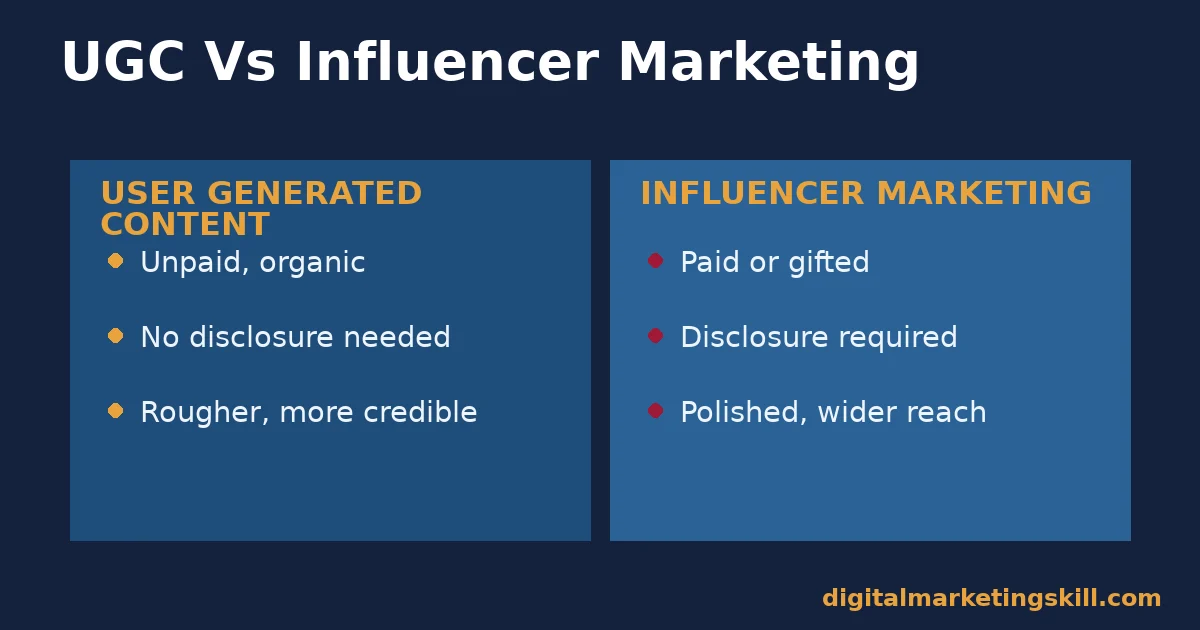
The FTC draws a clear line here. A genuine, unpaid customer post needs no disclosure. The moment you pay someone, or give them free product, to create content that looks like organic UGC, disclosure becomes required. Blurring that line is one of the fastest ways to lose the trust UGC is built on.
Ownership is a separate question from disclosure. Posting a photo publicly does not transfer copyright to a brand, so always get explicit permission before reusing someone’s content in a paid ad, an email, or any official marketing channel.
A quick written reply from the creator, even a simple “yes, go ahead,” is usually enough. Keep a record of it somewhere searchable, since a brand will eventually need to prove permission existed, not just that it probably did.
What Differs By UGC Format
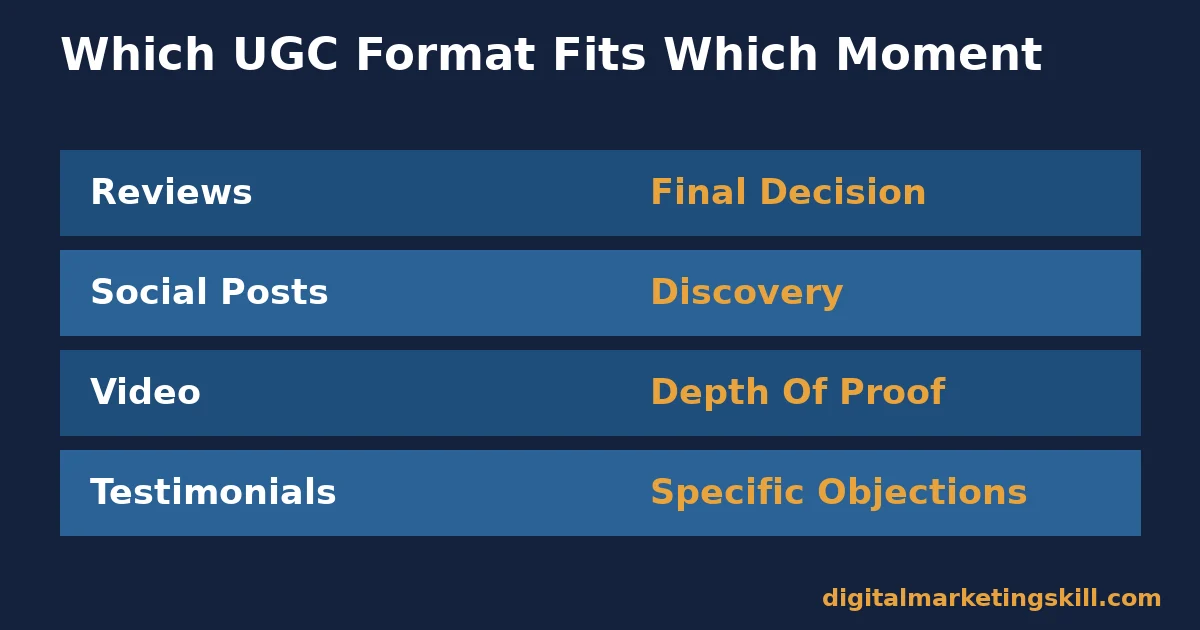
Not every format earns trust the same way, or fits every stage of the customer journey.
Reviews: Built For The Final Decision
Reviews work right before someone decides to buy. PowerReviews’ survey found 98% of shoppers call reviews an essential resource, and that share rises even further among Gen Z shoppers. A product page without any is a quiet source of lost sales.
Star rating alone is not the whole story, either. A product with a lower average rating but many detailed reviews often converts better than one with a perfect score and almost no reviews. Detail reads as more credible than a flawless number.
Social Posts: Built For Discovery
A photo or video on social media rarely closes a sale by itself. Its job is earlier: showing a real person using the product, in a context a stranger can picture themselves in.
Video: Built For Depth Of Proof
Video is the hardest format to fake convincingly. That is also what makes it the most persuasive. DataReportal’s global analysis found 91.1% of adult internet users watched online video in the past week, the most common weekly online activity tracked. A short, unscripted customer video usually beats a polished brand video for believability.
Testimonials: Built For Specific Objections
A written testimonial works best when it answers a specific doubt a buyer already has, such as durability, customer support, or ease of use. Generic praise persuades far less than a testimonial that names the exact worry it resolves.
Unboxing And Photos: Built For A Quick Glance
A photo of a product in someone’s real home, or a short unboxing clip, works fast. It answers one question in seconds: does this look like what I expect? That speed makes it ideal for a social feed, where people scroll past almost everything, and a confusing or staged-looking photo gets scrolled past just as fast as a boring one.
How To Lead With Each UGC Format
Knowing what each format is built for only helps once you act on it.
Reviews: Lead With A Simple Ask, Not Silence
Ask every customer for a review right after delivery, when the experience is still fresh. Silence is the default outcome. A short, direct request at the right moment changes that.
Social Posts: Lead With A Specific Prompt
“Post a picture with our product” rarely works. A specific prompt, like asking customers to show one problem the product solved for them, produces content that is both more useful and more persuasive. The more specific the ask, the easier it is for a customer to know exactly what to post, instead of guessing and giving up.
Video: Lead With Permission First
Always get clear permission before repurposing a customer’s video in your own marketing, even when they posted it publicly. The FTC’s endorsement guidance is clear that reposting someone else’s content does not remove your responsibility for how it gets used.
Testimonials: Lead With The Objection, Not The Praise
When you ask a happy customer for a quote, ask what almost stopped them from buying. The answer usually makes a sharper testimonial than a generic compliment about your brand.
Unboxing And Photos: Lead With A Consistent Branded Moment
Give customers one small, easy detail to include, such as a distinctive box insert or a recognizable background prop. Consistency across many customer photos builds a visual pattern that a brand’s own photoshoot cannot fake. Keep the ask small, though, since a complicated request gets ignored far more often than a simple one. Most customers will skip three steps. Few will skip one.
How To Measure Whether UGC Is Working
Four numbers separate UGC that helps from UGC that just looks nice.
Review coverage rate. The share of your product pages that actually have reviews. A gap here is a direct, fixable revenue leak, given how many shoppers refuse to buy without any. If a quarter of your catalog shows zero reviews, that is a quarter of your catalog quietly losing sales before a customer even reaches checkout.
Conversion rate with and without UGC present. Compare product pages that show real customer content against ones that do not, using your own historical data as the baseline. Run this comparison for at least a full month before drawing a conclusion, since shorter windows get skewed by random traffic swings.
Submission-to-feature rate. The share of submitted content that is actually usable, after moderation. A low rate usually means your prompt was too vague. Fix the prompt before you fix the moderation process. A clearer ask reduces the amount of unusable content arriving in the first place.
Repeat submission rate. The share of customers who contribute content more than once. This is the clearest sign that participating felt worthwhile to them, not like free labor extracted from them.
Track these four together, every quarter. A brand can grow total submissions while repeat submission rate quietly falls. That pattern usually means the reward feels less worthwhile over time, not that interest in the brand itself is fading.
The One Decision Rule For What To Collect First
Collect the format that removes your single biggest sales objection first, not whichever format looks best on social media. If customers abandon checkout because they are unsure about fit or durability, a specific review prompt beats a general photo contest every time.
Find that objection in your own support tickets or abandoned-cart data before guessing. Since the objection differs by product, copying another brand’s UGC strategy without checking your own data usually wastes the effort.
This works the same way wherever your customers live. A buyer in one country and a buyer in another both weigh the same question before paying: does this match what was promised? User generated content answers that question in the buyer’s own words, not the brand’s. That is why the mechanism travels across markets, even when the specific objection does not.
Illustrative, invented numbers: a skincare brand loses most hesitant buyers over one worry, whether a product suits sensitive skin. A UGC prompt asking “would this work for sensitive skin?” answers that exact doubt. A generic “share your glow” photo contest does not, even though it might generate more total posts.
A Real Case: Turning Student Outcomes Into UGC
User generated content works just as well inside education and training, not only retail. Digital Marketing Skill Institute features real, unscripted student testimonials rather than scripted brand ads. One graduate, Olajire Jacob, described starting with $500 to set up email marketing flows for clients, then scaling that work to $5,000 a month. That is one published, individual result, not a guaranteed outcome; see the earnings disclaimer for full context.
The lesson here is not the dollar figure, and it should not be read as a typical or guaranteed result. It is that an unscripted account of a real result, in the person’s own words, persuades in a way a polished brand claim cannot match. Because the story comes from the student, not a copywriter, it carries exactly the kind of credibility this guide has been describing.
Common Mistakes With User Generated Content
These mistakes show up repeatedly, across brands of every size, and each one is avoidable with a small process change.
Mistake: Reposting Without Permission
Posting publicly does not automatically grant a brand the right to reuse that content in paid ads or official marketing. Always ask first, and keep a record of the permission.
Mistake: Hiding Paid Content As Organic UGC
Paying for content and presenting it as spontaneous, unpaid UGC breaks FTC rules and, once discovered, breaks customer trust even faster than the rule itself.
Mistake: Skipping Moderation
Unmoderated submissions eventually include something off-brand, offensive, or simply low quality. A lightweight review step before anything goes live protects the credibility UGC is supposed to build.
Mistake: Ignoring Negative UGC
A critical review or complaint is still user generated content, and deleting it quietly tends to backfire once customers notice. Responding openly to a negative post usually builds more trust than hiding it ever could. Customers who see a brand handle criticism well often trust the positive reviews more too. The page simply stops looking curated.
Mistake: Using The Same Content Everywhere
A review that works well on a product page rarely works the same way in a paid ad or an email subject line. Match the specific piece of content to the channel and the moment in the buying journey, instead of reusing one quote everywhere by default. A long, detailed review suits a product page. A short, punchy line suits an ad.
Frequently Asked Questions About User Generated Content
What is user generated content?
User generated content is any photo, video, review, or post about a brand or product that a real customer creates, rather than the brand itself. It includes reviews, social media posts, testimonials, and unboxing videos.
Why is user generated content effective?
It is effective because people trust a recommendation from another customer more than one from a brand. Matter Communications found 69% of people trust a friend, family member, or relatable person over a brand’s own message. That gap is the entire reason UGC outperforms most paid advertising on a trust basis.
Do I need permission to repost user generated content?
Yes. Posting publicly does not grant a brand automatic rights to reuse that content. Always ask the creator directly and keep a record of their permission before using their content in your own marketing.
Does UGC need an FTC disclosure?
Genuine, unpaid customer content does not need a disclosure. A disclosure becomes required the moment a brand pays someone, or gives them free product, in exchange for content that looks like organic UGC.
What is the difference between UGC and influencer marketing?
UGC comes from everyday customers, usually uncompensated, and values authenticity over polish. Influencer marketing involves a paid creator with an existing following, and usually produces more polished content aligned with the influencer’s own brand.
How do you get more user generated content?
Ask with a specific prompt right after a positive experience, such as delivery or first use. A vague request like “share a photo” produces far less usable content than a specific one, such as asking what problem the product solved.
Can UGC help SEO?
Fresh, original reviews and user content can add unique text to a product page, which search engines can crawl and index. It is not a shortcut around the fundamentals covered in our search engine optimization guide.
Is user generated content only useful for e-commerce brands?
No. Service businesses, software companies, and even nonprofits can use testimonials, case studies, and social posts the same way. The format changes by industry, but the underlying trust mechanism stays the same. A software company’s case study and a skincare brand’s photo review both do the same job: let a stranger vouch for the result. The industry changes the packaging. It does not change the underlying trust gap being closed.
Should brands respond to negative reviews?
Yes, and quickly. An honest, calm response to a negative review often does more for trust than a stack of five-star reviews. It shows real people are reading and reacting, not just collecting praise.
How much user generated content does a small brand actually need?
Quality matters more than volume. A handful of specific, honest reviews that answer real objections usually outperforms dozens of generic five-star ratings with no detail behind them.
Where To Build Real UGC And Content Skills
Collecting a flood of photos and reviews is not the hard part. Knowing which format of user generated content answers which objection, and turning that into a repeatable system, is the skill that actually moves revenue.
What The Master Diploma Covers
The Digital Marketing Skill Institute’s Master Diploma in Digital & AI Marketing builds that skill directly, alongside the fundamentals in our content creation guide. It offers four AI-powered tracks: AI-Powered Social Media Management and Advertising, AI-Powered Lead Generation and Email Automation, AI-Powered Google Specialist, and AI-Powered WordPress and SEO Specialist. All four are drawn from ten execution-first courses, with a Full Stack option for completing all four tracks.
The program adds unlimited 1-on-1 coaching and mentoring, plus a U.S. Project Internship with a verified U.S. Work Reference Letter. It carries dual US and UK accreditation, recognised in more than 100 countries, and runs 100% online, so you can build these skills anywhere in your country.
Explore the full curriculum on the Master Diploma program page. Browse more breakdowns like this one on the digital marketing blog, or read graduate outcomes on the reviews page. When you are ready, apply here.
Wherever you live, the brands that win are the ones whose customers do the convincing for them. You can start building that skill today at Digital Marketing Skill Institute.
Every figure in this guide was checked against its original source before publication. Figures marked as illustrative are invented examples, not real results.
