
A buyer persona is a short, realistic profile of one type of customer, built from research about your real buyers. It gives that group a name, goals, problems and buying habits, so your team can picture one person instead of a crowd. It matters because messages written for a clear person usually land better than messages written for “everyone”.
Key Takeaways
- A buyer persona is fictional, but it must rest on real data about real people.
- Good personas cover goals, pain points, buying behaviour and the words customers use.
- You build them from interviews, surveys, analytics and input from sales and support teams.
- Most businesses need only a few personas. Miro suggests about two to five.
- A negative persona describes people who are a poor fit, so you can avoid wasting budget on them.
What Is a Buyer Persona?
The Nielsen Norman Group defines a persona as “a fictional, yet realistic, description of a typical or target user of the product.” Marketers use the same idea for buyers. SurveyMonkey puts it simply: “buyer personas are descriptions of each of your target customers.”
So a persona is a tool for focus. Instead of writing for “small businesses”, you write for “Sam, who runs a two-person bakery and has no time for marketing.” Sam is made up. However, everything about Sam comes from what real bakery owners told you.
A persona is also narrower than a target audience. According to Miro, a target audience is the broad group of potential customers, while a persona is a specific segment within it. In other words, one target audience can hold several personas.
How a Buyer Persona Works
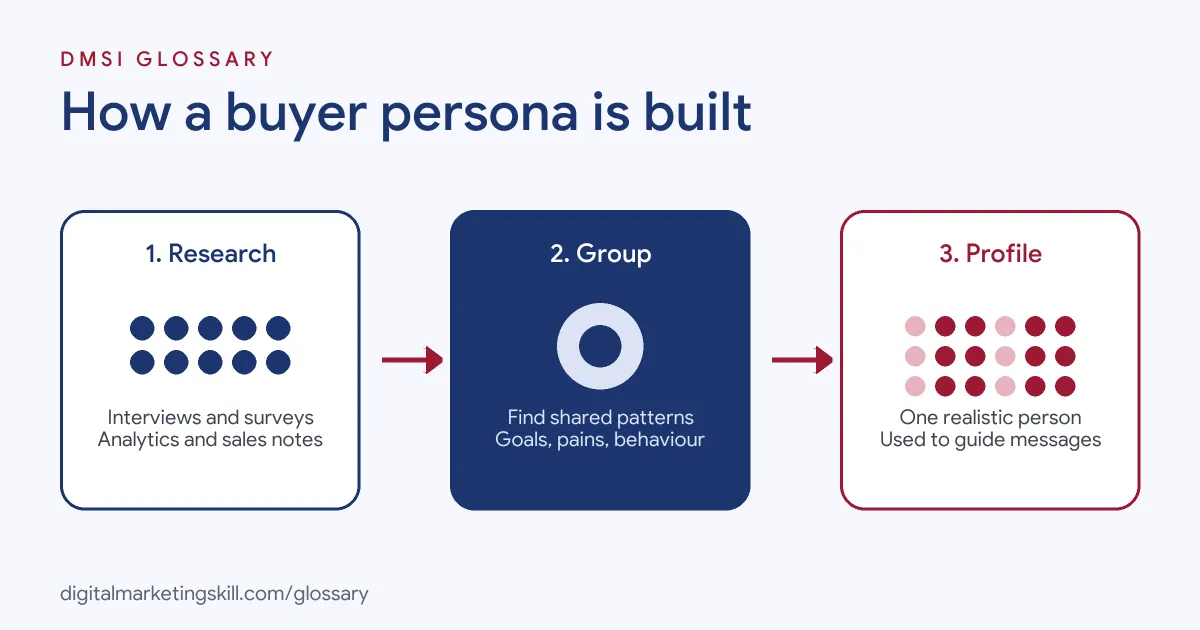
Every persona follows the same path. First, you research real customers. Next, you group what you learn into patterns. Finally, you turn each pattern into one clear profile that your team can use.
Research Real Customers
Start with people who already buy from you. SurveyMonkey notes that existing customers are the easiest source of insight. Then widen the net to people who fit your market but haven’t bought yet.
Use a mix of methods. Miro lists one-to-one interviews, larger surveys, website and social analytics, CRM data, online reviews and feedback from sales and support teams. The Nielsen Norman Group adds a firm rule: “Personas must be based on user research to accurately represent a product’s users.”
Find the Patterns
Next, look for traits that keep coming up. For example, many customers may share the same goal, the same worry or the same way of researching before they buy. The Nielsen Norman Group describes this as clustering people into groups, merging similar ones and dropping the less relevant ones.
Write the Profile
Finally, turn each group into one person. A typical profile includes a name and photo, basic demographics, goals, pain points, buying habits and a real quote. SurveyMonkey suggests you “fill in the purely fictional elements of persona building (i.e. the buyer’s name and backstory) last.” That way, the facts come first and the story comes second.
Put It to Use
A profile only matters once people act on it. SurveyMonkey lists three main uses. First, marketing and sales teams use personas to target qualified leads and tailor messages to each one’s priorities. Second, negative personas help you filter out buyers who rarely purchase or who need heavy support. Third, you can map how each persona reacts at key moments, such as a first purchase, an upsell or a return. Then you use those insights to improve the product, the service and retention.
In practice, this means one persona can shape a whole campaign. It guides the ad copy, the images, the landing page and even the email that follows.
Buyer Persona Examples
- Busy Bakery Sam: Owns a small bakery. Wants more weekday orders. Worries about time, not budget. Finds suppliers through local Facebook groups.
- Career-Change Priya: Works in retail and wants a remote career. Researches courses on YouTube and reads reviews before she signs up. Her main fear is wasting money on the wrong skill.
- IT Manager Leo: Buys software for a mid-sized firm. Needs proof of security and a clear case for his boss. He rarely buys on the first visit.
Each persona changes the message. Sam needs quick wins, Priya needs trust and Leo needs evidence. So the same product might need three different ads, three landing pages and three email openings, one for each person.
Buyer Persona vs Target Audience vs Ideal Customer Profile
| Term | What it describes | Main use |
|---|---|---|
| Target audience | The broad group you want to reach | Choosing channels and ad targeting |
| Buyer persona | One realistic person inside that group | Writing messages and content |
| Ideal customer profile (ICP) | The type of company that fits best, mostly in B2B | Deciding which accounts sales should chase |
In short, the audience tells you where to look, the ICP tells you which firms to pick, and the persona tells you how to talk to people.
How to Create a Buyer Persona
- Pull data on your current customers from your CRM, analytics and sales records.
- Interview five to ten customers. Ask about their goals, problems and how they chose you.
- Send a short survey to a wider group to check whether the patterns hold.
- Ask your sales and support teams what questions and objections they hear most.
- Group the answers into a few clear patterns.
- Write one profile per pattern, with goals, pain points, buying habits and a real quote.
- Share the profiles with your team, then review them as your market changes.
After that, use each persona when you plan content, write ads or build email sequences.
Best Practices
- Keep only useful details. The Nielsen Norman Group warns that extra details can “overwhelm the relevant ones.”
- Use real words. Quotes from interviews help you write copy that sounds like your buyers.
- Build them as a team. According to the Nielsen Norman Group, “persona creation is best done as a team,” because people then trust and use the result.
- Add a negative persona. Miro notes that negative personas “represent individuals who aren’t a good fit for your products or services.”
- Update them. Customers change, so review personas when your product or market shifts.
For a longer walk-through, see our guide to buyer personas for beginners.
Common Mistakes to Avoid
The biggest mistake is guessing. The Nielsen Norman Group is clear that personas “might be made-up people, but they should be based on information about real people.” A persona built in one meeting, with no research, just repeats what the team already believes. Another error is making too many profiles, so nobody remembers any of them. Some teams also fill personas with fun details, like a favourite film, that never affect a decision. Finally, many teams write personas once and leave them in a folder. A persona only helps when people use it.
Where You’ll Use a Buyer Persona at Work
Personas show up in product, content and creative roles. For example, recent remote job listings include:
- “Responsibilities include buyer persona development and customer segmentation, product positioning” (Product Marketing Manager).
- “Master and apply buyer persona insights to ensure every message and creative approach resonates with our target audiences” (Creative Strategy Senior Manager).
- “Partner with Sales, Customer Success, and Product to validate and refine persona profiles based on win/loss data, customer interviews, and market shifts” (Senior Product Portfolio Marketing Manager).
So whether you aim to be a Digital Marketing Manager, Growth Marketer or freelancer, you will need to research customers and turn what you learn into clear profiles.
Learn It in the Full Stack Programme
Buyer personas sit behind every channel, so they fit the Full Stack (all four tracks) option. It covers all ten courses, with one portfolio project from each track, from paid social to Google Ads, email and SEO. You also join a U.S. Project Internship from day one, with unlimited 1-on-1 mentoring.
Need help with the first step? Read our guide on how to identify your target audience.
Frequently Asked Questions
What is a buyer persona in simple terms?
It is a short profile of one type of customer, with a name, goals, problems and buying habits, based on research about real buyers.
How many buyer personas should a business have?
Miro suggests roughly two to five. If you are just starting, one well-researched profile is better than several guesses.
What is a negative persona?
It describes people who are a poor fit, such as buyers who rarely purchase. Knowing them helps you avoid wasting time and budget.
Is a buyer persona the same as a target audience?
No. A target audience is the broad group you want to reach. A persona is one realistic person inside that group.
Can I make a persona without customers yet?
Yes, but treat it as a draft. Interview people who fit your market, then update the profile once real customers arrive.
Sources: Nielsen Norman Group: Personas make users memorable; Miro: What is a buyer persona?; SurveyMonkey: How to create buyer personas; remote job listings on Himalayas.