
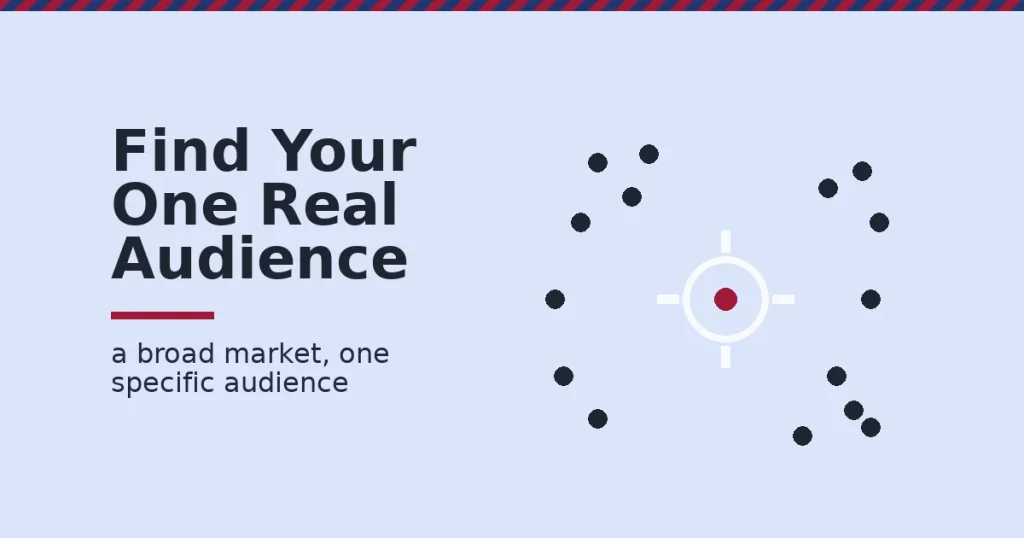
To identify your target audience, separate two things most businesses blur together. Your target market is the broad group your product serves. Your target audience is the specific people your next campaign needs to reach.
Start with real data, not a guess. 62% of small business owners say they never survey their own customers. Poor product-market fit remains the top reason startups fail, and both problems trace back to skipping real audience research.
Key Takeaways
- Vague targeting has a real cost. CB Insights analysed 431 VC-backed companies that shut down. Poor product-market fit was cited in 43% of failures, more than any other reason.
- Most small businesses skip the research. SurveyMonkey asked over 2,000 US small business owners and found 62% never survey their own customers (US data).
- Customers expect to be understood. Salesforce surveyed over 13,000 consumers and nearly 4,000 business buyers worldwide. It found 73% expect a company to understand their unique needs.
- Demographics shift sharply by platform and age. Pew Research found 80% of US adults 18-29 use Instagram versus 19% of adults 65 and older. That gap alone can change which channel you target first (US data).
- A real case shows the payoff. Old Spice’s own research found women made over half of body wash purchases. It retargeted its campaign around that insight and grew sales 125% within the year.
In this guide
- What Most “Identify Your Target Audience” Advice Misses
- Target Market vs. Target Audience: Why the Difference Matters
- Three Ways to Identify Your Target Audience
- How to Use Each Method to Identify Your Target Audience
- How to Identify Your Target Audience in Five Steps
- What to Include in a Target Audience Profile
- Using AI Tools to Identify Your Target Audience Faster
- Common Mistakes When Identifying Your Target Audience
- How to Measure Whether You Found the Right Audience
- The One Rule: Narrow Until It Hurts, Then Test
- A Real Case: How Old Spice Found a Different Audience
- Frequently Asked Questions About Identifying Your Target Audience
- Start With Five Conversations, Then Build the Audience
What Most “Identify Your Target Audience” Advice Misses
Most guides on how to identify your target audience hand you a worksheet: age, income, location, done. That skips the distinction that actually changes your strategy. Your target market and your target audience are not the same thing, and confusing them wastes budget on the wrong message.
This guide treats learning how to identify your target audience as a research process, not a guessing exercise. The demographic figures below are US-only. Apply the method, not the exact numbers, if you serve other countries. The Salesforce expectation data is global. Treat every figure here as a planning signal, not a law for your specific market.
It also treats the research itself as the hard part, not the final description. Most businesses can write an audience description once they have the data. Few actually gather the data first, which is the step that decides whether the description is accurate.
Target Market vs. Target Audience: Why the Difference Matters
Your target market is the broad group your product or service is built for. It is everyone who could reasonably buy it. Your target audience is narrower. It is the specific group you are speaking to in one campaign, one ad set or one piece of content.
A fitness brand’s target market might be “adults who want to get fitter.” That description is accurate but useless for writing an actual ad. When that same brand works to identify your target audience for one specific campaign, the result might be “women in their 30s returning to exercise after having a child.” Same market. Completely different audience. Completely different message.
This distinction matters because platforms now let you target audiences with precision. Google Ads builds audience segments from demographics, interests and behavior. A vague target market description cannot actually be entered into an ad platform. You need the narrower, specific audience to make the targeting tools work at all.
Think of the market as the ocean and the audience as the one spot you are fishing today. You still need to know the whole ocean exists, but you catch nothing by casting a line into all of it at once.
Three Ways to Identify Your Target Audience
Businesses usually lean on one research method by default. Each one answers a different question, so the strongest way to identify your target audience combines more than one.
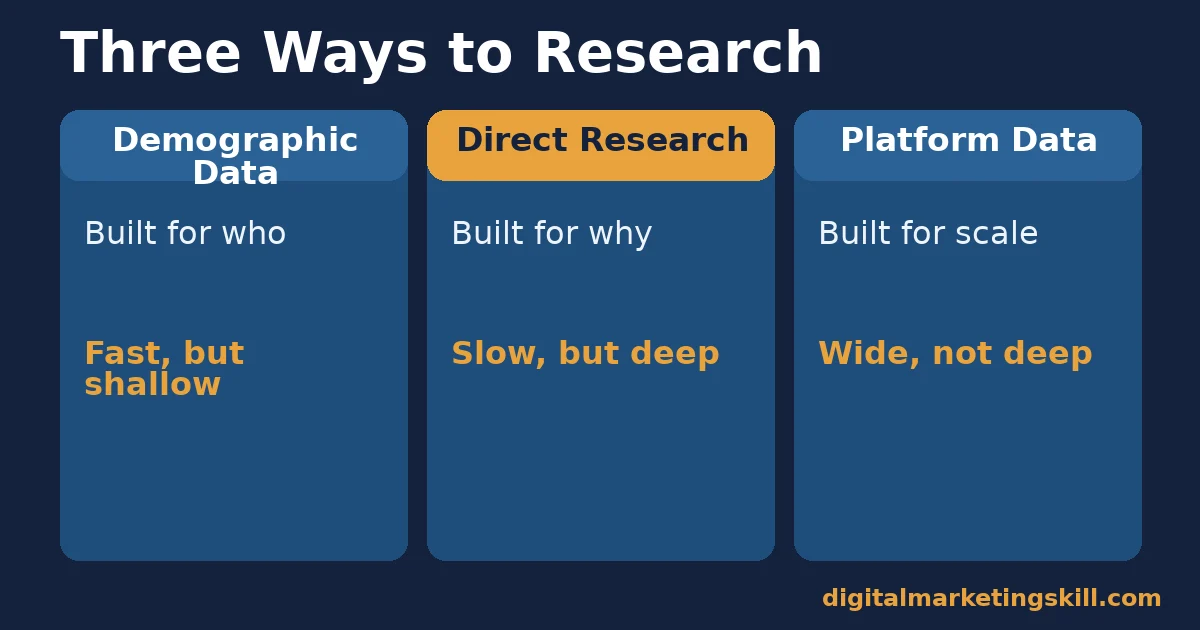
Demographic Data: Built for Who, Not Why
Demographic data describes age, gender, income, location and similar traits. Pew Research’s survey of 5,022 US adults found 80% of adults 18-29 use Instagram against 19% of adults 65 and older. That is the kind of gap that should decide where you post before you write a single caption.
Demographic data is easy to find and fast to apply, but it only tells you who someone is, not why they buy.
Direct Customer Research: Built for Why, Not Scale
Direct research means asking real customers real questions: surveys, interviews, support tickets, reviews. It is slower to gather than demographic data, but it is the only method that reliably tells you why someone chose you over a competitor.
This is also the method most businesses skip. SurveyMonkey’s survey of over 2,000 US small business owners found 62% never survey their own customers. That means most businesses are guessing at the “why” entirely, a gap the free resources at Digital Marketing Skill Institute are built to help close.
Platform and Behavioral Data: Built for Scale, Not Depth
Ad platforms and analytics tools track what people actually do: pages visited, products viewed, searches made. This data scales to thousands of data points automatically, which demographic surveys and interviews cannot match.
Its weakness is context. Behavioral data shows what someone did, not the reasoning behind it, so it works best paired with direct research rather than used alone. On its own, it tells you that people clicked, not whether they are the real target audience you set out to find.
How to Use Each Method to Identify Your Target Audience
Once you know what each method is built for, use it for the job it actually does well.
Demographic Data: Lead With It to Narrow Your Channel
Use demographic data first to decide where to show up at all. If your product serves a 50-plus audience, Instagram’s youth skew should immediately redirect budget toward channels that age group actually uses. Otherwise, you end up paying to reach people who were never going to buy, no matter how good the ad looks.
This step alone prevents a common, expensive mistake: building a beautiful campaign for a platform your real buyers barely open.
Direct Research: Lead With It to Write Your Message
Use direct research to write the actual words in your ad or email. A handful of real customer interviews, even five or six, usually surfaces the exact language your audience uses to describe their problem. You can then use that language directly in your own copy, instead of paraphrasing it into generic marketing speak.
Platform Data: Lead With It to Scale What Already Works
Use platform and behavioral data once you have a message that works on a small scale. Feed that proven message into a platform’s audience tools to find more people who behave like your best existing customers, rather than starting targeting from a blank guess. Because the tools are matching behavior, not guessing demographics, the audience they find often performs close to your original small test.
How to Identify Your Target Audience in Five Steps
- Start with your current best customers. Look at who already buys from you and repeats, not who you imagined would buy when you started.
- Ask them directly. Run a short survey or a handful of interviews asking what problem you solved and what almost stopped them from buying.
- Layer in demographic data. Check age, location and platform habits for that same group, using data like Pew’s Instagram-by-age figures as a benchmark for what to expect.
- Build one specific audience description. Combine the research into a single, specific description: who they are, what problem they have, and where they spend time online.
- Test it with a small campaign. Run a small, trackable campaign against that one audience before committing a full budget, and adjust based on what the data shows.
Repeat this sequence for every new product or major offer. The audience you identify for one launch is a starting point for the next one, not a permanent fixture you can reuse forever without checking it.
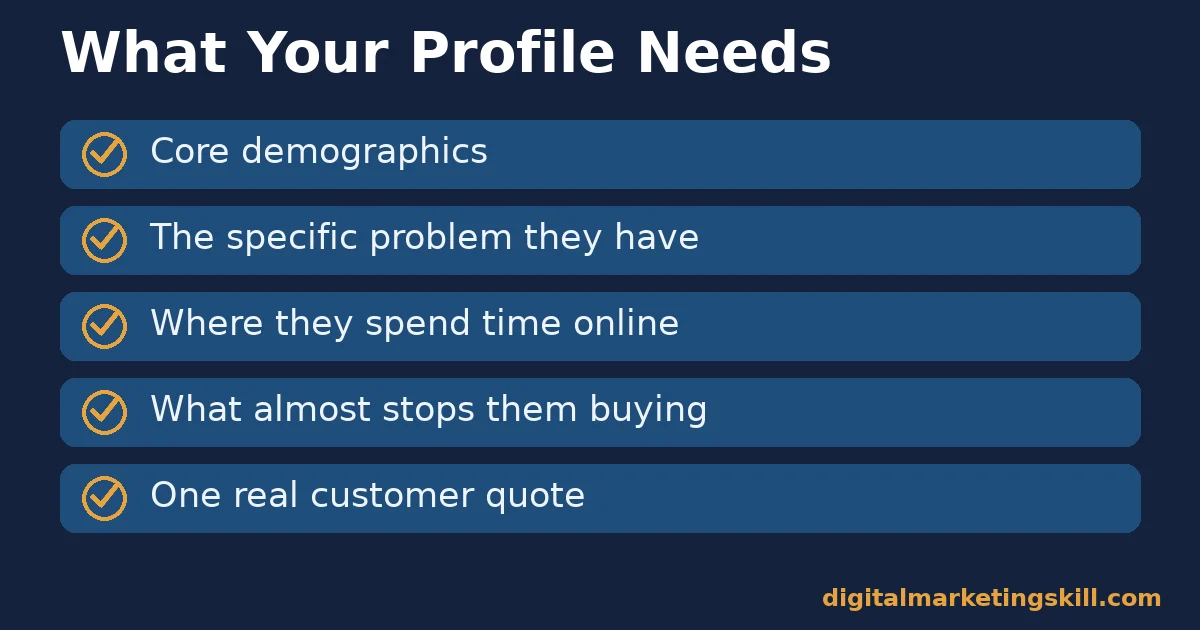
What to Include in a Target Audience Profile
Once you identify your target audience, write it down in one place so every campaign draws from the same source instead of a different guess each time. Share this document with anyone who writes copy or sets up a campaign, so the whole team targets the same people with the same understanding.
- Core demographics. Age range, location and any other trait that changes where you reach them, such as the Instagram age gap in the data above.
- The specific problem they have. Named in their own words, taken from real interviews or support conversations, not your internal product language.
- Where they spend time online. The specific platforms and content types they actually use, based on behavioral data, not assumption.
- What almost stops them from buying. The real objection, price concern or doubt that comes up most often in direct research.
- One real quote. An actual sentence from a customer interview or review that captures how they describe the problem, useful for writing ad copy later.
Keep this profile short enough to fit on one page. A long profile gets ignored. A profile nobody can remember without opening a document gets skipped the next time a campaign brief gets written in a hurry, which defeats the entire point of writing it down.
Using AI Tools to Identify Your Target Audience Faster
AI tools now speed up parts of this process, but they do not replace it. A language model can summarize patterns across hundreds of customer reviews or support tickets in minutes, work that used to take a researcher days to read through manually.
That speed is genuinely useful for the demographic and platform data stages, where you are looking for patterns across a large volume of existing information. It is far less reliable for the direct research stage. A model summarizing reviews cannot replace the nuance of a real conversation with an actual customer. Nuance is exactly what separates a usable audience description from a generic one.
Use AI to process and summarize research faster, not to invent an audience you have never actually talked to. A summary of real customer words is useful because it is grounded in something real.
However, a model’s guess about who “probably” buys your product, with no real data behind it, is not meaningfully different from guessing on your own. So always check that the underlying input was real customer data, not the model’s own assumption.
Common Mistakes When Identifying Your Target Audience
These mistakes show up repeatedly because they feel efficient in the moment, even though they cost more in wasted budget later.
- Describing a target market as if it were a target audience. “Everyone who needs marketing help” is a market, not an audience. It is too broad for any ad platform or message to work against.
- Skipping direct research entirely. Demographic and platform data describe behavior, not motivation. Without asking real customers, you are guessing at the “why.”
- Treating one campaign’s audience as permanent. A profitable audience for one product or offer is not automatically right for the next one. Re-check it each time.
- Chasing the biggest possible audience. A narrower, well-defined audience with a tailored message usually outperforms a broad one with a generic message, because the tailored message actually speaks to a real, specific problem.
- Ignoring the data you already have. Existing customer support tickets, reviews and sales records are often sitting unused, even though they usually hold more signal than a brand-new survey would.
How to Measure Whether You Found the Right Audience
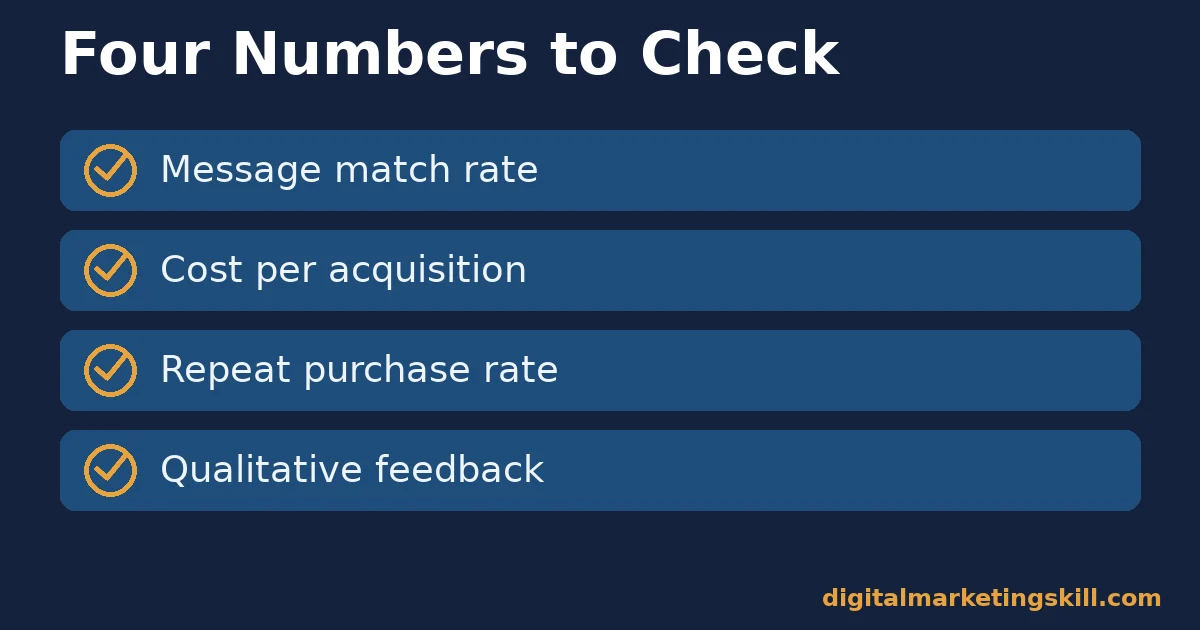
- Message match rate. How often people who click your ad also take the next step, like signing up or adding to cart. A big drop here means the audience does not match the message.
- Cost per acquisition. What it costs to turn one person in that audience into a customer. A well-matched audience should cost less to convert than a broad, untargeted one.
- Repeat purchase or return rate. Whether people from this audience come back. A high one-time conversion rate with low repeat behavior often means you reached the wrong audience for long-term fit.
- Qualitative feedback. What customers actually say in reviews, support tickets or surveys. Numbers tell you what happened; this tells you why.
Read these together. A low cost per acquisition with a poor repeat rate usually means you found people who buy once on impulse, not your real target audience. A high cost per acquisition with strong repeat behavior can still be worth it, because those customers keep paying back the initial cost over time.
The One Rule: Narrow Until It Hurts, Then Test
If you take one decision rule from this guide, make it this one. When you think your target audience description is specific enough, narrow it one level further, then run a small test before committing a full budget to it.
Most businesses target too broadly, not too narrowly, because a broad audience feels safer. In practice, a narrow, well-researched audience almost always converts better and costs less per customer than a broad, vague one. The fear of “missing out” on the broader market is usually what stops people from narrowing enough, even though the data consistently favors the narrower choice.
A Real Case: How Old Spice Found a Different Audience
Old Spice is a real, published case, not an illustrative one. Its own research found that women made more than half of body wash purchases. The brand had been marketing almost entirely to men. That single piece of audience research reshaped the entire campaign.
Instead of speaking only to men, the brand built a campaign that spoke to both audiences at once, giving women a reason to choose the product for their partner. Sales grew 125% within the year. The brand became the top-selling body wash for men in its market. The lesson was not a clever ad. It was correcting who the real audience actually was before writing a single line.
Frequently Asked Questions About Identifying Your Target Audience
What is the difference between target market and target audience?
Your target market is the broad group your product or service serves. Your target audience is the specific, narrower group you are speaking to in one particular campaign or message. A business has one target market and many possible target audiences within it.
How do I identify my target audience with no existing customers yet?
Start with direct research even without sales data. Interview people who match who you think will buy, read reviews of competitor products, and check demographic and platform data for your category. Treat your first audience description as a hypothesis to test, not a final answer, and plan to revise it once real customers start giving you actual feedback.
How many people should I interview to understand my target audience?
Five to ten real conversations with the right people usually surface the main patterns in language and motivation. More interviews add confidence, but the first handful typically reveals most of what changes your message. If the same answer keeps repeating by the sixth or seventh conversation, you have likely found the real pattern.
Is a narrow target audience risky for a small business?
It is usually less risky than a broad one. A narrow, well-researched audience converts at a lower cost per customer and makes your limited budget go further than spreading the same budget across a vague, broad group. The real risk is choosing a narrow audience based on a guess rather than actual research, since a wrong narrow guess still wastes budget quickly.
How often should I re-check my target audience?
Re-check it whenever you launch a new product, enter a new channel, or notice conversion costs rising without an obvious cause. A target audience that worked for one offer is not guaranteed to fit the next one. Treat the work to identify your target audience as ongoing maintenance, not a one-time project you finish and forget.
Can demographic data alone identify my target audience?
No. Demographic data tells you who someone is, such as their age or location, but not why they would buy from you. Pair it with direct customer research to understand motivation, then use platform data to scale what works.
What tools help with researching a target audience?
Free survey tools, a platform’s own audience or analytics dashboard, and a handful of direct customer interviews cover most of what a small business needs. You do not need expensive research software to identify your target audience accurately; consistent, honest questions matter far more than the tool you use to ask them.
Start With Five Conversations, Then Build the Audience
To identify your target audience, stop guessing and start researching: talk to five real customers, check the demographic and platform data for your category, then test a specific, narrow audience description with a small campaign before you scale it.
If you want structured training in audience research and targeting, the Master Diploma in Digital & AI Marketing covers this inside its four AI-powered tracks, including AI-Powered Lead Generation and Email Automation and AI-Powered Google Specialist, with a Full Stack option covering all four.
It also includes unlimited 1-on-1 mentoring and coaching, a U.S. Project Internship with a verified U.S. Work Reference Letter, and dual US and UK accreditation recognised in more than 100 countries, 100% online from anywhere in your country.
Browse the blog for more on researching and reaching an audience, and read real outcomes on the reviews page. When you are ready, apply here. Wherever you live, identifying your target audience starts with five real conversations, not a guess. Learn more at Digital Marketing Skill Institute.
Every figure in this guide was checked against its original source before publication. Figures marked as illustrative are invented examples, not real results.
![9 Amazing Digital Marketing Skills to Make Money Online [With Proof]](https://digitalmarketingskill.com/wp-content/uploads/2019/07/9-Amazing-Digital-Marketing-Skills-to-Make-Money-Online-With-Proof-17.png)






