
Off-page SEO is the work you do outside your own website to show search engines that your pages are trusted, useful and well known. It mainly covers links from other sites, mentions, reviews and how people talk about your brand online. It matters because search engines look at what others say about you, not just what you say about yourself.
Key Takeaways
- Off-page SEO happens away from your site, through links, mentions, reviews and public relations.
- Google says one quality factor is whether “other prominent websites link or refer to the content.”
- Links also help Google discover pages. It says it “primarily finds pages through links from other pages it already crawled.”
- Buying links for ranking purposes breaks Google’s spam policies. Paid links must be marked as sponsored or nofollow.
- For local businesses, reviews and links from other sites feed into how prominent Google thinks you are.
What Is Off-Page SEO?
Search engine optimisation has three main parts. On-page SEO covers the content and code of each page. Technical SEO covers how the site is built and crawled. The third part covers everything that happens beyond your site.
In simple terms, it is your reputation on the web. When respected sites link to you, quote you or review you, they send a signal that your content deserves attention. Google’s guide notes that “one of the most effective and lasting ways” to spread the word about a site is word of mouth.
The best-known tactic is link building. However, the field also includes digital PR, brand mentions, reviews, partnerships and community activity. Each one helps more people, and more search engines, find and trust you.
How Off-Page SEO Works
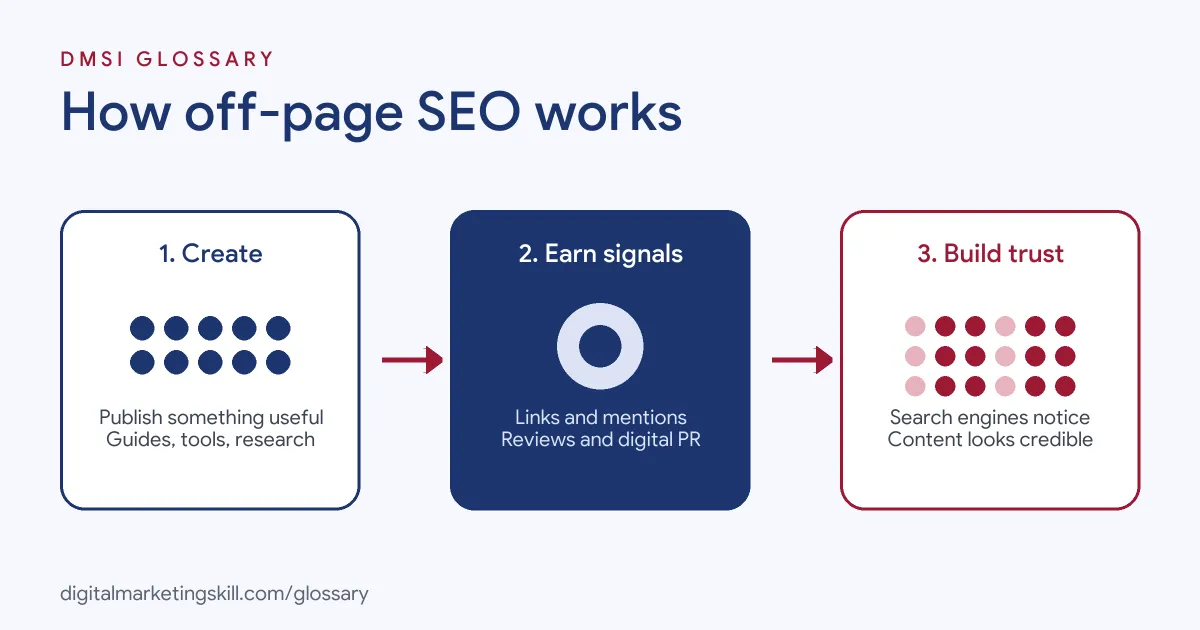
The process follows a simple chain. First, you create something worth talking about. Next, other people discover it and link to it or mention it. Then search engines notice those signals and treat your content as more trustworthy.
Links as Trust Signals
Google explains that “one of the factors used to determine quality is understanding if other prominent websites link or refer to the content.” It adds that this “is generally a good sign that the information is trustworthy.” So a single link from a respected industry site is usually worth more than many links from unknown pages. Context matters too. A link from a page on the same topic, placed naturally in the text, makes more sense to readers than one hidden in a footer.
Links for Discovery
Links also help search engines find your pages in the first place. According to Google, “the vast majority of the new pages Google finds every day are through links.” As a result, a new page with no links pointing to it can take longer to be found.
Reviews and Local Prominence
For local searches, Google looks at relevance, distance and prominence. It describes prominence as “how well-known a business is.” Importantly, it says this is “based on info like how many websites link to your business and how many reviews you have.” That is why reviews on your Business Profile are an important outside signal for shops, clinics and other local firms.
Off-Page SEO Examples
Here are three common ways businesses earn outside signals:
- Original research: A recruitment firm surveys its candidates and publishes the results. Journalists and bloggers then cite the figures and link to the report.
- Local reviews: A dental practice asks happy patients to leave a Google review after each visit. Over time, the profile builds more reviews than nearby competitors.
- Expert commentary: A marketing consultant answers questions from reporters on her specialist topic. As a result, she earns mentions and links in trade publications.
In each case, the business creates something of value first. The links and mentions follow because other people find it useful.
Off-Page SEO vs On-Page SEO
These two areas work together, but they focus on different things. Here is a quick comparison:
| Feature | On-page work | Off-page work |
|---|---|---|
| Where it happens | On your own pages | On other websites and platforms |
| Who controls it | You, fully | Other people, so you can only influence it |
| Main activities | Content, titles, headings, internal links | Link earning, digital PR, reviews, mentions |
| What it signals | What the page is about | Whether others trust and value it |
In short, on-page work makes your page clear, and outside signals make it credible. You usually need both to compete for popular searches.
How to Handle Paid and User-Generated Links
Not every link is meant to pass trust. Google asks site owners to label some links with a rel attribute:
| Attribute | When to use it |
|---|---|
rel="sponsored" |
Links that are adverts or paid placements |
rel="ugc" |
Links in user-generated content, such as comments and forum posts |
rel="nofollow" |
Other cases where you don’t want Google to associate your site with the link |
Therefore, if you sponsor a blogger or buy an advert, the link should carry one of these labels. Otherwise, it may count as link spam.
How to Build Off-Page SEO Step by Step
You can start with a simple, repeatable process:
- Check which sites already link to you, for example in Google Search Console.
- Study who links to your main competitors, and note the types of sites.
- Create one strong asset, such as a guide, tool or piece of research.
- Make a list of relevant sites, writers and communities that might find it useful.
- Reach out with a short, personal message that explains the value to their readers.
- Claim and complete your Business Profile if you serve local customers, then ask for reviews.
- Track new links and mentions every month, and note which efforts worked.
Over time, repeat the steps that bring the best results. Consistent effort usually beats one big push.
Best Practices for Off-Page SEO
A few habits keep your work safe and effective:
- Earn, don’t buy. Focus on content people want to share and cite.
- Stay relevant. A link from a site in your industry tells readers and search engines more than a random one.
- Use natural link text. Google’s policies flag “links with optimized anchor text” in guest posts and press releases as a form of link spam.
- Build relationships. Writers who trust you will come back for future stories.
- Reply to reviews. Thoughtful replies show customers, and potential customers, that you care.
Common Mistakes to Avoid
Many beginners chase quantity over quality. For instance, they buy cheap link packages, which can break Google’s rules on “buying or selling links for ranking purposes.” Others take part in “excessive link exchanges” or use “automated programs or services to create links.” Another trap is posting links in blog comments and forums. Google asks site owners to mark those links as user-generated content, and the posts can annoy the very communities you want to impress. Some also ignore reviews, even though they matter for local search. Finally, many give up too early. Outside signals build slowly, so results can take months.
Where You’ll Use Off-Page SEO at Work
Off-site skills appear in many SEO job listings. For example, recent remote roles ask candidates to:
- Step in to “own off-page SEO and link acquisition” (SEO Specialist).
- “Implement on-page and off-page SEO improvements to increase rankings and visibility” (SEO Specialist).
- Show a “strong understanding of SEO principles: on-page, off-page & technical SEO” (SEO Executive).
One listing also describes building “a high-quality backlink profile through targeted outreach, digital PR, content partnerships, and relationship-building.” So if you want to work as an SEO Specialist, you will need both outreach skills and a clear sense of which links are worth having.
Learn It in the WordPress and SEO Track
You can learn these skills in the AI-Powered WordPress and SEO Specialist track. There, you build a WordPress site or store and rank it with an SEO content plan. You also join a U.S. Project Internship from day one and get unlimited 1-on-1 mentoring.
For practical ideas, read our guide to link building strategies.
Frequently Asked Questions
What is off-page SEO in simple terms?
It is everything you do outside your website to build trust with search engines. That mainly means earning links, mentions and reviews from other places.
Is off-page SEO the same as link building?
Not quite. Link building is the biggest part, but the work also includes digital PR, brand mentions, reviews and community activity.
Can I pay for backlinks?
Google’s spam policies forbid buying links for ranking purposes. If you pay for a placement, the link should use the sponsored or nofollow attribute.
Do reviews help SEO?
For local search, yes. Google says the number of reviews you have is one of the things that shapes how prominent your business appears.
How long does off-page SEO take to work?
It usually takes months, because other sites need time to find and link to your content. Steady effort tends to work better than short bursts.
Sources: Google: How Search works, ranking results; Google Search Central: SEO Starter Guide; Google Search Central: Spam policies; Google Search Central: Qualify outbound links; Google Business Profile Help: Local ranking; remote job listings on Himalayas.