
Ad creative is everything people see or hear in an advert: the image or video, the headline, the main text and the call to action. It is the part of an ad that has to stop someone scrolling and give them a reason to act. It matters because the same budget and targeting can produce very different results depending on the creative you run.
Key Takeaways
- Creative covers the visuals, the copy and the call to action, not just the picture.
- In Meta’s Marketing API, an ad creative is “an object that contains all the data for visually rendering the ad”.
- Every platform sets limits on text length, image size and aspect ratio.
- Google’s responsive ads mix and match the assets you supply, so you need several strong options.
- Testing clearly different creative concepts is a routine part of improving paid social results.
What Is Ad Creative?
When you set up a campaign, you make two big kinds of decisions. First, you decide who sees the ad and how much to spend. Second, you decide what the ad actually looks and sounds like. That second part is the the creative.
For example, a gym runs an Instagram ad for a free trial week. The creative is a 10-second video of a busy class, the headline “Your first week is on us”, a short line of text and a “Sign up” button. Change the video to a quiet empty gym, and the same ad may perform very differently.
In paid social, the word is used as a noun for both one ad and a whole set. So you may hear “this ad creative is tired” or “we need new creatives for the launch”. It is a core part of paid social work.
How Ad Creative Works
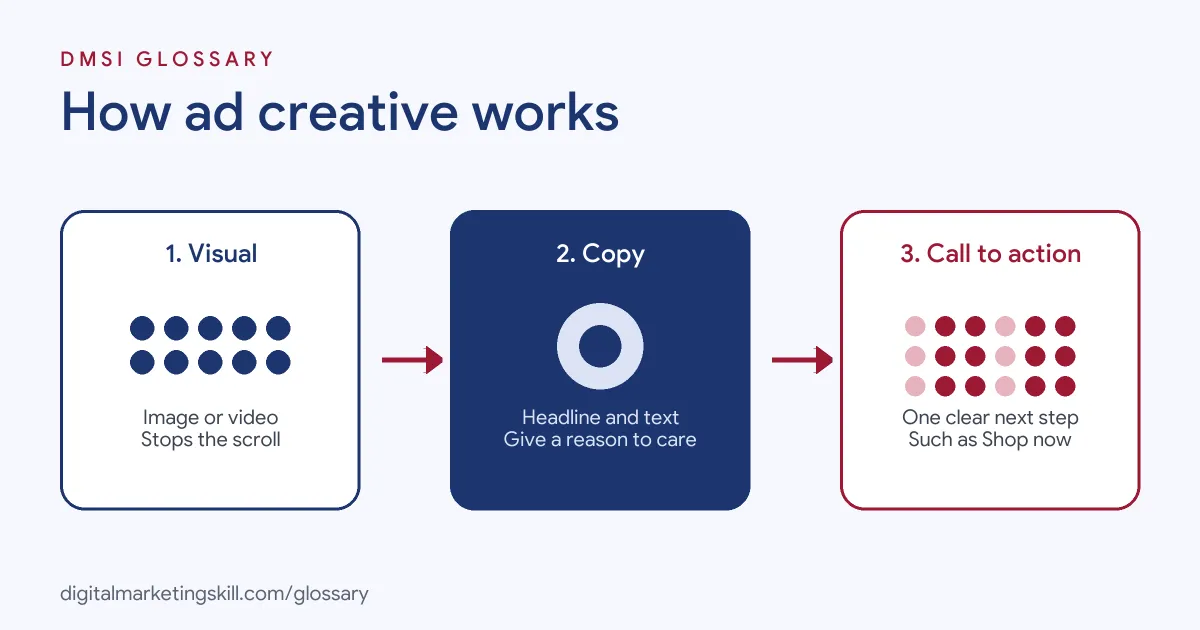
Every Good creative has three layers. Together, they move a viewer from noticing to acting.
The Visual
The image or video does the first job, which is getting attention. In a busy feed, people decide in a moment whether to stop. So the visual should show the product, the person or the result clearly, and fit the placement’s shape.
The Copy
Next, the words explain why the viewer should care. This usually means a headline and some primary or introductory text. Each platform caps the length. For example, Google’s responsive search ad headlines support up to 30 characters, and descriptions up to 90.
The Call to Action
Finally, the call to action tells people what to do next, such as “Shop now”, “Learn more” or “Sign up”. It should match the landing page. Otherwise, people who click feel misled and leave.
How Platforms Assemble It
Many ad formats now combine your assets automatically. With responsive display ads, you upload images, headlines, logos, videos and descriptions, and Google says “Google AI will generate ad combinations” for websites, apps, YouTube and Gmail. Similarly, Google responsive search ads let you add up to 15 headlines and 4 descriptions, then test combinations to learn which perform best.
Ad Creative Examples
Here are three made-up examples of creative built around one clear idea:
- Before and after: A cleaning company shows a split image of a messy oven and a spotless one, with the headline “Oven cleaning in 2 hours”.
- Customer story: An online tutor runs a short video of a student explaining how their grades improved, with a “Book a free lesson” button.
- Product in use: A backpack brand shows its bag on a commuter’s bike in the rain, with text about the waterproof zip.
Each one shows a benefit rather than just a product. As a result, the viewer understands the point in seconds.
Ad Creative Specs by Platform
Every platform has its own rules. Here are a few examples from official help pages:
| Platform and format | Text limits | Visual guidance |
|---|---|---|
| Google responsive search ads | 3 to 15 headlines of up to 30 characters; 2 to 4 descriptions of up to 90 | Text only |
| Google responsive display ads | Several headlines and descriptions | Images, logos and videos; Google combines them |
| LinkedIn carousel ads | Card headline up to 45 characters; introductory text up to 255 | 1:1 images, at least 1080 x 1080 pixels, up to 10 MB each |
| Meta (Facebook and Instagram) | Limits on text and image size | Set out in Meta’s Ads Guide for each placement |
Specs change from time to time, so check the platform’s help page before you design.
How to Make Ad Creative That Works
Follow these steps for each new campaign:
- Start with one message. Pick the single benefit that matters most to your audience.
- Write a short brief. Note the audience, the offer, the placement and the action you want.
- Make several concepts. For example, try a demo, a customer story and a bold offer.
- Size for each placement. Check the specs for feeds, stories and other placements.
- Write the copy last. Make the headline and visual say the same thing.
- Launch and compare. Run the concepts side by side and watch cost per result, not just clicks.
- Refresh regularly. When results drop, make new versions of the winning idea.
How to Judge Creative Results
Look past likes. Instead, compare each version on the numbers that match your goal. For awareness, that might be reach and video views. For sales or leads, focus on click-through rate, conversion rate and cost per result.
Here is a made-up example. Two videos each spend £200. Video A gets more clicks, but Video B brings 20 sign-ups at £10 each, while Video A brings 12 at about £17. So Video B wins, even though it looked weaker on clicks. In short, judge creative by the result you paid for.
Ad Creative Best Practices
- Show, don’t tell. A visual of the product working beats a list of features.
- Design for sound off. Add captions or on-screen text to videos, so the message still works if someone watches without sound.
- Keep the brand visible. Use your logo, colours or face early, so people remember who the ad was from.
- Match the landing page. The offer, image and wording should carry through after the click.
- Edit AI output. If you draft visuals or copy with AI, edit them to fit your brand and check every product detail.
Common Creative Mistakes
A frequent mistake is cramming too much into one ad. Another is reusing the same image for every placement, so it gets cropped badly. Some advertisers also test tiny changes, such as one word, when testing clearly different concepts usually teaches you more. Finally, many teams run one creative for months, even after results fade.
Where You’ll Use Ad Creative at Work
Creative work sits at the centre of paid social and performance roles. For example, remote job listings include lines like these:
- “Produce ad creative with AI tools (image, video, copy), then edit it to match our brand and keep product details accurate” (Growth Marketing Manager – Paid Media & Klaviyo).
- “You’ll create static ad creative and landing pages that convert, working closely with growth and marketing to turn campaign briefs into assets that perform.” (Senior Ad Graphic Designer).
- “This is for you if you can script viral-style videos and direct shoots, translate trends into high-performing ad creatives, and manage budgets and targeting.” (Paid Ads Manager).
So if you want to work as a Paid Social Specialist, Social Media Manager or Content Creator, you will brief, make and test new creative every week.
Learn It in the Social Media Track
You can build and test real campaign creative in the AI-Powered Social Media Management and Advertising track. It covers content creation for graphics and video, and you plan, create and run a paid social campaign for a real brand. You also get unlimited 1-on-1 mentoring and a U.S. Project Internship from day one.
For setup tips, read our guide to the five choices behind a Facebook ad setup, or find fresh angles with our creative content ideas.
Frequently Asked Questions
What is ad creative in simple terms?
It is what people see and read in an ad: the picture or video, the words and the button. It is separate from the targeting and budget.
Does the copy count as creative?
Yes. Headlines, main text and the call to action all count, alongside the image or video.
How often should I change my my ads?
There is no fixed rule. Watch your results, and make new versions when cost per result starts to rise.
How many creatives should I test?
Start with a few clearly different concepts. Then make variations of the winner, rather than testing many tiny changes at once.
Can I use AI to make ad creative?
Yes, many teams do. However, you should edit the output to fit your brand and check every product detail is accurate.
Sources: Meta for Developers: Ad creative; Google Ads Help: About responsive search ads; Google Ads Help: About responsive display ads; LinkedIn Help: Carousel ads specifications; remote job listings on Himalayas.