
Evergreen content is content that stays useful and relevant long after you publish it, because it covers a topic people keep searching for and the core answer rarely changes. Guides such as “how to tie a tie” or “how to write a cover letter” are classic examples. It matters because one well-made evergreen piece can bring in visitors, leads and links for a long time, while news-style posts fade within days.
Key Takeaways
- Ahrefs defines it as content built around a topic “with consistent, lasting demand.”
- The best topics have steady search interest and an answer that doesn’t change quickly.
- Evergreen doesn’t mean “publish and forget.” Even stable topics need regular updates to stay competitive.
- Guides tied to one tool or platform often look evergreen but go out of date fast.
- Nielsen Norman Group suggests auditing content and marking each piece to keep, update or remove.
What Is Evergreen Content?
The name comes from evergreen trees, which keep their leaves all year. In the same way, this kind of content stays fresh through every season. Ahrefs puts it like this: evergreen content “remains relevant long past its original publication date and is built around a topic with consistent, lasting demand.”
Ahrefs also gives a useful contrast. “How to tie a tie” is evergreen, because the demand is steady and the answer hasn’t changed. A post about last week’s football scores is not, because even though people search for scores all the time, each post expires quickly.
So two things make a piece evergreen: lasting interest in the topic and a lasting answer. You need both.
How Evergreen Content Works
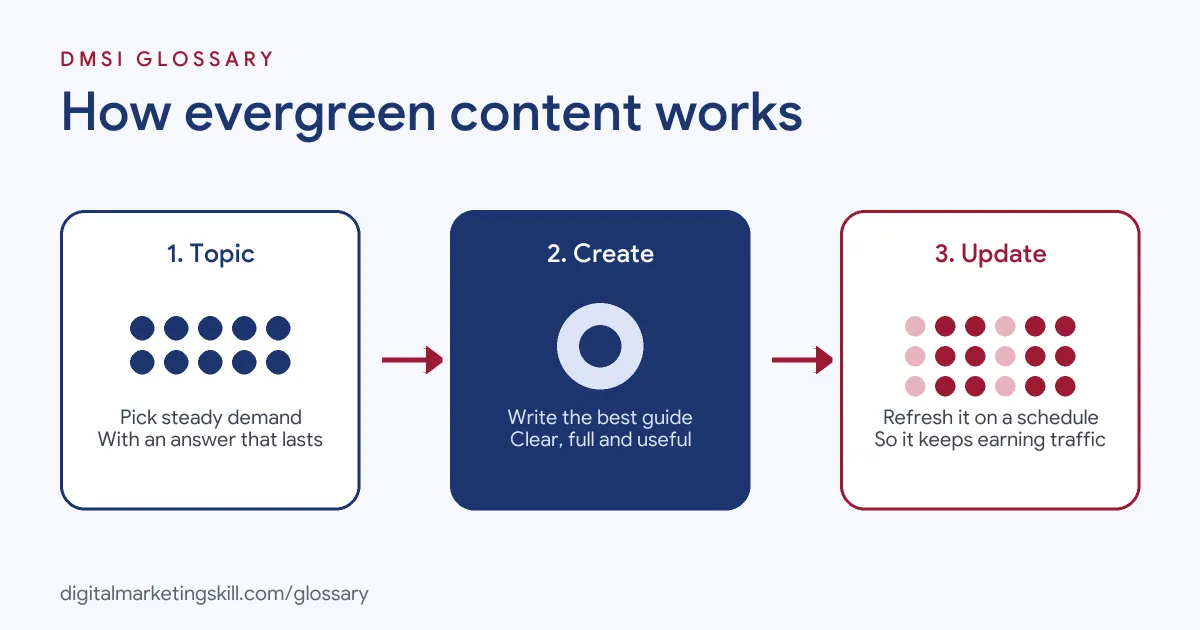
The idea works in three stages. First, you pick a topic with steady demand. Next, you create the most useful page you can on it. Then you keep it up to date, so it continues to earn traffic over time.
Steady Demand
Ahrefs suggests checking search trends for a topic before you commit. A flat line over a long period shows steady demand, which is ideal. Sudden spikes, by contrast, suggest the topic is tied to news or hype, so it is less likely to stay evergreen. Ahrefs also warns that some topics that look stable are actually in slow decline, so look at the long-term pattern, not just the last few months. If interest is shrinking year after year, pick a different topic.
A Stable Answer
Next, check whether the answer itself stays the same. Ahrefs proposes a simple test with questions such as: “Is the fundamental information likely to be the same in five years?” and is the topic “independent of specific tools, platforms, people, or trends that could change?” If the answer shifts quickly, the topic isn’t truly evergreen, even when search demand is steady.
Ongoing Updates
Here is the part many people miss. Ahrefs looked at the top 20 Google results for “compound interest,” one of the most stable topics there is, and found they had been updated, on average, within the last 10 months. In other words, competitors keep refreshing their pages, so you need to as well.
Evergreen Content Examples
Here are some common formats, with made-up topics:
- How-to guides: “How to clean a cast-iron pan” or “How to write a cover letter.”
- Definitions and explainers: “What is compound interest?” or a glossary page like this one.
- Checklists and templates: “Moving house checklist” or “Wedding budget template.”
Formats that are rarely evergreen include news, event recaps, trend round-ups and posts about the latest feature of one app.
Evergreen Content vs Topical Content
| Feature | Evergreen content | Topical content |
|---|---|---|
| Search demand | Steady over a long time | Spikes, then drops |
| Lifespan | Long, with updates | Short |
| Example | “How to tie a tie” | Last week’s football scores |
| Best for | Long-term traffic and leads | Quick bursts of attention and timely news |
Most good content plans use both. Topical posts catch attention now, while evergreen pages build value over time.
How to Create Evergreen Content
- Find a stable topic. Look for search interest that stays flat or grows steadily over a long period.
- Test the answer. Ask whether the core information will still be true in a few years.
- Avoid tool-specific traps. Ahrefs warns that “How to use [specific tool]” topics can decay fast when the tool changes.
- Write the best page you can. Next, cover the topic fully, clearly and with real expertise.
- Keep the wording timeless. Phrases tied to a moment make a page look old, so avoid them where you can.
- Set a review schedule. Decide how often you’ll check the page, based on how fast the topic changes.
- Update with substance. Finally, add fresh facts or better examples rather than just changing the date.
How Often to Update
Ahrefs says every topic has its own “content refresh rate.” For example, it suggests financial products, software comparisons and AI tool guides usually need monthly or quarterly updates. Meanwhile, SEO guides, marketing tactics and industry how-tos are usually fine with yearly or twice-yearly refreshes. So match your schedule to the topic, rather than updating everything at the same pace.
A Simple Refresh Checklist
When a page comes up for review, work through these checks:
- Is every fact, number and step still correct?
- Do the screenshots and examples still match what readers will see?
- Are there new questions people ask that the page doesn’t answer?
- Do all the links still work and point to the best pages?
- Does the title still describe the page clearly?
If most answers are yes, a light edit is enough. If several are no, plan a proper rewrite.
A Worked Example
Here is a made-up example. A travel blog publishes “How to pack a carry-on bag.” Interest in the topic stays steady all year, and the basic advice barely changes. So the post keeps bringing in readers. However, after a while, its photos look old and one airline’s size rule has changed. The blogger reviews the page, updates the size guidance, adds a short packing list and answers two new reader questions. As a result, the page stays useful and competitive, without starting from scratch.
Best Practices
- Put people first. Google says its systems aim to reward helpful, reliable content “created to benefit people.”
- Link to it often. For instance, point newer posts back to your best evergreen guides.
- Keep a list. Track your evergreen pages, their owners and their next review date.
- Refresh the examples. Old screenshots and examples make a page feel dated, even if the advice holds.
Common Mistakes
The biggest mistake is treating evergreen as “write once, never touch.” Another is picking a topic that depends on one tool or platform, so the guide breaks when the interface changes. Some writers also fill pages with dated phrases, which makes them look stale. Others never link to their evergreen pages from newer posts, so readers and search engines rarely find them. Finally, Ahrefs notes that a cosmetic date change without real improvement “won’t move the needle.”
Where You’ll Use Evergreen Content at Work
Content and SEO teams plan around this idea all the time. For example, one real remote job listing includes this line:
- “Support editorial teams in making content more discoverable from planning through publication, including live blogs, content calendars, evergreen packages, explainers, and event-based coverage around audience demand and emerging discovery opportunities” (Freelance Editorial Distribution Specialist).
In practice, an SEO Specialist chooses evergreen topics and sets update schedules. A Website Manager keeps those pages accurate, while a WordPress Developer makes sure they load fast and stay easy to edit.
Learn It in the WordPress and SEO Track
The AI-Powered WordPress and SEO Specialist track covers search engine optimisation and content marketing. You build a WordPress site or store and rank it with an SEO content plan, which is the perfect place to test evergreen pages. You also get unlimited 1-on-1 mentoring and a U.S. Project Internship from day one.
For the wider strategy, read our glossary entry on content marketing, or see our guide to a blog content strategy.
Frequently Asked Questions
What is evergreen content in simple terms?
It is content that stays useful for a long time, because people keep searching for the topic and the answer rarely changes.
Is evergreen content good for SEO?
Yes. It can earn steady traffic over time. However, you still need to update it, because competitors refresh their pages too.
How often should I update evergreen content?
It depends on the topic. Fast-moving subjects may need monthly or quarterly updates, while stable how-tos may need only a yearly check.
Can news be evergreen?
Not usually. News is tied to a moment. However, an explainer on the background to a story can be evergreen, as long as you keep it accurate over time.
What are examples of evergreen content?
How-to guides, definitions, checklists, templates and beginner explainers are common examples.
Sources: Ahrefs: Evergreen content; Google Search Central: Creating helpful, reliable, people-first content; Nielsen Norman Group: Content inventory and auditing; remote job listings on Himalayas.