
A call to action (CTA) is a short prompt, such as “Shop now,” “Book a call” or “Save this post,” that tells your audience exactly what to do next. It usually appears at the end of an ad, post, email or web page, often as a button or a clear line of text. It matters because people rarely take a step you haven’t asked for, so a clear CTA turns attention into clicks, sign-ups and sales.
Key Takeaways
- A CTA gives one clear next step, written as an action.
- TikTok advises ending ads with a clear CTA and guiding viewers “on what to think, feel, or do.”
- Google’s ABCD guidance says: “Include a call to action (CTA): Be intentional and add a CTA to drive a specific objective.”
- The best CTAs match the goal and the stage the viewer is at.
- One clear request usually beats several competing ones.
What Is a Call to Action?
Every piece of marketing has a job. The CTA is the moment you ask the reader to do that job. Without it, people may enjoy your content and then simply scroll on.
Google’s guidance for YouTube ads puts it under “Direction,” which it sums up as “Ask them to take action.” It advises you to “say what you’d like viewers to do.” TikTok’s best practices for performance ads make the same point: have a hook, highlight your selling points “and end with a clear call-to-action.”
CTAs come in many forms. A button on a landing page, a line at the end of an Instagram caption, a link in an email and a spoken line in a video can all do the same job.
How a Call to Action Works
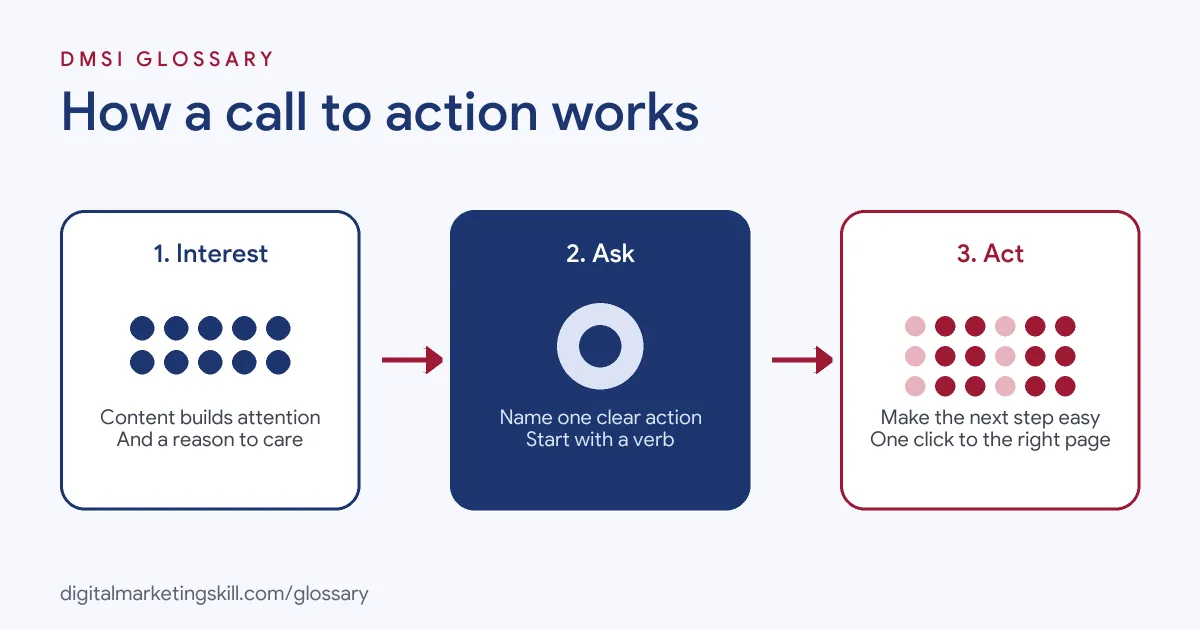
A CTA works in three steps. First, the content builds interest or trust. Next, the CTA names one clear action and, ideally, a reason to take it. Finally, the next step is easy, such as a button that leads straight to the right page.
The Wording
Start with a verb. “Book,” “Download,” “Shop,” “Join” and “Reply” all tell people exactly what happens. Then, where you can, add the benefit, such as “Get your free guide” rather than just “Submit.”
The Timing
Timing matters too. For ads aimed at action, Google suggests you “present the ask after the context is set.” For full-funnel ads, it advises using CTAs “throughout your ad, and be more direct as you go.” So the CTA should arrive once people understand why they should act.
The Format
In video, Google recommends you “reinforce your onscreen CTA with voice-over to ensure that the next step is clear.” In social captions, Sendible advises you to “always include a CTA,” whether it’s a question, a prompt or a pointer to the link in your bio. In proposals, Zoom’s guide suggests ending with “one explicit action,” such as signing or booking a call.
Soft and Hard CTAs
Marketers often talk about soft and hard asks. A soft CTA asks for a small, low-risk step, such as “Watch the full video” or “Read the guide.” A hard CTA asks for a bigger commitment, such as “Buy now” or “Book a consultation.” Neither is better on its own. Instead, match the ask to how warm the audience is. New viewers usually respond to soft asks, while people who already know you are more ready for hard ones. Google’s advice to “be more direct as you go” in full-funnel ads follows the same idea.
Call to Action Examples
Here are some made-up examples for different goals:
- Awareness post: “Follow for a new baking tip every Monday.”
- Engagement post: “Which colour should we launch next? Tell us in the comments.”
- Lead generation: “Download the free checklist and plan your first campaign tonight.”
- Sales ad: “Shop the spring range. Free returns on every order.”
- Service page: “Book a free 15-minute call.”
Each one starts with a verb and asks for a single, specific step.
Call to Action Types by Goal
| Goal | Typical CTA | Where it appears |
|---|---|---|
| Awareness | Follow, watch, learn more | Social posts and video ads |
| Engagement | Comment, save, share | Captions and stories |
| Leads | Download, sign up, get the guide | Landing pages and lead ads |
| Sales | Shop now, buy, book | Product pages, emails and sales ads |
In short, ask for a small step when people are just getting to know you, and a bigger step when they are ready.
How to Write a Call to Action
- Decide the one action. Choose the single most important step for this piece.
- Start with a verb. For example, “Book,” “Get” or “Join.”
- Add the benefit. Explain what people gain, such as “free,” “in five minutes” or “for beginners.”
- Match the stage. Next, ask for a small step from new audiences and a bigger one from warm ones.
- Make it easy. Link straight to the right page, with as few steps as possible.
- Repeat it in video. Show it on screen and say it out loud, as Google suggests.
- Test versions. Finally, try two wordings and keep the one that performs better.
A Worked Example: Testing Two CTAs
Here is a made-up example. A language school runs the same Facebook ad to two groups. Version A ends with “Learn more.” Version B ends with “Book your free trial lesson.” Everything else stays the same: the image, the text and the audience.
After two weeks, Version B gets fewer clicks, but far more of those clicks turn into bookings. That’s because the wording sets a clear expectation, so the people who click already want a lesson. The school keeps Version B and then tests a new detail: “Book your free trial lesson this week.” Small changes like this, tested one at a time, add up over a campaign.
A Quick CTA Checklist
Before you publish, run through these questions:
- Does it start with a clear verb?
- Is there only one main action?
- Does it say what people get?
- Does the link go to the right page?
- Is it easy to see on a phone?
If you can answer yes to all five, your CTA is ready.
Best Practices
- One ask per piece. Several CTAs compete with each other and confuse people.
- Be specific. “Get the free price list” beats a vague “Click here.”
- Match the landing page. The page people reach should deliver exactly what the CTA promised.
- Make buttons stand out. For instance, use a clear colour and enough space around them.
- Keep it honest. Don’t promise something the next page doesn’t offer.
Common Mistakes
A common mistake is leaving the CTA out altogether, hoping people will work out the next step. Another is using bland words like “Submit” or “Click here,” which say nothing about the benefit. Some brands also ask for too much too soon, such as “Buy now” in a first-touch awareness video. Finally, many send people to a home page instead of the page that matches the ad, so interest fades before they act.
Where You’ll Use CTAs at Work
CTAs come up in copywriting, email and website roles. For example, real remote job listings include lines like these:
- “Write compelling subject lines, preview text, call-to-action buttons, and targeted SMS messaging.” (Senior Copywriter).
- “Improve booking CTAs, trust signals, reviews, and pricing clarity” (Digital Marketing Manager).
So whether you become a Social Media Manager, a Content Creator or a Paid Social Specialist, you will write and test CTAs in posts, captions and ads every week.
Learn It in the Social Media Track
The AI-Powered Social Media Management and Advertising track covers content creation, social media marketing and analytics, and social media advertising. You plan, create and run a paid social campaign for a real brand, so you can test which call to action drives results. You also get unlimited 1-on-1 mentoring and a U.S. Project Internship from day one.
To write CTAs for posts, read our glossary entry on the caption. For more on persuasive wording, see our copywriting tips.
Frequently Asked Questions
What is a call to action in marketing?
It is a short prompt that tells people what to do next, such as “Shop now,” “Sign up” or “Book a call.”
Where should a call to action go?
Usually where people have enough context to act, often at the end of a post, ad or section. Long pages may repeat it.
What makes a good call to action?
It starts with a verb, names one clear action, explains the benefit and leads to a page that delivers it.
Should every post have a CTA?
Most should. Even a simple “Save this for later” or “Tell us below” gives people an easy next step.
How do I test a CTA?
Run two versions with different wording or placement, then compare clicks or sign-ups and keep the winner.
Sources: Google Ads Help: About the ABCDs of effective video ads; TikTok Ads Help: Creative best practices for performance ads; Sendible: Instagram character limits explained; Zoom: How to write a marketing proposal; remote job listings on Himalayas.