Copywriting tips only help once you have a method behind them. You need to know who you are writing to, what single action you want, and proof that backs the claim. This guide covers the formulas, headline and CTA data, and a worked example for your next page, email, or ad.
Key Takeaways
- 79% of people scan a new web page instead of reading it word for word. Only 16% read word by word, per Nielsen Norman Group’s usability research.
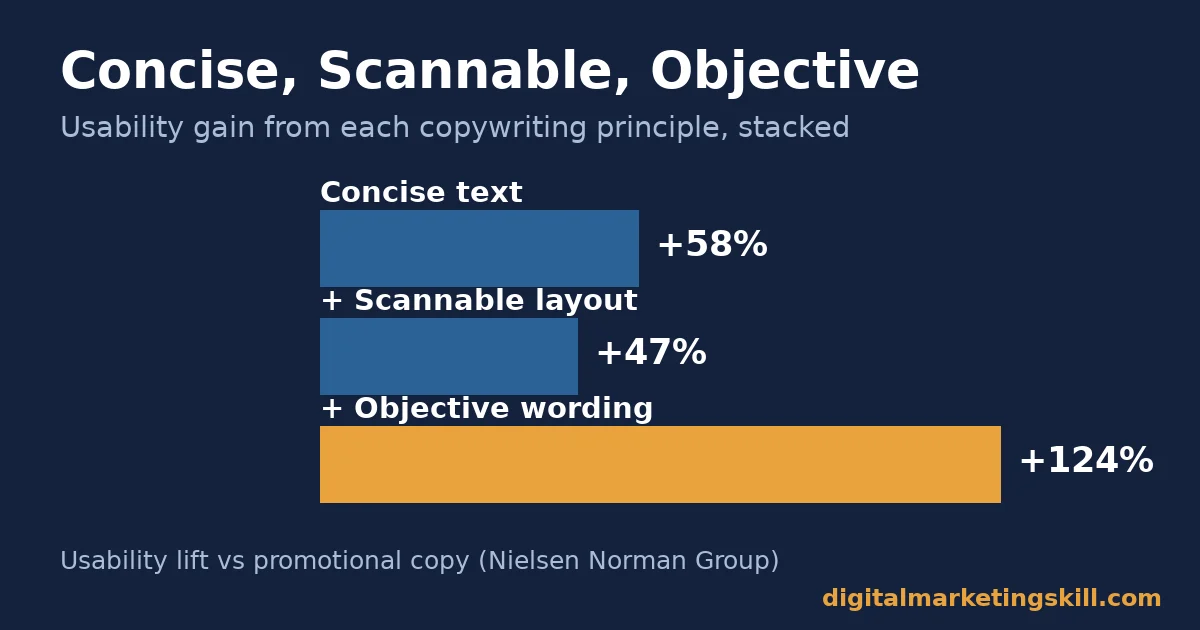
- Combining concise wording, a scannable layout, and objective language lifted usability by 124% in NN/g’s controlled test, versus typical promotional copy.
- A “my”-versus-“your” button wording test is one of the most cited in conversion optimization. One run produced 90% more clicks; a follow-up run on a different page produced 24.91% fewer clicks, per ClickZ’s review of both tests.
- In a controlled study of 2,000 landing pages, a hero section built around one specific stat delivered an 18% lift, the best of seven patterns tested, per Digital Applied’s study.
In this guide
- Why Most Copywriting Tips Lists Don’t Work
- How People Actually Read Your Copy
- What Differs By Format
- How To Lead With Each Format
- Copywriting Tips for Email Subject Lines
- A Pre-Publish Copywriting Tips Checklist
- Using Social Proof Without Overstating It
- Writing CTAs for Different Funnel Stages
- Three Formulas Behind Good Copywriting Tips
- Common Copywriting Mistakes That Waste Good Ideas
- How To Measure What’s Working
- The One Decision Rule That Saves the Most Wasted Effort
- What This Looks Like in Practice
- Frequently Asked Questions About Copywriting Tips
- Where to Learn Copywriting Tips Properly
Why Most Copywriting Tips Lists Don’t Work
Most copywriting tips lists are a grab-bag. Use power words. Write short sentences. Add urgency. None of that works without an order to apply it in.
This is a practical reading of public usability and conversion research, not a fixed formula. Every test result here came from a specific audience and page. Your result on a different audience can land far from the average. Nothing here guarantees a specific lift.
The real gap is this: most copy is written for a reader who does not exist, someone who reads every word in order. Real readers scan first. They commit only if the first few words earn it. Fix that order, and the rest of these copywriting tips start to work.
How People Actually Read Your Copy
Nielsen Norman Group’s long-running usability research found that 79% of test users always scanned a new page. Only 16% read word by word. People pick out individual words and phrases rather than full sentences, especially on a first visit.
That single fact should shape how you write before any specific tip does. A scannable structure matters more than clever phrasing buried in a dense paragraph. Short paragraphs, meaningful subheadings, and one idea per sentence all serve the scanning reader directly.
NN/g’s testing also found something copywriters often get backwards. Readers actively reject promotional language. In their study, concise text alone improved usability by 58%. A scannable layout added another gain. The combination of concise, scannable, and objective writing produced a 124% usability improvement over typical promotional copy. Objective, specific claims beat hype, because readers must mentally filter out exaggeration to find the facts.
What Differs By Format
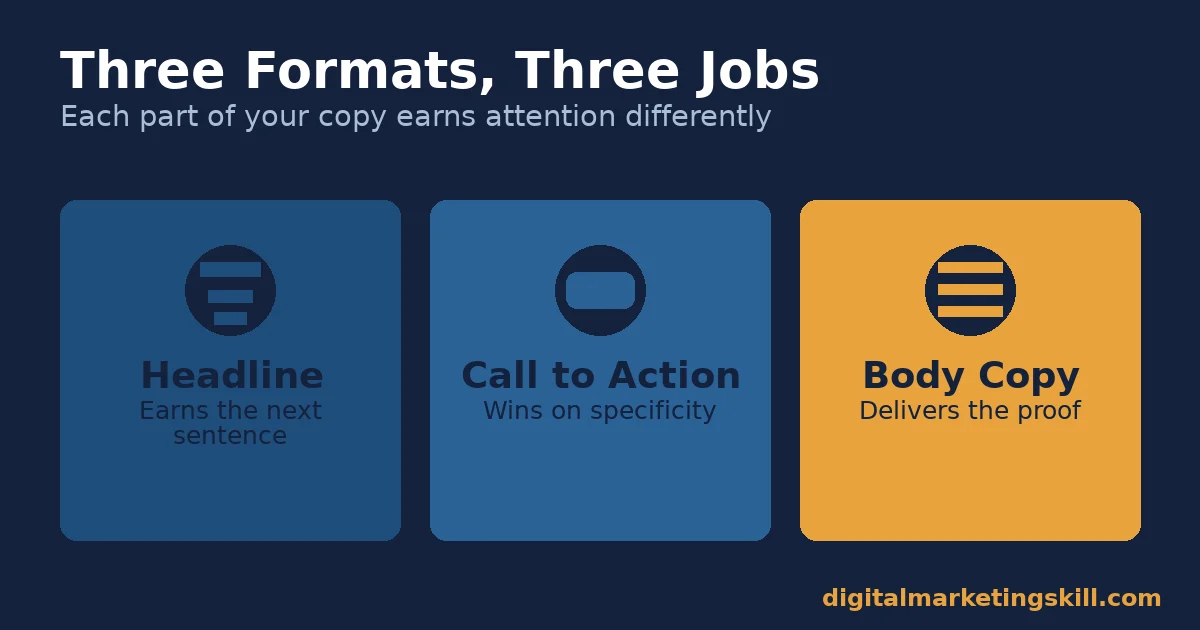
Copywriting tips that work for one format often fail in another. Readers approach each format differently.
Headlines: Built For the Scan, Not the Read
A headline has one job: earn the next sentence. Readers see it in isolation, often before they commit to anything else on the page. That means a headline carries more weight per word than any other line you write.
Calls to Action: Built For a Single Decision
Readers see a call to action at the exact moment they decide whether to act. Unlike a headline, a CTA wins or loses on specificity and ownership of the action, not on curiosity.
Body Copy: Built For the Reader Who Stays
Body copy only reaches people who passed the headline test. Its job is proof. That means specific benefits, real numbers, and objections answered before the reader thinks to raise them.
How To Lead With Each Format
Headlines: Lead With a Specific Number or Outcome
A number or a named outcome beats a vague claim. It gives the scanning reader something concrete to latch onto. “Cut onboarding time in half” earns more attention than “Better onboarding,” because the reader can picture exactly what the first one means.
Calls to Action: Lead With Ownership Language, Then Test It
Try first-person phrasing, “Start my trial” instead of “Start your trial.” It has outperformed second-person phrasing in some well-documented tests. Still, treat it as a hypothesis, not a rule. The same change has also underperformed on a different page, so test it on your own audience first.
Body Copy: Lead With the Reader’s Situation, Not Your Product
Open each section by naming the reader’s actual situation before you describe your product. A reader recognizes their own problem faster than they parse a feature list. That recognition is what keeps them reading past the first paragraph.
Copywriting Tips for Email Subject Lines
An email subject line is really just a one-line headline, read in an inbox instead of on a page. The same scanning behaviour applies, so the same copywriting tips carry over, with a few channel-specific details added.
Mailchimp’s own guidance for senders recommends keeping subject lines to no more than nine words and 60 characters, since longer lines get cut off on mobile inboxes before the reader sees the full line. The platform also advises against stacking more than three punctuation marks in one subject line, since excess punctuation increases the odds an email gets filtered as spam before a reader ever sees it.
Personalization, such as merge tags for a name or location, is one of the few subject-line copywriting tips with consistent backing across senders. The mechanism is the same one driving the headline advice above: a specific, relevant detail earns attention faster than a generic one, whether it sits in an inbox or at the top of a landing page.
A Pre-Publish Copywriting Tips Checklist
Before you publish any piece of copy, run it against five quick checks.
- Can you judge the headline on its own? Cover the rest of the page and read only the headline. If it does not make a clear promise by itself, rewrite it.
- Is there exactly one call to action? Count every button and link asking for an action. More than one competing CTA usually means cutting, not adding.
- Does every claim have proof nearby? A benefit stated without a number, example, or named source reads as an unsupported claim to a skeptical reader.
- Would it survive a five-second read? Since most readers scan, the page needs to make its case even if the reader never gets past the first screen.
- Is the urgency, if any, real? If you cannot point to an actual reason for urgency, cut the urgency language rather than inventing a reason.
Using Social Proof Without Overstating It
Social proof, a testimonial, a review count, a customer logo, works because it answers a question the reader is already asking silently: has this worked for someone like me? Among the copywriting tips that genuinely move conversion, specific social proof is one of the strongest, because it is evidence rather than a claim about yourself.
The specificity matters more than the volume. “Trusted by thousands” is a claim. “4.8 stars from 2,300 reviews” is evidence, because a reader can mentally verify it is the kind of number a company would not simply invent. Where you can, replace a vague trust statement with a specific, checkable one.
Review count matters too, up to a point. In a survey of 1,141 US consumers, BrightLocal found that 59% expect a business to have between 20 and 99 reviews before they trust the average star rating, and 50% said they trust reviews as much as a personal recommendation from someone they know (a US-only figure). A handful of reviews reads as thin; a specific, moderate count reads as credible.
Keep social proof honest. A testimonial you cannot verify, or a number you rounded up generously, undermines the exact trust the social proof was meant to build the moment a reader notices the gap.
Writing CTAs for Different Funnel Stages
Not every call to action should ask for the same level of commitment. A first-time visitor and a returning, warmed-up lead are reading the same page with very different willingness to commit.
Early-stage copy, a blog post or a first ad, should usually ask for a small, low-risk action: read more, watch a short demo, download a guide. Late-stage copy, a pricing page or a cart, can ask directly for the sale, because the reader has already self-selected as interested.
Matching the ask to the stage is one of the most overlooked copywriting tips. A “Buy Now” button on a reader’s very first interaction with your brand usually converts worse than a smaller ask would, simply because you asked for more trust than the moment had earned.
Three Formulas Behind Good Copywriting Tips
You do not need dozens of formulas. Three cover almost every situation.
- AIDA (Attention, Interest, Desire, Action): open with a scroll-stopping line, build interest with a relevant detail, create desire with a specific benefit, then close with one clear action. Works well for ads and landing pages.
- PAS (Problem, Agitate, Solution): name the reader’s problem, make the cost of ignoring it concrete, then present your offer as the fix. Works well for email and problem-aware audiences.
- FAB (Features, Advantages, Benefits): state what the product does, what that makes possible, and what it means for the reader personally. Works well for product pages and comparisons.
Pick one formula per piece of copy, rather than blending all three. A reader notices when a page tries to do everything at once, and the copy loses its single thread of persuasion.
Illustrative, invented example using PAS for an email: “Still manually copying leads into your CRM every morning?” (problem), “That’s an hour a day you’re not spending on calls that actually close deals” (agitate), “Our integration syncs leads automatically, the moment they come in” (solution). Each line does one job, and the formula keeps them in the order a skeptical reader needs.
Common Copywriting Mistakes That Waste Good Ideas
- Burying the action in paragraph three. If a scanning reader never reaches the ask, it does not matter how well the ask is written.
- Writing about the product instead of the reader. Copy full of “we” and “our” reads as a brochure. Copy full of “you” reads as a conversation.
- Stacking multiple calls to action. Every extra option splits attention and lowers the odds any single one gets taken.
- Using urgency with no real reason behind it. A reader who senses manufactured urgency distrusts everything else on the page.
How To Measure What’s Working
Four numbers tell you whether your copy is actually working, not just whether you like how it reads.
- Click-through rate: the share of people who saw a headline or subject line and clicked through. A low rate at good traffic means the opening line is not earning the next step.
- Conversion rate: the share of visitors who completed the action your CTA asked for. Track it per page, not just site-wide.
- Bounce or exit rate: a high rate right after the headline suggests it promised something the body copy did not deliver.
- Scroll depth: how far down the page readers get before leaving. A sharp drop-off marks exactly where your copy lost the reader.
Check these for two to four weeks per test. That is long enough to reach a meaningful sample before you decide whether a copywriting tips change actually worked or failed.
The One Decision Rule That Saves the Most Wasted Effort
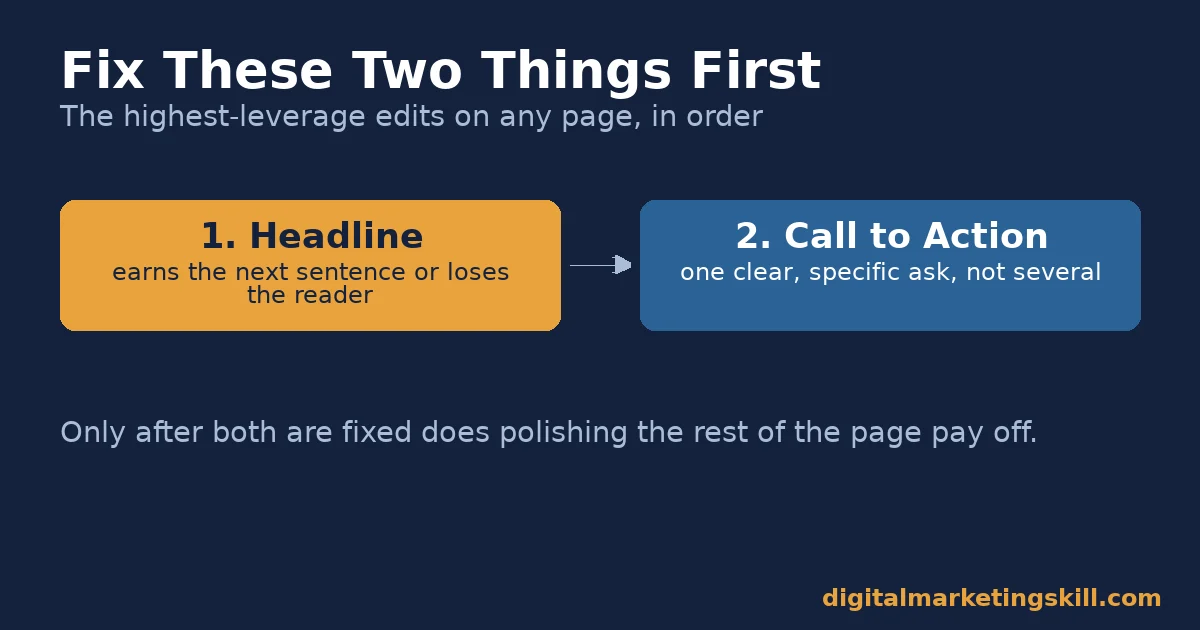
Decision rule: fix the headline and the single call to action before polishing word choice anywhere else on the page. Readers decide whether to keep scanning within the first few words. No amount of polish further down recovers a reader the headline already lost.
Illustrative, invented numbers: picture two versions of a product page. Version A opens with “Welcome to our platform” and buries its CTA in paragraph four. Version B opens with “Launch your first campaign in 10 minutes” and repeats one clear CTA near the top and bottom.
In testing, Version A converts at 1.2%. After rewriting only the headline and CTA placement, Version B converts at 2.6%, more than double, because the two highest-leverage elements on the page were fixed first.
What This Looks Like in Practice
Digital Applied’s controlled study of 2,000 landing pages offers a useful real-world check on the headline principle above. The study tested seven different hero section patterns. A hero built around one specific, concrete statistic outperformed every other pattern tested, including customer quotes, product screenshots, and generic stock photography, which was the worst performer of the seven.
One limit applies here: this figure is a median across many pages and industries, not a guarantee for any single page. A specific-stat hero only works when you actually have a credible, sourced number to lead with. A fabricated or shaky statistic would likely erode the same trust the real version builds.
The same study also found the weakest performer among the seven hero patterns was generic stock photography with no specific claim attached, which actually underperformed the page’s baseline. That pairing, a specific stat near the top, matters more than any decorative image choice, is a useful reminder that most copywriting tips about visuals really come back to the words attached to them.
Frequently Asked Questions About Copywriting Tips
What’s the single most useful copywriting tip for beginners?
Write for a scanning reader, not a careful one. Put your most important point, headline, subheading, or opening sentence, where it can be read in isolation, since most readers never commit to reading every word.
Do copywriting formulas like AIDA actually work?
They work as a structure, not a script. AIDA, PAS, and FAB each give you an order to organize persuasion in. The actual words still need to be specific and true to your product to convert.
Should I always use urgency in my copy?
No. Urgency only works when it is real, such as an actual deadline or limited stock. Invented urgency is easy for readers to spot, and it damages trust in the rest of the page.
How long should a headline be?
Short enough to be read in a glance, specific enough to promise one clear outcome. There is no fixed word count. A headline with a concrete number or outcome usually beats a longer, vaguer one at any length.
Is “my” always better than “your” in a call to action?
No. Documented tests show it winning by a wide margin on some pages and losing on others, including a case where it underperformed by nearly 25%. Treat it as a hypothesis worth testing on your own audience, not a universal rule.
What’s the difference between copywriting and content writing?
Copywriting is built to drive one specific action: a purchase, a signup, a click. Content writing is built to inform or build trust over time, with persuasion as a secondary effect.
How do I know if my copy needs a rewrite or just a better headline?
Check scroll depth and exit rate first. If most readers leave right after the headline, the headline is the problem. If readers scroll through the body but still do not convert, the call to action or the proof in the body needs work.
How short should an email subject line be?
Under nine words and 60 characters is a reasonable ceiling, per Mailchimp’s own sender guidance, mainly because longer lines get cut off on mobile inboxes before the reader sees the point.
Do copywriting tips differ between B2B and B2C audiences?
The underlying mechanics, scanning behaviour, proof near claims, one clear action, stay the same. What changes is the proof itself: B2B readers respond to case studies and numbers, while B2C readers often respond more to social proof and immediate benefit.
How many reviews does a business need before copy can cite them credibly?
Survey data suggests readers start trusting an average star rating once a business has somewhere between 20 and 99 reviews. Below that range, citing the review count in copy can draw attention to how thin it actually is.
Where to Learn Copywriting Tips Properly
Reading copywriting tips is a start. Turning them into copy that actually converts, and testing it against real traffic, takes structured practice and feedback on real work.
Digital Marketing Skill Institute’s Master Diploma in Digital & AI Marketing is built around four AI-powered tracks, totalling ten execution-first courses, with a Full Stack option for learners who want all four: AI-Powered Social Media Management and Advertising, AI-Powered Lead Generation and Email Automation, AI-Powered Google Specialist, and AI-Powered WordPress and SEO Specialist.
The program runs 100% online, with unlimited 1-on-1 coaching and mentoring, a U.S. Project Internship with a verified U.S. Work Reference Letter, and dual US and UK accreditation recognised in more than 100 countries. The coaching and coursework work the same way, anywhere in your country.
If you want the fundamentals first, see our full guide to what copywriting is and how buying-decision psychology shapes persuasive writing. Once your copy is live, our SEO writing guide covers making it discoverable too.
Explore the full program on the Digital Marketing Skill Institute homepage, browse more guides on our blog, read student outcomes on our reviews page, and when ready, apply here. Results vary by effort and market; see our earnings disclaimer, and visit digitalmarketingskill.com to learn more.
Every figure in this guide was checked against its original source before publication. Figures marked as illustrative are invented examples, not real results.