
Creative testing is the process of running different versions of an ad, such as new images, videos, hooks or headlines, against each other to find out which one performs best. You change one element at a time, give each version a fair share of budget, and compare the results on a clear metric. It matters because the creative is often the biggest driver of ad results, so a steady testing habit helps you spend less for each lead or sale.
Key Takeaways
- It compares ad versions to find the strongest image, video, hook or copy.
- A fair test changes one main variable, uses a clear metric and runs long enough to give a reliable answer.
- TikTok’s split testing divides your audience into two equal groups, so each group sees only one version.
- Meta’s ad-level testing feature lets you compare up to five versions of your creative inside an existing ad set.
- Testing never really ends. Winning ads tire over time, so you keep testing new ideas.
What Is Creative Testing?
Most ad accounts have one or two ads doing most of the work. The question is how you find them. Creative testing answers it with evidence rather than opinion.
In practice, you might test two hooks for the same video. Everything else stays the same: the audience, the budget, the offer and the landing page. After the test, you look at which hook brought leads or sales at the lower cost. Then you keep the winner and test a new challenger against it.
It is a form of A/B testing applied to ads. For the general method, see our glossary entry on A/B testing.
How Creative Testing Works
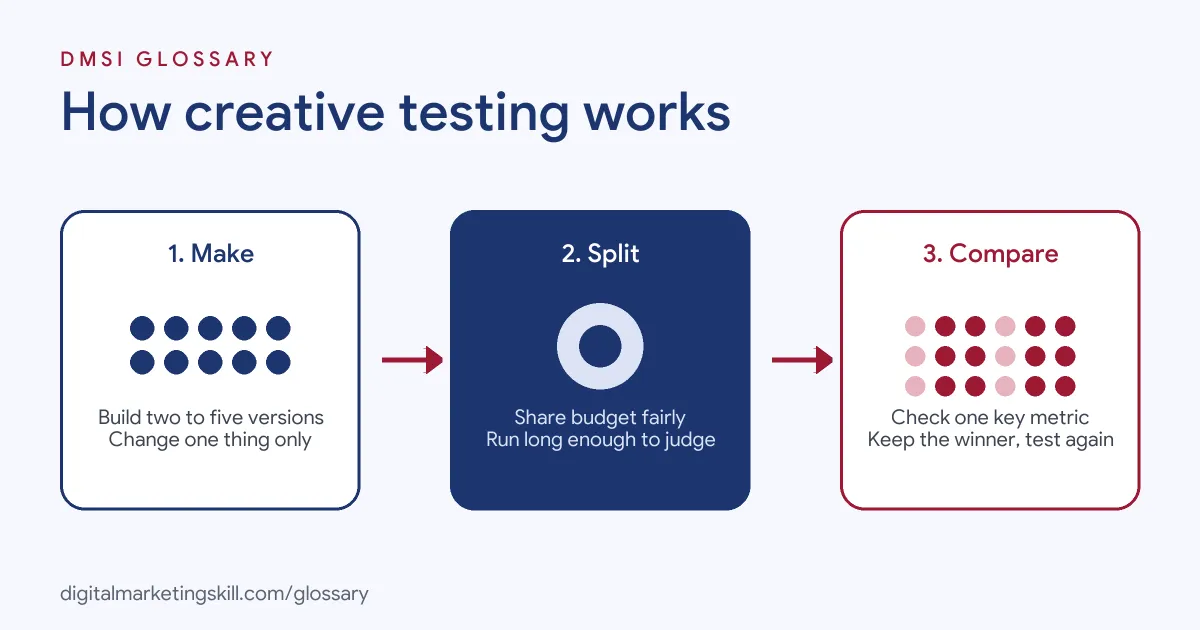
Every test follows the same loop. First, you form an idea, such as “a customer review will beat a product shot.” Next, you run the versions with a fair split of budget and audience. Finally, you compare results on one metric, keep the winner and plan the next test.
Choosing What to Test
Start with the elements that matter most. These are usually the format (image or video), the first few seconds of a video, the main visual and the headline. Small tweaks, such as button colour, tend to matter less. So test big ideas first, then fine-tune.
Creative Testing on TikTok
TikTok Ads Manager has a built-in split testing tool. Its help centre says the tool lets you “test two different versions of your ads to determine which one performs best.” It works by keeping other variables the same and splitting “your audience into two equal groups, with each group seeing only one ad group.” Creative is one of the variables you can choose, alongside targeting, placement and bidding.
Creative Testing on Meta
Meta also offers a testing option at the ad level. According to Jon Loomer, who covers Meta ads, Meta describes it as a way to “compare up to 5 different versions of your creative.” During set-up, you choose “the portion of your budget that you want to dedicate to the test,” how many days it runs and “the metric for comparing performance.” When it ends, “you’ll see results in the Experiments section.”
Creative Testing Examples
Here are three made-up examples of tests a team might run:
- Hook test: A fitness app runs the same video with three different opening lines. One that starts with a question gets the lowest cost per install, so it becomes the new control.
- Format test: A fashion brand tests a single image against a carousel of the same products. The carousel brings more clicks, but the single image brings cheaper sales, so the brand keeps the image.
- Message test: A training provider tests a “career change” angle against a “learn a new skill” angle. As a result, it learns which motivation drives more sign-ups from its audience.
In each case, the team changes one thing and judges the result on a business metric.
Creative Testing Methods Compared
There is more than one way to run a test. Here is how the main options compare:
| Method | How it works | Best for |
|---|---|---|
| Platform split test | The platform divides the audience so each group sees one version | Clean, reliable answers on one variable |
| Ad-level creative test | Several creatives run inside one ad set with a set share of budget | Testing many creatives quickly |
| Side-by-side ads | You run versions in the same ad set and let delivery decide | Quick signals, but less control over fairness |
Split tests give the clearest answers. However, ad-level tests let you try more ideas at once, so many teams use both.
How to Run a Creative Test
- Write a clear hypothesis, such as “user-generated video will beat studio video on cost per lead.”
- Pick one variable to change and keep everything else the same.
- Choose one main metric, such as cost per lead or cost per purchase.
- Make the versions. Two to five is enough for most tests.
- Set the budget and duration, so each version gets enough results to judge.
- Launch, then avoid changing the test while it runs.
- Compare the results, keep the winner and log what you learned.
Best Practices
- Test ideas, not tiny tweaks. A new angle or hook teaches you more than a new font.
- Judge on business results. Cheap clicks mean little if they don’t turn into leads or sales.
- Keep a testing log. Note each test, the result and the lesson, so the team builds on it.
- Refresh before fatigue sets in. Watch frequency and results, and have new creative ready. See our entry on ad fatigue for the warning signs.
- Build a system. One listing for a Senior Director, Paid Social asks for expertise in “building creative testing systems that work at scale.”
How to Read the Results
A test is only as good as the way you read it. So look at the numbers in this order:
- Volume: did each version get enough results? A handful of sales is not enough to call a winner.
- Main metric: which version has the lower cost per lead or sale?
- Supporting signals: check click-through rate and video watch time to understand why it won.
- Size of the gap: a tiny difference may be luck, so treat it as a tie and test again.
For example, imagine version A gets 40 leads at a lower cost than version B, which gets 38. That gap is small, so the honest answer is “no clear winner yet.” By contrast, 60 leads against 20 tells you something real.
Common Mistakes to Avoid
Many teams change several things at once, so they can’t tell what made the difference. Others end tests too early, after a handful of results, which often picks the wrong winner. Some judge on click-through rate alone, even when the real goal is sales. Finally, many find a winner and then stop testing. Because ads wear out, that leaves the account with nothing ready when results drop.
Where You’ll Use Creative Testing at Work
Testing is a core skill for paid social and media buying roles. For example, recent remote job listings ask for:
- “Experience with A/B testing, creative testing, and identifying profitable advertising strategies.” (Media Buyer).
- The ability to “develop and run creative testing frameworks” (Senior Meta Media Buyer).
- Skills in “audience targeting, creative testing, and campaign optimization” for TikTok (Paid Media Strategist).
So as a Paid Social Specialist or Social Media Manager, you will plan tests, brief new creative and report on what won and why.
Learn It in the Social Media Track
You can practise planning and running ad tests in the AI-Powered Social Media Management and Advertising track. It covers content creation (graphics and video), social media marketing and analytics, and social media advertising. Your portfolio project is to plan, create and run a paid social campaign for a real brand, so you can show real test results. You also get unlimited 1-on-1 mentoring and a U.S. Project Internship from day one.
Frequently Asked Questions
What is creative testing in advertising?
It means running different versions of an ad against each other to see which one performs best. You then keep the winner and test new ideas against it.
How many ads should I test at once?
Two to five versions is a sensible range. Meta’s tool compares up to five, while TikTok’s split test compares two.
How long should a creative test run?
Long enough for each version to collect a fair number of results. Ending a test after a few conversions often picks the wrong winner.
What should I test first?
Start with big elements, such as the format, the hook in the first seconds and the main message. Smaller details can come later.
What is the difference between creative testing and A/B testing?
Creative testing is A/B testing applied to ad creative. A/B testing is the wider method and can cover pages, emails and audiences too.
Sources: TikTok Ads Manager: About Split Testing; Jon Loomer: Creative testing feature for Meta ads; Jon Loomer: Meta creative testing limits; remote job listings on Himalayas and Himalayas.