
B2B marketing is marketing that one business does to sell products or services to other businesses, rather than to individual consumers. It targets the people who research, approve and pay for purchases inside a company, such as managers, specialists and finance teams. Because business purchases are often large, slow and made by groups, it needs a different approach from selling to shoppers.
Key Takeaways
- In B2B marketing, the buyer is a company, but the decisions are still made by people, usually several of them.
- Gartner says a typical buying group for a complex B2B solution involves six to ten decision makers.
- LinkedIn’s B2B Institute finds that 95% of potential buyers are not ready to buy today.
- So strong B2B teams balance brand building for future buyers with lead generation for buyers who are ready now.
- Common channels include LinkedIn, search, email, webinars, case studies and events.
What Is B2B Marketing?
B2B stands for business-to-business. A software firm selling payroll tools to employers does it. So does a packaging supplier selling boxes to food brands, or an agency selling SEO services to law firms.
The opposite is B2C, or business-to-consumer, where a brand sells to individual shoppers. The core skills overlap. You still need a clear audience, a strong message and good measurement. However, the buying process looks very different.
For example, a shopper might buy trainers in ten minutes. By contrast, a company choosing new accounting software may take months. It will compare suppliers, ask for demos, check security and get sign-off from finance. Your marketing has to support every one of those steps.
How B2B Marketing Works
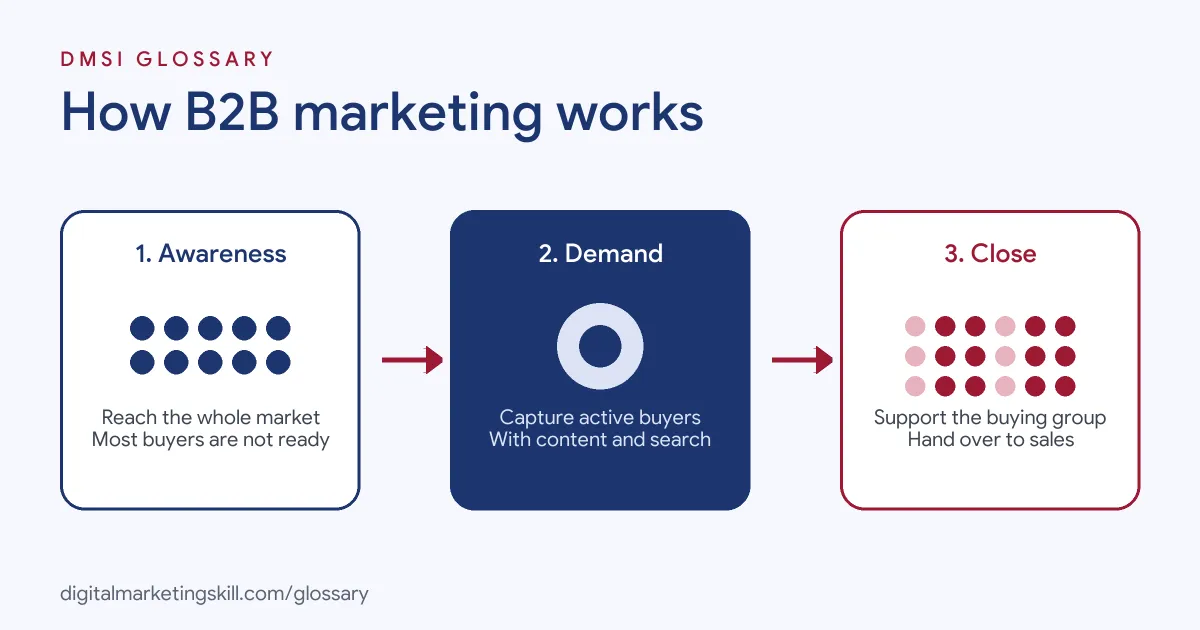
Most programmes follow the same broad pattern. First, you build awareness with the whole market. Next, you capture interest from people who are actively looking. Finally, you help sales turn those people into customers.
The Buying Group
One person rarely makes a business purchase alone. Gartner states that “the typical buying group for a complex B2B solution involves six to 10 decision makers.” Each person has a different worry. A user cares about ease of use, IT cares about security, and finance cares about cost.
Gartner also lists six “buying jobs” that groups work through: problem identification, solution exploration, requirements building, supplier selection, validation and consensus creation. In practice, they do not happen in a neat line. Buyers loop back and repeat steps.
The 95-5 Rule
LinkedIn’s B2B Institute calls this the 95-5 rule. Its research shows that “95% of your potential buyers aren’t ready to buy today.” They are “out-market” now, but they will be “in-market” later.
That’s because business purchases are rare. In joint research with the Ehrenberg-Bass Institute, LinkedIn found that 75% of companies buy computers once every four years. Similarly, 80% change banking services once every five years. As a result, brand advertising matters. It keeps you in mind until the buyer is finally ready.
Self-Directed Research
Buyers now do much of their research alone. Gartner found that when B2B buyers are considering a purchase, “they spend only 17% of that time meeting with potential suppliers.” The rest goes on online research, internal meetings and comparing options. So your website, content and reviews do a lot of selling before sales ever speak to anyone.
B2B Marketing Examples
Here are three made-up examples that show how this works in practice:
- Software company: A project tool runs LinkedIn ads to operations managers. It offers a free template, then follows up with an email series and a demo invitation.
- Manufacturing supplier: A parts maker publishes detailed product specs and case studies. Engineers find them through search and request a quote.
- Marketing agency: An agency hosts a monthly webinar for e-commerce founders. Attendees who ask questions get a call from the founder.
In each case, the business helps the buyer learn first and sell second.
B2B Marketing vs B2C Marketing
The two disciplines share tools, but the context changes almost everything:
| Factor | B2B | B2C |
|---|---|---|
| Who buys | A group inside a company | An individual or household |
| Decision time | Weeks to months | Minutes to days |
| Order value | Often high, with contracts | Usually lower, one-off or subscription |
| Main appeal | Return on investment, risk and fit | Emotion, convenience and price |
| Key channels | LinkedIn, search, email, events, sales teams | Social media, search, marketplaces, influencers |
In short, B2B buyers are still people. Emotion and trust still matter. However, they also need to justify the choice to colleagues.
How to Build a B2B Marketing Plan
- Define your ideal customer. Describe the type of company that buys from you, such as industry, size and location.
- Map the buying group. List each role involved and what each one needs to see.
- Choose your message. Explain the problem you solve and the result a customer can expect.
- Build helpful content. Create guides, case studies and comparison pages for each buying job.
- Pick two or three channels. For instance, start with LinkedIn, search and email rather than spreading thin.
- Agree with sales. Set a shared definition of a qualified lead and a clear hand-off process.
- Measure pipeline. Track meetings, opportunities and revenue, not just clicks.
How to Measure Results
Clicks and likes tell you little in this field. Instead, track the numbers your sales and finance teams care about:
- Qualified leads: how many contacts meet your agreed definition of a marketing qualified lead.
- Pipeline value: the total value of open sales opportunities that marketing helped create.
- Sales cycle length: the average time from first contact to signed deal.
- Win rate: the share of opportunities that turn into customers.
- Acquisition cost: what you spend to win each new account, also called customer acquisition cost.
Because deals take months, review these figures over a quarter or longer. Weekly swings are usually noise.
Best Practices for B2B Marketing
- Invest in brand as well as leads. The 95-5 rule suggests most of your future buyers are not looking yet.
- Write for every role. Give finance a cost case and IT a security page, for example.
- Target named accounts. LinkedIn lets you upload a list of companies to target. Its help centre says the list must have at least 300 rows, and it recommends 1,000 or more.
- Use proof. Case studies and customer quotes reduce the risk a buyer feels.
- Make your site self-serve. Buyers spend little time with suppliers, so answer their questions online.
- Be patient with results. Long sales cycles mean campaigns can take months to show revenue.
For more channel ideas, see our guides to B2B marketing strategy and B2B lead generation.
Common Mistakes to Avoid
First, many teams judge every campaign on leads in the same month. Yet most buyers are out-market, so brand work looks weak in the short term. Second, some brands talk only about features and forget the business result. Third, marketing and sales often disagree on what a good lead is. Finally, teams target one contact and ignore the rest of the buying group. Fixing these four issues usually improves results quickly.
Where You’ll Use B2B Marketing at Work
Many remote marketing roles focus on business buyers. For example, job listings mention:
- “10+ years of experience in B2B marketing, with deep, recognized expertise and authority in demand generation.” (Senior Demand Generation Manager).
- A role that “combines B2B marketing strategy” with outbound targeting and campaign execution (Growth Marketing Consultant).
- A plan “across B2C acquisition and B2B demand generation” (Director, Digital Marketing).
So whether you aim to be a Digital Marketing Manager, Growth Marketer or Freelance Digital Marketer, B2B skills widen the roles open to you. Agencies especially need people who can market to other businesses, because their own clients are businesses.
Learn It in the Full Stack Programme
B2B work draws on every channel, so the best fit is the Full Stack programme (all four tracks). You take all ten courses and complete one portfolio project from each track. That covers paid social, lead generation and email automation, Google Ads and analytics, and WordPress and SEO. You also get unlimited 1-on-1 mentoring and a U.S. Project Internship from day one.
Frequently Asked Questions
What does B2B marketing mean?
It means marketing from one business to another business. The goal is to win companies as customers, rather than individual shoppers.
What is an example of B2B marketing?
A software company running LinkedIn ads to HR managers, then offering a free demo, is a typical example. So is a supplier publishing case studies for engineers.
How is B2B marketing different from B2C?
B2B purchases involve groups, longer timelines and larger orders. B2C purchases are usually made by one person, faster and for less money.
Which channels work best for B2B marketing?
LinkedIn, search, email, webinars and case studies are common choices. The right mix depends on where your buyers research and who is in the buying group.
Why does brand matter in B2B?
Most buyers are not ready to buy right now. A strong brand keeps you in mind, so you are on the shortlist when they start looking.
Sources: Gartner: The B2B buying journey; LinkedIn B2B Institute: The 95-5 rule; LinkedIn Help: Company list targeting; remote job listings on Himalayas.