
A digital marketing agency is a business that plans and runs online marketing for other companies, such as paid ads, SEO, social media, email and web design. Clients pay the agency a fee, a retainer or a share of ad spend, and the agency’s team does the work and reports on results. It matters because many businesses lack the time, skills or tools to run every channel in-house, so agencies are one of the main places where digital marketers work.
Key Takeaways
- An agency is a team of specialists that runs marketing for several client businesses at once.
- Some agencies are full-service, while others focus on one channel, such as SEO or paid search.
- Agencies often manage many ad accounts. Google Ads manager accounts let them “view and manage multiple Google Ads accounts” from one place.
- Google’s Premier Partner status goes to the “top 3% of participating companies within a given country,” judged each year.
- In the US, the FTC says that handing work to an outside company “doesn’t relieve you of responsibility” for your advertising.
What Is a Digital Marketing Agency?
Think of an agency as a hired marketing team. Instead of employing an SEO expert, an ads manager and a designer, a business hires one firm that already has them all.
For example, a dental practice might hire an agency to run its Google Ads, improve its local SEO and post on Instagram. The agency sends a monthly report showing new patient enquiries. As a result, the practice gets expert help without hiring three people.
Agencies come in many sizes. Some are one or two people, much like a freelance digital marketer with a few helpers. Others have hundreds of staff across several countries.
How a Digital Marketing Agency Works
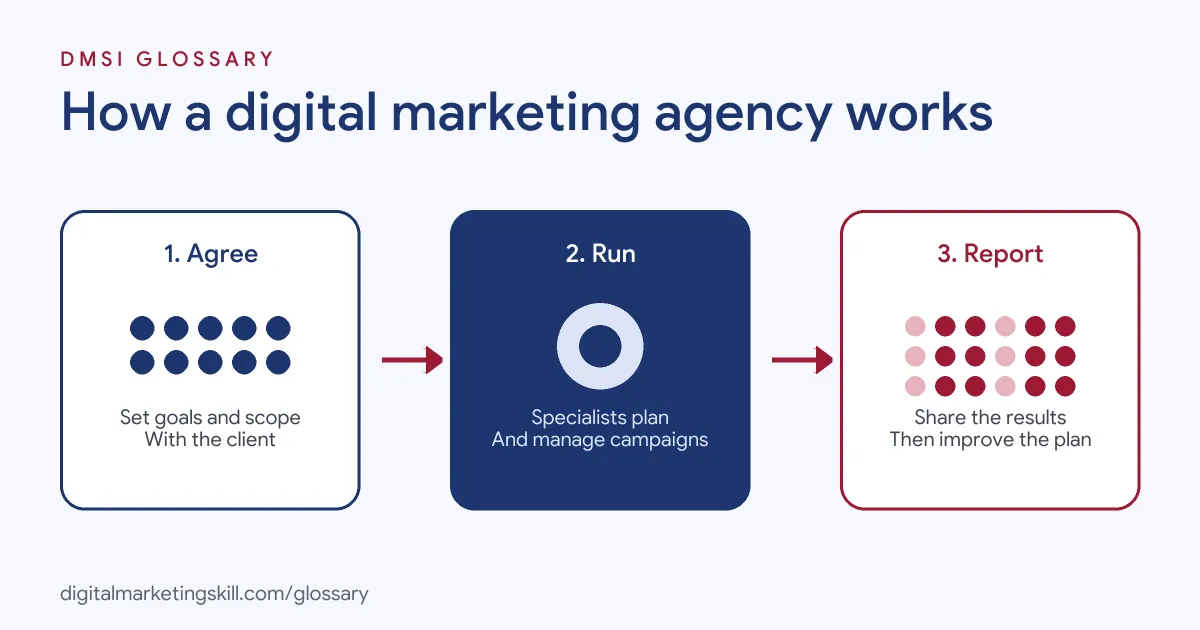
Most agency relationships follow three steps. First, the agency agrees goals, scope and fees with the client. Next, its specialists plan and run the campaigns. Finally, it reports results and adjusts the plan, usually every month.
Services
Common services include search engine optimisation, paid search, paid social, content, email marketing, web design and analytics. A full-service agency offers most of these. A specialist agency does one or two very well. For instance, one real job listing describes a “fully remote digital marketing agency serving luxury real estate, travel, B2B, and restaurant brands.”
Managing Client Accounts
Agencies need access to clients’ ad and analytics accounts. Google Ads manager accounts help here. Google describes them as useful for “third parties such as agencies” and says they let you “Use a single sign in to access all client Google Ads accounts.” Google also notes that client account admins “can unlink the account at any time,” so the client keeps control.
Partner Programmes
Many agencies join platform partner programmes. To earn Google Partner status, Google says a company needs a “minimum optimisation score of 70%,” must “maintain a 90-day ad spend of $10,000 USD across managed accounts,” and needs at least half of its account strategists certified in Google Ads. Premier Partners must also rank in the top 3% of participating companies in their country.
Roles Inside an Agency
Agencies split the work between a few types of role. Account managers look after the client relationship, agree priorities and share reports. Specialists, such as PPC, SEO or social media experts, do the hands-on work in each channel. Creative staff write copy and design ads, pages and emails. In smaller agencies, one person often covers several of these jobs, so broad skills are useful. In larger ones, people tend to specialise and work in teams.
Digital Marketing Agency Examples
Here are three made-up examples of different agency types:
- Full-service agency (example): A 40-person firm runs ads, SEO, social media and websites for retail brands.
- SEO specialist (example): A six-person team only does SEO and content for law firms.
- Paid media agency (example): A small team manages Google and Meta ads for online shops and charges a percentage of ad spend.
In each case, the agency’s focus shapes the clients it attracts and the skills it hires. A clear focus also makes it easier to explain what the agency does in one short sentence.
Agency vs Freelancer vs In-House Team
Here is how the three options compare for a business:
| Option | Strength | Trade-off |
|---|---|---|
| Agency | A range of specialists and tools in one place | Usually costs more than one freelancer |
| Freelancer | Flexible, focused and often lower cost | One person has limited time and skills |
| In-house team | Deep knowledge of the business, every day | Hiring, training and tools are costly |
In short, many businesses mix these options, such as an in-house manager working with a specialist agency.
How to Choose a Digital Marketing Agency
- Define your goal. Decide what you want, such as more leads, more sales or better rankings.
- Check relevant experience. Ask for case studies in your own industry or channel.
- Ask how they report. Agree which numbers you will see and how often.
- Confirm account ownership. Make sure your ad and analytics accounts stay in your name.
- Review the contract. Check the scope, notice period and what happens to your data if you leave.
- Look for partner status. Platform badges, such as Google Partner, show certain standards were met.
- Start with a trial. A short first project lets both sides test the fit.
Our guide to choosing a marketing agency goes into more detail.
A Simple Fee Example
Here is a made-up example. A shop spends £5,000 a month on ads. Agency A charges a flat £750 retainer. Agency B charges 15% of ad spend, which is also £750 at this level. However, if the shop doubles its ad spend, Agency B’s fee doubles to £1,500 while Agency A’s stays the same. So it pays to understand how fees grow before you sign.
Best Practices for Working With a Digital Marketing Agency
- Share real goals and data. An agency can only optimise for what it knows.
- Keep ownership of accounts. Give the agency access rather than letting it own your accounts.
- Agree disclosure rules. If the agency runs influencer or endorsement work, make sure posts are labelled correctly.
- Meet regularly. A short monthly review keeps everyone focused on the same results.
- Judge on business outcomes. Look at leads and sales, not only clicks and impressions.
Common Mistakes to Avoid
A common mistake is hiring an agency without clear goals, then judging it on vague feelings. Another is letting the agency own the ad accounts, which makes switching hard later. Some businesses also expect instant results from SEO, which takes time to build. Others pick the cheapest offer without checking experience. Finally, many forget that the business is still responsible for its advertising, even when an agency runs it.
Where You’ll Find Agency Work
Agencies hire for many digital roles. For example, real remote job listings mention agencies like this:
- “Bullseye Strategy is a fully remote digital marketing agency serving luxury real estate, travel, B2B, and restaurant brands.” (Paid Media Manager).
- “Our client is a growing digital marketing agency specializing in search engine optimization.” (SEO Account Manager).
- “We are looking for a high-octane Sales Executive to lead a critical expansion phase for a premier digital marketing agency.” (Account Executive).
So whether you want to work in an agency or start your own, you will need skills across channels and the ability to report results clearly.
Learn It in the Full Stack Programme
Agency Owner is one of the roles the Full Stack (all four tracks) programme prepares you for, alongside Digital Marketing Manager, Growth Marketer and Freelance Digital Marketer. You take all ten courses and build one portfolio project from each track, so you can show results across social, email, Google and SEO. You also get unlimited 1-on-1 mentoring and a U.S. Project Internship from day one.
Next, read our guide to the digital marketing agency model and how agencies win clients.
Frequently Asked Questions
What does a digital marketing agency do?
It plans and runs online marketing for other businesses, such as ads, SEO, social media and email, and reports on the results.
How do agencies charge?
Common models include monthly retainers, project fees, hourly rates and a percentage of ad spend.
What is a Google Partner agency?
It is a company that meets Google’s requirements for performance, ad spend and certifications. Premier Partners are the top 3% in their country.
Should I hire an agency or a freelancer?
Choose an agency if you need several skills at once. Choose a freelancer if you need focused help in one area.
Can I start my own digital marketing agency?
Yes. Many agency owners start as freelancers, then hire help as client work grows. A strong portfolio and a clear niche make the first clients easier to win.
Sources: Google Ads Help: How to become a Google Partner or Premier Partner; Google Ads Help: About manager accounts; FTC: Endorsement Guides, What People Are Asking; remote job listings on Himalayas.