
Copywriting is the craft of writing words that persuade someone to take an action, such as clicking an ad, joining a list or buying a product. It covers everything from a three-word headline to a long sales page. It matters because the same offer can succeed or fail depending on how clearly the words explain why it is worth having.
Key Takeaways
- Good copy has one job: move the reader to one clear next step.
- Most people scan web pages rather than read them, so short, front-loaded lines work best.
- Every channel has its own rules. For example, Google Ads headlines allow up to 30 characters.
- Claims must be true and provable. UK guidance warns against false or unsupported statements in ads.
- AI tools can speed up drafts, but you still need to check facts, tone and fit.
What Is Copywriting?
Copy is any text written to sell or persuade. Content, by contrast, is text written mainly to inform or entertain. In practice, the two overlap. A helpful blog post can still end with a strong call to action.
You will find copy in ads, emails, landing pages, product pages, social posts, video scripts and even button labels. Each piece has a reader, a goal and a single action it wants. Copywriting is the skill of linking those three things in as few words as possible.
For example, compare two button labels on a course page. “Submit” tells the reader nothing. “Get my free guide” tells them what they get and that it costs nothing. That small change is copywriting at work.
How Copywriting Works
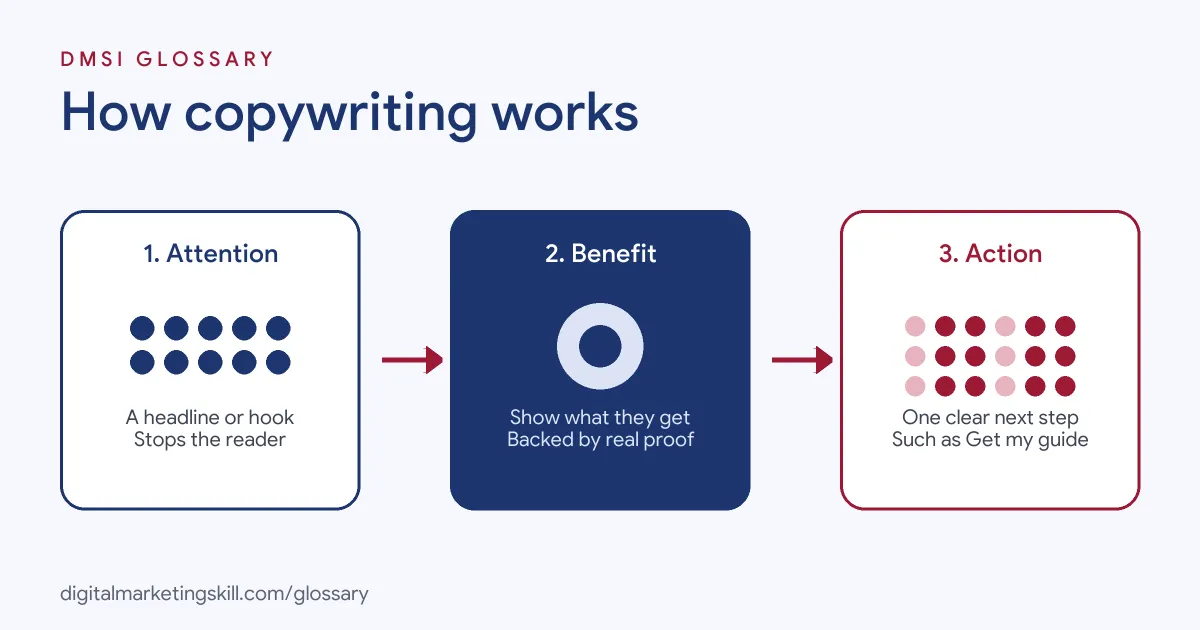
Strong copy follows a simple path. First, it grabs attention. Next, it shows the reader that you understand their problem. Then it explains how your offer helps. Finally, it asks for one clear action.
Know the Reader First
Before you write a word, you need to know who you are writing for. What do they want? What worries them? Which words do they use? Reviews, support emails and sales calls are good places to find this language. As a result, your copy sounds like the reader, not like a brochure.
Write Copy for Scanning
People rarely read every word online. In research by Nielsen Norman Group, 79% of test users “always scanned any new page they came across; only 16 percent read word-by-word.” So your copy must work at a glance. Use clear headings, short paragraphs and bold key phrases. Put the most important words first.
Common Copywriting Frameworks
Frameworks give you a structure to start from. Two of the best known are:
- AIDA: Attention, Interest, Desire, Action. It suits ads and sales pages.
- PAS: Problem, Agitate, Solution. It names a pain, shows why it matters, then offers the fix.
Neither is a rule. Instead, treat them as checklists to make sure no step is missing. They work just as well for a short ad as for a long sales page.
Copywriting Examples
Here are three made-up examples that show the same skill in different places:
- Search ad headline: A plumber writes “Boiler Fixed Today in Leeds”. It fits Google’s 30-character limit and answers the searcher’s need straight away.
- Email subject line: A bakery sends “Your free loaf is waiting”. It is short, personal and tells the reader what’s inside.
- Landing page headline: A bookkeeping app writes “Do your accounts in 10 minutes a week”. It sells the result, not the features.
In each case, the words focus on what the reader gets. That is the core of good copy.
Copywriting by Channel
Each channel shapes how you write. Here is a quick guide:
| Channel | Main goal | Key constraint |
|---|---|---|
| Google search ads | Win the click from a searcher | Headlines up to 30 characters, descriptions up to 90 |
| Social ads | Stop the scroll | The first line must hook before the text is cut off |
| Earn the open, then the click | The subject line competes with a full inbox | |
| Landing page | Turn a visitor into a lead or sale | One page, one offer, one action |
Google also lets you add up to 15 headlines and 4 descriptions to one responsive search ad. It then tests combinations to find what performs best. So you need a range of distinct lines, not 15 versions of the same one.
How to Write Copywriting That Converts
Use these steps for any piece, from an ad to a sales page:
- Write down the one action you want the reader to take.
- Describe the reader in one sentence. Note their main problem in their own words.
- List the benefits of your offer. Then turn each feature into an outcome for the reader.
- Draft a headline that states the biggest benefit. Write several options, not one.
- Add proof, such as numbers, reviews or a guarantee, but only if they are true.
- Write a clear call to action that says what happens next.
- Cut every word that doesn’t earn its place. Then read it aloud.
- Test two versions where you can, and keep the one that gets more of your chosen action.
Turn Features Into Benefits
Step three is where most copy improves. A feature is what the product has. A benefit is what the reader gains from it. Here is a made-up example for a project management app:
- Feature: “Shared task lists”. Benefit: “Everyone knows who is doing what.”
- Feature: “Automatic reminders”. Benefit: “No more missed deadlines.”
- Feature: “Mobile app”. Benefit: “Check progress from anywhere.”
A quick trick helps here. After each feature, ask “so what?” until you reach something the reader truly cares about.
Best Practices for Copywriting
- Lead with the benefit. Readers care about what they get, not how clever the product is.
- Use “you” more than “we”. It keeps the focus on the reader.
- Be specific. “Save two hours a week” beats “save time”.
- Keep one idea per sentence. Short lines are easier to scan.
- Back up every claim. UK consumer guidance says content must not make “false or unsupported statements”.
- Check AI drafts. AI can give you a fast first draft. However, you are still responsible for the facts and the tone.
Common Copywriting Mistakes
Many beginners make the same errors. First, they write about the company instead of the reader. Second, they pack in several offers, so the reader doesn’t know what to do. Third, they use vague words such as “innovative” or “world-class” that prove nothing. Fourth, they hide the call to action at the bottom of a long block of text. Finally, they make claims they can’t support, which can mislead customers and break advertising rules.
Where You’ll Use Copywriting at Work
Writing skills appear in almost every marketing job ad. For example, recent remote listings ask for:
- “Strong copywriting skills, with the ability to write clear, persuasive messaging for different audiences and stages of the customer journey” (Marketing Lead).
- “Excellent copywriting and content creation skills with strong attention to detail” (Digital Events and Social Media Executive).
- Someone “Comfortable using AI tools regularly to accelerate copywriting, creative development, research, campaign optimisation, and performance analysis” (Marketing Lead).
So whether you aim to become a Digital Marketing Manager, a Growth Marketer or a Freelance Digital Marketer, you will write copy every week. Employers will also want proof, such as ads, emails or pages you wrote and the results they got.
Learn It in the Full Stack Track
Copy is used in every channel, so the best fit is the Full Stack option, which covers all four tracks. You take all ten courses and complete one portfolio project from each track, from a paid social campaign to an email sequence, a Google Ads campaign and an SEO content plan. You also work on a U.S. Project Internship from day one, with unlimited 1-on-1 mentoring.
Next, read our copywriting tips and our guide to copywriting skills. You may also like our glossary entry on AI copywriting.
Frequently Asked Questions
What is copywriting in simple terms?
It is writing that persuades people to do something, such as click, sign up or buy. Ads, emails and sales pages are all forms of copy.
What is the difference between copywriting and content writing?
Copy aims to drive an action. Content mainly informs or entertains. However, many pieces do both, such as a helpful article that ends with a sign-up offer.
Do you need a degree to learn copywriting?
No. Employers usually care more about your samples and results. A portfolio of real ads, emails or pages is the strongest proof you can show.
Can AI replace copywriting skills?
AI can produce quick drafts and ideas. Even so, a person still needs to understand the reader, check every claim and decide what to publish.
How long should copy be?
As long as it needs to be and no longer. A search ad headline has 30 characters, while a sales page for a costly product may need much more detail.
Sources: Nielsen Norman Group: How users read on the web; Google Ads Help: About responsive search ads; CMA: Social media endorsements guide; remote job listings on Himalayas.