
Prompt Chaining is a way of using AI where you split a big task into smaller steps and feed the output of one prompt into the next. Instead of asking a chatbot to do everything in one go, you guide it through a sequence, such as research, outline, draft and edit. As a result, each step is simpler, and the final output is often more accurate and consistent. It also makes it easier to see where things went wrong and fix just that step.
Key Takeaways
- Prompt chaining breaks one complex task into a series of focused prompts.
- The output of each step becomes the input for the next step.
- It improves control, consistency and the ability to check each stage.
- A common pattern is draft, review against criteria, then refine.
- Marketers use it for content, research, reporting and automated workflows.
What Is Prompt Chaining?
A prompt is the instruction you give an AI model. A single prompt works well for simple jobs. However, long tasks with many parts can overload it. The model may skip steps, mix up instructions or lose the right tone.
Prompt chaining solves this by splitting the work. The Prompt Engineering Guide describes it as a method “where a task is split into subtasks with the idea to create a chain of prompt operations.” Similarly, IBM calls it a technique for “generating a desired output by following a series of prompts.”
Think of a car assembly line. One station fits the wheels, the next adds the doors, and another checks the paint. Each worker does one job well. In the same way, each prompt in a chain has one clear task. So the final product is built step by step, with checks along the way.
Why It Matters
For marketers, quality and consistency matter more than speed alone. A chain lets you control each stage, so the brand voice stays steady. In addition, you can review the middle steps. For example, you can check an outline before the AI writes the full article. IBM notes that “Prompt chaining helps reduce error rates by providing the model with better context and more focused input.” Finally, a chain is easy to reuse. Once it works, you can run it again for every new brief.
How Prompt Chaining Works
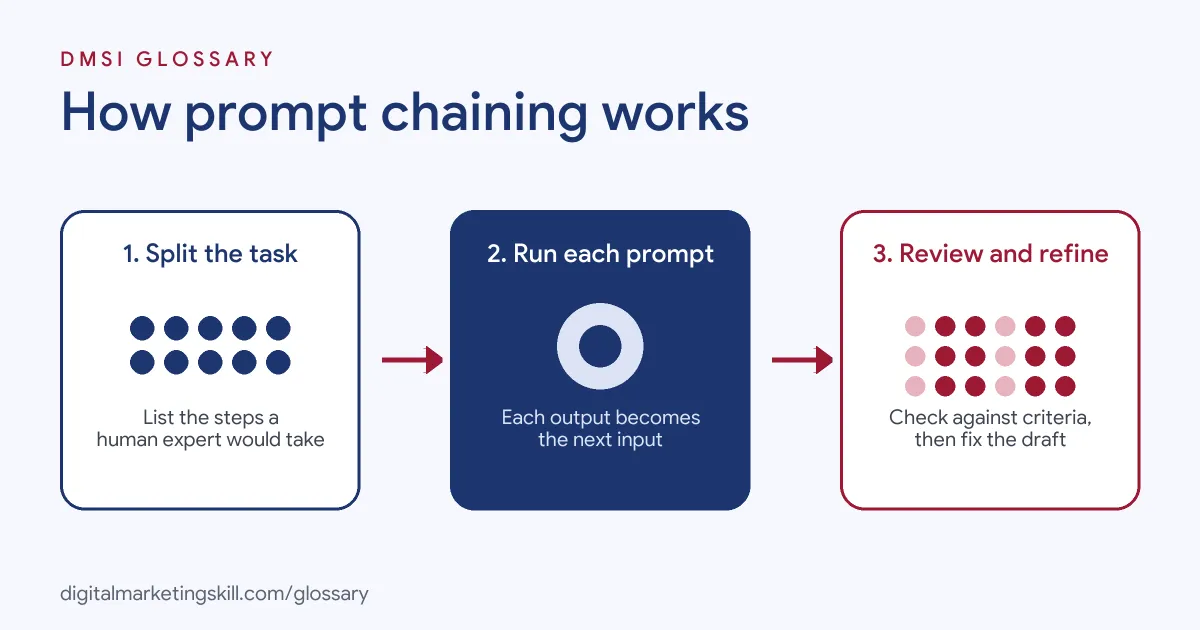
Every chain follows the same basic idea. First, you define the steps. Then you run the first prompt and pass its output into the second. After that, you repeat until you reach the final result.
Breaking Down the Task
Start by listing the steps a human expert would follow. For instance, a blog post might need keyword research, an outline, a draft and an edit. Each step becomes its own prompt. Also, give each prompt one clear goal, so the model knows exactly what to produce.
Passing Outputs Along
Next, you pass the result of one step into the next prompt. For example, the Prompt Engineering Guide shows a document question task. There, “the first prompt is responsible for extracting relevant quotes to answer a question.” Then a second prompt uses those quotes to write the answer. Clear labels, such as tags around each piece of text, help the model see what it received.
Reviewing and Refining
Many chains include a quality check. Anthropic’s Claude documentation says, “The most common chaining pattern is self-correction: generate a draft → have Claude review it against criteria → have Claude refine based on the review.” So the AI checks its own work before you see it.
Manual or Automated
You can run a chain by hand in a chat window, one prompt at a time. Alternatively, you can automate it with an API or a no-code tool. Anthropic notes that “Each step is a separate API call so you can log, evaluate, or branch at any point.” As a result, automated chains suit repeat tasks, such as weekly reports.
Examples of Prompt Chaining
- A content agency writing blog posts. Prompt one turns a brief into an outline. Prompt two writes each section. Then prompt three edits the draft against the client’s style guide.
- An ecommerce team writing product copy. First, one prompt pulls key features from a supplier sheet. Next, a second prompt writes short descriptions. Finally, a third checks each one for banned claims.
- A marketing manager preparing a monthly report. One prompt summarises campaign data. Another lists the main wins and problems. After that, a final prompt turns the notes into a short email for the client.
Prompt Chaining vs Single Prompts vs Chain-of-Thought
| Point | Prompt chaining | Single prompt | Chain-of-thought prompting |
|---|---|---|---|
| Number of prompts | Several, in sequence | One | One |
| How it works | Each output feeds the next prompt | Model answers in one go | Model reasons step by step inside one answer |
| Can you check middle steps? | Yes, between prompts | No | Only by reading its reasoning |
| Best for | Long, multi-stage tasks | Quick, simple tasks | Logic and maths problems |
These methods also work together. For example, one step in a chain can use chain-of-thought prompting or few-shot prompting.
How to Build a Prompt Chain
- Define the end result. Write down exactly what the final output should look like.
- List the steps. Break the task into three to five stages that a human would follow.
- Write one prompt per step. Give each prompt a single goal, the right context and a clear format for its output.
- Label what you pass on. Wrap earlier outputs in clear tags or headings, so the model knows what each part is.
- Add a review step. Ask the model to check the draft against your criteria, then fix the issues it finds.
- Test with real inputs. Run the chain on several briefs. Then note where the output goes wrong.
- Fix the weak link. Improve only the step that fails, rather than rewriting the whole chain.
- Save and reuse. Store the chain as a template or automation for your team.
A Simple Chain for Social Posts
Here is a chain you can try with any AI chat tool. First, paste a blog post and ask for its five key points as a list. Next, ask the model to turn each point into a short social post for one platform. Then paste your brand voice rules and ask it to check each post against them. After that, ask it to fix any post that breaks a rule. Finally, ask for two headline options for each post, so you can pick the best one. Each step is small, so the model has less room to drift. In addition, you can stop at any point and correct the output by hand. For example, if the key points miss something, you fix the list before any posts are written. As a result, the final posts stay close to the original article and your brand voice.
Best Practices for Prompt Chaining
- Keep each step small. One task per prompt gives the model less room to drift.
- Use clear formats. Ask for lists, tables or labelled sections, so the next step can use them easily.
- Check the middle steps. Review outlines and summaries before the final draft is written.
- Set the tone early. Put brand voice rules in a system prompt or the first step, so they carry through.
- Fact-check the output. Chains reduce errors but don’t remove them, so a human should verify facts and claims.
- Don’t over-chain. If one prompt does the job well, a chain only adds time and cost.
Common Mistakes to Avoid
- Too many tasks in one step. This defeats the point of chaining.
- Losing context. If you forget to pass on key details, later steps guess.
- Messy hand-offs. Unlabelled text makes it hard for the model to tell instructions from content.
- Errors that spread. A mistake in step one flows into every later step. So check early outputs.
- No final human review. AI output still needs a human eye before it goes live.
- Never testing. A chain that worked once may fail on a new kind of brief.
Where You’ll Use Prompt Chaining at Work
Prompt chaining shows up in AI-focused roles and in marketing jobs that build AI workflows. It is a core skill within wider prompt engineering. For example, real remote job listings ask for:
- “Author, refactor, and chain prompts (system/tool/policy) for varied tasks.” (Prompt Engineer (LLM Systems, Evals & Safety)).
- “Experience exploring behavior of AI tools (fine-tuning, prompt chains, chain-of-thought debugging, or building agents).” (Customer Success Engineer – AI SaaS).
Learn It in the Full Stack Track
Prompt chaining is useful in every area of marketing, so you can learn it across all four tracks in Full Stack. Every track includes a U.S. Project Internship from day one, with unlimited 1-on-1 mentoring.
Frequently Asked Questions
Is prompt chaining the same as chain-of-thought prompting?
No. Prompt chaining uses several separate prompts in a row. By contrast, chain-of-thought asks the model to reason step by step inside one answer.
Do I need to code to use prompt chaining?
No. You can run a chain by hand in any chat tool. However, code or no-code tools help when you want to automate it.
How many steps should a chain have?
Use as few as the task needs. Three to five steps cover most marketing tasks.
Does prompt chaining stop AI mistakes?
It reduces them, but it doesn’t stop them. So you still need to check facts and claims before you publish.
Which AI tools support prompt chaining?
Any chat-based model can follow a chain if you paste outputs between prompts. Also, most AI APIs let you automate the steps.
Sources: Prompt Engineering Guide: Prompt Chaining; IBM: What is prompt chaining?; Anthropic Claude Docs: Prompting best practices; remote job listings on Himalayas and Himalayas.