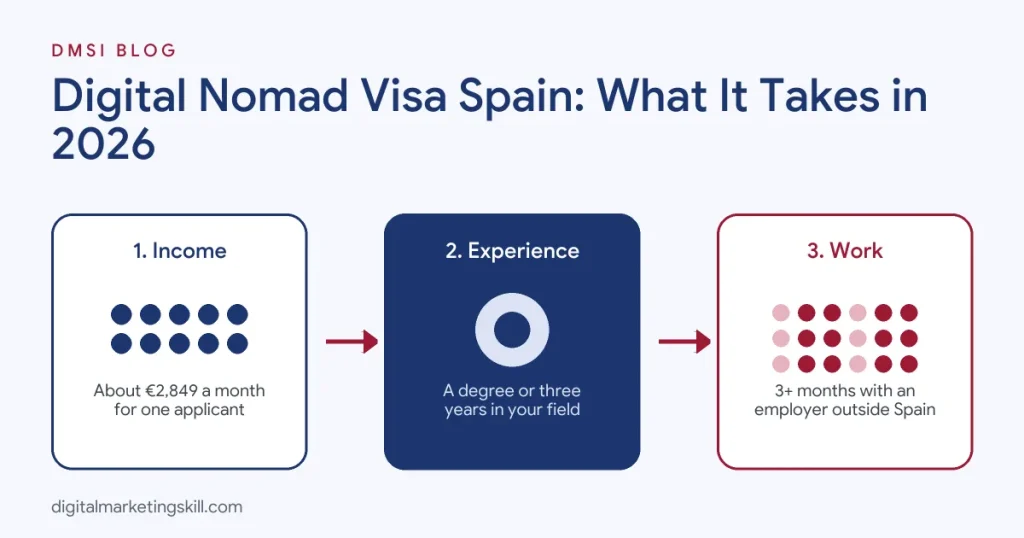
The digital nomad visa Spain offers lets non-EU remote workers, including UK citizens since Brexit, live in Spain while working for employers or clients based outside Spain. In 2026 most guides put the income requirement at €2,849 a month for a single applicant, which is 200% of Spain’s minimum wage. You also need a university degree or three years of experience, at least three months with your current employer or client, and no more than 20% of your income from Spanish clients.
This guide explains how the visa works, why you will see two different income figures, how Spain compares with other countries, and how to build the remote income that qualifies. If you are still choosing a country, start with our guide to picking the right digital nomad visa country. We are not immigration advisers, and nothing here guarantees a visa.
Key Takeaways
- Spain’s 2026 minimum wage (SMI) was raised by Royal Decree 126/2026 to €1,221 a month over 14 payments, which most guides convert to a visa threshold of €2,849 a month.
- Family members raise the threshold by 75% of the SMI for the first person (about €1,068) and 25% for each extra person (about €356), so a family of three needs roughly €4,274 a month.
- Applicants need a degree or at least three years of relevant experience, and at least three months with an employer or client that has traded for at least a year.
- Eligible employees can apply for the Beckham Law, a flat 24% tax rate on work income up to €600,000, within six months of registering with Spanish Social Security.
- Spain’s threshold is lower than Greece (€3,500), Croatia (€3,622.50) and Portugal’s D8 (€3,680) in 2026.
In this guide
- What Most Guides to Spain’s Digital Nomad Visa Miss
- How the Digital Nomad Visa Spain Actually Works
- The Income Requirement, Explained
- Spain’s Digital Nomad Visa for UK Citizens
- How Spain Compares With Other Digital Nomad Visas
- Real Remote Roles That Would Clear the Threshold
- How to Prepare: Six Steps
- Common Mistakes With Spain’s Digital Nomad Visa
- How to Measure Whether You Are Ready
- The One Rule for Spain’s Digital Nomad Visa
- An Illustrative Case
- Frequently Asked Questions About the Digital Nomad Visa Spain Offers
- Your Next Step
What Most Guides to Spain’s Digital Nomad Visa Miss
Most guides list the requirements and the paperwork. They skip the part that stops most people before they apply: you need the remote income first. The visa does not give you a job. It lets you live in Spain while doing a remote job you already have.
That means the real question is not “how do I apply?” but “do I already earn at least €2,849 a month from employers or clients outside Spain, and have I done so for at least three months?” If the answer is yes, the visa is mostly paperwork. If the answer is no, your first project is building that income.
The second thing guides miss is that the income figure itself is confusing. You will see €2,849 in most places and €2,442 in a few. We explain why below, so you can plan with the right number.
How the Digital Nomad Visa Spain Actually Works
Spain’s digital nomad visa, officially the international telework residence permit, was created by Spain’s Startup Law (Ley 28/2022) and launched in January 2023. It is for people from outside the EU and EEA who work remotely using a computer and the internet for companies or clients not based in Spain.
Built for remote employees
If you are employed by a company outside Spain, you need a contract that shows you have worked for that company for at least three months, that the company has traded for at least a year, and that it allows you to work from Spain. You also need to show how your social security is covered, either through a certificate from your home country or registration in Spain. Employees are the group most likely to qualify for the Beckham Law tax regime.
Built for freelancers and contractors
If you work for your own clients, you can still apply, but you must show stable contracts with clients outside Spain, and Spanish clients can make up no more than 20% of your income. Freelancers usually register as self-employed in Spain and rarely qualify for the Beckham Law, so budget for Spain’s standard tax rates.
Where you apply
You can apply at a Spanish consulate in your home country, which usually gives you a one-year visa, or from inside Spain while you are there legally, which can give you a residence permit of up to three years. Permits can be renewed for up to five years in total, after which long-term residence becomes possible.
| Requirement | What Spain asks for | What to prepare |
|---|---|---|
| Nationality | From outside the EU and EEA | Valid passport |
| Income | About €2,849 a month in 2026 for one person | Payslips, invoices and bank statements |
| Qualifications | A degree or three years of relevant experience | Degree certificate or official proof of experience |
| Work relationship | At least three months with your employer or client | Contract and a letter allowing work from Spain |
| Employer | Trading for at least one year, not based in Spain | Company registration documents |
| Spanish clients | No more than 20% of income | Breakdown of income by client |
| Other | Health insurance and a clean criminal record | Policy documents and a police certificate |
The Income Requirement, Explained
Spain ties the income threshold to its minimum wage, the Salario Mínimo Interprofesional (SMI). Royal Decree 126/2026, published in February 2026, raised the SMI by 3.1% to €1,221 a month, paid over 14 payments a year. That is €17,094 a year.
Here is where the two figures come from. If you take 200% of €1,221, you get €2,442. But Spanish salaries are paid in 14 installments, so most immigration lawyers and guides first spread the yearly SMI over 12 months (€1,424.50), then double it, which gives €2,849 a month or €34,188 a year. Most sources, including several law firms, now use €2,849. Planning around the higher figure is the safer choice.
| Who is applying | Share of SMI | Monthly amount (2026) |
|---|---|---|
| Main applicant | 200% | About €2,849 |
| First family member | +75% | About +€1,068 |
| Each extra family member | +25% | About +€356 |
| Example: couple with one child | 300% | About €4,274 |
The threshold rises whenever the SMI rises, so check the current figure with the consulate or office where you apply.
Spain’s Digital Nomad Visa for UK Citizens
Since Brexit, UK citizens are treated as non-EU nationals in Spain. Without a visa, you can stay in the Schengen area for up to 90 days in any 180-day period, which is not enough to live there. Spain’s digital nomad visa is one of the main legal routes for Britons who want to keep a UK job or UK clients while living in Spain.
There is no UK digital nomad visa for people moving the other way; the UK does not offer a dedicated route of this kind. Searches for “digital nomad visa UK” are usually from Britons looking for routes abroad, like this one.
For UK applicants, three things need extra care. First, your UK employer must agree in writing that you can work from Spain, because it affects tax and social security. Second, you will need proof of social security coverage, which UK employees usually arrange through HMRC. Third, once you live in Spain for more than half the year, you are likely to become a Spanish tax resident. Speak to a tax adviser who knows both countries before you move.
Nigerian and other non-EU applicants follow the same rules and usually apply through the Spanish consulate in their home country.
How Spain Compares With Other Digital Nomad Visas
Spain’s threshold is one of the lower ones among popular European digital nomad visas in 2026. Thailand takes a different approach, with a savings test instead of an income test.
| Country | Visa | 2026 financial test | Notable feature |
|---|---|---|---|
| Spain | Digital nomad visa | About €2,849 a month | Beckham Law 24% flat tax for eligible employees |
| Greece | Digital nomad visa | €3,500 a month after tax | Applications must now be made at a consulate before travel |
| Croatia | Digital nomad temporary stay | €3,622.50 a month, or savings | Foreign income exempt from Croatian income tax; up to 18 months |
| Portugal | D8 digital nomad visa | €3,680 a month (four times the minimum wage) | Average income over the last three months |
| Thailand | Destination Thailand Visa (DTV) | 500,000 baht in savings | Five-year multiple entry, 180 days per entry |
For a full country-by-country view, see our guide to digital nomad visa countries. If you are still deciding whether the lifestyle suits you, read our guide to becoming a digital nomad.
Real Remote Roles That Would Clear the Threshold
The threshold of about €34,188 a year is within reach for many mid-level remote roles. These real listings from Himalayas were open to applicants outside the US when we checked them on 19 November 2026, and published pay above that level. You would still need the employer to agree to you working from Spain, and the employer must not be based in Spain.
| Role | Company | Level | Eligible locations | Published pay |
|---|---|---|---|---|
| Community Management Associate | Wikimedia Foundation | Entry-level | 20 countries, including the UK | $62,074 to $93,077 a year |
| Growth Marketing Manager | Nectar Life | Mid-level | No location limit | $55,000 to $70,000 a year |
| Community Manager | Kickstarter | Mid-level | UK and US | $115,906 a year |
| Community and Content Manager | Freebird Club | Mid-level | Ireland and the UK | €35,000 to €42,000 a year |
Our October 2026 snapshot of 750 worldwide remote listings found a median published pay of $56,800 a year, with entry and mid-level roles mostly between $14,000 and $60,000. In other words, many entry roles fall below Spain’s threshold, while many mid-level roles clear it. Building skills that move you from entry to mid-level is often the real path to the visa. Our guide to remote jobs in the UK shows how to find roles you are eligible for.
How to Prepare: Six Steps
- Check your income against the threshold. Add up your last three months of income from outside Spain. If it averages at least €2,849 a month for one person, you are in range.
- Check your qualifications. Find your degree certificate, or gather official proof of three years of relevant work, such as contracts and tax records.
- Get your employer’s or clients’ letters. You need written permission to work from Spain and proof of how long you have worked together.
- Sort social security and tax. Ask how your social security will be covered, and speak to a tax adviser about the Beckham Law and Spanish tax residence.
- Prepare translations and apostilles. Spain usually requires official documents to be apostilled and translated into Spanish by a sworn translator.
- Choose where to apply. Decide between your home consulate and an application from inside Spain, and check current processing times.
Common Mistakes With Spain’s Digital Nomad Visa
Applying before you have the income
The visa needs at least three months of qualifying income. Starting a new remote job a week before you apply will not meet the rule.
Planning around the lower figure
A few sources quote €2,442. Most use €2,849. Plan for the higher number so a consulate’s reading of the rule does not catch you out.
Working mostly for Spanish clients
Spanish clients can make up no more than 20% of your income. If you plan to build a client base in Spain, this is the wrong visa.
Assuming the Beckham Law applies automatically
It does not. You must apply within six months of registering with Spanish Social Security, and freelancers rarely qualify.
Using an unofficial letter as proof of experience
Without a degree, you need official proof of three years of experience. A short reference letter alone is often not enough.
How to Measure Whether You Are Ready
- Income ratio. Divide your average monthly income from outside Spain by €2,849. A ratio of 1.0 or more means you meet the basic test; a cushion above that is safer.
- Months of history. Count months with your current employer or main clients. You need at least three.
- Spanish share. Divide income from Spanish clients by total income. Keep it at or below 20%.
The One Rule for Spain’s Digital Nomad Visa
Build the remote income first and the visa second. The application is paperwork; the qualifying income is the hard part, and it is the part that stays with you wherever you live.
An Illustrative Case
This is an illustrative example, not a real person. It shows how the steps above can fit together. Results like this are not typical or guaranteed.
Chloe lives in Bristol and works as a junior marketing assistant on £24,000 a year. She wants to live in Valencia, but her income from her UK job is below Spain’s threshold and her employer has not agreed to her working abroad.
She spends a year building skills in email marketing and paid social, and moves to a mid-level remote email marketing role with an Irish company that pays above the threshold and allows work from Spain. After four months in the role, she gathers her contract, payslips, degree certificate and the company’s letter, takes advice on tax, and applies for the visa.
Frequently Asked Questions About the Digital Nomad Visa Spain Offers
How much income do I need for Spain’s digital nomad visa?
Most guides and lawyers put the 2026 figure at about €2,849 a month, or €34,188 a year, for one person. That is 200% of Spain’s minimum wage spread over 12 months. Family members raise the amount.
Why do some sites say €2,442 instead of €2,849?
Spain’s minimum wage is €1,221 a month paid over 14 installments. Doubling €1,221 gives €2,442, while spreading the yearly wage over 12 months first gives €2,849. Most sources use €2,849, so it is the safer figure to plan around.
Can UK citizens apply for Spain’s digital nomad visa?
Yes. Since Brexit, UK citizens are non-EU nationals and can apply if they meet the income, qualification and work requirements. Your UK employer will need to agree in writing that you can work from Spain.
Is there a UK digital nomad visa?
No. The UK does not have a dedicated digital nomad visa. Britons who want to work remotely abroad usually look at visas offered by other countries, such as Spain, Portugal or Greece.
Can freelancers get Spain’s digital nomad visa?
Yes, if they show stable contracts with clients outside Spain, meet the income threshold, and earn no more than 20% from Spanish clients. Freelancers rarely qualify for the Beckham Law tax regime.
Do I need a degree?
You need either a university degree or at least three years of relevant professional experience. Without a degree, you must prove the experience with official documents.
How long does the visa last?
A visa from a consulate is usually for one year. A permit applied for inside Spain can last up to three years. You can renew it for up to five years in total.
Can I bring my family?
Yes. Your partner and children can apply with you, but each person raises the income requirement: about 75% of the minimum wage for the first family member and 25% for each extra person.
Can Nigerians apply for Spain’s digital nomad visa?
Yes, the visa is open to non-EU nationals, including Nigerians, who meet the requirements. Applications are usually made through the Spanish consulate in Nigeria. Requirements for documents and translations can differ by consulate.
Does the visa guarantee permanent residence?
No. After five years of legal residence you may be able to apply for long-term residence, but this depends on meeting the rules at the time. We are not immigration advisers, so check with an accredited adviser.
Your Next Step
Spain’s digital nomad visa rewards people who already earn remotely at a mid-level. The Master Diploma in Digital & AI Marketing at Digital Marketing Skill Institute is built around four AI-powered tracks: Social Media Management and Advertising, Lead Generation and Email Automation, Google Specialist, and WordPress and SEO Specialist. A Full Stack option covers all four.
Every track includes a U.S. Project Internship from day one and unlimited one-on-one coaching, so you finish with real results and a verified U.S. work reference letter. The program carries dual US and UK accreditation, is recognised in more than 100 countries, and runs 100% online over three months.
You can start building remote income wherever you live, anywhere in your country. Read student reviews, then apply for the 65% partial scholarship to see if you qualify. For the wider picture of visa routes, see our global income and relocation guide.
Every figure in this guide was checked against its original source before publication. Job listings were checked on Himalayas in November and may have closed since. Visa rules and thresholds change; check the current rules with the Spanish consulate or an accredited adviser. We are not immigration advisers. The case above is an illustrative example, not a real result.