Remote jobs in the UK are roles you do from home while living in Britain, either for a UK employer on PAYE or for an overseas company that hires UK residents. The most common are customer service, content writing, social media, community, email marketing, SEO and virtual assistant roles. The catch is that most listings labeled “remote” are only open to people in one country, usually the US, so the fastest route is to filter for roles that name the UK, then apply with proof of results.
This guide shows how remote jobs in the UK actually work, which roles hire most, and what we found when we checked 849 live remote listings. If you are starting from zero, read our guide to remote jobs with no experience alongside this one.
Key Takeaways
- The ONS found that 28% of working adults in Great Britain hybrid worked between January and March 2025, the highest share since it began tracking.
- Workers with a degree were ten times more likely to hybrid work than those with no qualifications, according to the ONS (41% compared with 4%).
- In our check of 849 remote listings on Himalayas on 19 November 2026, only 36 named the UK as an eligible location and just 5 had no location limit.
- LinkedIn reported that remote jobs were 9% of paid US postings but drew 37% of applications, so remote roles attract heavy competition.
- Entry-level UK listings we found ranged from a part-time customer support role at £5,000 to £20,000 a year to a community associate role at $62,074 to $93,077.
In this guide
- What Most Lists of Remote Jobs in the UK Miss
- How Remote Jobs in the UK Actually Work
- What the Official Data Says About Remote Work in the UK
- The Remote Roles UK Employers Hire Most
- Real Remote Jobs Open to UK Residents
- Where to Find Remote Jobs in the UK
- How to Get Hired: Six Steps
- Remote Jobs in the UK With No Experience
- Common Mistakes in a UK Remote Job Search
- How to Measure Your Job Search
- The One Rule for Remote Jobs in the UK
- An Illustrative Case
- Frequently Asked Questions About Remote Jobs in the UK
- Your Next Step
What Most Lists of Remote Jobs in the UK Miss
Search for “remote jobs UK” and you will see thousands of results. Most lists then hand you a few job boards and a list of job titles. They skip the one question that decides whether you can actually get hired: is this role open to someone living in the UK?
“Remote” describes where you work, not who can apply. A company in Texas can post a “remote” job and still only hire people with the right to work in the US, on US payroll, in US time zones. A UK candidate who applies is screened out by the first question on the form.
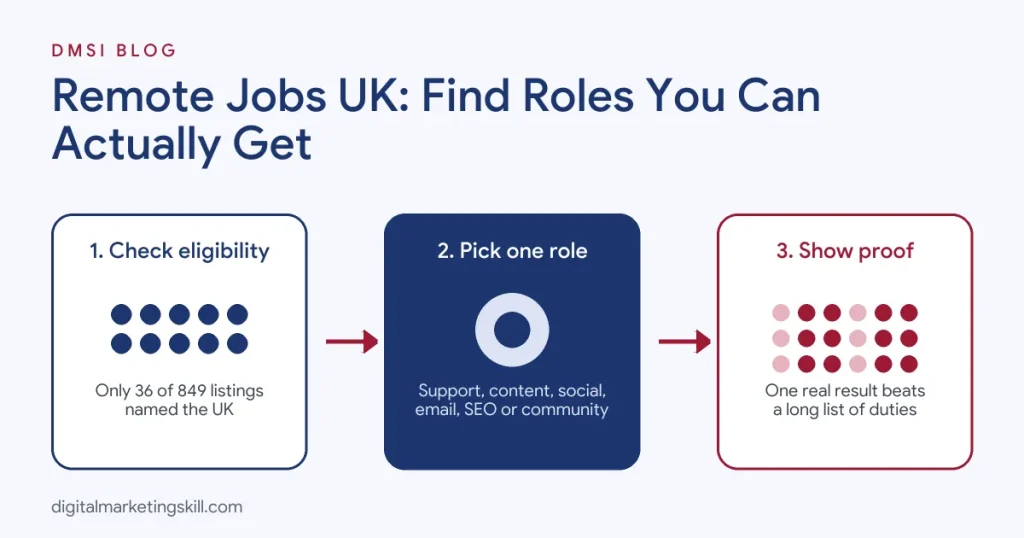
We tested this. On 19 November 2026 we pulled 849 live remote listings from the Himalayas job board across marketing, social media, content, customer support, virtual assistant, community and data entry roles, leaving out senior and director titles. Only 36 of them named the United Kingdom as an eligible location. Just 5 had no location limit at all. The rest were limited to other countries, mostly the US.
That is the gap. If you send 50 applications to “remote” jobs without checking eligibility, most of them may never reach a person. If you send 15 applications only to roles that name the UK, every one of them has a chance. The rest of this guide is built around that filter.
How Remote Jobs in the UK Actually Work
Every remote job open to a UK resident falls into one of three setups. Knowing which one you are applying for tells you how you will be paid, how tax works and what the employer will ask for.
Built for UK employers
A UK company hires you as an employee and you work from home. You are paid through PAYE (Pay As You Earn, the system that takes income tax and National Insurance from your salary before you receive it), and you get the same rights as an office worker, such as paid holiday and sick pay. The employer will run a right to work check before you start. Many of these roles are hybrid rather than fully remote, so read whether you need to attend an office on set days.
Built for overseas employers hiring in the UK
A company based abroad hires you through one of two routes. It may use an employer of record (EOR), a company that legally employs you in the UK on its behalf and runs PAYE for you, so it feels like a normal UK job. Or it may hire you as a contractor, which means you invoice the company and handle your own tax through Self Assessment. Overseas employers often pay in dollars or euros, and some pay more than UK averages for the same role.
Built for freelancers
You find your own clients, in the UK or abroad, and work for several of them at once. You register as self-employed with HMRC once your income from self-employment is over the £1,000 trading allowance in a tax year. Freelancing is the most flexible setup and the least predictable. Our guide to freelancing for beginners covers the first steps.
| Setup | How you are paid | Tax | What to check in the listing |
|---|---|---|---|
| UK employer | Monthly salary in pounds | PAYE, handled by the employer | Office days, home working allowance, right to work |
| Overseas employer via EOR | Salary in pounds through the EOR | PAYE, handled by the EOR | “UK” or “EMEA” in the eligible locations, time zone |
| Overseas employer, contractor | Invoice, often in dollars or euros | Self Assessment, handled by you | Payment method, currency, contract length |
| Freelance clients | Per project or retainer | Self Assessment, handled by you | Scope, deadlines, who owns the work |
What the Official Data Says About Remote Work in the UK
The Office for National Statistics (ONS) tracks how people in Great Britain work. Its June 2025 report found that 28% of working adults hybrid worked between January and March 2025, meaning they split time between home and a workplace. The share of hybrid workers has gradually risen since March 2022, while the share who only travel to work has fallen. The share working only from home has stayed broadly the same.
Two findings matter for anyone looking for remote work. First, access is uneven by qualification. Workers with a degree or equivalent were ten times more likely to hybrid work than those with no qualifications. Second, hybrid working rose with income, so higher-paid roles are more likely to offer it.
In practice, this tells you that fully remote UK roles exist but are a smaller pool than hybrid ones, and that the work which travels home most easily is knowledge work: writing, analysis, marketing, support and admin. You do not need a degree to do those jobs, but you do need to show you can do them. That is why proof of skill matters more in a remote search than in a local one.
The Remote Roles UK Employers Hire Most
The listings we checked clustered around a few role families. Each one has a common first title, a typical setup and a piece of proof that makes your application stand out.
| Role family | Common first title | Typical setup | Proof to show |
|---|---|---|---|
| Customer service and support | Customer support agent | UK employer or overseas via EOR, often shifts | Written replies to three sample customer emails |
| Content writing | Content writer or copywriter | Contractor or freelance, sometimes employed | Two published articles on a real site |
| Social media | Social media marketer or coordinator | Contractor, freelance or UK employer | A one-month content calendar and a results report |
| Community | Community associate or manager | Employed, often by tech or travel brands | An example of a group you grew or moderated |
| Email and lifecycle marketing | Email marketing specialist | Contractor or employed | A sample welcome email sequence |
| SEO | SEO assistant or specialist | Contractor or employed | A short audit of a real website |
| Virtual assistant | Virtual assistant | Contractor, part-time or full-time | A process document for a task you handle well |
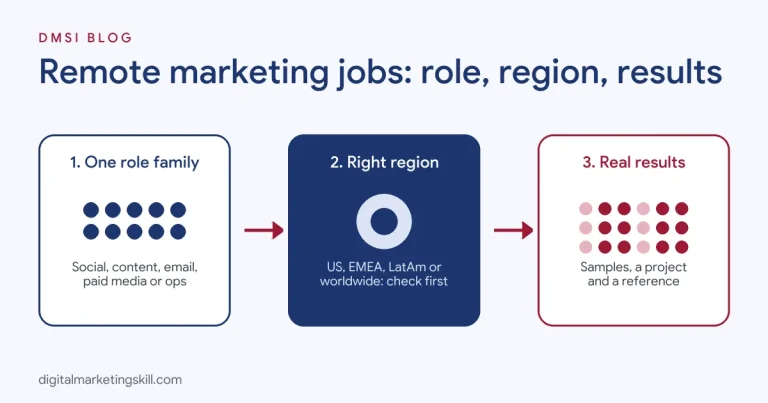
Remote customer service jobs are one of the most searched remote roles in the UK. They are also one of the easiest to start, because many employers train new starters. The trade-off is that many are shift-based and pay close to entry-level wages. Marketing roles such as content, social media, email and SEO usually pay more as you build results, and they are more likely to be open to overseas employers. For a deeper look at those roles, read our guide to remote marketing jobs by role family and region.
Real Remote Jobs Open to UK Residents
These are real listings from Himalayas that named the UK as an eligible location when we checked them on 19 November 2026. Pay is shown only where the employer published it. Listings close quickly, so treat this as a picture of what is out there, not a list to apply to today.
| Role | Company | Level | Eligible locations | Published pay |
|---|---|---|---|---|
| Customer Support Agent (part-time) | Tower Trophies | Entry-level | UK | £5,000 to £20,000 a year |
| Community Management Associate | Wikimedia Foundation | Entry-level | 20 countries, including the UK | $62,074 to $93,077 a year |
| Copywriter, eCommerce Email | Hustler Marketing | Entry-level | UK | Not published |
| Community Manager | Freebird Club | Mid-level | UK | £30,000 to £33,000 a year |
| Community and Content Manager | Freebird Club | Mid-level | Ireland and the UK | €35,000 to €42,000 a year |
| Community Growth Marketer | WiFi Tribe | Mid-level | UK | $30,000 to $70,000 a year |
| Website Content Writer | Grouper | Mid-level | UK | Not published |
| Email and SMS Marketing Specialist | KultreMedia | Mid-level | UK, US, Canada, Philippines | Not published |
| SEO Specialist | Boosta | Mid-level | Europe, including the UK | Not published |
Three patterns stand out. Community roles were common and often published pay. Several overseas employers paid in dollars or euros. And the freelance social media listing we found from Liberty Music PR described its pay as “£15 Per Hour”, which shows how wide the range is between freelance and salaried roles.
For a wider view of pay, our October 2026 snapshot of 750 worldwide remote listings on Himalayas found that 116 published pay, with a median of $56,800 a year. Entry and mid-level roles mostly sat between $14,000 and $60,000.
Where to Find Remote Jobs in the UK
Where you search matters less than how you filter. Use these sources, and on each one set the location filter to the UK or to “anywhere” before you read a single listing.
- Remote-first job boards such as Himalayas list eligible countries on each role, which makes the UK filter easy.
- LinkedIn lets you set the location to United Kingdom and the work type to remote. Recruiters also search profiles, so your profile matters as much as your applications. Our guide to how recruiters decide who to contact on LinkedIn explains what they look for.
- Freelance marketplaces such as Upwork suit content, social media and virtual assistant work. Compare fees first in our guide to freelance marketplaces.
- Company career pages of remote-first companies often list roles before job boards pick them up.
- Our daily list of remote jobs shares checked roles with the eligible countries shown.
How to Get Hired: Six Steps
- Pick one role family. Choose the role that fits your strengths from the table above. Applying to everything makes your CV look unfocused.
- Filter for UK eligibility first. Read the location line before the job title. Skip any listing that does not name the UK, Europe, EMEA or “anywhere”.
- Build one piece of proof. Create the item in the “proof to show” column for your role. A real result beats a long list of duties.
- Rewrite your CV around results. Lead with what you achieved, in numbers where you can. Our guide to a digital marketing resume shows how to pass both the software screen and the human one.
- Show you can work remotely. Mention the tools you use, such as Slack, Google Workspace or Asana, and the hours you can overlap with the team. See our list of remote work tools.
- Apply in small, steady batches. Send five to ten tailored applications a week and track every one, rather than 50 copies of the same CV.
Remote Jobs in the UK With No Experience
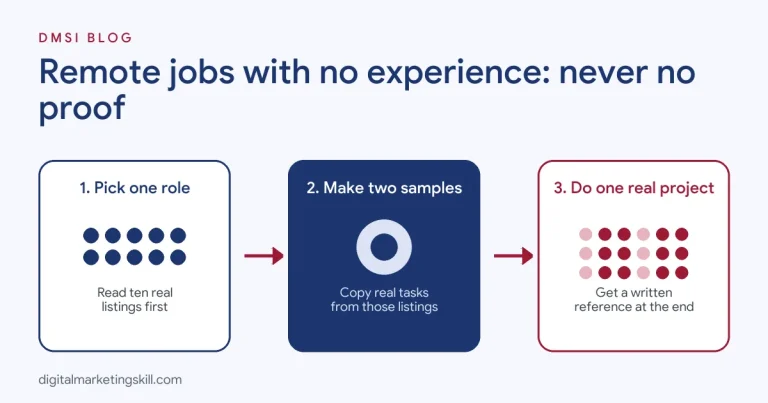
“Remote jobs UK no experience” is one of the most searched variations of this topic. Entry-level remote roles do exist. In our sample, the Tower Trophies support role and the Hustler Marketing copywriter role were both listed as entry-level and open to UK residents.
However, “no experience” rarely means “no proof”. A Kickresume study of 1,400 LinkedIn ads in the US and UK found that 28% of entry-level ads asked for at least 1.5 years of experience. For marketing roles, the share was 31%. The way around this is to create the experience yourself: a sample project, a volunteer role or an internship that gives you results to point to.
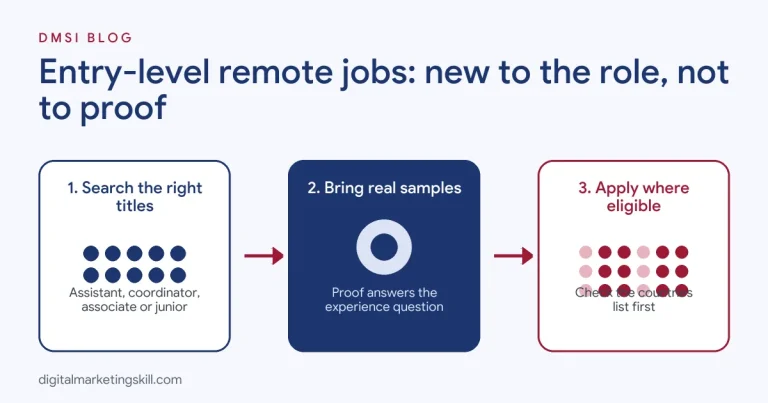
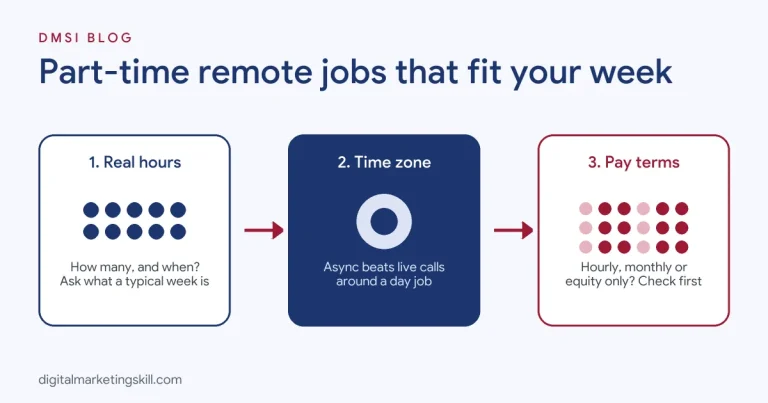
Our guides to entry-level remote jobs and part-time remote jobs cover this in more depth, including which roles train new starters.
Common Mistakes in a UK Remote Job Search
Applying to roles that are not open to the UK
This is the most common and most costly mistake. Read the eligible locations before anything else. If a listing says “US only” or names US states, move on, however good it looks.
Ignoring time zones
A UK resident working for a US East Coast company overlaps for a few hours each afternoon. A West Coast company may want you online into the evening. Check the hours in the listing and be honest about what you can cover.
Sending a CV that lists duties, not results
Remote hiring managers cannot watch you work, so they rely on evidence. “Managed social media” tells them little. “Grew Instagram followers by 40% in three months” tells them a lot.
Falling for job scams
Fake remote jobs are common. Warning signs include an interview held only by text chat, a request to pay for training or equipment, and an offer that arrives before any real interview. A genuine employer will never ask you to pay to start work.
Forgetting the tax side
If you work as a contractor or freelancer, you are responsible for your own tax through Self Assessment. Set money aside from each payment, and keep records from day one.
How to Measure Your Job Search
Track three numbers each week. They tell you which part of your search to fix.
- Eligible applications sent. Only count roles that name the UK. If this number is low, widen your search sources.
- Response rate. Divide replies by applications. If fewer than one in ten get a reply, your CV or proof needs work.
- Interview-to-offer rate. If you get interviews but no offers, practice answers to common questions. Our list of digital marketing interview questions is a good place to start.
The One Rule for Remote Jobs in the UK
Check who can apply before you check what the job is. A role you are eligible for, with one strong piece of proof attached, will do more for you than ten roles you could never be hired for.
An Illustrative Case
This is an illustrative example, not a real person. It shows how the steps above can fit together. Results like this are not typical or guaranteed.
Amara lives in Leeds and works in retail. She wants a remote role in content marketing. In her first month she sends 40 applications to any listing labeled “remote” and hears back from none. When she checks, most of those roles were US-only.
She changes her approach. She filters only for roles that name the UK or Europe, picks content writing as her role family, and writes two articles for a local charity’s website. She rewrites her CV around those articles and the traffic they brought in. Over the next six weeks she sends 18 eligible applications, gets four replies and two interviews, and is offered a junior content writer role with a UK agency.
Frequently Asked Questions About Remote Jobs in the UK
What are the most common remote jobs in the UK?
The most common are customer service, content writing, social media, community management, email marketing, SEO and virtual assistant roles. These are knowledge jobs that can be done from a laptop, so employers are more willing to offer them remotely.
Can I work for a US company from the UK?
Yes, if the company hires in the UK. It may employ you through an employer of record, which runs UK payroll for you, or hire you as a contractor. Many US remote jobs are open only to US residents, so check the eligible locations first.
Do remote jobs in the UK pay less than office jobs?
Not necessarily. Pay depends on the role, level and employer more than on location. Some overseas employers pay UK remote staff in dollars or euros at rates above UK averages, while many entry-level support roles pay close to minimum wage.
How do I pay tax on a remote job in the UK?
If you are employed by a UK company or through an employer of record, tax is taken through PAYE. If you are a contractor or freelancer, you register as self-employed with HMRC and pay through Self Assessment once you earn over the £1,000 trading allowance.
Are there remote jobs in the UK with no experience?
Yes, but there are fewer than most people expect, and many still want proof. Customer support, virtual assistant and junior content roles are the easiest to start. A sample project or internship can stand in for paid experience.
How can I tell if a remote job is open to UK residents?
Read the location line in the listing. Look for “UK”, “United Kingdom”, “Europe”, “EMEA” or “anywhere”. If it names only the US or other countries, or asks for US work authorization, you will not be eligible.
What is the difference between remote and hybrid jobs?
A remote job lets you work from home all the time. A hybrid job splits time between home and a workplace, often two or three days in the office each week. The ONS found that hybrid working is far more common in Great Britain than working only from home.
Which remote jobs pay the most in the UK?
Roles that tie directly to revenue, such as paid advertising, SEO, email marketing and growth marketing, tend to pay more as you gain results. Entry roles pay less, but they are a way in to these higher-paid families.
Where can I find remote jobs in London?
Use the same sources as for the rest of the UK and set the location to London or to the UK. Many London employers offer hybrid roles, so check how many office days the role needs.
How do I spot a fake remote job?
Be wary of interviews held only by text, requests to pay for training or equipment, and job offers that arrive without a real interview. Research the company, check that its website and staff exist, and never send money to start a job.
Your Next Step
Remote employers hire for one role family and for proof. The Master Diploma in Digital & AI Marketing at Digital Marketing Skill Institute is built around four AI-powered tracks that match the main role families: Social Media Management and Advertising, Lead Generation and Email Automation, Google Specialist, and WordPress and SEO Specialist. A Full Stack option covers all four.
Every track includes a U.S. Project Internship from day one and unlimited one-on-one coaching, so you finish with real results and a verified U.S. work reference letter. The program carries dual US and UK accreditation, is recognised in more than 100 countries, and runs 100% online over three months.
You can build that proof wherever you live, anywhere in your country. Read student reviews, then apply for the 65% partial scholarship to see if you qualify.
Every figure in this guide was checked against its original source before publication. Job listings were checked on Himalayas in November and may have closed since. The case above is an illustrative example, not a real result.