
CRM in digital marketing means using one shared system to store customer data, automate repeat tasks, and surface insight for decisions. Most teams only use one of those three jobs well. This guide names which job to fix first, and which to add next.
Key Takeaways
- CRM still pays back, but less than it used to. Nucleus Research’s recent analysis of 11 ROI case studies found CRM returned $3.10 for every dollar spent. That is down sharply from the $8.71 the same firm reported a decade earlier.
- Irrelevant outreach actively repels buyers. 73% of B2B buyers actively avoid sellers who send irrelevant outreach, according to Salesforce’s 7th edition State of Sales report, based on over 4,000 sales professionals.
- Retention moves profit more than most teams expect. Harvard Business Review, citing Frederick Reichheld’s research, found that raising customer retention by just 5 percentage points lifted profits by 25% to 95%, depending on the industry studied.
- The same research put a number on acquisition cost. Reichheld’s widely cited analysis estimated that acquiring a new customer costs roughly 5 times more than retaining an existing one, though the underlying study has since drawn methodological criticism.
- Customer data is also a liability if mishandled. The global average cost of a data breach reached $4.44 million, based on the IBM and Ponemon Institute study of 600 organizations.
In this guide
- What Most CRM in Digital Marketing Guides Get Wrong
- How CRM Actually Drives Revenue
- Three Jobs CRM in Digital Marketing Does, and What Each One Misses
- How to Strengthen Each CRM in Digital Marketing Job
- The Metrics That Show CRM in Digital Marketing Is Working
- The One Rule for Where to Start With CRM in Digital Marketing
- A Real Case: Why CRM’s Average Return Has Fallen
- Frequently Asked Questions About CRM in Digital Marketing
- Build the CRM Habit, Not Just the CRM Platform
What Most CRM in Digital Marketing Guides Get Wrong
Most explainers list CRM benefits and CRM types side by side. They treat every feature as equally important. Nothing in the list says where to start. That hides the real question: which capability should a team fix first. That long feature list looks impressive in a sales demo, but a team with limited time cannot act on all of it at once.
A second gap is treating CRM in digital marketing as a database problem alone. A CRM full of accurate contact records still fails if nobody automates the follow-up. Automation still fails if the underlying data is wrong. Neither one fixes the other, which is why this guide treats them as separate problems rather than one combined project.
A third gap is skipping adoption entirely. A platform nobody uses the same way every time cannot produce useful data, no matter how capable it is on paper. Vendors rarely mention this part, because adoption is the buyer’s job, not the software’s.
This guide splits CRM in digital marketing into three jobs: centralizing data, automating repeat tasks, and surfacing insight for decisions. Each job needs its own fix. The order you tackle them in depends on where your team is today.
How CRM Actually Drives Revenue
CRM in digital marketing starts with a simple core function. It is a shared record of every interaction a business has with a customer or prospect. Salesforce’s own definition frames CRM as a system that unifies company data and connects every customer touchpoint, not just a database. The record only creates value once someone acts on it.
Centralized data removes the first failure point. Without it, a sales rep, a support agent and a marketer each hold a different, partial picture of the same customer. Reichheld’s research tied poor customer understanding to the acquisition cost gap. Retaining a known customer is cheaper than acquiring one a business barely understands, and a central record is what lets a team recognize that customer in the first place.
Automation removes a second failure point: inconsistency. A human team forgets follow-ups under pressure. Automated sequences do not. That matters because Salesforce’s research found custom, relevant outreach keeps buyers engaged, while generic blasts push them away.
Analytics removes a third failure point: guessing. A CRM with years of interaction history can show which actions actually preceded a sale. That beats relying on instinct about what probably worked, especially once a team grows beyond the size where one person remembers every deal.
Three Jobs CRM in Digital Marketing Does, and What Each One Misses
That distinction matters because many teams buy a CRM expecting the software alone to change outcomes. The platform only stores and organizes; a person or an automated rule still has to decide what to do with what it shows. The best CRM in the world cannot force a team to act on what it surfaces. That gap between having data and using it is where most CRM value quietly disappears.
Each failure point costs differently. Missing data wastes time on duplicate work. Missing automation wastes attention on tasks a machine could do. A missing analytics layer wastes money repeating decisions that already failed once.
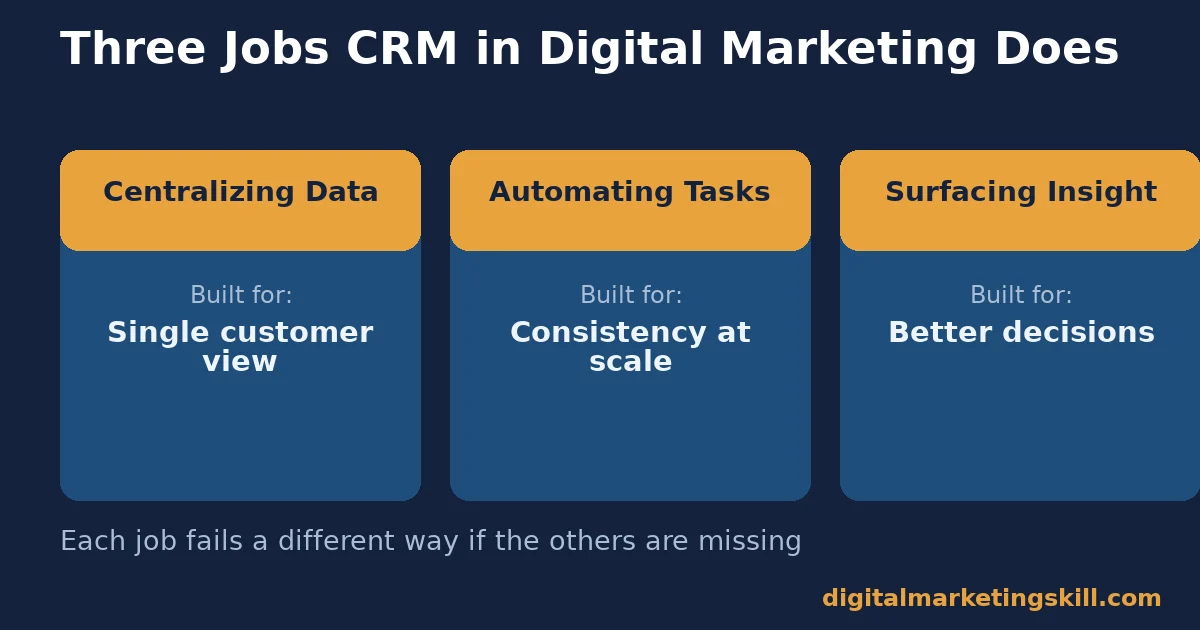
None of these three jobs substitutes for the others. A business with perfect data and no automation still responds too slowly. A business with heavy automation built on bad data just sends irrelevant messages faster, to more people.
Treat these as three separate checks on your CRM in digital marketing setup, not one combined score.
Centralizing Data: Built For a Single Customer View
This job stores contact details, purchase history and interaction logs in one place. Every team sees the same record instead of a partial one. It is also the slowest job to do well, since it depends on people entering data correctly, every single time. There is no shortcut around that.
The blind spot is that centralized data can still be wrong. A CRM full of outdated or duplicate records creates a false sense of certainty. That is worse than no data at all, because people trust it anyway. Fixing this takes a regular cleanup habit, not a one-time import.
Automating Tasks: Built For Consistency at Scale
This job handles follow-up emails, lead scoring and routine reminders. Nothing depends on a team member remembering to do it. It is also the fastest job to set up. That speed is exactly why it often gets built before the data underneath it is ready.
The blind spot is that automation scales whatever it is given. Automating a sequence built on a wrong assumption just sends the wrong message to more people, faster than a human ever could. Review automated sequences on a schedule, not only when a customer complains.
Surfacing Insight: Built For Better Decisions
This job turns stored history into a decision: which channel converts, which lead score predicts a sale, which customers are worth a retention push. It is also the job most teams skip, because it takes longer to show results than the other two, and the payoff is easy to postpone when the inbox is already full. It is worth the wait anyway.
The blind spot is that insight without action changes nothing. A dashboard nobody checks is no better than no dashboard at all. Build analytics last, once the data feeding it is actually trustworthy.
How to Strengthen Each CRM in Digital Marketing Job
Centralizing Data: Lead With a Single Source of Truth
Pick one system as the record of truth for customer data. Route every other tool into it, instead of letting each tool keep its own copy. A martech stack built around one central record is easier to keep accurate than five disconnected tools pulling in different directions. When a new tool is added, connect it to the central record first, before anyone starts using it day to day.
Automating Tasks: Lead With the Highest-Volume Repeat Task
Automate the single task your team repeats most often first, not the most complex one. A simple email automation strategy for new-lead follow-up usually returns more than an elaborate multi-channel sequence nobody maintains past the first month. Start with one trigger and one message, then add a second step only once the first is working reliably.
Surfacing Insight: Lead With One Metric Someone Owns
Pick one metric, such as response time or conversion rate by source. Assign a named person to review it weekly. An unowned dashboard decays into noise within a month, even on a good platform. Write down what action follows if the number moves, so the review has a clear point beyond just looking at it.
The Metrics That Show CRM in Digital Marketing Is Working
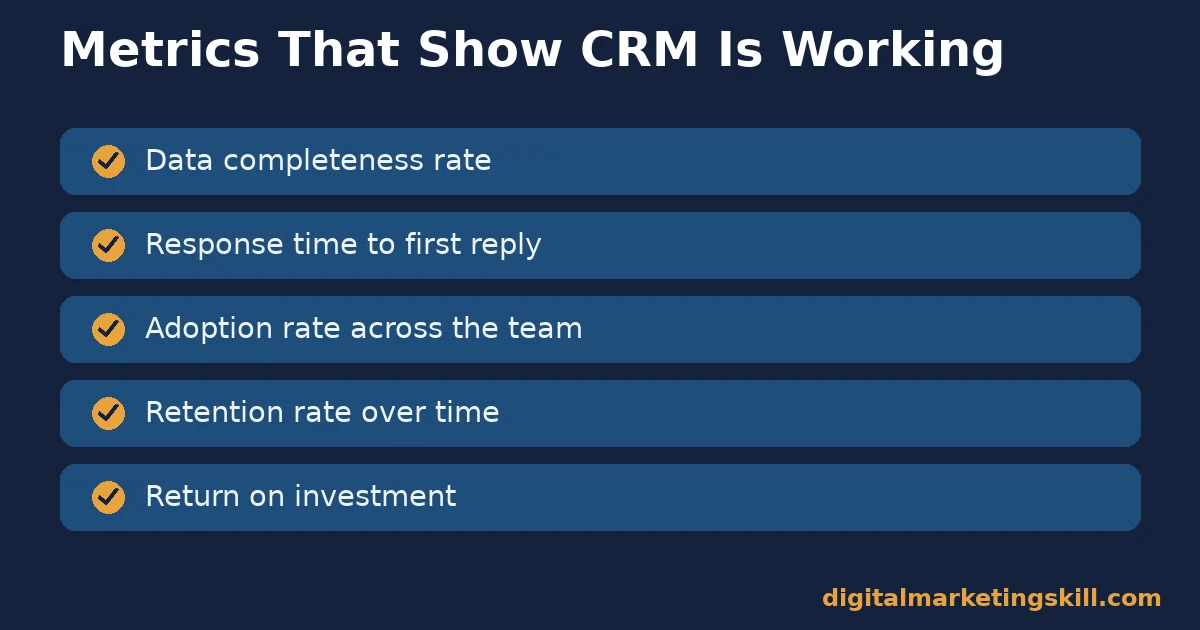
- Data completeness rate: the percentage of customer records with no missing required fields. Low completeness undermines every other metric on this list.
- Response time: how long it takes a lead to get a first reply. A faster response consistently correlates with higher conversion in CRM research, often more than any single message’s wording.
- Adoption rate: the percentage of your team actually logging activity in the CRM, not working around it. Low adoption is the single most common reason CRM investments underperform their stated projections.
- Retention rate: the percentage of customers who stay over a given period. Even a small improvement here compounds, per Reichheld’s research. Pair it with proven customer retention strategies, not CRM data alone.
- Return on investment: value generated against platform cost and the time spent maintaining it. Compare your own number over time, not an industry average that varies by setup.
Check adoption rate before trusting any other number on this list. A CRM with low adoption produces data too incomplete for the other four metrics to mean anything useful.
Review all five metrics on a fixed monthly schedule, not just after a complaint or a slow quarter. A short, repeated check catches a slipping adoption rate weeks before it shows up as a missed target further down the list.
The One Rule for Where to Start With CRM in Digital Marketing
For CRM in digital marketing, the starting point depends on your team. If you have no shared customer record yet, start with centralizing data. If data is already centralized but inconsistent, fix data quality before adding more automation on top of it.
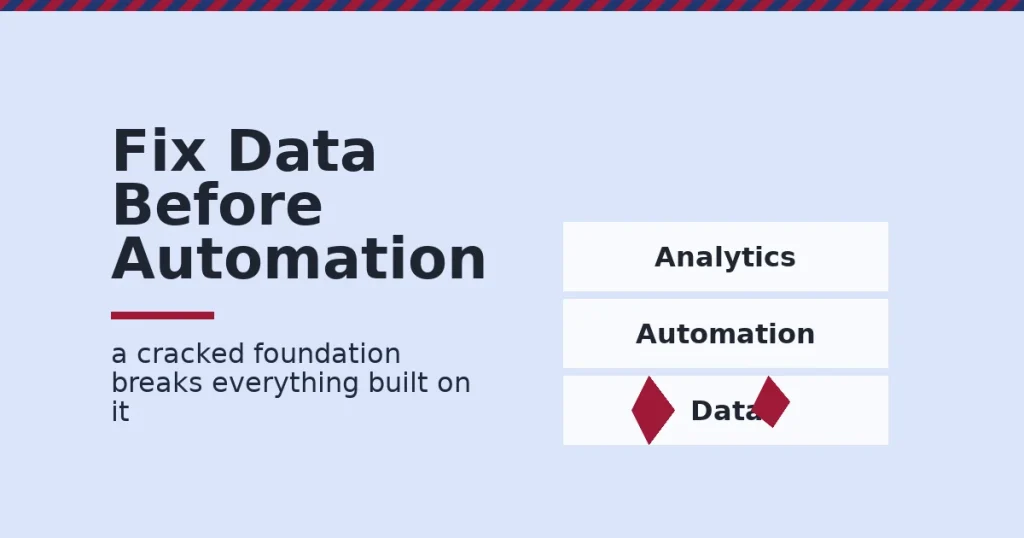
The reasoning is simple. Automation built on a shaky data foundation just multiplies the mistakes already in the system. A clean, centralized record is the one prerequisite every other CRM benefit depends on. Skipping it to chase a faster win usually costs more time later.
Illustrative, invented example: picture two companies adopting CRM at the same time, each with ten sales reps. Company A has no prior customer database, so centralizing records is its obvious first step.
Company B already has a CRM, but three sales reps keep parallel spreadsheets out of habit. For Company B, retiring those spreadsheets and enforcing one source of truth matters more than adding a new automation feature, even though the spreadsheets feel faster to the reps who built them. That feeling is exactly why the old habit keeps surviving.
Neither company’s rule is permanent. Once Company A’s data is centralized, automation becomes the next bottleneck. Once Company B’s spreadsheets are gone, analytics becomes worth building on top of the clean record.
Revisit the rule every quarter rather than deciding once and forgetting about it. A team that fixed its data a year ago can quietly let a new tool start a second, uncontrolled record without anyone noticing for months.
A Real Case: Why CRM’s Average Return Has Fallen
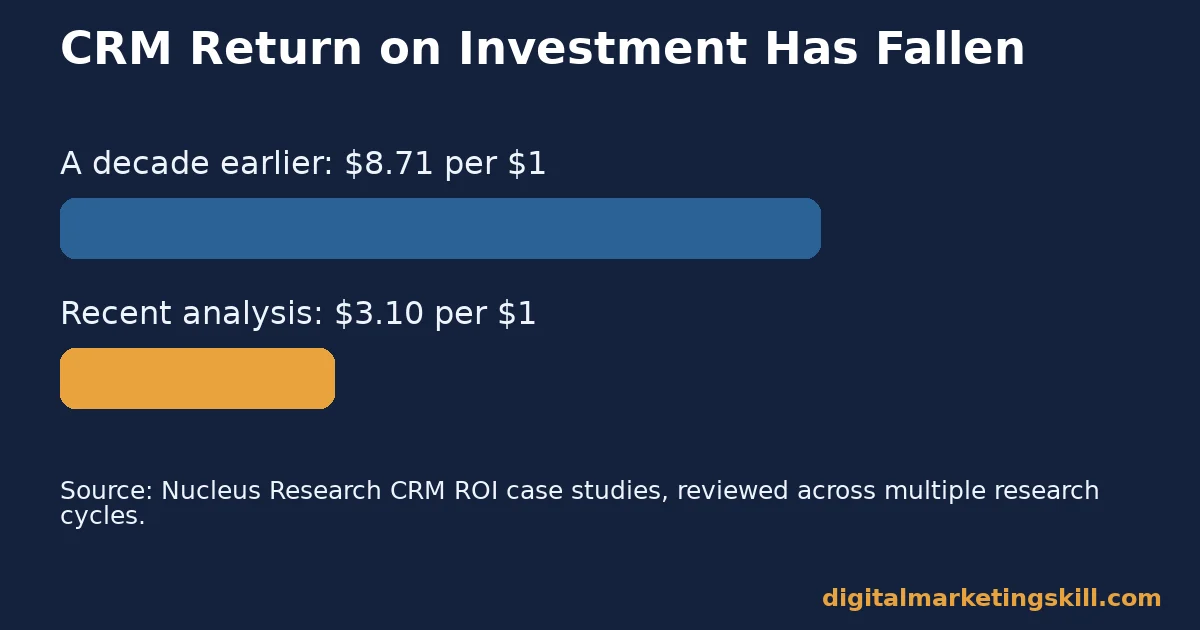
Nucleus Research has tracked CRM in digital marketing return on investment across multiple research cycles. A decade earlier, its case studies put the average return at $8.71 for every dollar spent. Its most recent analysis, covering 11 recent case studies, found that figure had fallen to $3.10.
The firm’s own explanation points to maturity, not failure. Early CRM adopters were often skilled teams solving an acute problem, which produced outsized returns. As CRM adoption spread to less prepared teams, the average return fell toward a more typical range.
Limits worth stating plainly: 11 case studies is a small sample. Companies that submit case studies to a research firm are not a random sample of every CRM user; they tend to be success stories. Treat $3.10 as a realistic planning benchmark, not a guarantee for any specific business. Your own result could land above or below it.
The practical lesson is to measure your own return rather than import an industry figure. A new CRM implementation with strong adoption and clean data can still land well above $3.10. A poorly adopted one, even on an excellent platform, can land below it.
The decline also carries a quiet warning for anyone evaluating a new platform on the strength of a vendor’s quoted case study. A single success story says little about the typical outcome; the gap between $8.71 and $3.10 is exactly that difference, playing out at an industry scale.
Frequently Asked Questions About CRM in Digital Marketing
What is CRM in digital marketing, in one sentence?
CRM in digital marketing is the practice of using one shared system to store customer data, automate repeat outreach, and surface insight that improves marketing and sales decisions.
How much does a CRM cost?
Pricing varies widely by feature set and user count, from free basic tiers with limited functionality to enterprise plans with heavy customization. Compare the cost against the specific job, data, automation or analytics, you need it to do first, rather than choosing by price alone. A cheap plan that nobody adopts still costs more than an expensive one a team actually uses.
What is the difference between CRM and marketing automation?
CRM centers on the customer record itself: who someone is and what they have done. Marketing automation centers on the sequence of actions triggered by that record, such as a follow-up email series. Many platforms now combine both, but the two jobs remain distinct, and a weak record will undermine even a well-designed sequence.
Why do CRM in digital marketing projects fail even with a good platform?
Low adoption is the most common cause. If a team logs activity inconsistently, the resulting data is too incomplete to automate or analyze reliably, no matter how capable the platform itself is. A platform switch rarely fixes this, since the habit, not the software, was the actual gap.
Is CRM worth it for a small team?
Often yes, since the core value, one accurate customer record instead of scattered notes, matters at any size. Start with centralizing data and one automated follow-up sequence before adding advanced analytics. A small team that masters the basics usually outperforms a larger one drowning in unused features.
How does CRM affect customer data privacy?
A CRM concentrates customer data in one place, which raises the stakes if it is mishandled. The global average cost of a data breach reached $4.44 million in recent research, so access controls and data minimization are not optional extras.
Limit who can export full customer records, and remove data you no longer have a clear reason to keep. Review those access rules on a schedule, not only after an incident forces the question.
Which CRM job should a new team build first?
Centralizing data, almost always. Automation and analytics both depend on accurate, complete records. Building either one first on a shaky data foundation tends to multiply existing mistakes instead of fixing them. This holds regardless of team size or industry.
What happens if a team ignores CRM in digital marketing altogether?
Customer knowledge stays locked inside individual inboxes and memories instead of a shared record. When a team member leaves, that knowledge usually leaves with them, and the acquisition-cost gap Reichheld’s research describes gets paid in full on every departure.
A new hire then starts from zero on every account the previous person managed, which is slower and more expensive than it looks on paper. A shared record is what prevents that reset.
Build the CRM Habit, Not Just the CRM Platform
Choosing the right CRM matters less than building the habit behind it: centralizing, automating and reviewing customer data the same way every time.
The Digital Marketing Skill Institute’s Master Diploma in Digital & AI Marketing is built from four AI-powered tracks, totaling ten execution-first courses: AI-Powered Social Media Management and Advertising, AI-Powered Lead Generation and Email Automation, AI-Powered Google Specialist, and AI-Powered WordPress and SEO Specialist, with a Full Stack option for learners who complete all four.
The AI-Powered Lead Generation and Email Automation track covers exactly this kind of CRM and automation work, from centralizing lead data to building sequences that convert without annoying buyers. It also covers reading CRM data to decide what to fix next, instead of guessing.
Every track includes unlimited one-on-one coaching and mentoring, a U.S. Project Internship with a verified U.S. Work Reference Letter, and dual US and UK accreditation recognised in more than 100 countries.
You can apply from anywhere in your country and study 100% online.
Start with the digital marketing blog for more guides, browse real outcomes on the reviews page, or go straight to the Master Diploma program page for the full curriculum.
Wherever you live in your country, you can apply at digitalmarketingskill.com/apply/. Learn more about the institute at https://digitalmarketingskill.com/, or start again any time from https://digitalmarketingskill.com/.
Every figure in this guide was checked against its original source before publication. Figures marked as illustrative are invented examples, not real results.
