
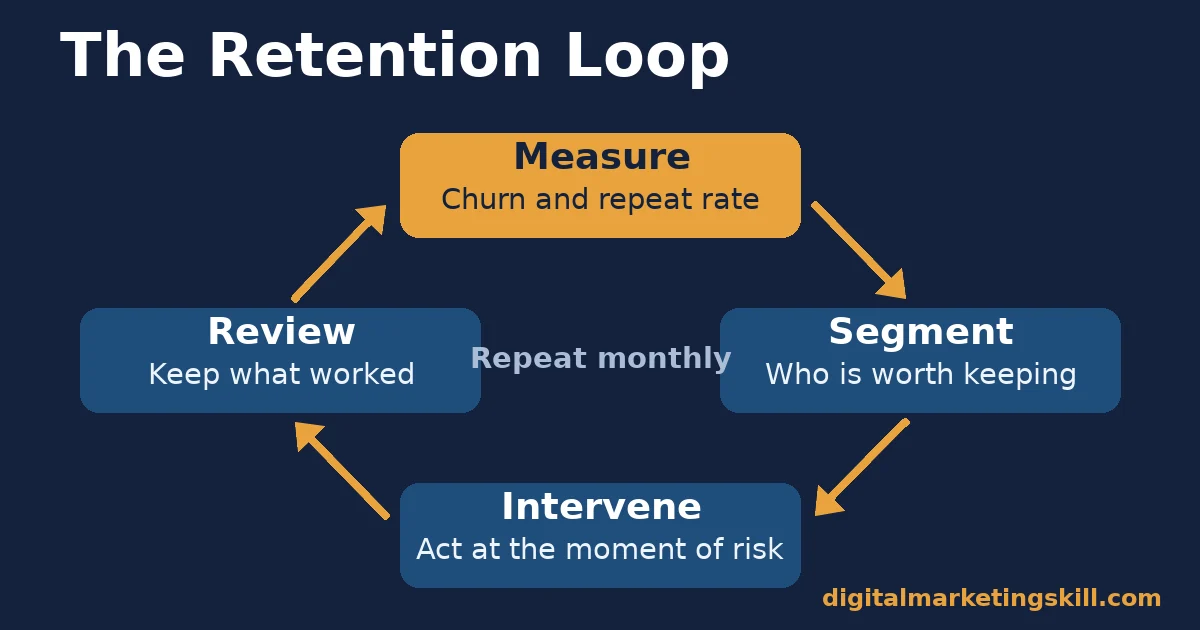
Customer retention management is the ongoing system a business uses to measure, protect and grow repeat business from the customers it already has. It works as a four-stage loop. You measure retention, pick the customers worth keeping, act when they are most likely to leave, and review what worked each month.
Key Takeaways
Retention and reputation reinforce each other: a positive online reputation brings new customers in, and strong retention is what keeps the reviews coming.
- The famous statistic is narrower than people think. Bain’s Fred Reichheld wrote that a 5% rise in customer retention produces more than a 25% rise in profit in financial services. That claim is narrower than the “25% to 95%” often quoted.
- Keeping customers usually costs less than finding new ones. Harvard Business Review reports that winning a new customer costs five to 25 times more than keeping one. The range depends on the study and the industry.
- One bad experience can end the relationship. Zendesk’s CX Trends research, with nearly 5,100 consumers in 22 countries, found that 63% would switch to a competitor after just one bad experience.
- Not every customer is worth keeping. Bain argues that many firms waste half their marketing spend on disloyal customers. Those buyers never stay long enough to repay the cost of winning them. Our guide to difficult customers breaks down the types worth firing and the ones worth fixing.
- Four numbers run the system. Retention rate, churn rate, repeat purchase rate and Net Promoter Score show where customers leave. They also show whether your fixes work.
In this guide
- What Most Guides on Customer Retention Management Miss
- How Customer Retention Management Really Works
- What Changes by Business Model
- How to Run Customer Retention Management for Each Model
- How to Measure Customer Retention Management
- Four Customer Retention Management Mistakes to Avoid
- The Most Useful Rule: Keep the Right Customers First
- A Real Case: Why Vanguard Turned Away $40 Million
- Frequently Asked Questions About Customer Retention Management
- Start With One Segment, Then Expand
What Most Guides on Customer Retention Management Miss
Most articles on customer retention management give you a list of tactics. Send discounts, start a loyalty scheme, write follow-up emails. Each tactic can work. However, a list does not tell you who owns retention, which number to watch, or when to act. So teams try a tactic, forget to measure it, and move on to the next idea.
This guide treats customer retention management as a system rather than a list. You will get a four-stage loop and the numbers that drive it. You will also see how the work changes for subscription businesses, repeat-purchase stores and service firms.
Here are the ground rules. Every statistic comes from a named source, and each has limits. The Bain brief discusses financial services. Zendesk, a customer service software company, ran its own survey, so read those figures as self-reported attitudes. The four-stage loop is our own framework, an informed inference from that evidence, not a settled fact.
The Misquoted Statistic Behind Most Retention Advice
You have probably seen the claim that a 5% rise in retention lifts profit by 25% to 95%. In Bain’s “Prescription for cutting costs” brief, Fred Reichheld writes something narrower: in financial services, a 5% increase in customer retention produces more than a 25% increase in profit.
The wider range goes back to earlier research by Reichheld and W. Earl Sasser Jr., published in Harvard Business Review as “Zero Defections: Quality Comes to Services”. So the direction is well supported, but the exact size depends on your industry. Treat the numbers as a reason to measure your own retention, not as a forecast.
How Customer Retention Management Really Works
Retention pays because returning customers become more valuable each year they stay. Bain’s brief gives four reasons. Returning customers tend to buy more over time, and they cost less to serve. They also refer others. Finally, they often pay a premium rather than switch to a competitor they do not know.
Winning new customers, meanwhile, costs more. In “The Value of Keeping the Right Customers”, Harvard Business Review’s Amy Gallo notes that winning a new customer costs five to 25 times more than keeping an existing one. The spread is wide because it depends on the study and the industry.
Service quality decides whether customers stay. In Zendesk’s CX Trends report, 63% of nearly 5,100 consumers in 22 countries said they would switch to a competitor after just one bad experience. It measures what people say, not what they later do. Even so, it shows why customer retention management cannot sit with marketing alone.
A retention system turns those economics into a routine. First, you measure who stays and who leaves. Next, you segment customers so you know which ones are worth the effort. Then you step in at the moments when customers are most likely to drift away. Finally, you review the numbers and keep only the actions that moved them.
Why Retention Compounds Over Time
Here is an illustrative example, with invented numbers. Two online shops each start with 1,000 customers and win 300 new ones a year. Shop A keeps 60% of its customers each year, while Shop B keeps 75%.
After one year, Shop A has 900 customers and Shop B has 1,050. After three years, Shop A has shrunk to about 804 customers. Shop B has grown to about 1,116. Every retained customer is still there when next year’s new customers arrive. Both shops spent the same on acquisition. The difference came entirely from retention, which is why small gains matter so much.
What Changes by Business Model
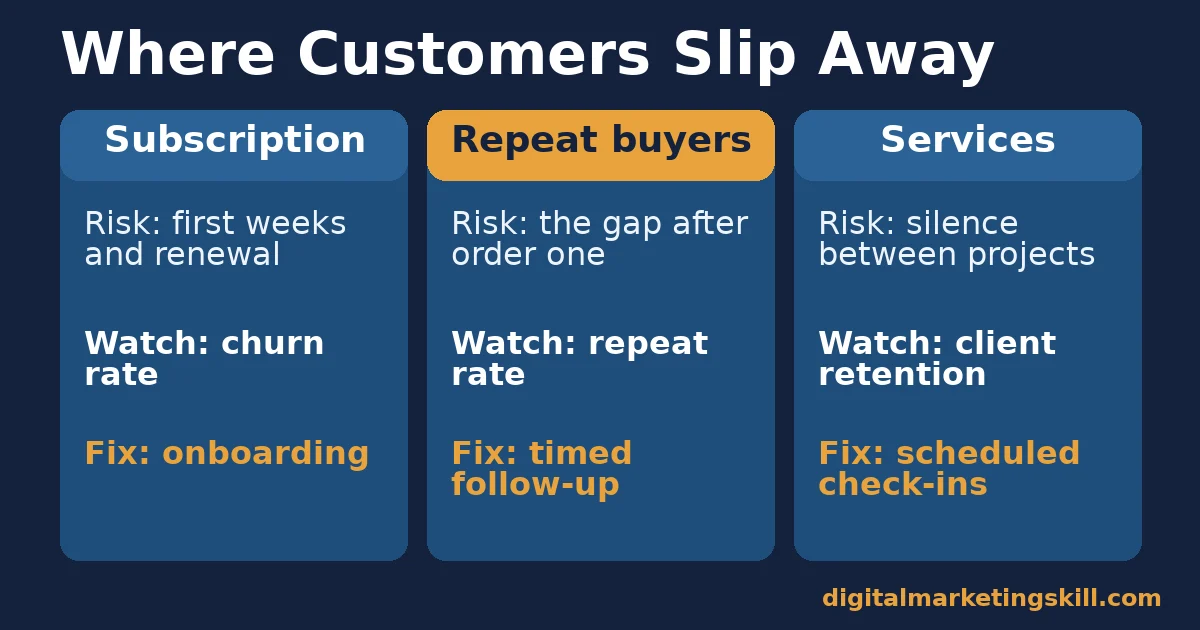
Customer retention management looks different depending on how customers buy from you. The loop stays the same, but the moment of risk, the key metric and the first fix all change. Three common models cover most businesses, wherever they operate.
Subscription Businesses: Built on Renewals
Subscription businesses, such as software tools, gyms and streaming services, get paid every month or year. There are two danger zones. The first is the opening few weeks, when new users decide whether the product fits. The second is the renewal date, when they decide whether to pay again.
Because revenue is recurring, churn rate is the key number. Churn rate is the share of customers who cancel during a period. A small monthly churn compounds into a large yearly loss, so subscription teams need to watch it closely.
Repeat-Purchase Stores: Built on Habit
Online shops, cafes and consumer brands need customers to come back without a contract. The biggest risk is the gap after the first order. If a customer buys once and hears nothing useful, they often forget the brand entirely.
The key number here is the repeat purchase rate. Shopify’s customer reports documentation defines a returning customer as one whose order history already includes at least one earlier order. That gives you a clear number to count.
Service Businesses: Built on Relationships
Agencies, consultants, accountants and freelancers often sell projects or monthly plans. Clients rarely quit with a bang. Instead, they go quiet between projects and then hire someone else next time.
The key number is client retention rate, the share of last period’s clients who bought again. Because each client is worth a lot, even losing two or three can change a small firm’s year. Our guide to customer retention rate covers the exact formula and how to read it for different business models.
How to Run Customer Retention Management for Each Model
Each model needs a different first move. The headings below mirror the models above, so you can go straight to the one that fits your business. If you want a longer list of specific tactics, see our guide to customer retention strategies that keep customers coming back.
Subscription Businesses: Lead With Onboarding
Map the first 30 days of a new customer’s experience. Identify the one action that predicts long-term use, such as connecting an account or finishing a first project. Then design emails, in-app prompts and support calls that push every new customer towards that action.
Before each renewal, send a short summary of the value the customer received. People cancel when they cannot remember why they pay, so a clear reminder protects revenue. A well-planned email automation strategy can handle most of this without extra staff.
Repeat-Purchase Stores: Lead With Timing
Look at how long your returning customers usually wait between their first and second orders. Then schedule a follow-up just before that point, with a useful reason to return, such as a refill reminder, a care guide or a relevant product.
Discounts can help, but use them carefully. If every follow-up contains a code, you train customers to wait for one. Instead, reward the behaviour you want, such as a second purchase within a set window.
Service Businesses: Lead With Scheduled Check-ins
Put a check-in in the calendar 30 and 90 days after each project ends. Share one useful observation about the client’s results, and ask what is coming up next for them.
Also set expectations honestly at the start. Promise a realistic timeline, then report progress often. Clients forgive slow results far more readily than surprises, so clear communication is a retention tool in its own right.
Loyalty Schemes: Useful Only With a Clear Goal
A loyalty scheme rewards customers for behaving in a way you want, such as buying more often or spending more per order. Many schemes fail because the goal is vague. Decide first whether you want repeat visits or bigger baskets, because the reward should match that single goal.
Keep rewards simple, attainable and affordable. If customers must spend a lot to earn a small gift, they feel cheated. Also check that you can recover the cost of the reward from the extra spending it creates.
How to Measure Customer Retention Management
Measurement turns good intentions into a system. Each metric below is defined in one sentence, with a note on how to read it. Review them monthly, next to the acquisition and revenue numbers you already track.
- Customer retention rate. The share of customers at the start of a period who are still customers at the end, excluding new ones. A falling rate is the earliest sign that your loop has a leak.
- Churn rate. The share of customers who leave during a period. It mirrors retention, and subscription businesses usually track it monthly.
- Repeat purchase rate. The share of customers who have bought two or more times. For stores, this is the clearest sign that the first order turned into a habit.
- Purchase frequency and average order value. Frequency is total orders divided by unique customers, while average order value is revenue divided by orders. Together they show whether loyal customers buy more over time.
- Customer lifetime value. Average order value multiplied by purchase frequency and by the average number of years a customer stays. Compare it with what you pay to acquire a customer.
- Net Promoter Score. Bain’s Net Promoter System asks how likely customers are to recommend you on a 0 to 10 scale. It subtracts the share of detractors (0 to 6) from the share of promoters (9 or 10).
How to Calculate Your Retention Rate
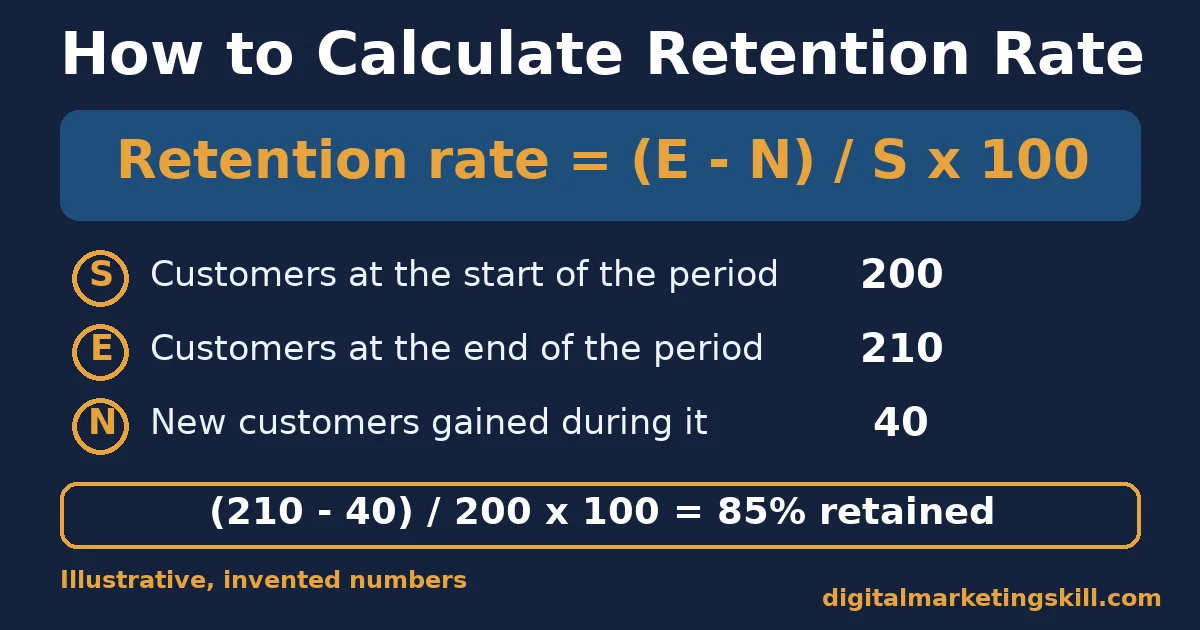
The standard formula divides returning customers by starting customers. Start with the customers at the end of the period (E). Subtract the new customers you gained (N). Then divide by the customers at the start (S) and multiply by 100.
To see how different groups behave over time, use cohorts. A cohort is a group of customers who share a starting point, such as the month of their first purchase. Google Analytics cohort exploration lets you compare how each group returns over the following weeks, which shows whether your changes are working.
How to Read the Numbers Together
One number alone can mislead you, so read them as a set. If retention falls while Net Promoter Score holds steady, look at price or a new competitor first. If Net Promoter Score falls first, expect churn to follow in the next few months, so act early.
Likewise, a rising repeat purchase rate with a falling average order value may mean discounts are doing the work. That can be fine for a while. But if lifetime value drops below what you pay to win a customer, the loop is losing money. In that case, cut the discount and test a service improvement instead.
Four Customer Retention Management Mistakes to Avoid
Most retention programmes fail for simple, avoidable reasons. Check your own plan against these four before you add any new tactic.
- Discounting everyone. Blanket discounts reward customers who would have stayed anyway, so they cut margin without changing behaviour.
- Measuring once a year. A yearly check spots a leak too late. Monthly reviews let you fix problems while the customers are still reachable.
- Having no owner. When everyone owns retention, nobody does. Give one person the retention rate as their number, even in a small team.
- Ignoring service. Marketing emails cannot repair a bad support experience. Instead, share churn reasons with the people who serve customers every day.
Each of these mistakes breaks one stage of the loop. Discounting skips segmentation, yearly checks weaken measurement, and a missing owner means nobody reviews results. So fixing them strengthens customer retention management as a whole, not just one tactic.
The Most Useful Rule: Keep the Right Customers First
If you remember one decision rule from this guide, make it this one. Spend your retention effort on the customers most likely to stay and grow, not on everyone equally. Bain’s brief puts it plainly: not every customer has the potential to be profitable and long-standing, so you should segment them first.
In practice, sort customers into three groups by value and fit. Protect the top group with personal attention. Nurture the middle group with automated follow-up. And let pure bargain hunters go if they only buy at a loss. As a result, your time goes where it earns the most.
Bain even suggests changing sales incentives, for example by reducing a bonus if a new customer leaves within 18 months. That rule rewards teams for winning customers who stay, rather than customers who simply sign up.
A Simple Plan for Your First Month
You can put this rule to work in four weeks. Keep each step small, so it gets done.
- Week one: list your buyers. Pull everyone who bought from you in the past year, with how often they bought and how much they spent.
- Week two: sort them. Split the list into top, middle and low groups. Mark the ten names you would most hate to lose.
- Week three: act on the top group. Call or email each of the ten. Ask how things are going, and fix one thing they raise.
- Week four: set your baseline. Work out your retention rate and write it down. Next month, you will know if it moved.
That is the whole loop in miniature. It costs time, not money, and it gives you a real number to improve.
A Real Case: Why Vanguard Turned Away $40 Million
Bain’s brief describes how Vanguard, the investment company, applied this rule. Vanguard once rejected an institutional investor who wanted to put $40 million into a fund. The company expected that customer to pull the money out quickly, which would raise costs for the investors who stayed.
The decision fitted a wider focus on customer retention and on choosing the right customers from the start. According to Bain, the cost of Vanguard’s flagship S&P 500 index fund fell from 0.20% of assets to 0.18% over three years. That is a 10% improvement. Bain names retention as one reason for that fall.
Keep the limits in mind. This is one company, described by Bain as an example, and many factors affect fund costs. Still, the case shows the core idea of customer retention management clearly: loyal customers make a business cheaper to run, so it can pay to turn some customers away.
Frequently Asked Questions About Customer Retention Management
What is customer retention management?
Customer retention management is the system a business uses to measure, protect and grow repeat business from existing customers. It combines metrics such as retention rate and churn with planned actions at the moments customers are most likely to leave.
How do you calculate customer retention rate?
Subtract the new customers gained during a period from the customers at the end, divide by the customers at the start, and multiply by 100. For example, (210 minus 40) divided by 200 gives 85%.
What is a good customer retention rate?
There is no single good figure, because retention varies widely by industry and business model. The most useful benchmark is your own trend, so track the rate monthly and aim to improve it step by step.
What is the difference between customer retention and customer loyalty?
Retention describes behaviour: the customer keeps buying. Loyalty describes attitude: the customer prefers you and recommends you. Net Promoter Score is one common way to measure loyalty.
Does a 5% increase in retention really raise profits by 25% to 95%?
Bain’s Fred Reichheld wrote that a 5% increase in retention produces more than a 25% increase in profit in financial services. The wider range is often quoted, but the size of the effect depends on your industry.
Who should own customer retention management?
One named person should own the retention rate, even in a small business. They do not do all the work, but they review the numbers monthly and make sure marketing, sales and service act on them.
Which tools help with customer retention management?
A CRM or e-commerce platform records who buys and when. Google Analytics cohort exploration shows how groups of customers return over time, and an email tool automates follow-up at the right moments.
Start With One Segment, Then Expand
Customer retention management does not need a big budget to start. Pick your most valuable customer segment, measure its retention rate this month, and add one intervention at its moment of highest risk. Then review the number after a month and decide whether to keep, change or drop the action. If you are unsure who your best customers are, start by building a clear customer avatar.
These same retention habits are exactly what keep a frontline role ahead of automation; see our guide to customer service automation skills for the metrics worth tracking.
If you want structured practice, Digital Marketing Skill Institute teaches these skills hands-on. The Master Diploma in Digital & AI Marketing includes ten practical courses, among them AI-powered email marketing and automation and AI-powered Google Analytics. It comes with unlimited 1-on-1 coaching and mentoring and real project work inside a U.S. company. The diploma is dual US and UK accredited and recognised in more than 100 countries.
The programme is fully online, so you can study from anywhere in your country. You can browse more guides on the Digital Marketing Skill Institute blog and read what past students say on our reviews page. When you are ready, apply for the Master Diploma when you are ready. You can also start from the Digital Marketing Skill Institute homepage.
Every figure in this guide was checked against its original source before publication. Figures marked as illustrative are invented examples, not real results.
